
Essential Question
How can we tell metals from nonmetals?
By the end of this lesson, you should be able to classify an element using its location on the periodic table and using its properties, which is exactly what you’ll do in the lab.
Three Main Categories
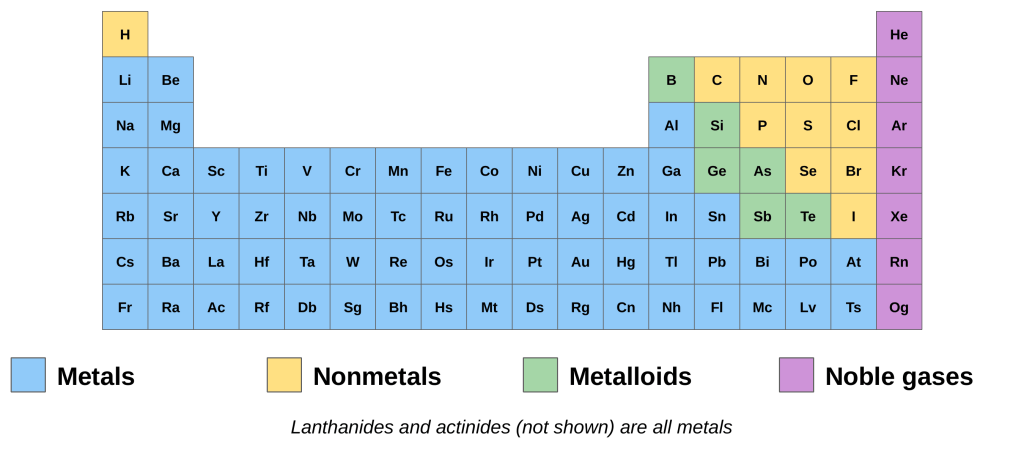
- Metals are on the left side and in the middle. That’s most of the periodic table.
- Nonmetals are in the upper right corner. Hydrogen is also a nonmetal, even though it sits above group 1.
- Metalloids sit along the staircase between the metals and nonmetals: boron, silicon, germanium, arsenic, antimony, and tellurium. Some tables also list polonium and astatine.
- Noble gases in group 18 are a special family of nonmetals.
Properties of Metals
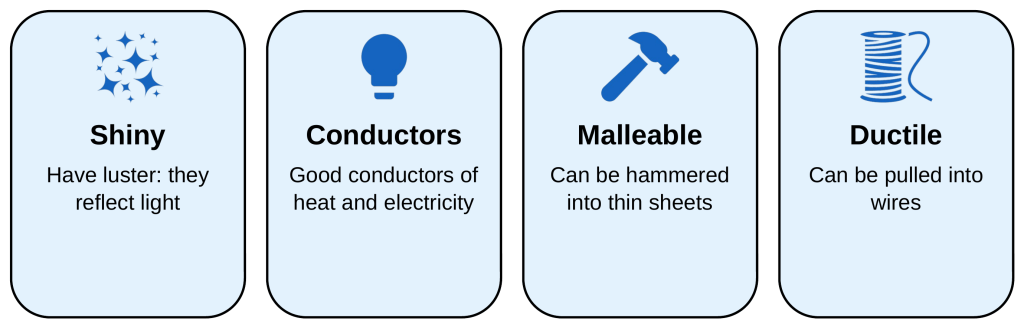
- Shiny: metals have luster and reflect light.
- Conductors: good conductors of heat and electricity, which is why wires are copper and pans are metal.
- Malleable: can be hammered or rolled into thin sheets, like aluminum foil. A metal flattens instead of shattering.
- Ductile: can be pulled into thin wires.
Almost all metals are solid at room temperature. The one exception is mercury, which is a liquid. Examples: copper, iron, aluminum, gold.
Properties of Nonmetals
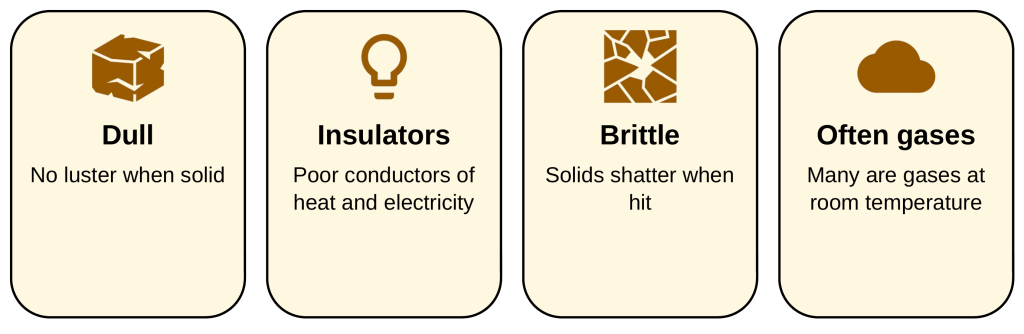
- Dull: solid nonmetals, like sulfur, have no luster.
- Insulators: poor conductors of heat and electricity.
- Brittle: solid nonmetals shatter when hit with a hammer.
- Often gases: many are gases at room temperature, like oxygen and nitrogen. Bromine is the only liquid nonmetal.
Examples: oxygen, nitrogen, sulfur, carbon.
Properties of Metalloids
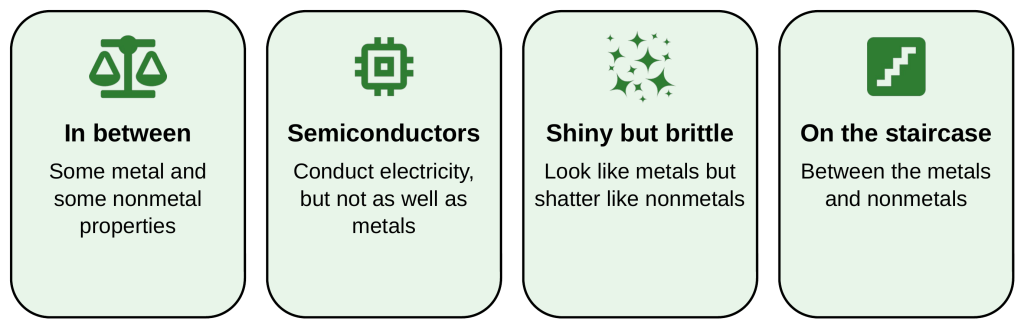
- In between: metalloids have some properties of metals and some of nonmetals.
- Semiconductors: they conduct electricity, but not as well as metals, and their conductivity can be controlled. That’s why silicon is used in computer chips and solar cells.
- Shiny but brittle: silicon looks like a metal but shatters like a nonmetal.
Examples: silicon, boron, germanium, arsenic.
Noble Gases
- Group 18 nonmetals: helium, neon, argon, krypton, xenon, and radon
- Very unreactive: they almost never form compounds.
- All are gases at room temperature.
Because they don’t react, helium is used in balloons and argon is used inside light bulbs. When electricity passes through noble gases, they glow, which is how neon signs work. You’ll learn why they’re so unreactive when we study electrons in the next unit.
Metals Lose, Nonmetals Gain
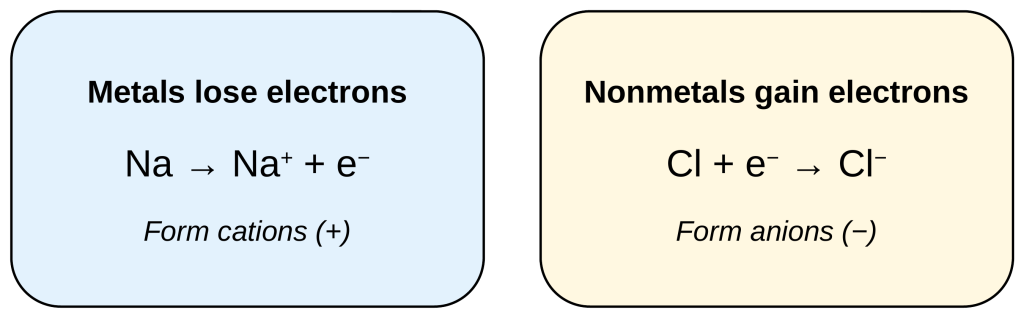
This connects to the ions lesson. Metals tend to lose electrons and form cations, like Na+. Nonmetals tend to gain electrons and form anions, like Cl−. When a metal and a nonmetal react, the metal gives electrons to the nonmetal. Sodium and chlorine react this way to form sodium chloride, table salt. Noble gases usually do neither.
Comparing the Three
| Property | Metals | Nonmetals | Metalloids |
|---|---|---|---|
| Luster | Shiny | Dull | Often shiny |
| Conductivity | Good | Poor | Semiconductor |
| Hammer test | Flattens | Shatters | Shatters |
| Electrons | Tend to lose | Tend to gain | Varies |
| Reacts with acid? | Many fizz (H2 gas) | No | Usually no |
Luster, conductivity, and the hammer test are physical properties: you can test them without changing what the substance is. Gaining or losing electrons and reacting with acid are chemical properties. Many metals, like magnesium and zinc, fizz in hydrochloric acid as they release hydrogen gas. A shiny sample that shatters and conducts only a little electricity is probably a metalloid.
Worked Examples
Try each problem on your own first, then check your work against the solution.
Example 1: Classify by Location
Classify each element as a metal, nonmetal, metalloid, or noble gas.
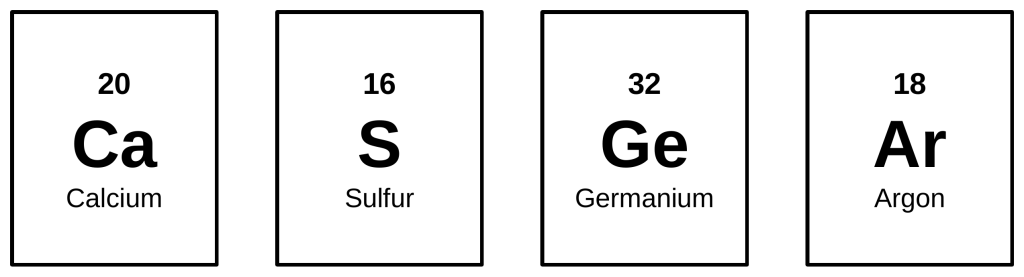
- Calcium (Ca): group 2 on the left side → metal
- Sulfur (S): upper right, not on the staircase → nonmetal
- Germanium (Ge): on the staircase → metalloid
- Argon (Ar): group 18 → noble gas
Example 2: Classify by Properties
A student tests three unknown solids. Classify each sample as a metal, nonmetal, or metalloid.
| Sample | Luster | Conductivity | Hammer test |
|---|---|---|---|
| A | Shiny | Good | Flattens |
| B | Dull yellow | None | Shatters |
| C | Shiny gray | Weak | Shatters |
- Sample A: shiny, conducts well, and flattens (malleable). Every property matches a metal → metal
- Sample B: dull, does not conduct, and shatters (brittle). Every property matches a nonmetal → nonmetal (it could be sulfur)
- Sample C: shiny like a metal, but brittle like a nonmetal, and only a weak conductor (a semiconductor). It’s a mix → metalloid (it could be silicon)
Example 3: Predict Properties
Element X is in group 2, period 4. Predict three of its physical properties. Will it tend to gain or lose electrons?
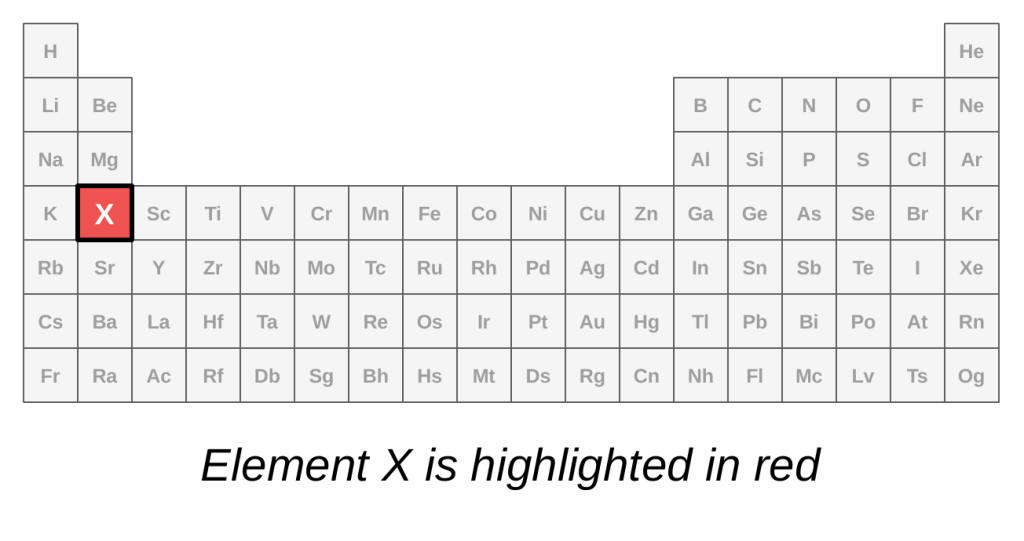
- Classify: group 2 is on the left side of the periodic table, so element X is a metal. (It’s calcium.)
- Predict physical properties: shiny, a good conductor of heat and electricity, and malleable (also ductile and solid at room temperature).
- Electrons: metals tend to lose electrons, so element X forms a cation (Ca2+).
Example 4: Explain a Use
Silicon is used to make computer chips, but copper is used to make electrical wires. Explain why, using the properties of metalloids and metals.
- Classify: copper is a metal and silicon is a metalloid.
- Copper: a wire needs to carry electricity well and bend without breaking. Copper is an excellent conductor and is ductile.
- Silicon: a chip needs electricity to flow in a controlled way. Silicon is a semiconductor, so its conductivity can be controlled. It’s brittle, so it would make a poor wire.
Sample answer: Copper is a metal, so it is an excellent conductor of electricity and is ductile, which lets it be drawn into wires that carry current without breaking. Silicon is a metalloid and a semiconductor, so its ability to conduct electricity can be controlled, which is what a computer chip needs. Silicon is brittle, so it would not work well as a wire.
Big Ideas
- Metals: left side, shiny, conduct, malleable.
- Nonmetals: upper right, dull, brittle, insulators.
- Metalloids: on the staircase, in between.
- Metals lose electrons, and nonmetals gain them.
Back to the essential question: we can tell metals from nonmetals by their location on the periodic table and by testing their properties, like luster, conductivity, and what happens when you hit them with a hammer. You’ll use all of this in the lab.

