
Virtual Labs

Interactive simulations that run in the browser on any device. No login and no equipment needed. The tags on each lab show the concepts it focuses on. Take them, adapt them, and use them in your own room.

Chemistry

For Chemistry, Honors Chemistry and AP Chemistry.
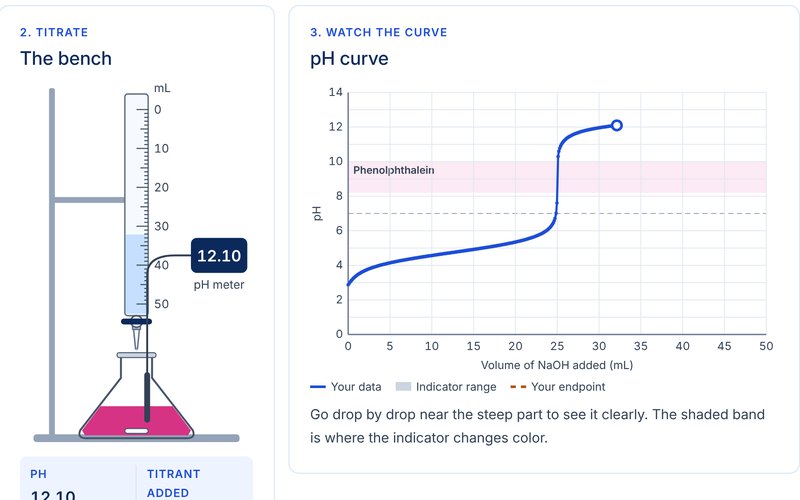
The Virtual Titration Simulator: a burette over a pink flask with a pH meter reading 12.10, next to a pH curve for acetic acid titrated with NaOH that jumps steeply at 25 mL.

Chemistry and AP Chemistry

Virtual Titration Simulator

Acid-base titration

pH curves

Equivalence point

pKa and buffers

Indicators

Titrate a strong or weak acid or base drop by drop, watch the pH curve form, and find the equivalence point and the pKa from your own data.
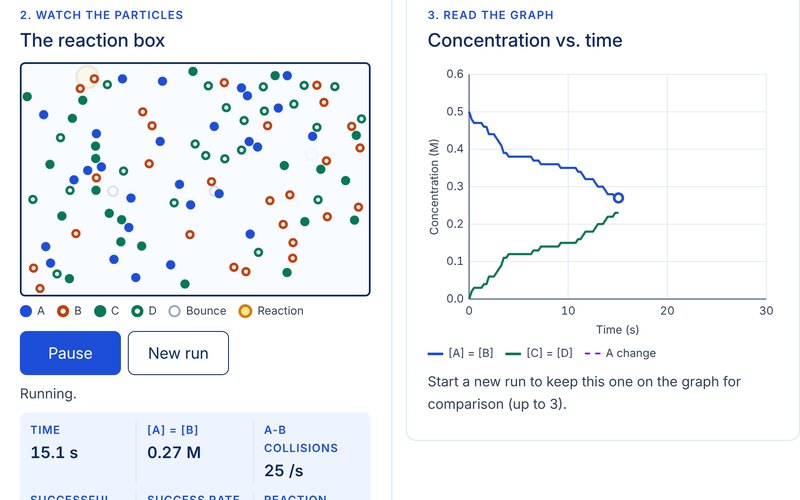
The Kinetics and Collision Theory Sandbox: a reaction box of colored A, B, C and D particles, next to a concentration vs. time graph where reactant concentration falls as product concentration rises.

Chemistry and AP Chemistry

Kinetics and Collision Theory Sandbox

Collision theory

Reaction rates

Activation energy

Catalysts

Energy profiles

Watch particles collide, change the temperature, the concentration and the activation energy, add a catalyst, and see why only some collisions lead to a reaction.
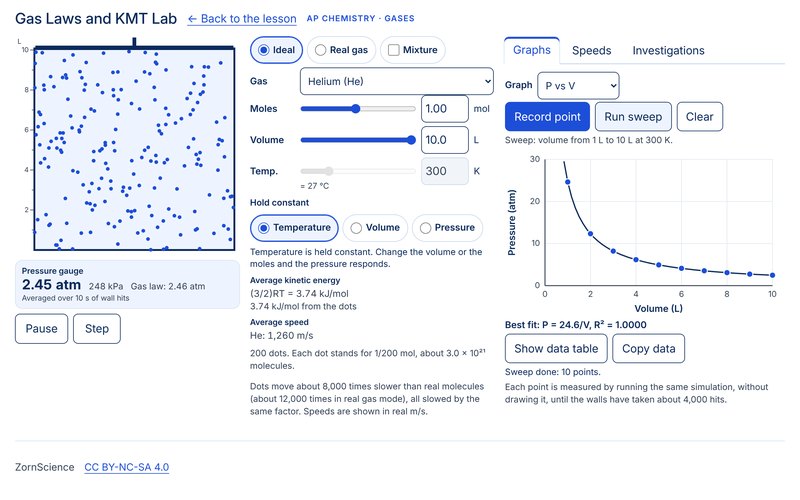
The Gas Laws and KMT Lab: gas particles in a container under a movable piston with a pressure gauge, controls for moles, volume and temperature, and a pressure vs. volume graph showing an inverse curve.

AP Chemistry

Gas Laws and KMT Lab

Gas laws

Kinetic molecular theory

Partial pressures

Maxwell-Boltzmann

Real gases

Move a piston, heat the gas, and add more particles while you watch them hit the walls, then graph the gas laws and see when real gases stop acting ideal.

Physics

For Physics and Honors Physics.
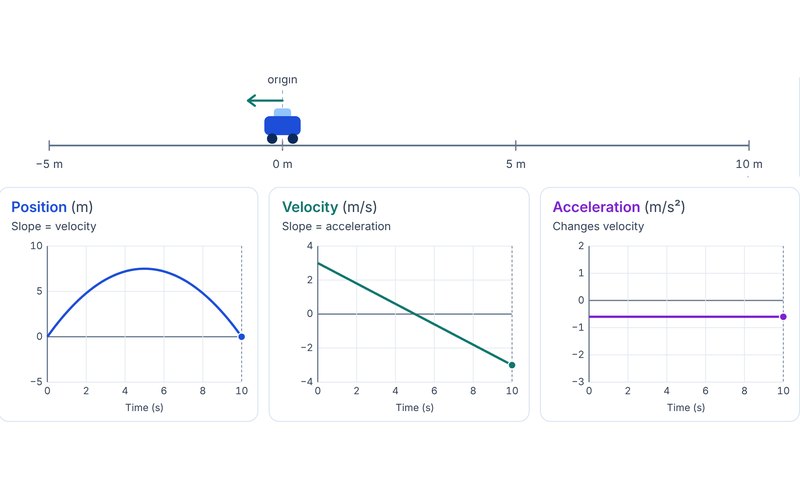
The Physics Graphing Lab: a cart on a motion track heading left, above three graphs of the same motion. Position is a downward-opening parabola, velocity is a line falling from 3 to -3 m/s, and acceleration is a flat line at -0.6 m/s squared.

Physics

Physics Graphing Lab

Position-time graphs

Velocity-time graphs

Acceleration

Kinematic equations

Slope as rate of change

Predict the position, velocity and acceleration graphs for a moving cart, then run it and compare your prediction with the model.
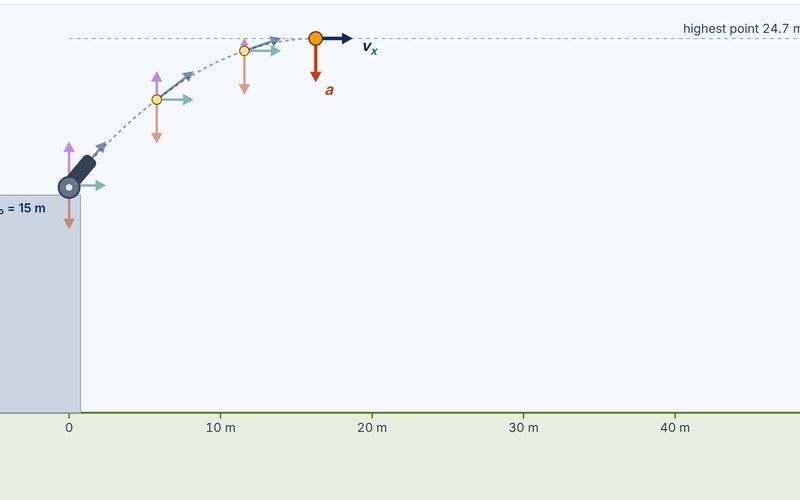
The Projectile Motion Vector Lab: a cannon on a 15 m ledge fires a ball along a dashed arc. At the highest point the ball has only a horizontal velocity arrow and a downward acceleration arrow, with earlier snapshots showing shrinking upward velocity components.

Physics

Projectile Motion Vector Lab

Projectile motion

Velocity components

Vectors

Free-fall acceleration

Independence of motion

Fire a cannon, turn on the velocity and acceleration vectors, and watch the horizontal velocity stay the same while the vertical velocity shrinks, flips at the top and grows.
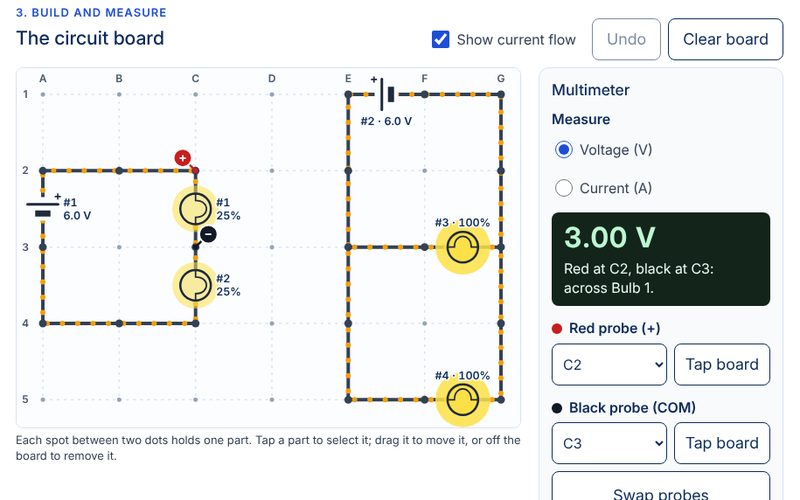
The Circuit Builder: on the left, two bulbs in series with a 6.0 V battery glow dimly at 25%; on the right, two bulbs in parallel on another 6.0 V battery glow fully at 100%. A multimeter panel reads 3.00 V across Bulb 1.

Physics

Circuit Builder

Ohm’s law

Series circuits

Parallel circuits

Multimeters

Electric power

Build circuits from batteries, wires, resistors, switches and bulbs, probe them with a multimeter, and find out why bulbs in series and in parallel glow so differently.