
In this lesson
Take it with you
- Lesson slides (PDF)
- Practice worksheet (PDF)
- Answer key (PDF)
- AP Chemistry Unit 2 Practice (activity)
Essential Question
How are ions arranged in an ionic solid?
A grain of table salt looks simple from the outside, but inside, a huge number of ions are lined up in a very specific pattern. By the end of this lesson, you should be able to draw that pattern and explain why the ions arrange themselves that way.
Video not loading? Watch it on YouTube.
What Is an Ionic Solid?
- Cations (+): positive ions that form when an atom loses electrons
- Anions (−): negative ions that form when an atom gains electrons
- Ionic solids usually form between a metal and a nonmetal.

There is no such thing as a single NaCl molecule. The formula NaCl tells us the ratio of ions in the solid: one Na+ for every Cl−. In the diagrams on this page, purple circles are cations and green circles are anions.
Coulomb’s Law Review
F ∝ q1q2 / r2
- q1 and q2 = the charges on the two ions
- r = the distance between the centers of the ions

Opposite charges attract and like charges repel. Larger charges or a smaller distance make the force stronger. Because r is squared, cutting the distance in half makes the force four times stronger.
A Repeating Pattern
- Ions form a regular, repeating pattern called a crystal lattice.
- Each ion is surrounded by ions of the opposite charge.

In this layer of solid NaCl, every Cl− has Na+ ions as its closest neighbors, and every Na+ has Cl− ions as its closest neighbors. The pattern keeps going in every direction until it reaches the surface of the crystal.
Maximize Attraction, Minimize Repulsion
- Nearest neighbors have opposite charges, so the attraction is strong.
- Like charges are farther apart, on the diagonals, so the repulsion is weaker.
- Attraction wins, so the energy is as low as possible and the solid is stable.

Key idea: the cations and anions in an ionic crystal are arranged in a systematic, repeating 3-D pattern that maximizes the attraction between opposite charges and minimizes the repulsion between like charges.
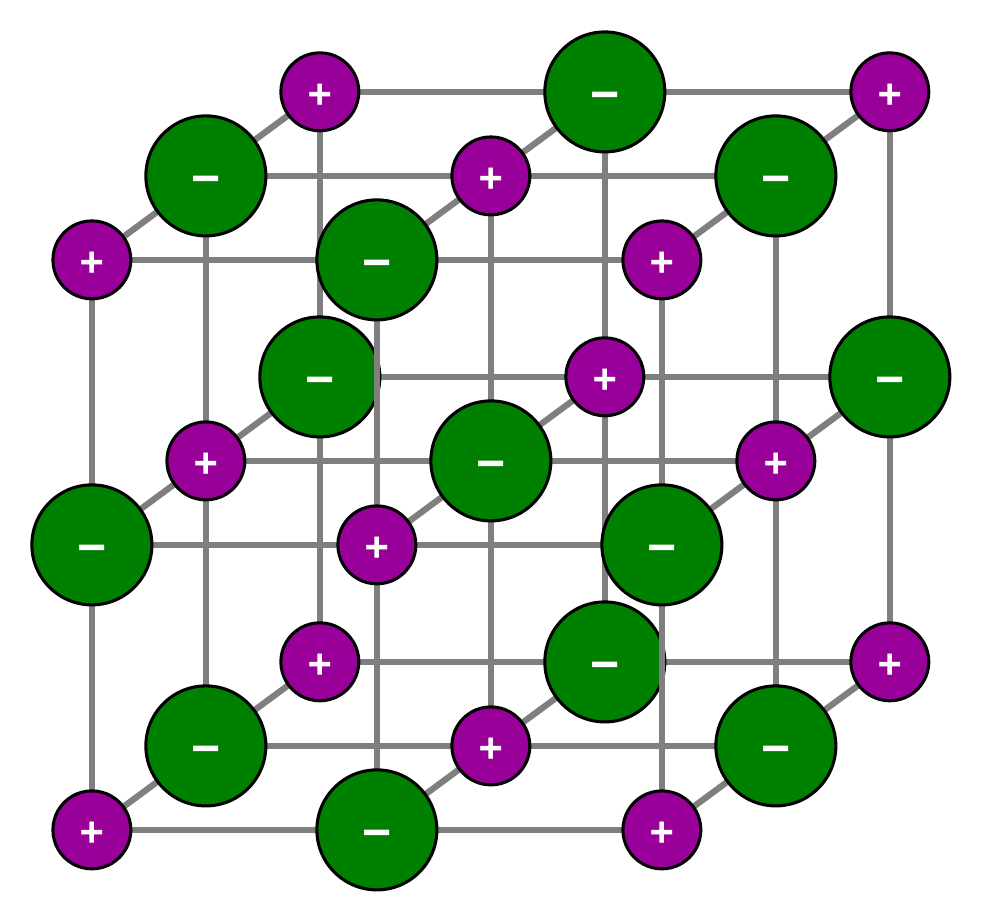
A 3-D Array
- The same alternating pattern repeats left to right, up and down, and front to back.
- A single grain of salt contains about 1018 ions.
Exam tip: you will not be asked to memorize or name specific crystal structures. You do need to explain why the ions are arranged this way using Coulomb’s law.
Ion Size
- Ions get larger down a group, because each one has another shell of electrons.
- Anions are usually larger than cations. A cation has lost electrons (often a whole outer shell), so it shrinks. An anion has gained electrons, which adds electron repulsion, so it spreads out.

In NaCl, the Cl− ion (181 pm) is almost twice as wide as the Na+ ion (102 pm). Whenever you draw an ionic solid, the relative sizes need to match.
Drawing Particle Diagrams
When you draw or choose a particle diagram of an ionic solid, check all three:
- Alternate charges: every ion is surrounded by ions of the opposite charge.
- Correct relative sizes: check the radii. Anions are usually larger than cations.
- Correct ratio: match the formula so the total charge is zero.

The diagram on the right puts like charges side by side in rows. That would cause strong repulsion, so it is not consistent with Coulomb’s law.
Why Ionic Solids Are Brittle
- A force shifts one layer of ions.
- Like charges line up next to each other.
- The repulsion splits the crystal apart.

Shifting a layer by just one ion puts positive ions next to positive ions and negative ions next to negative ions. That’s why a salt crystal shatters when you hit it with a hammer instead of bending. In Topic 2.4, you’ll see that metals behave very differently.
Stronger Attraction, Higher Melting Point
- Larger charges → stronger attraction
- Smaller ions → stronger attraction
- Stronger attraction → higher melting point

To melt an ionic solid, you have to pull the ions away from each other. In NaCl, the product of the charges is 1 × 1 = 1, but in MgO it is 2 × 2 = 4. Mg2+ and O2− are also smaller ions, so they get closer together. As a result, NaCl melts at 801 °C, while MgO melts at about 2,800 °C.
Worked Examples
Try each problem on your own first, then open the solution to check your work.
Example 1: Choosing a Particle Diagram
Which particle diagram best represents a layer of solid LiF? Justify your answer.

Show the solution
- Identify the ions: Li is a Group 1 metal, so it forms Li+. F is a Group 17 nonmetal, so it forms F−. The formula LiF gives a 1:1 ratio.
- Compare sizes: Li+ (76 pm) has lost its only valence shell, so it is very small. F− (133 pm) has gained an electron, so it is larger. The + ions should be drawn smaller than the − ions.
- Eliminate B: the charges alternate, but the + ions are drawn larger than the − ions. The sizes are backwards.
- Eliminate C: the sizes are right, but like charges sit next to each other in rows, which would cause strong repulsion.
- Answer: Diagram A
Sample exam justification: Diagram A is the best representation because the Li+ ions are drawn smaller than the F− ions, and each ion is surrounded by ions of the opposite charge, which maximizes attraction and minimizes repulsion.
Example 2: Comparing Attractions
Use Coulomb’s law to estimate how many times stronger the attraction between ions is in CaO than in KF. Ionic radii: K+ = 138 pm, F− = 133 pm, Ca2+ = 100 pm, O2− = 140 pm.
Show the solution
- Relationship: F ∝ q1q2/r2. We are comparing two solids, so the proportionality is all we need. No actual force in newtons is required.
- KF charges: K+ and F−. Use the size of each charge: q1q2 = (1)(1) = 1
- KF distance: when two ions touch, r = cation radius + anion radius = 138 pm + 133 pm = 271 pm. So FKF ∝ 1/(271)2
- CaO charges and distance: Ca2+ and O2−, so q1q2 = (2)(2) = 4 and r = 100 pm + 140 pm = 240 pm. So FCaO ∝ 4/(240)2
- Set up the ratio: FCaO/FKF = [4/(240)2] ÷ [1/(271)2] = 4 × (271/240)2. Dividing by a fraction is the same as multiplying by its reciprocal. The picometers cancel, so the answer has no units.
- Calculate: 271/240 = 1.129, and (1.129)2 = 1.275. Then 4 × 1.275 = 5.10
- Answer: The attraction in CaO is about 5.1 times stronger. A factor of 4 comes from the charges and only about 1.3 from the smaller distance, so charge has the bigger effect. This matches real data: KF melts at 858 °C, and CaO melts at about 2,600 °C.
Example 3: Finding the Error
A student drew this particle diagram of solid MgCl2. Identify the error and explain why it is a problem.

Show the solution
- Check the charges: the + and − ions alternate. This part is correct.
- Check the sizes: Mg2+ is a small cation and Cl− is a large anion. This part is correct.
- Check the ratio: there are 8 Mg2+ ions and 8 Cl− ions, a 1:1 ratio. The formula MgCl2 needs 2 Cl− for every Mg2+.
- Check the total charge: 8(+2) + 8(−1) = +16 − 8 = +8. An ionic compound must be neutral overall.
- Answer: The ratio of ions is wrong.
Sample exam answer: The diagram shows a 1:1 ratio of Mg2+ to Cl− ions, but MgCl2 needs two Cl− ions for every Mg2+ ion. With a 1:1 ratio, the solid would have an overall positive charge instead of being neutral.
Practice
- 2.3 Structure of Ionic Solids Practice Worksheet (PDF)
- 2.3 Structure of Ionic Solids Practice Answer Key (PDF)
Practice with instant feedback
Answer original AP-style questions for Unit 2 and see an explanation right after each one. Choose Topic 2.3 or mix topics. No login needed.
Lesson Slides
Big Ideas
- Ionic solids are 3-D arrays of cations and anions.
- The pattern maximizes attraction and minimizes repulsion.
- Particle diagrams need correct charges, sizes, and ratios.
- Stronger attraction → higher melting point.
Back to the essential question: the ions in an ionic solid are arranged in a repeating, three-dimensional pattern where every ion is surrounded by ions of the opposite charge, because that arrangement maximizes attraction and minimizes repulsion. Next up, Topic 2.4 looks at the structure of metals and alloys.
AP Alignment
This lesson covers Topic 2.3, Structure of Ionic Solids, in Unit 2 (Compound Structure and Properties) of the College Board AP Chemistry Course and Exam Description (CED). Learning objective:
- 2.3.A: Represent an ionic solid with a particulate model that is consistent with Coulomb’s law and the properties of the constituent ions.
Essential knowledge: 2.3.A.1
Suggested skill: 4.C Model Analysis. Explain the connection between particulate-level and macroscopic properties of a substance using models and representations.