
Essential Question
What determines the type of bond between two atoms?
In Unit 1, we looked at atoms one at a time. Now we look at what happens when atoms come together. By the end of this lesson, you should be able to look at two atoms, make a claim about how they bond, and back it up with evidence.
Electronegativity (EN)
Electronegativity is how strongly an atom pulls on the electrons it shares in a bond. A high electronegativity means a strong pull.
- Increases left to right across a period
- Decreases down a group
- Fluorine is the most electronegative element.
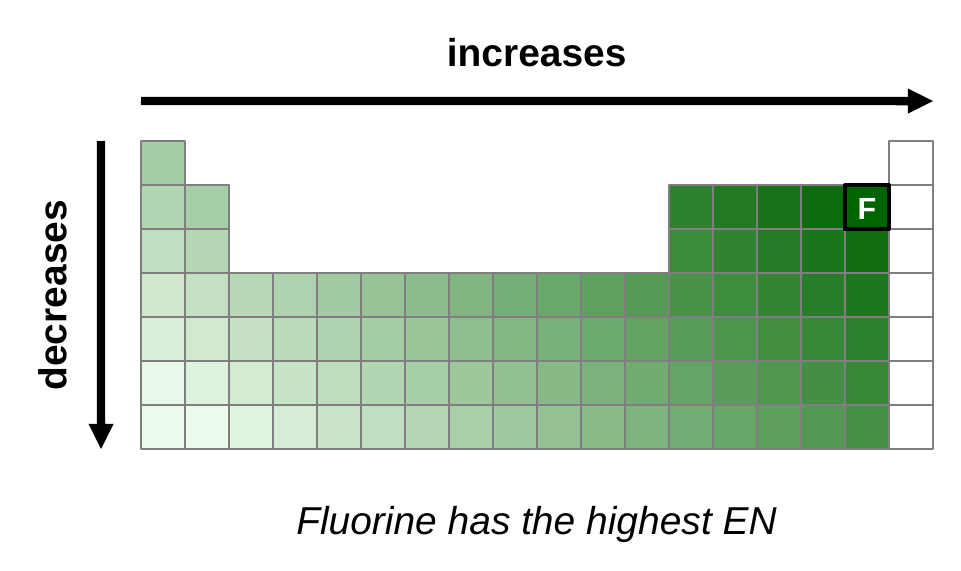
The noble gases on the far right are left blank. They rarely form bonds, so they are usually left out of this trend.
Coulomb’s Law
F ∝ q1q2 / r2
- F = attractive force
- q1, q2 = the two charges
- r = distance between the charges
Bigger charges or a smaller distance → stronger pull. Because r is squared, distance has a big effect. For an atom, one charge is the positive nucleus, the other is a valence electron, and r is how far that valence electron is from the nucleus. This is the reason behind both electronegativity trends.
Why EN Increases Across a Period
- Same shell, more protons
- Valence electrons pulled harder
- Li → F: EN increases
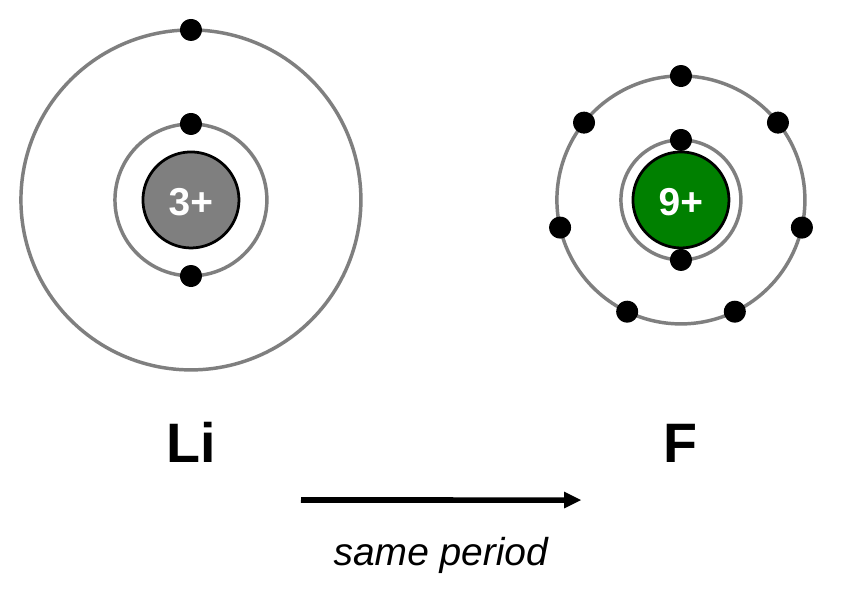
Lithium and fluorine are both in period 2, so their valence electrons are in the second shell. Both atoms have the same two core electrons shielding the nucleus, so lithium’s valence electron feels a net charge of about +1, while fluorine’s valence electrons feel about +7. More charge at about the same distance means a stronger attraction. That also makes the fluorine atom smaller.
Why EN Decreases Down a Group
- Extra shell of electrons
- Valence electrons farther away (larger r)
- F → Cl: EN decreases
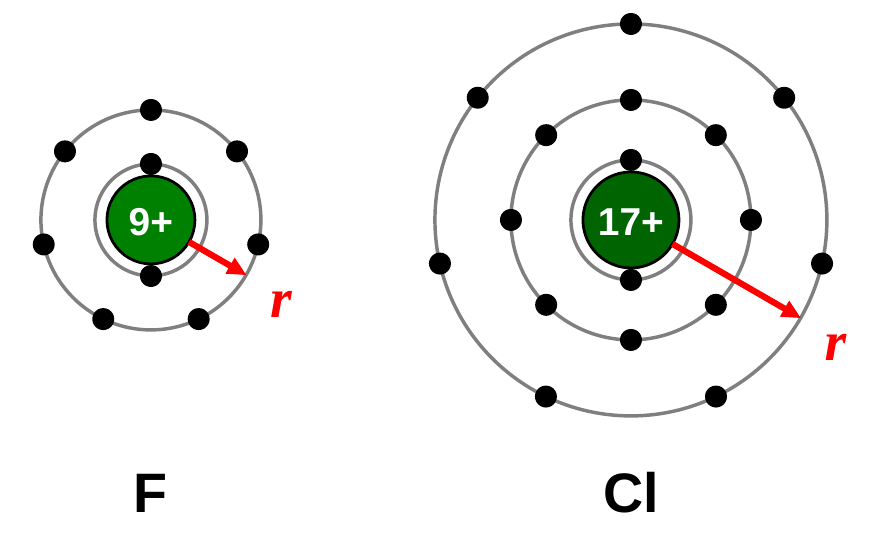
Chlorine has more protons (17), but its extra protons are mostly cancelled out by its extra inner electrons, so the valence electrons in both atoms feel about the same net charge. The big difference is distance. Chlorine’s valence electrons are in the third shell, farther from the nucleus. Since r is squared in Coulomb’s law, a larger distance means a weaker attraction.
Nonpolar Covalent Bond
- Electrons shared equally
- Atoms with equal or very similar EN
- C–H bonds count as nonpolar
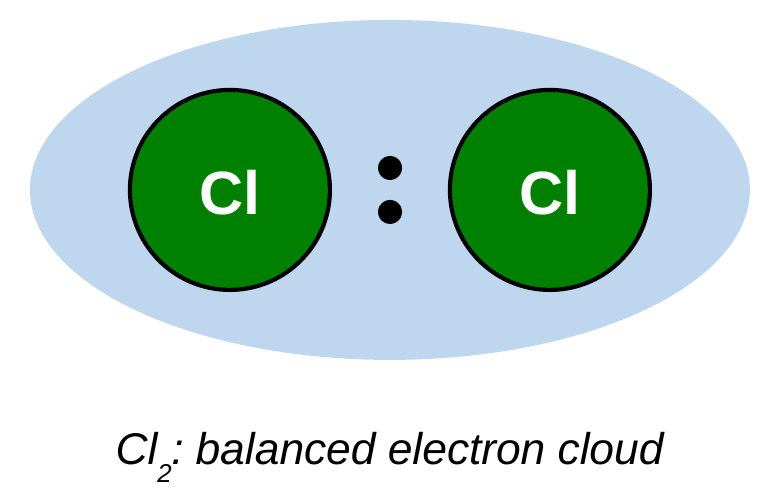
In Cl2, both atoms have the same electronegativity, so they pull on the shared electrons equally and the electron cloud is balanced. The atoms don’t have to be identical: carbon (2.6) is slightly more electronegative than hydrogen (2.2), but the difference is so small that C–H bonds are treated as effectively nonpolar.
Polar Covalent Bond
- Electrons shared unequally
- Higher EN atom gets a partial negative charge (δ−)
- Other atom gets δ+
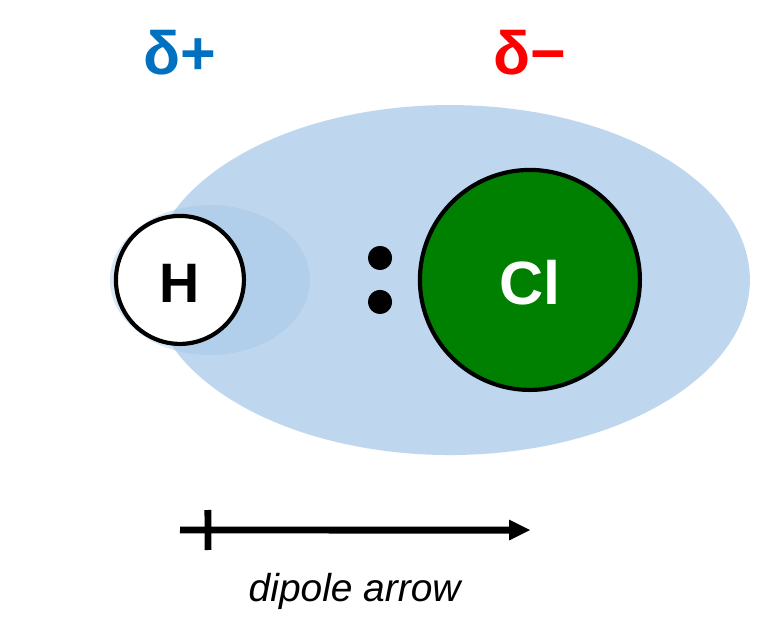
In HCl, chlorine is more electronegative, so it pulls the shared electrons closer to itself. These are partial charges, not full charges, because the electrons are still being shared. The dipole arrow points toward the more electronegative (δ−) atom, and the cross at its tail marks the δ+ end.
Bigger ΔEN, Bigger Bond Dipole
- ΔEN = difference in electronegativity (larger EN − smaller EN)
- Greater ΔEN → greater bond dipole
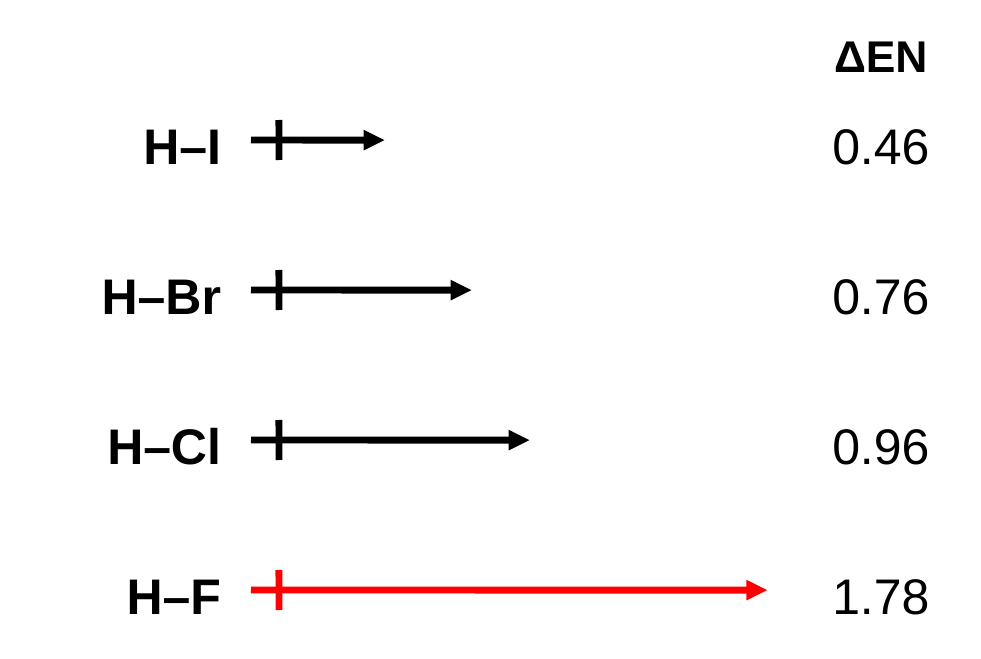
Going from H–I down to H–F, the halogen gets more electronegative, so ΔEN grows from 0.46 to 1.78 and the bond dipole gets bigger. This matches the periodic trend: fluorine is at the top of group 17, so it pulls the hardest.
A Bonding Continuum
- All polar bonds have some ionic character
- No sharp line between covalent and ionic
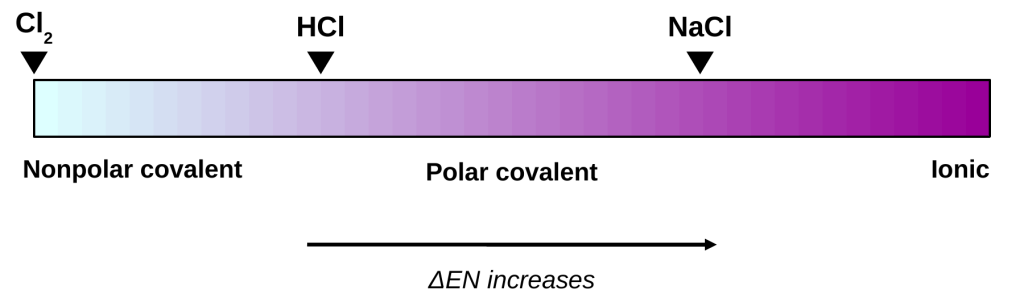
As ΔEN increases, the sharing gets more and more unequal, until one atom has basically taken the electrons and we call the bond ionic. HCl (ΔEN = 0.96) is mostly covalent, but it is partly ionic too.
Exam tip: you may have learned cutoff numbers in another class, but for AP Chemistry, treat bond type as a gradual change, not separate boxes.
Ionic Bond
- Metal transfers electrons to nonmetal
- Forms + and − ions
- Opposite charges attract (Coulomb’s law)
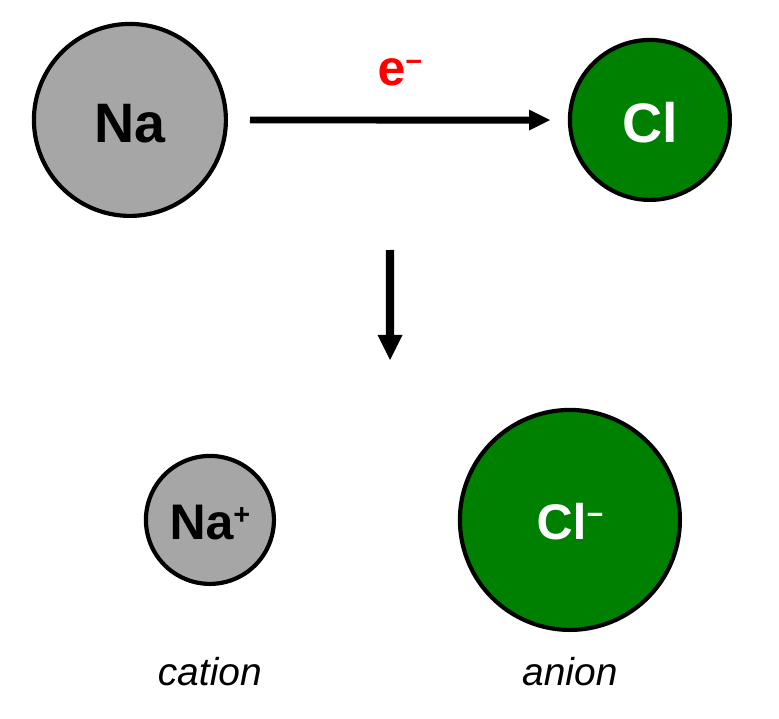
Sodium has a low electronegativity and loses its one valence electron. Chlorine has a high electronegativity and gains that electron. The Na+ ion is smaller than the sodium atom because it lost its outer shell, and the Cl− ion is bigger than the chlorine atom because the extra electron adds repulsion. The ionic bond is the Coulombic attraction between these opposite charges.
Metal or Nonmetal?
- Metal + nonmetal → usually ionic
- Nonmetal + nonmetal → usually covalent
- ΔEN is a guide, not the whole story
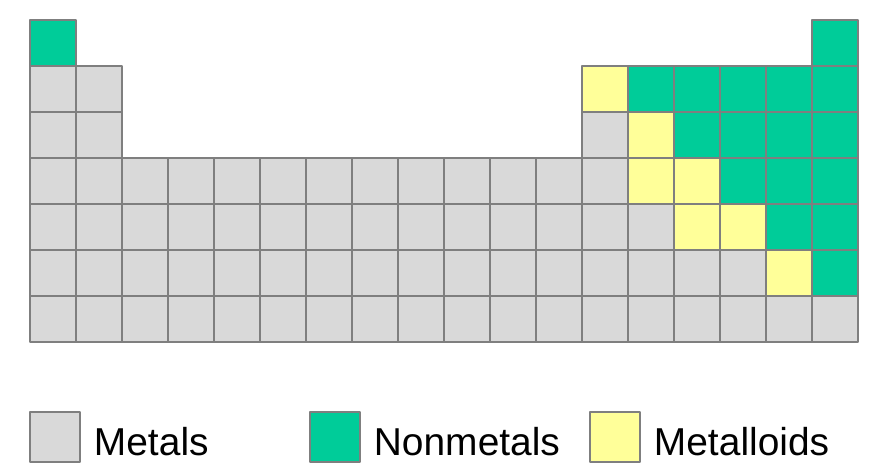
Hydrogen fluoride has a ΔEN of 1.78, which is pretty large. But HF is made of two nonmetals, and it is a gas at room temperature, not a hard ionic solid. It is a polar covalent molecule. The best way to decide the type of bonding is to look at the properties of the substance.
Metallic Bond
- Metal cations in a regular pattern
- Valence electrons are delocalized
- Electrons not tied to any one atom
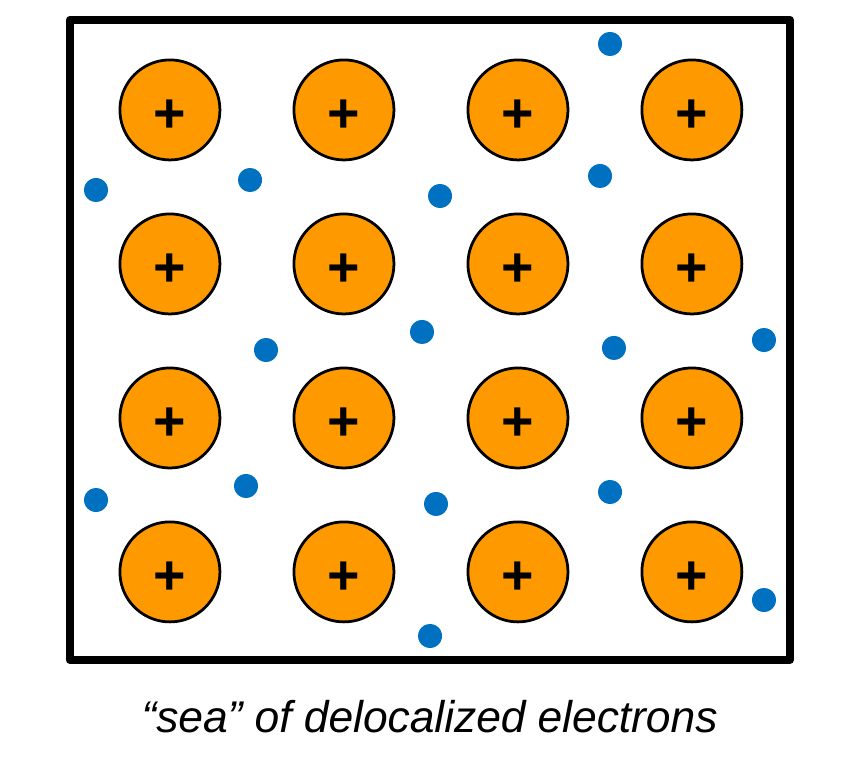
The metallic bond is the attraction between the positive metal cations and a “sea” of mobile electrons. Those mobile electrons are the reason metals conduct electricity so well. Topic 2.4 goes deeper into metals.
Properties Reveal Bond Type
Properties are the best evidence for bond type.
| Ionic | Covalent (molecular) | Metallic | |
|---|---|---|---|
| Melting point | High | Low | Often high |
| Conducts as a solid? | No | No | Yes |
| Conducts when melted? | Yes | No | Yes |
To conduct electricity, a substance needs charged particles that can move. Metals conduct as solids because of their delocalized electrons. Ionic solids don’t conduct because the ions are locked in place, but once melted, the ions are free to move. Molecular substances have no ions and no free electrons, so they don’t conduct either way. Network covalent solids, like diamond, are an exception with very high melting points. We’ll see those later in the unit.
Worked Examples
Try each problem on your own first, then check your work against the solution.
Example 1: Ranking Bond Polarity
Use the electronegativity values to rank these bonds from least polar to most polar: C–H, N–H, O–H. (EN values: H = 2.2, C = 2.6, N = 3.0, O = 3.4)
- Equation: ΔEN = higher EN − lower EN. Subtract the smaller value from the larger one so ΔEN is positive.
- C–H: 2.6 − 2.2 = 0.4
- N–H: 3.0 − 2.2 = 0.8
- O–H: 3.4 − 2.2 = 1.2
- Answer: C–H < N–H < O–H (least polar to most polar). A larger ΔEN means a larger bond dipole.
- Check with the trend: C, N, and O are all in period 2, left to right. EN increases across a period, so oxygen pulls hardest on the shared electrons. The answer matches.
Example 2: Partial Charges
In an N–O bond, which atom has the partial negative charge (δ−)? Justify your claim using atomic structure.
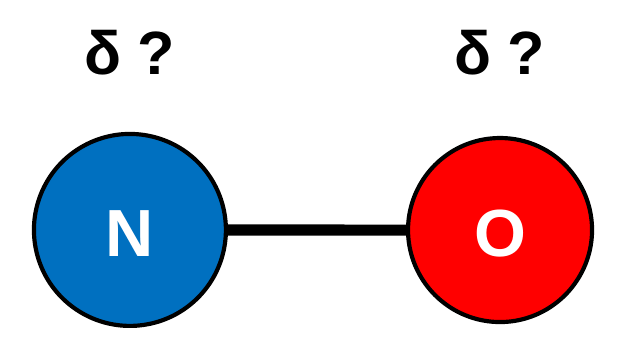
- Claim: oxygen has the partial negative charge.
- Evidence: nitrogen has 7 protons and oxygen has 8. Both are in period 2, so their valence electrons are in the same shell (n = 2), about the same distance from the nucleus.
- Reasoning (Coulomb’s law): more charge at the same r → stronger attraction. Oxygen’s nucleus attracts the shared electrons more strongly, so oxygen is more electronegative.
- Answer: O is δ− and N is δ+. The dipole arrow points toward O.
Sample exam justification: Oxygen has the partial negative charge. Oxygen has one more proton than nitrogen, and the valence electrons of both atoms are in the second shell. With a greater nuclear charge at about the same distance, oxygen attracts the shared electrons more strongly, so the electrons spend more time near oxygen.
Example 3: Identify the Bond Type
A white solid melts at 801 °C. It does not conduct electricity as a solid, but it does conduct when melted. What type of bonding is present? Justify your answer.
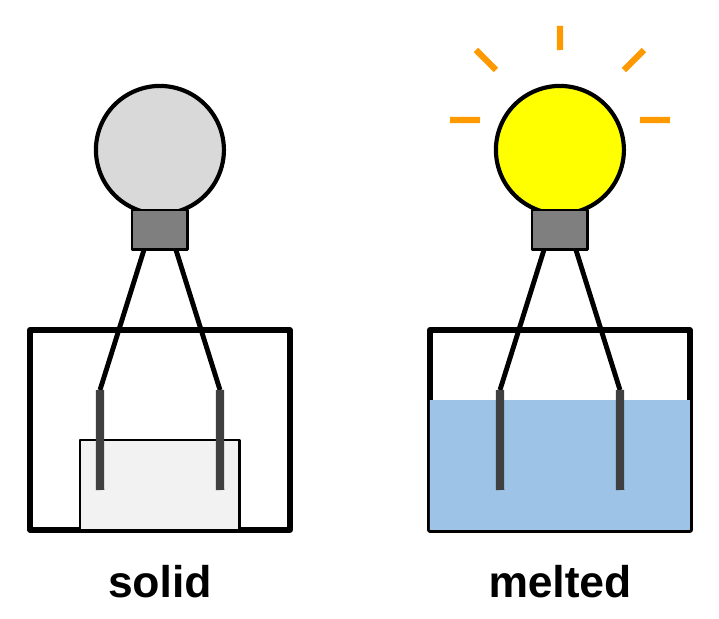
- Melting point: 801 °C is high, so the particles are held by strong attractions. That rules out a molecular covalent substance.
- Solid does not conduct: a metal would conduct as a solid because of its delocalized electrons, so this is not metallic.
- Conducts when melted: charged particles (ions) that were locked in place in the solid are free to move in the liquid.
- Answer: ionic bonding. These are the properties of sodium chloride, table salt, but the properties alone are enough evidence.
Big Ideas
- Electronegativity is an atom’s pull on shared electrons. It increases across a period and decreases down a group.
- Equal sharing → nonpolar covalent. Unequal sharing → polar covalent.
- Electron transfer → ionic. Delocalized electrons → metallic.
- Bond type is a continuum, and properties are the best evidence.
Back to the essential question: the type of bond depends on the atoms involved, especially their electronegativities and whether they are metals or nonmetals, and we confirm it using the properties of the substance. Next up, Topic 2.2 looks at the energy involved in forming a bond.

