
Essential Question
What makes molecules stick to each other?
A drop of water is made of trillions of separate molecules, yet they stay together instead of flying apart. By the end of this lesson, you should be able to name the attractions holding molecules together, explain where they come from, and compare their strengths in different substances.
Intramolecular vs. Intermolecular
- Intramolecular = within a molecule (covalent bonds)
- Intermolecular = between molecules (IMFs)
- Melting and boiling overcome IMFs, not bonds
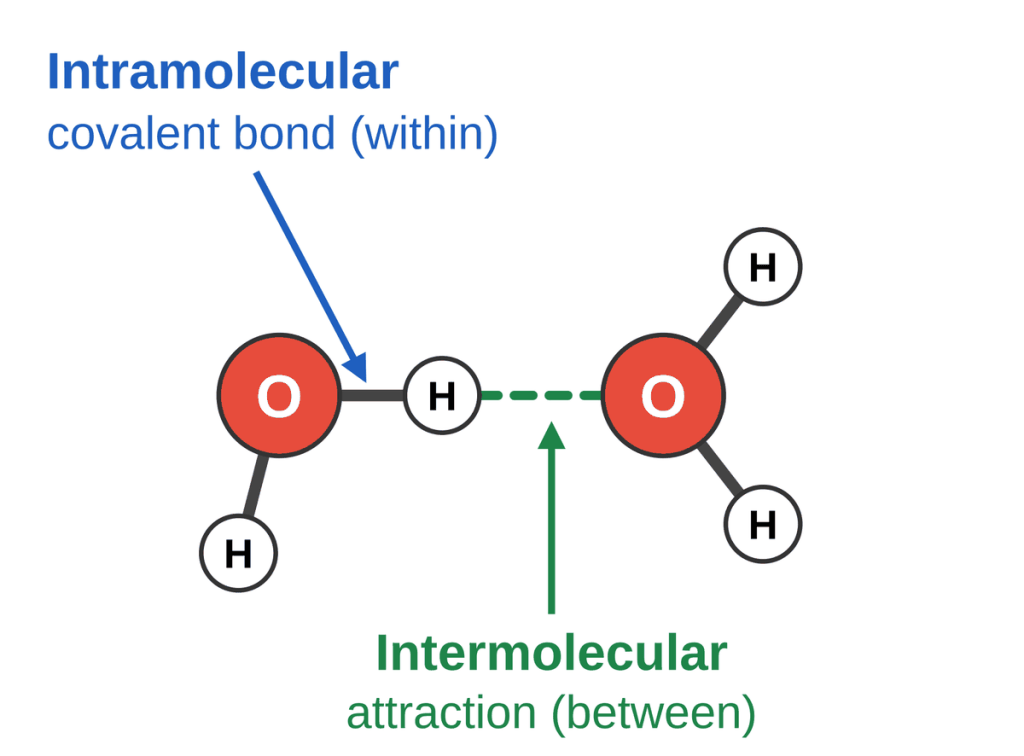
When water boils, the molecules do not break apart into hydrogen and oxygen. You still have H2O, just as a gas. Boiling separates whole molecules from each other, which means it overcomes the intermolecular forces. IMFs are much weaker than covalent bonds, which is why a stove can boil water but can’t split it into elements.
IMFs Are Coulombic Attractions
F ∝ q1q2/r2
- Opposite charges attract
- Bigger charges (q) → stronger attraction
- Closer together (smaller r) → stronger attraction
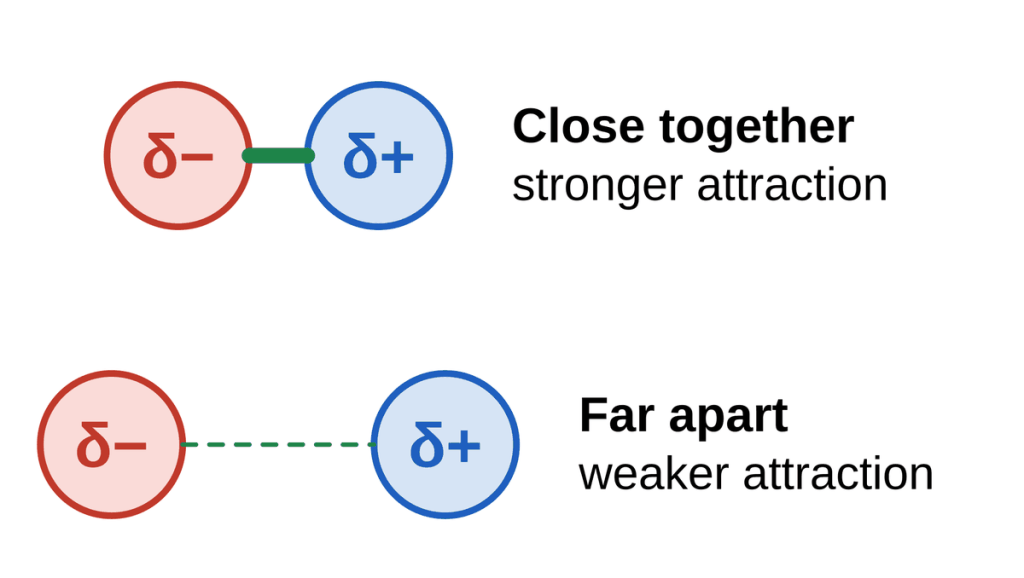
Every IMF in this topic comes back to Coulomb’s law from Unit 1. Most IMFs involve partial charges, written with the Greek letter delta (δ+ and δ−), instead of the full charges on ions. Whenever you compare two IMFs, the explanation goes back to the size of the charges and the distance between them.
London Dispersion Forces (LDF)
- Present in all atoms and molecules, polar or nonpolar
- Moving electrons create temporary dipoles
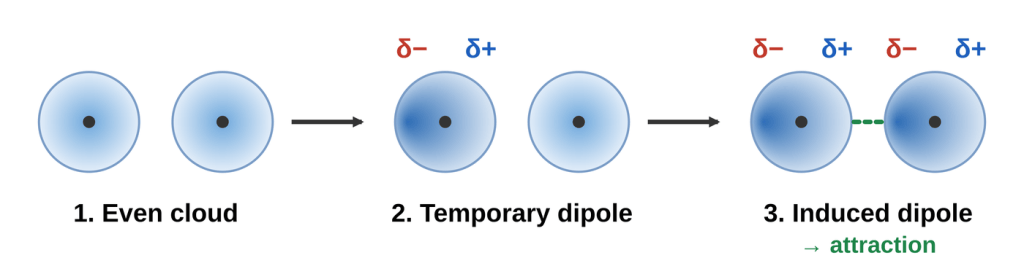
On average, the electrons in an atom are spread out evenly (1). But electrons are always moving, so at any instant more of them may be on one side, creating a temporary dipole (2). That dipole pushes on the electrons of a neighbor, giving it an induced dipole (3). The δ+ end of one now lines up with the δ− end of the other, and they attract. These dipoles flicker on and off constantly, but averaged over time they add up to a real attraction.
Polarizability
- Polarizability: how easily an electron cloud gets distorted
- More electrons → more polarizable → stronger LDF
- Pi bonds also increase polarizability
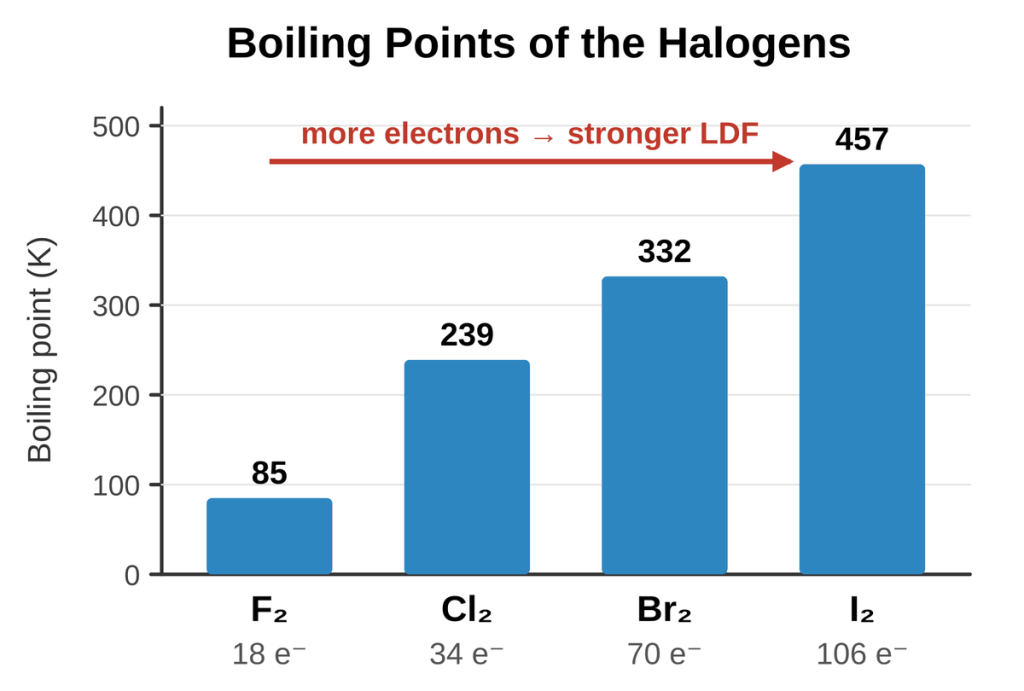
A molecule with more electrons has a bigger electron cloud, and its outer electrons are farther from the nucleus, so they shift more easily. The halogens are all nonpolar, so LDF is their only IMF. As the number of electrons goes up from F2 to I2, so does the boiling point. That’s why fluorine and chlorine are gases at room temperature, bromine is a liquid, and iodine is a solid.
Shape Matters: Contact Area
- Same formula (C5H12) = same number of electrons
- More surface contact → stronger LDF
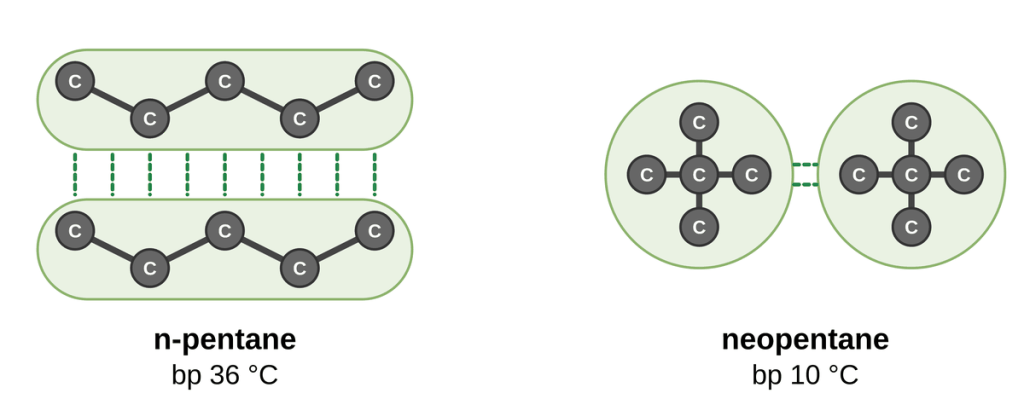
n-Pentane is a long chain, so neighboring molecules can line up along their whole length. Neopentane is compact, almost like a ball, so neighbors only touch at a small spot. Same electrons, different shape: n-pentane boils at 36 °C and neopentane boils at only 10 °C.
Dipole-Dipole Forces
- Between polar molecules (permanent dipoles)
- The δ+ end of one molecule attracts the δ− end of a neighbor
- Molecules line up to maximize attraction
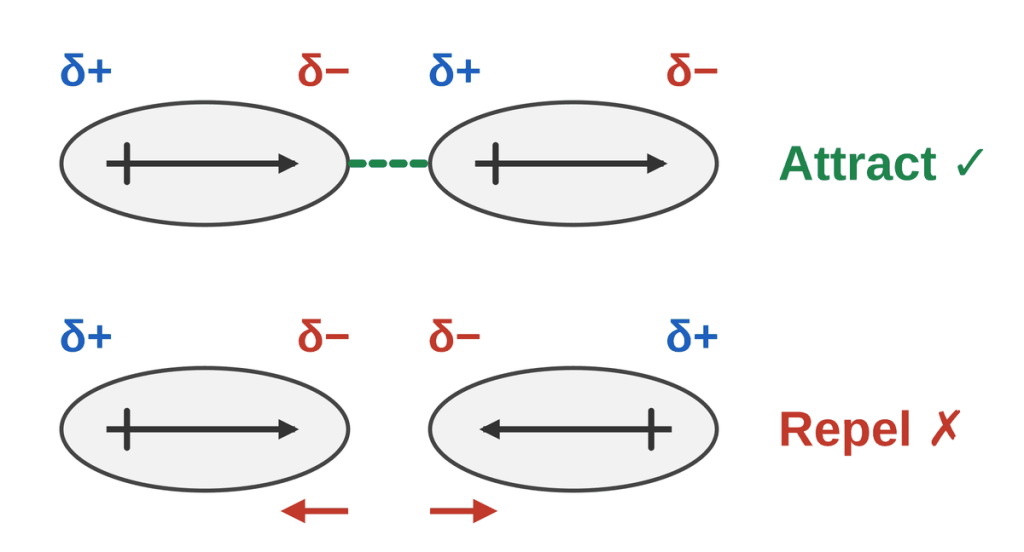
The dipole arrow points toward the δ− end, and the cross marks the δ+ end. Orientation matters: opposite ends attract, but like ends repel. Polar molecules still have LDF too. Dipole-dipole forces act in addition to LDF, not instead of it.
Similar Size: Polar Wins
| Substance | Polarity | IMFs | Molar mass | Boiling point |
|---|---|---|---|---|
| Butane, C4H10 | Nonpolar | LDF only | 58 g/mol | −1 °C |
| Acetone, C3H6O | Polar | LDF + dipole-dipole | 58 g/mol | 56 °C |
Butane and acetone have the same molar mass and a similar number of electrons, so their LDF is about the same. Acetone’s dipole-dipole forces add extra attraction, which shows up as a much higher boiling point. For molecules of similar size, the polar one usually has stronger IMFs.
Hydrogen Bonding
- H covalently bonded to N, O, or F
- That H is attracted to a lone pair on N, O, or F nearby
- An especially strong dipole-dipole attraction
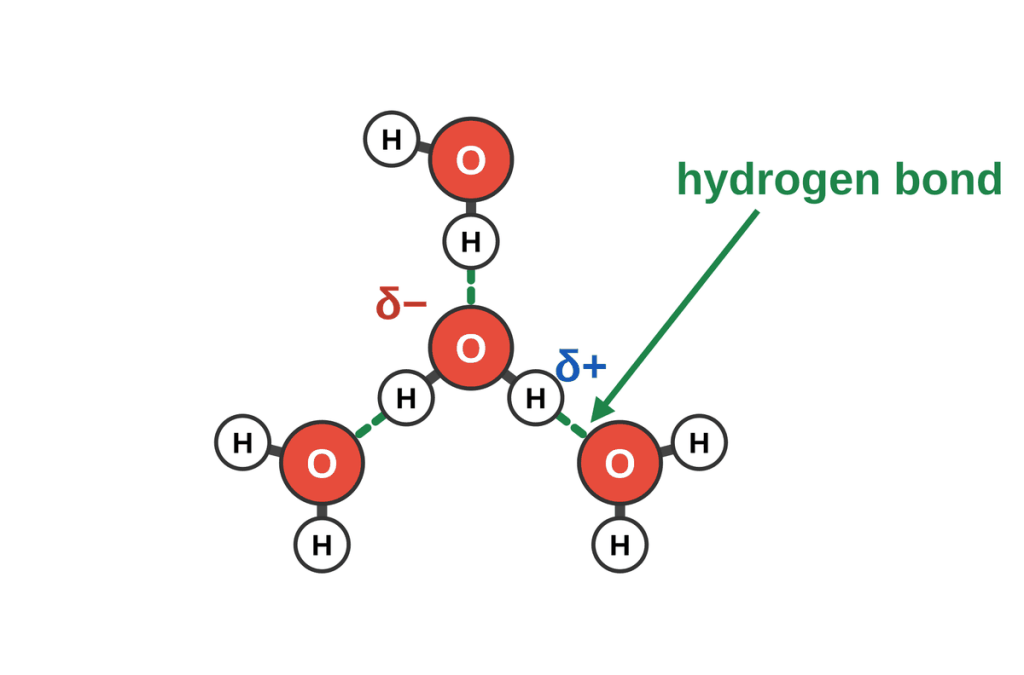
Despite the name, a hydrogen bond is not a bond. It is an intermolecular attraction. N, O, and F are very electronegative and very small, so they leave the H with a large δ+ charge. Because H is so tiny, the molecules can get very close. A large partial charge plus a short distance gives a strong Coulombic attraction. The lone pair can be on another molecule or on a different part of the same large molecule.
H-Bonding Check: Is the H on N, O, or F?
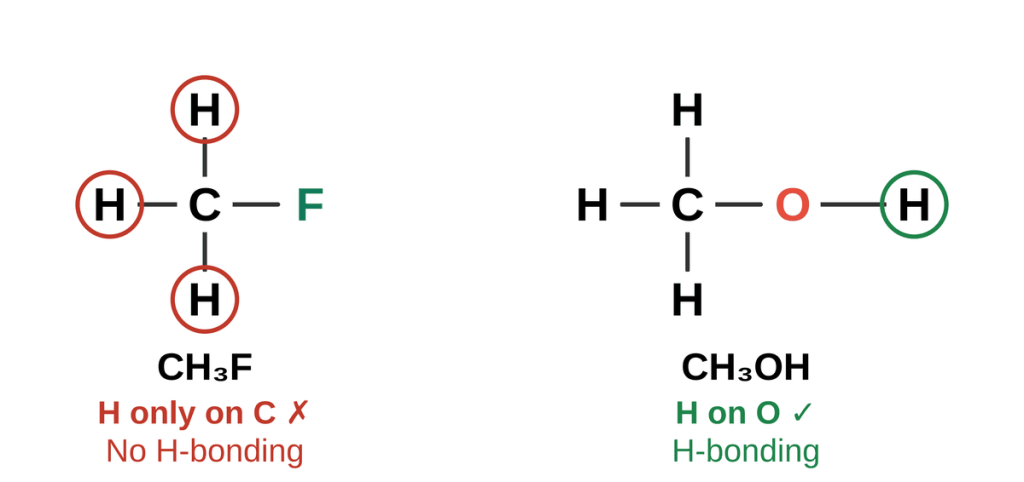
Seeing an F or an O in a formula is not enough. In CH3F, every hydrogen is bonded to carbon, so CH3F molecules do not hydrogen bond with each other (they have LDF and dipole-dipole). In CH3OH, one hydrogen is bonded directly to oxygen, so methanol can hydrogen bond. Always draw the structure and look for an H directly bonded to N, O, or F.
Ion-Dipole Forces
- Between an ion and a polar molecule
- Stronger than dipole-dipole forces
- Stronger with a higher ion charge and a smaller ion
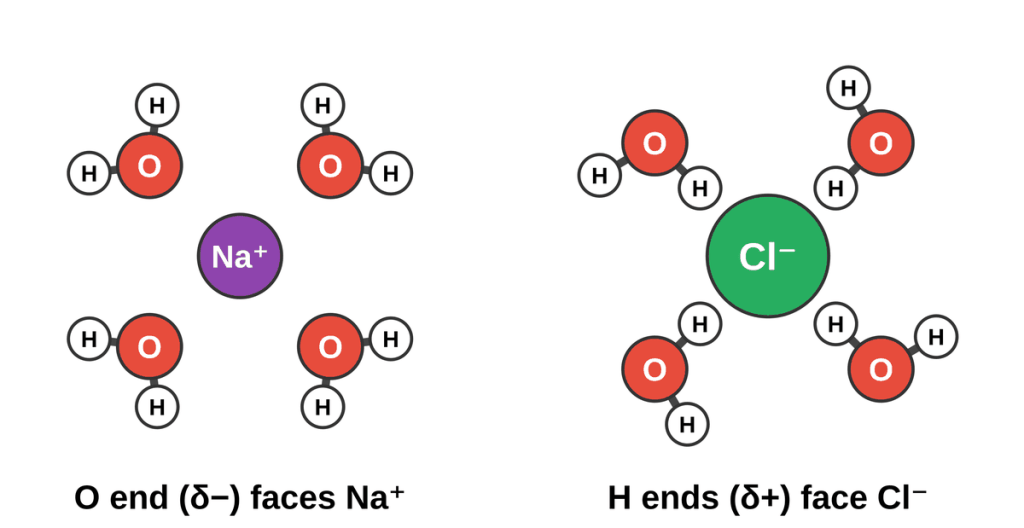
This is what happens when salt dissolves in water. Water molecules turn their δ− oxygen ends toward Na+ and their δ+ hydrogen ends toward Cl−. An ion has a full charge, not just a partial charge, so ion-dipole forces are stronger than dipole-dipole forces. By Coulomb’s law, Mg2+ attracts water more strongly than Na+, and a smaller ion lets the water molecules get closer.
Dipole-Induced Dipole
- Between a polar and a nonpolar molecule
- The dipole distorts the nonpolar electron cloud
- Example: O2 dissolving in water
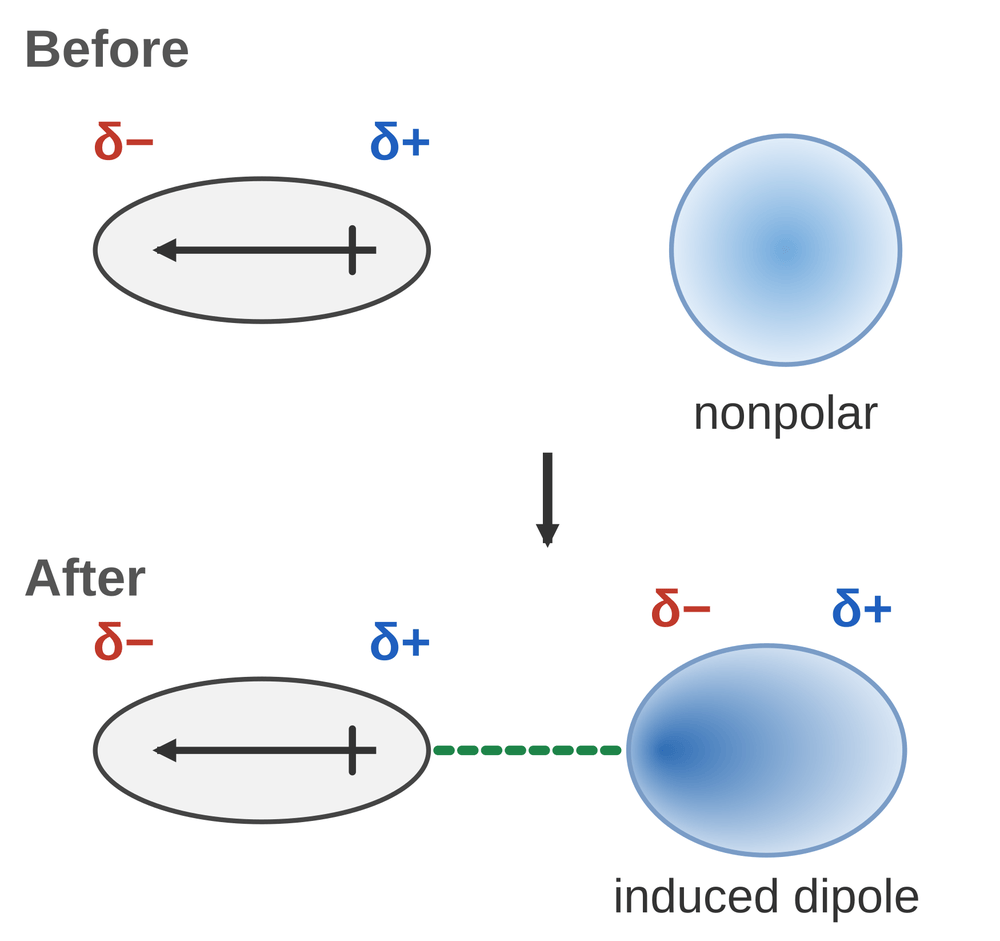
A nonpolar molecule has no permanent dipole, but its electron cloud can still be pushed around. The δ+ end of the polar molecule pulls the nonpolar electrons toward it, creating an induced dipole, and the two molecules attract. This force gets stronger with a bigger dipole on the polar molecule and a more polarizable nonpolar molecule. It’s why a small amount of O2 dissolves in water, which is what fish breathe.
Mixtures: Look at Both Particles
| Particles | IMFs between them | Example |
|---|---|---|
| Nonpolar + nonpolar | LDF | I2 in CCl4 |
| Polar + nonpolar | LDF + dipole-induced dipole | O2 in H2O |
| Polar + polar | LDF + dipole-dipole (+ H-bonding if possible) | CH3COCH3 in H2O |
| Ion + polar | Ion-dipole | NaCl in H2O |
Two different polar molecules can hydrogen bond if one has an H on N, O, or F and the other has a lone pair on N, O, or F. Acetone can’t hydrogen bond with itself, but water’s H can bond to acetone’s oxygen.
Identifying IMFs in a Pure Substance
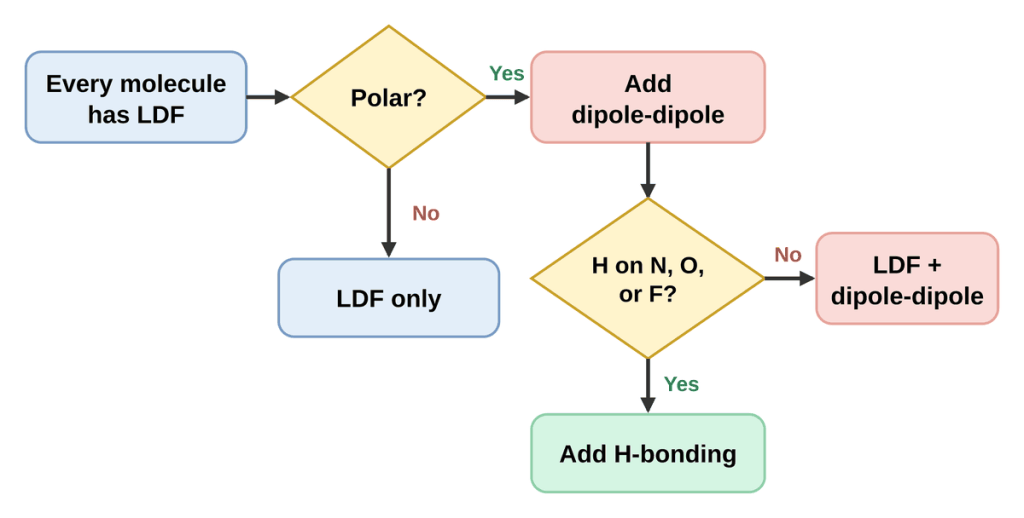
Start with LDF, because every molecule has it. To decide whether a molecule is polar, use its Lewis structure and VSEPR shape from Unit 2. Notice that the forces add up: a molecule with hydrogen bonding still has dipole-dipole forces and LDF too.
Can LDF Beat Hydrogen Bonding?
| Substance | Strongest IMF | Electrons | Boiling point |
|---|---|---|---|
| Octane, C8H18 | LDF only | 66 | 126 °C |
| Water, H2O | Hydrogen bonding | 10 | 100 °C |
Octane is nonpolar, yet it boils at a higher temperature than water. It has far more electrons and a long chain with lots of surface contact, so all those dispersion forces add up. In large molecules, LDF is often the strongest IMF. Hydrogen bonding only wins when you compare molecules of similar size.
IMFs in Biomolecules
- Big molecules have IMFs between different parts of the same molecule
- Hydrogen bonds hold the two strands of DNA together
- Proteins fold because of these attractions
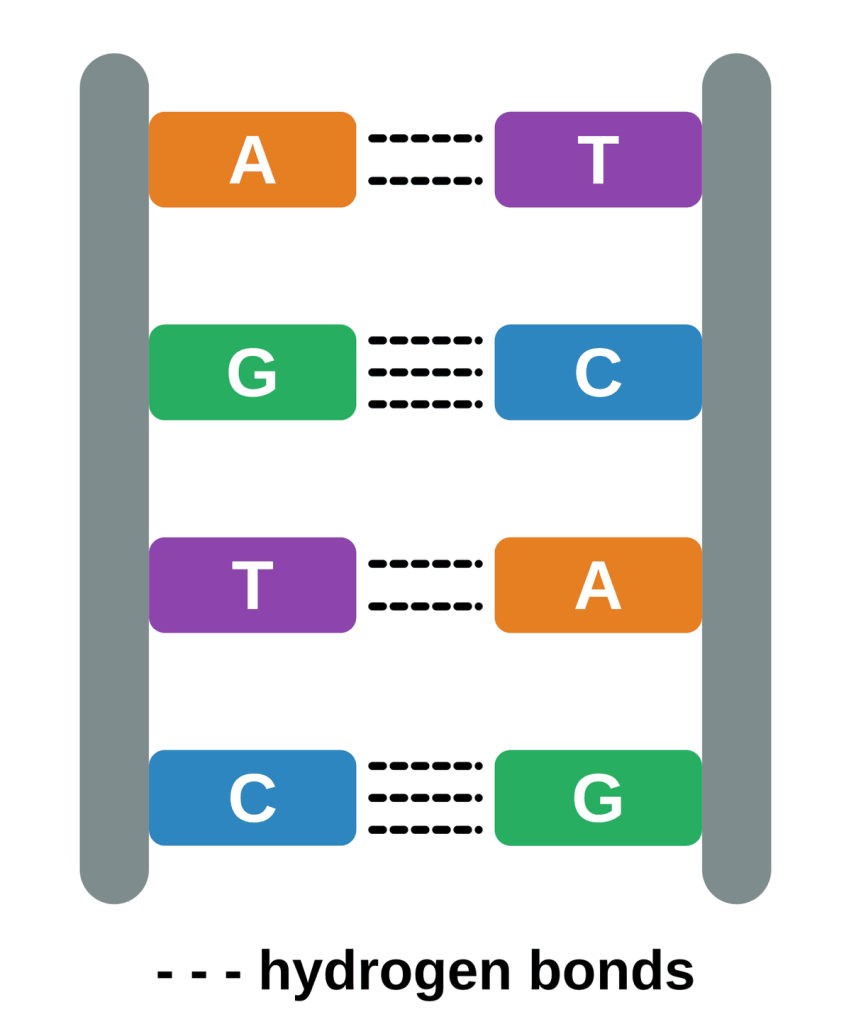
A pairs with T using two hydrogen bonds, and G pairs with C using three. Because these are IMFs and not covalent bonds, the strands can separate when DNA is copied or when it’s heated in a lab.
Say It Like a Chemist
| Avoid | Say instead |
|---|---|
| “Boiling breaks the bonds.” | “Boiling overcomes the IMFs between molecules.” |
| “Van der Waals forces” | “London dispersion forces” (name the specific IMF) |
| “It has stronger IMFs.” | Name the IMF and explain why it’s stronger (electrons, polarizability, polarity, contact area) |
The College Board specifically says “London dispersion forces” should not be used as another name for “van der Waals forces.” On free-response questions, full credit comes from naming the specific force and connecting it to a particle-level reason.
Worked Examples
Try each problem on your own first, then check your work against the solution.
Example 1: Comparing Boiling Points
Which has the higher boiling point, CH4 or CCl4? Justify your answer in terms of intermolecular forces.
- Identify the IMFs: both molecules are tetrahedral and symmetrical, so their bond dipoles cancel. Both are nonpolar, so LDF is the only IMF in each.
- Count electrons: CH4 = 6 + 4(1) = 10 e−. CCl4 = 6 + 4(17) = 74 e−.
- Compare polarizability: CCl4 has many more electrons and a larger electron cloud, so it is more polarizable and has stronger LDF.
- Connect to boiling point: stronger LDF takes more energy to overcome when the liquid turns into a gas.
- Answer: CCl4 has the higher boiling point. For reference, CH4 boils at about −162 °C and CCl4 at about 77 °C.
Sample exam justification: Both CH4 and CCl4 are nonpolar, so the only IMF in each is London dispersion forces. CCl4 has more electrons, so its electron cloud is more polarizable and its LDF is stronger. More energy is needed to overcome these stronger attractions, so CCl4 has the higher boiling point.
Example 2: Identifying All the IMFs
Identify all of the intermolecular forces present in a pure sample of CH2Cl2.
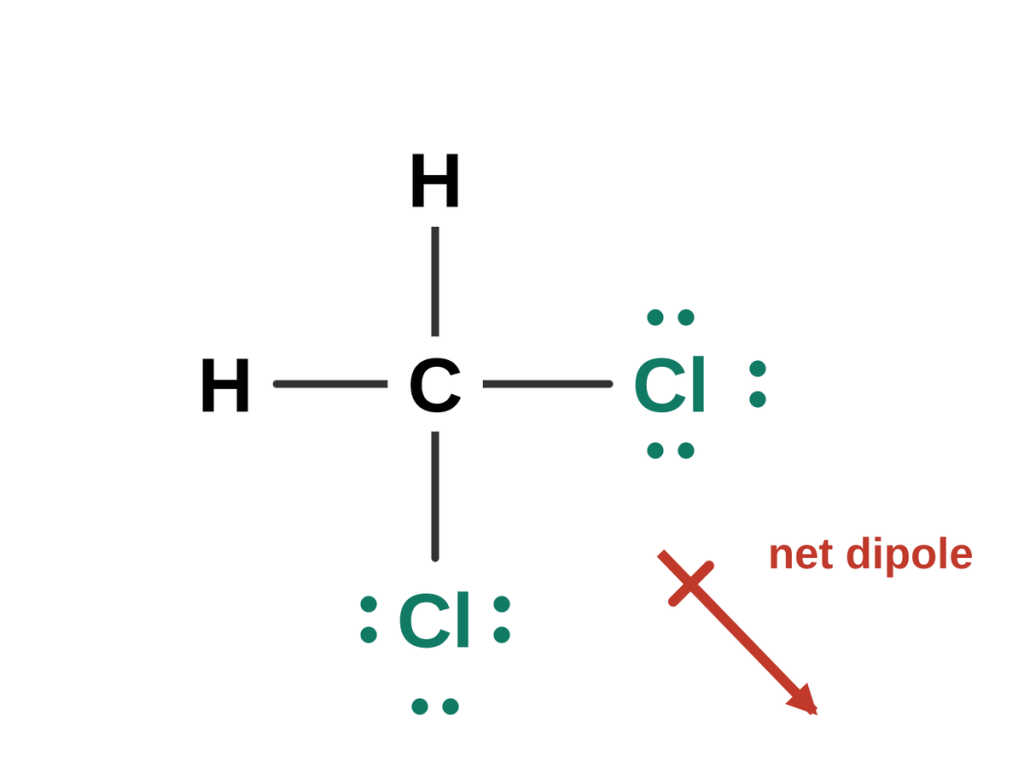
- Lewis structure: C in the center, bonded to two H atoms and two Cl atoms. Each Cl has three lone pairs.
- Shape: 4 electron domains and 0 lone pairs on C → tetrahedral.
- Polarity: the C-Cl bonds are polar, and the atoms around C are not all the same, so the bond dipoles don’t cancel. CH2Cl2 is polar.
- List the IMFs: every molecule has LDF. Polar molecules also have dipole-dipole forces.
- Check for H-bonding: both H atoms are bonded to C, not N, O, or F, so there is no hydrogen bonding.
- Answer: London dispersion forces and dipole-dipole forces
Example 3: Which Can Hydrogen Bond?
Which of these substances can form hydrogen bonds between their own molecules: CH3OCH3, CH3NH2, HF, and CH2O?
- CH3OCH3 (dimethyl ether): H3C-O-CH3. There is an O, but every H is bonded to C. No.
- CH3NH2 (methylamine): H3C-NH2. Two H atoms are bonded directly to N, and N has a lone pair. Yes.
- HF: H is bonded directly to F, and F has three lone pairs. Yes.
- CH2O (formaldehyde): C is double bonded to O, and both H atoms are on C. No.
- Answer: CH3NH2 and HF
- The trap: dimethyl ether and formaldehyde can accept a hydrogen bond from a molecule like water, because their O has lone pairs. They can’t hydrogen bond with themselves, because they have no H on N, O, or F to give.
Example 4: IMFs in a Mixture
Identify the strongest intermolecular force between CH3OH and H2O. Then draw one of these interactions.
- Classify each molecule: both are polar, both have an O-H bond, and both have lone pairs on O.
- List the IMFs: LDF, dipole-dipole, and hydrogen bonding. For these small molecules, hydrogen bonding is the strongest.
- Draw the molecules: methanol (H3C-O-H) with two lone pairs on O, and a bent water molecule with two lone pairs on O.
- Show the hydrogen bond: draw a dashed line from the δ+ H of methanol’s O-H to a lone pair on water’s δ− O. Keep the O-H and the dashed line close to a straight line.
- Answer: hydrogen bonding. Drawing it the other way, with water’s H pointing at methanol’s O, is also correct.
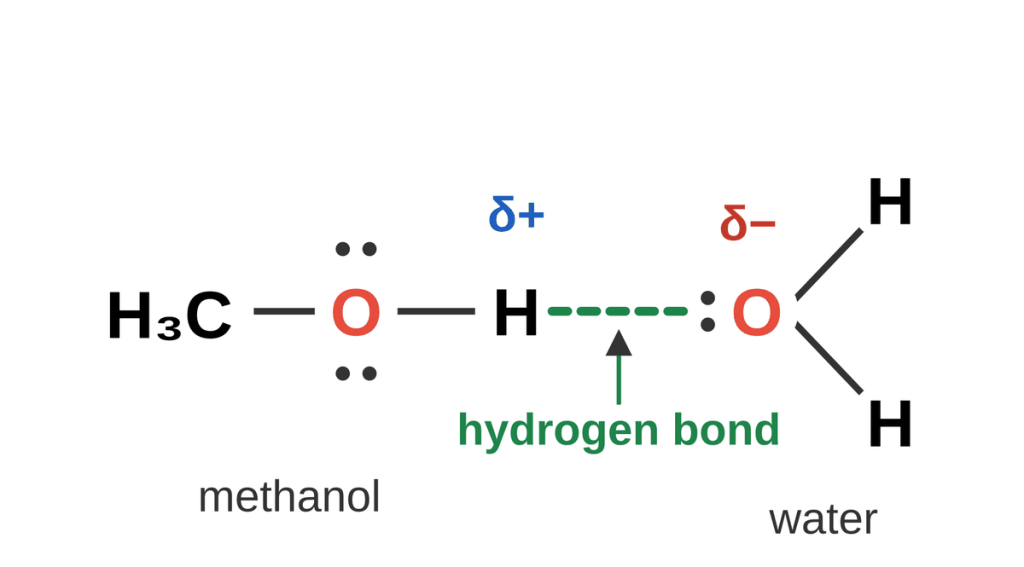
Exam tip: when you draw a hydrogen bond, the H must point at the N, O, or F. An O pointing at an O, or an H pointing at an H, loses the point.
Example 5: Explaining a Trend
HCl is the most polar of these molecules, yet it has the lowest boiling point. Explain this trend.
| Substance | Boiling point |
|---|---|
| HCl | −85 °C |
| HBr | −67 °C |
| HI | −35 °C |
- Identify the IMFs: all three are polar, and none has H on N, O, or F. All three have LDF and dipole-dipole forces.
- Compare dipole-dipole forces: electronegativity decreases from Cl to I, so polarity goes HCl > HBr > HI. If dipole-dipole forces were in control, HCl would boil highest. It boils lowest, so something else is in control.
- Compare LDF: HCl = 1 + 17 = 18 e−, HBr = 1 + 35 = 36 e−, HI = 1 + 53 = 54 e−. More electrons → more polarizable → stronger LDF.
- Decide which force wins: the boiling point rises in the same direction as LDF and opposite to polarity. LDF is the dominant IMF in these molecules.
Sample exam justification: HI has the most electrons, so its electron cloud is the most polarizable and it has the strongest London dispersion forces. The increase in LDF from HCl to HI outweighs the decrease in dipole-dipole forces, so more energy is needed to separate HI molecules, and HI has the highest boiling point.
Big Ideas
- IMFs are Coulombic attractions between molecules, much weaker than bonds.
- Every molecule has LDF. More electrons and more contact area mean stronger LDF.
- Polar molecules add dipole-dipole forces. H on N, O, or F adds hydrogen bonding.
- Ions and polar molecules attract through ion-dipole forces.
- In large molecules, LDF is often the strongest IMF.
Back to the essential question: molecules stick to each other because of Coulombic attractions between partial or full charges, in the form of London dispersion forces, dipole-dipole forces, hydrogen bonding, and ion-dipole forces. Next up, Topic 3.2 uses these forces to explain the properties of different types of solids.

