
The video lesson for this topic is coming soon.
Essential Question
Why do objects keep doing what they’re already doing?
A soccer ball sits still until someone kicks it, and once it’s rolling, it keeps rolling. By the end of this lesson, you should be able to explain inertia, recognize balanced forces and equilibrium, and tell the difference between a scientific law and a theory.
Newton’s First Law
- At rest stays at rest
- Moving keeps the same velocity
- Unless an unbalanced force acts
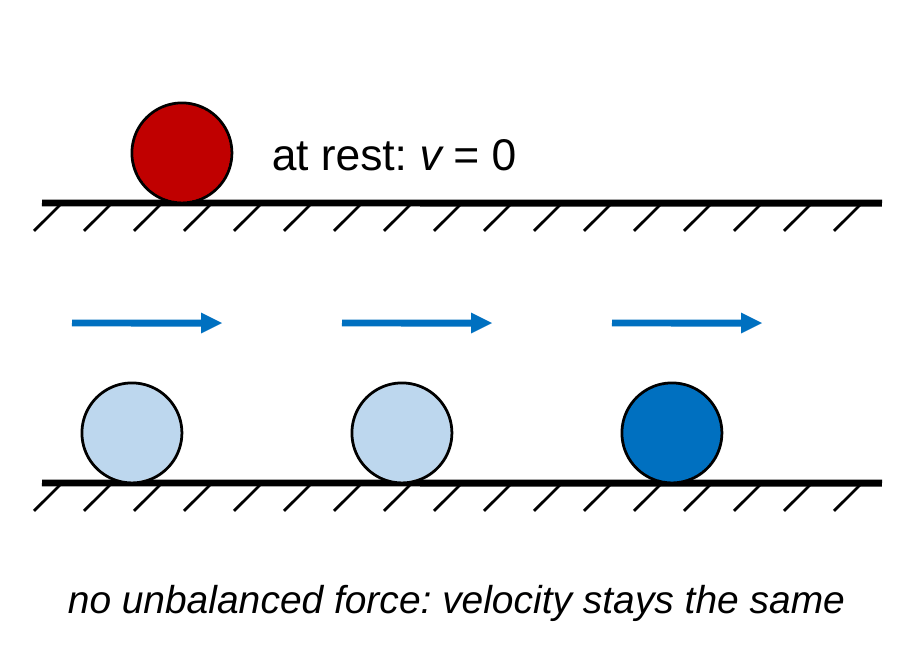
Newton’s first law says an object at rest stays at rest, and an object in motion keeps moving at the same speed in the same direction, unless an unbalanced force acts on it. A ball on the ground won’t start rolling by itself. A puck sliding on smooth ice keeps going in a straight line. Objects don’t need a force to keep moving. They need a force to change how they move.
Inertia
- Resists a change in motion
- More mass, more inertia
- Not a force
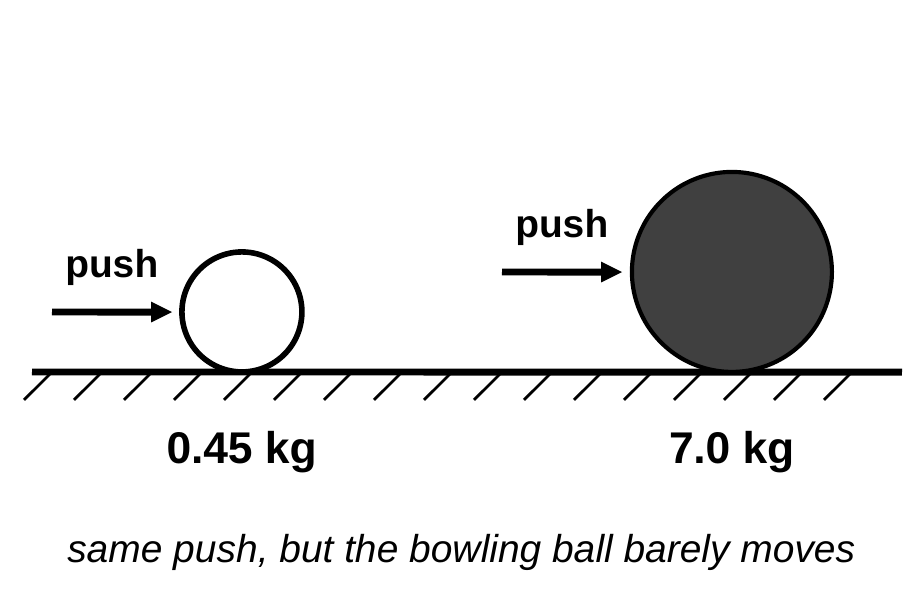
Inertia is an object’s tendency to resist any change in its motion. The more mass an object has, the more inertia it has. Give a soccer ball and a bowling ball the same push, and the soccer ball takes off while the bowling ball barely budges. The bowling ball is also much harder to stop once it’s rolling. Inertia is a property of the object, not a force.
Riding in a Car
- Car brakes: you keep going
- Seat belt pulls you back
- Car turns: you keep going straight
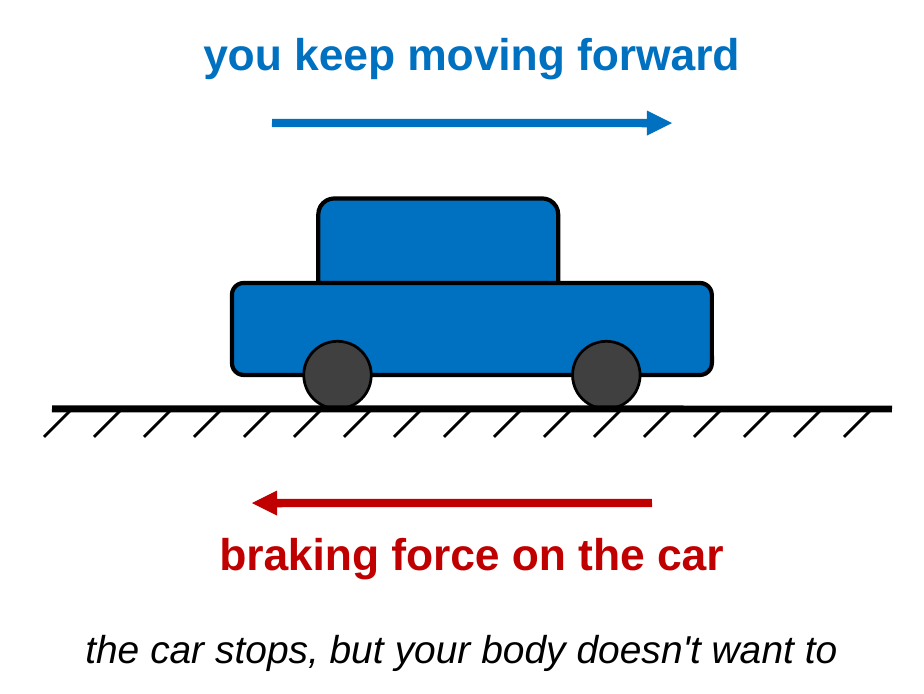
When a car brakes, the brakes and road push backward on the car, so the car slows down. Nothing pushes backward on you at first, so your body’s inertia keeps you moving forward. That’s why you lurch toward the dashboard. A seat belt supplies the backward force that slows you down with the car. In a sharp turn, your body keeps trying to go straight, so you slide toward the outside of the turn.
Objects and Systems
- Object: one thing we study
- System: a group of objects
- We choose the boundary
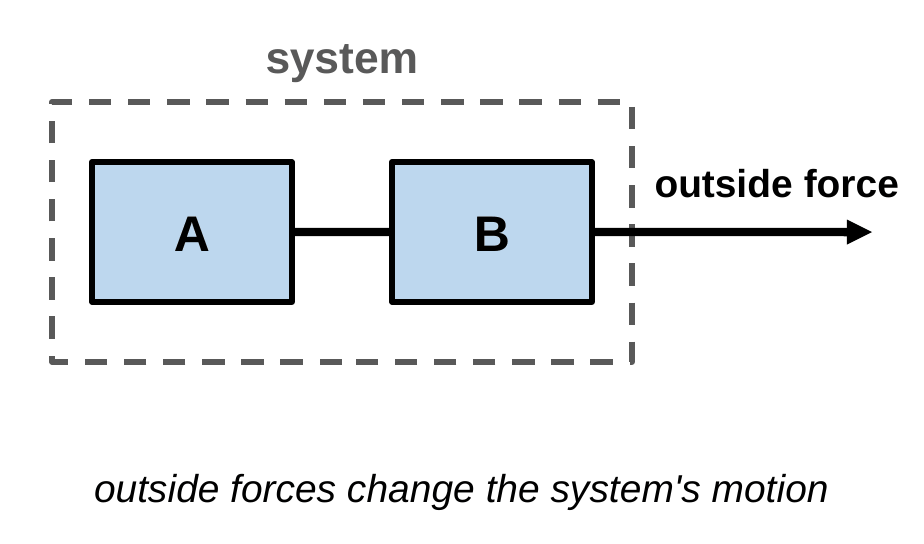
Before we look at forces, we decide what we’re studying. An object is a single thing, like one block. A system is a group of objects we treat as one, like both blocks together. Forces between objects inside the system, like the link pulling A and B together, don’t change the motion of the whole system. Only forces from outside the system do.
Balanced Forces
- Equal size, opposite directions
- They cancel out
- Velocity does not change
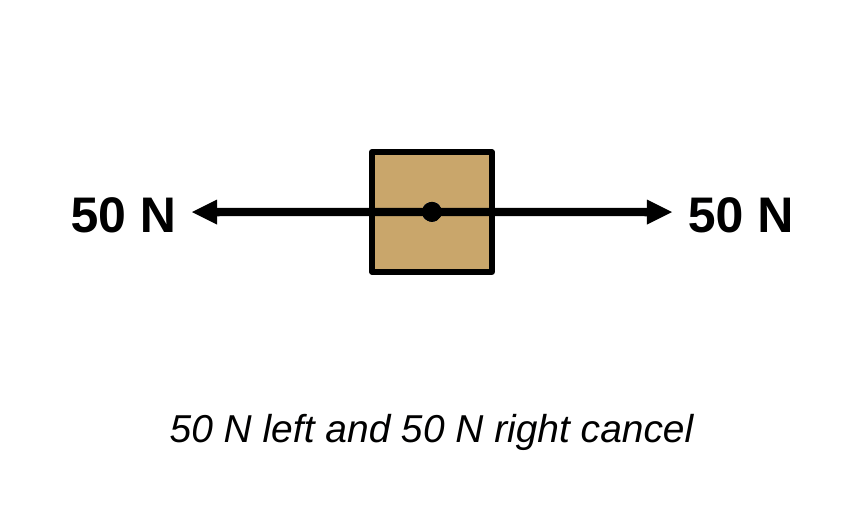
When two forces on an object are the same size and point in opposite directions, they cancel out. We call them balanced forces. Here, a 50 N pull to the left and a 50 N pull to the right add up to zero, just like a tug-of-war where neither team wins. Balanced forces cannot change an object’s velocity.
Equilibrium
- Balanced forces: equilibrium
- Can be at rest
- Can move at constant velocity
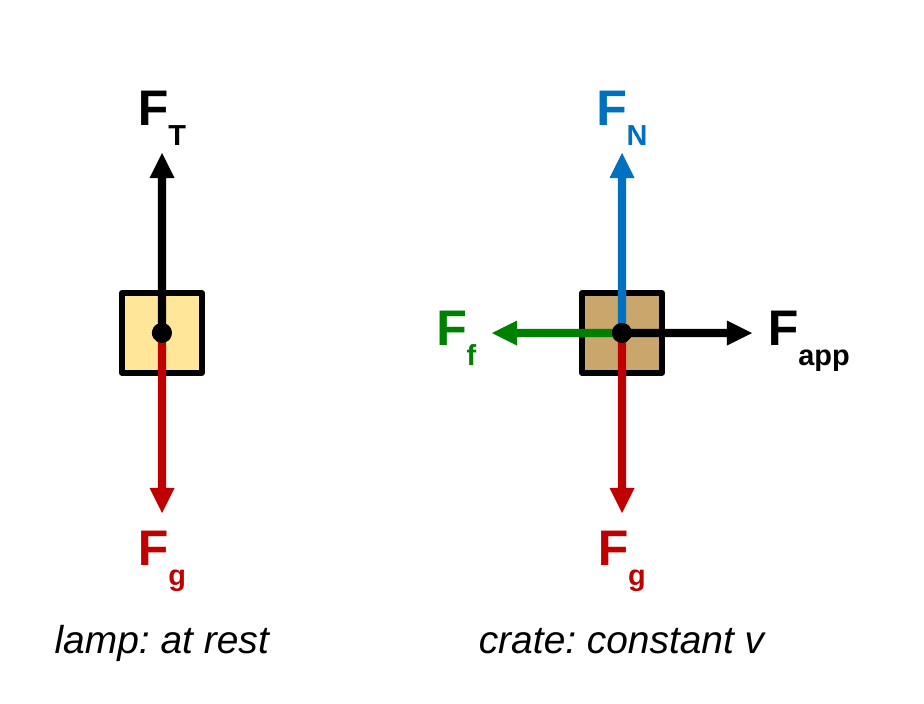
An object with balanced forces is in equilibrium. Equilibrium does not only mean sitting still. A hanging lamp at rest is in equilibrium, because the upward pull of the cord (FT) balances its weight (Fg). A crate pushed across the floor at a constant velocity is also in equilibrium, because the push (Fapp) balances friction (Ff), and the floor’s upward push (FN) balances its weight.
Laws vs. Theories
- Law: describes what happens
- Theory: explains why
- A theory never becomes a law
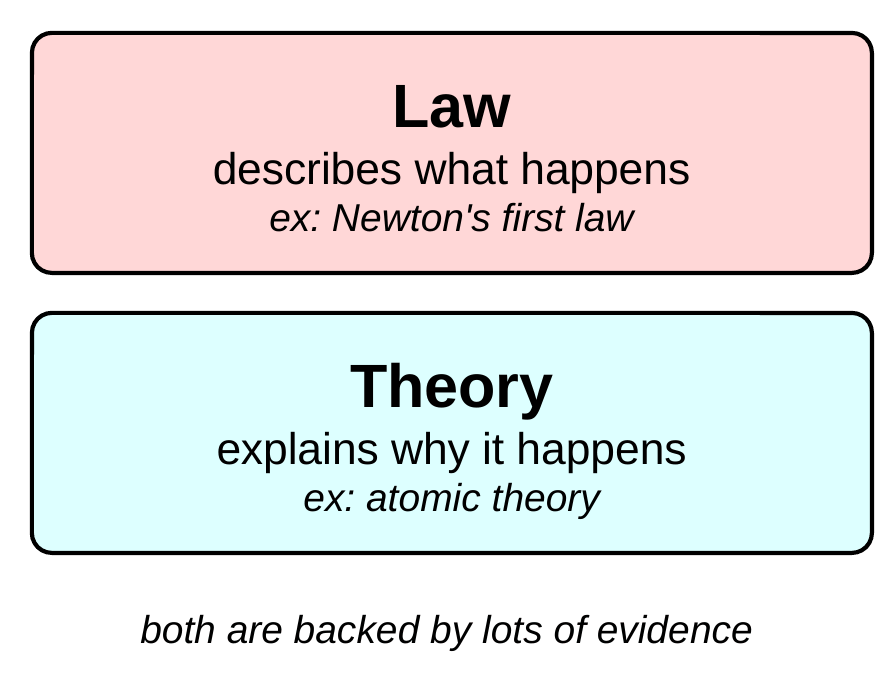
In science, a law describes what happens, often as a rule or an equation. Newton’s first law describes how objects move when forces are balanced. A theory explains why something happens. Atomic theory explains the behavior of matter using atoms. Both are supported by lots of evidence. A theory does not “graduate” into a law when it gets enough proof. They are different kinds of ideas that do different jobs.
Worked Examples
Try each problem on your own first, then check your work against the solution.
Example 1: The Tablecloth Trick
A magician yanks a tablecloth out from under a set of dishes. The dishes barely move. Use inertia to explain why.
- Starting motion: The dishes start at rest.
- Forces: The cloth slides out so fast that friction acts on the dishes for only a split second.
- Inertia: The dishes resist any change in their motion, and that tiny, brief force can’t change their velocity much.
- Answer: The dishes’ inertia keeps them at rest, because no large unbalanced force acts on them for long enough to get them moving.
Heavier dishes work even better, because more mass means more inertia.
Example 2: A Hanging Lamp
A 24 N lamp hangs at rest from a cord. What force does the cord exert on the lamp?
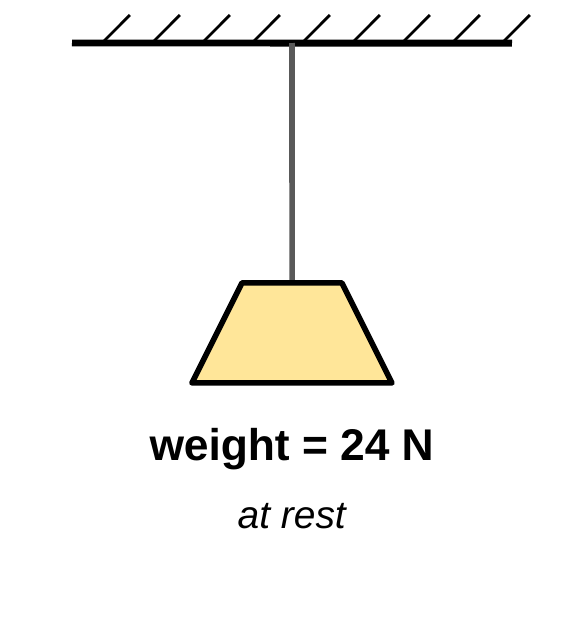
- Knowns: Fg = 24 N down. The lamp is at rest.
- Equilibrium: At rest means the forces are balanced, so the upward force must equal the downward force.
- Equation: FT = Fg
- Answer: FT = 24 N up
Example 3: Constant Velocity Crate
A worker pushes a crate east with a 135 N force. The crate slides across the floor at a constant velocity. What is the friction force on the crate?
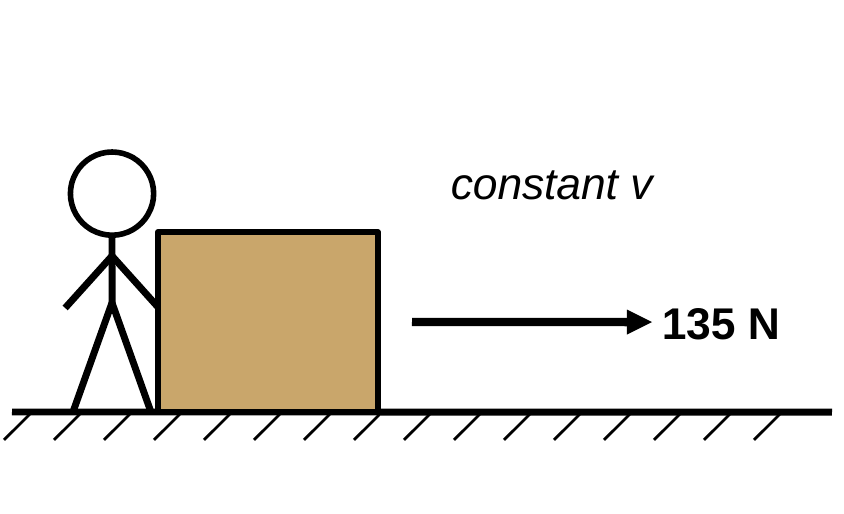
- Knowns: Fapp = 135 N east. Constant velocity.
- Equilibrium: Constant velocity means the forces are balanced.
- Equation: Ff = Fapp, pointing the opposite way
- Answer: Ff = 135 N west
A common mistake is thinking the push must be bigger than friction to keep the crate moving. At constant velocity, the forces are exactly equal.
Example 4: Which Has More Inertia?
A 1,200 kg car is parked. A 65 kg cyclist rides past at 8.0 m/s. Which one has more inertia? Explain.
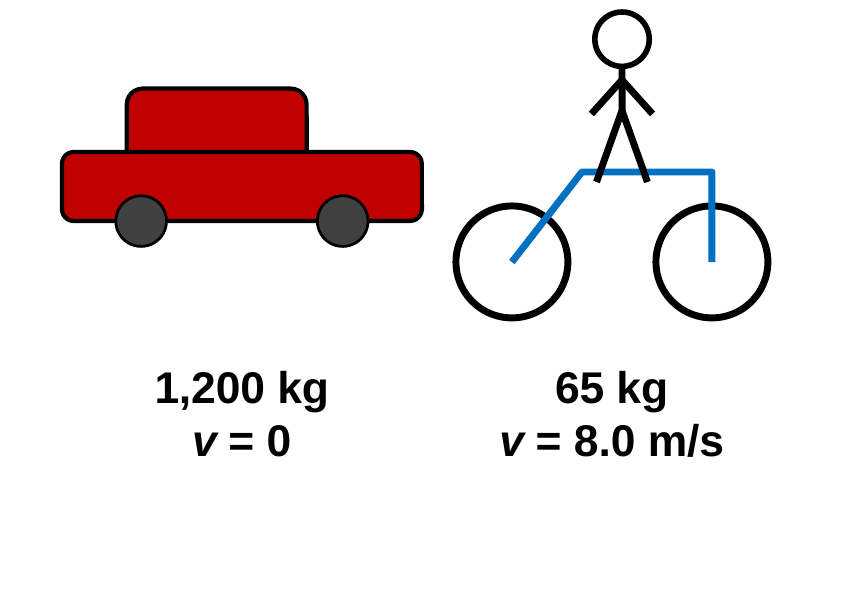
- Knowns: car: m = 1,200 kg, at rest. Cyclist: m = 65 kg, moving at 8.0 m/s.
- What decides inertia: Inertia depends only on mass. Speed does not matter.
- Compare: 1,200 kg ÷ 65 kg ≈ 18, so the car has about 18 times more mass.
- Answer: The parked car has more inertia, because it has much more mass.
Big Ideas
- No unbalanced force: velocity stays the same
- Inertia resists change; more mass, more inertia
- Equilibrium: at rest or constant velocity
- Laws describe; theories explain
Back to the essential question: objects keep doing what they’re already doing because of inertia. With no unbalanced force, an object at rest stays at rest, and a moving object keeps the same velocity. More mass means more inertia. Next up, we’ll look at the different types of forces that act on everyday objects.

