
The video lesson for this topic is coming soon.
Essential Question
What pushes and pulls act on everyday objects?
Last lesson, we saw that an unbalanced force is what changes an object’s motion. By the end of this lesson, you should be able to name the common forces, tell what causes each one, and sort them into contact forces and long-range forces.
What Is a Force?
- A push or a pull
- Has size and direction
- Measured in newtons (N)
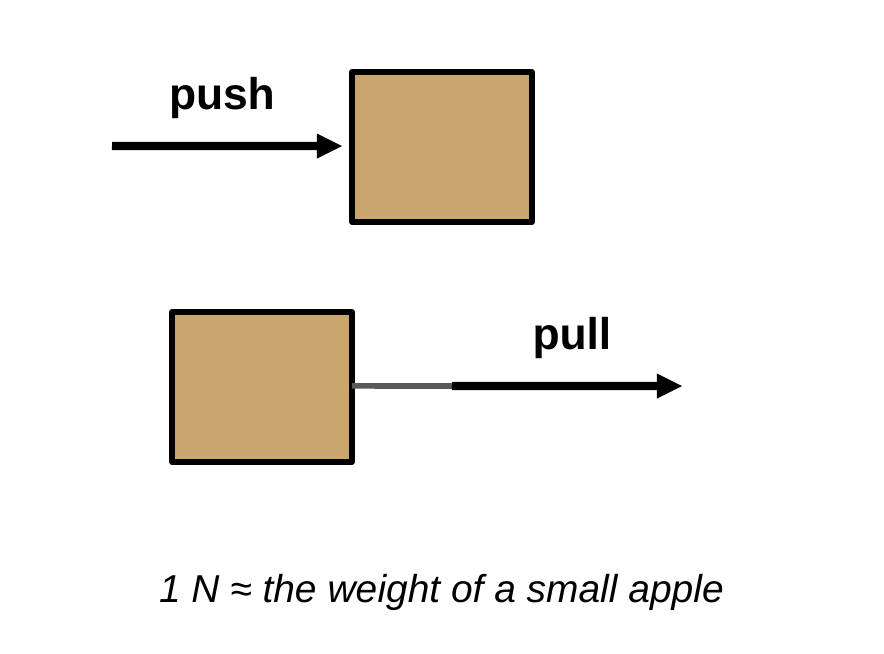
A force is a push or a pull on an object. Force is a vector, so it has a size and a direction. We measure force in newtons (N). One newton is about the weight of a small apple sitting in your hand.
Contact vs. Long-Range
- Contact: objects must touch
- Long-range: act across a gap
- Gravity works without touching
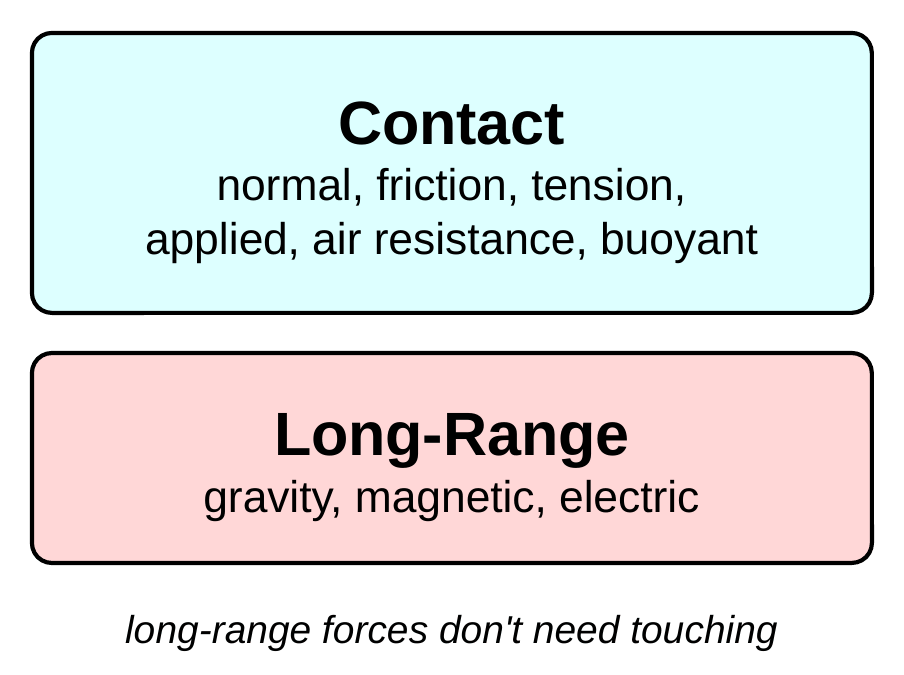
Contact forces only act when two objects touch. Normal force, friction, tension, applied force, air resistance, and buoyant force are all contact forces. Long-range forces (also called field forces) act across empty space. Gravity is the one you feel every day, and magnetic and electric forces are long-range too.
Gravitational Force
- Earth pulls objects toward it
- Also called weight
- Symbol: Fg
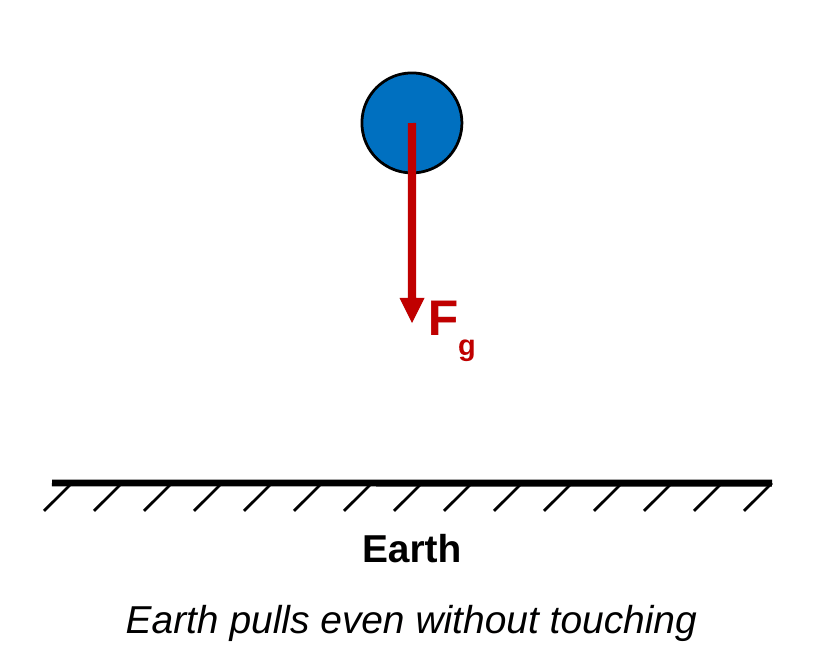
The gravitational force is the pull of Earth on an object. We also call it the object’s weight, and we write it as Fg. Gravity is a long-range force, so it acts even when the object isn’t touching the ground. Near Earth, it always points straight down, toward the center of Earth.
Normal Force
- A surface pushes on an object
- Perpendicular to the surface
- Symbol: FN
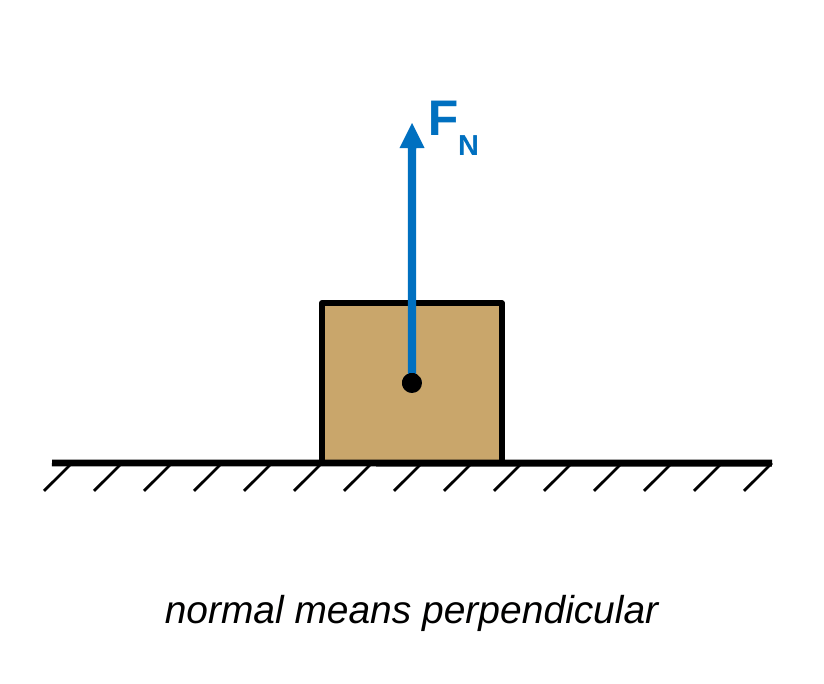
When an object presses on a surface, the surface pushes back. That push is the normal force, FN. In math, “normal” means perpendicular, so the normal force always points straight out of the surface at a 90° angle. For a box on a flat floor, the normal force points straight up.
Friction
- Opposes sliding
- Parallel to the surface
- Symbol: Ff
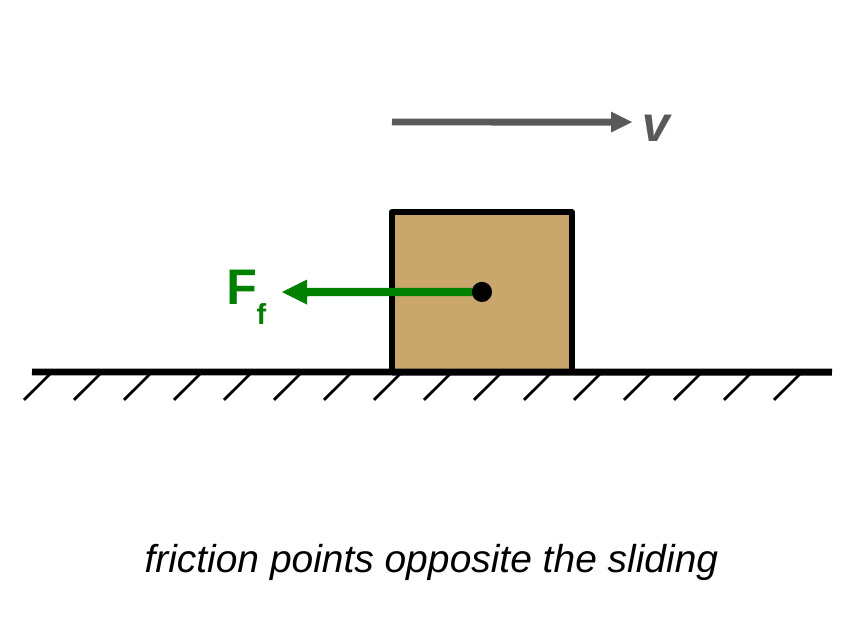
Friction, Ff, is the force a surface exerts on an object that slides (or tries to slide) across it. Friction acts parallel to the surface and points opposite the sliding. If a box slides to the right, friction on the box points to the left. Rougher surfaces and heavier objects usually mean more friction.
Tension
- A pull through a rope or cable
- Always pulls, never pushes
- Symbol: FT
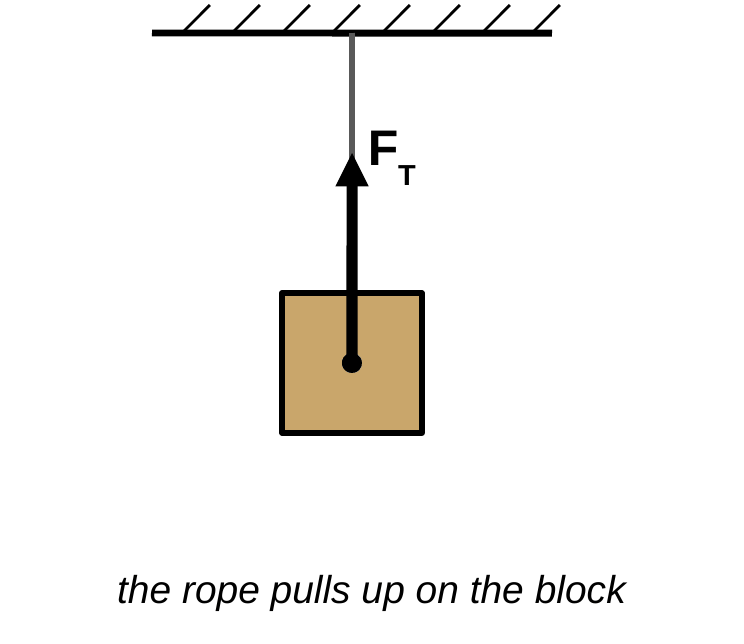
Tension, FT, is the pulling force from a rope, string, chain, or cable. Tension always pulls along the rope, away from the object. A rope can’t push. Try pushing something with a piece of string and you’ll see why.
Applied Force
- A push or pull you apply
- A contact force
- Symbol: Fapp
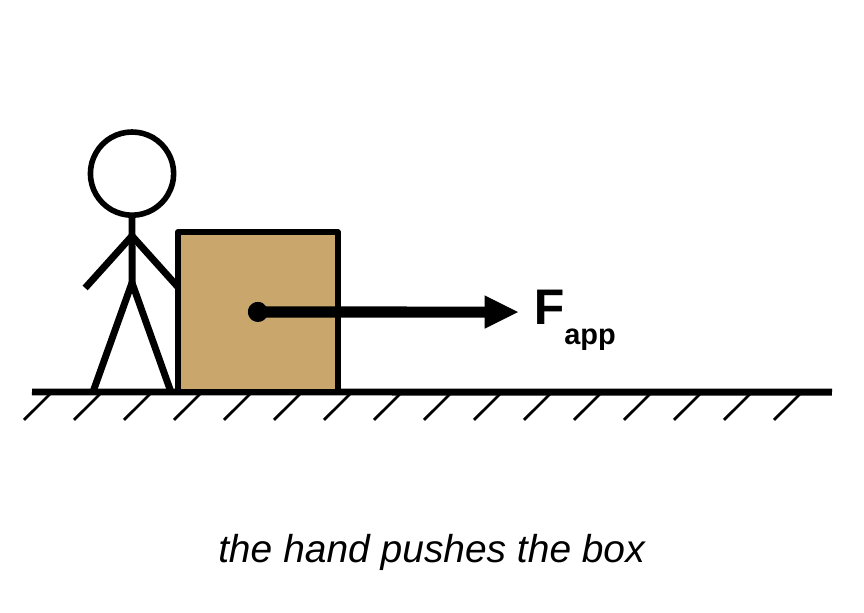
An applied force, Fapp, is a push or pull that a person or another object puts directly on something, like your hand pushing a box, a foot kicking a ball, or a bat hitting a baseball. It points in whatever direction the push or pull goes.
Air Resistance and Buoyancy
- Air resistance opposes motion through air
- Buoyant force: a fluid pushes up
- Both are contact forces
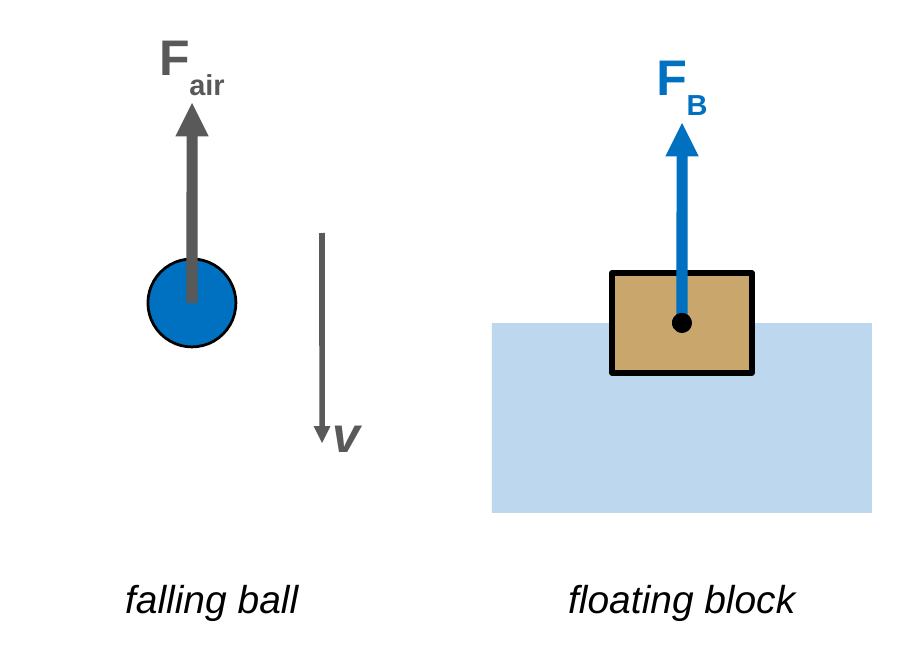
Air resistance is the push of air against an object moving through it. It points opposite the motion, so on a falling ball it points up. It’s really a kind of friction with the air. The buoyant force, FB, is the upward push a fluid like water or air gives an object sitting in it. It’s what keeps boats floating and helium balloons rising.
Worked Examples
Try each problem on your own first, then check your work against the solution.
Example 1: Book on a Desk
A book rests on a desk. Name each force acting on the book, what exerts it, and its direction.
- Contact forces: Only the desk touches the book. The desk pushes up on it, so there is a normal force.
- Long-range forces: Earth pulls down on the book with gravity.
- Anything else?: Nothing pushes, pulls, or slides the book, so there is no applied force or friction.
- Answer: Gravity (Fg), exerted by Earth, pointing down, and the normal force (FN), exerted by the desk, pointing up.
Example 2: Flying a Kite
A kite flies on a string on a windy day. List the forces on the kite. Is each one a contact force or a long-range force?
- Gravity: Earth pulls the kite down. This is a long-range force.
- Tension: The string pulls the kite toward the person. The string touches the kite, so this is a contact force.
- Air: The moving air pushes on the kite. Air touches the kite, so this is a contact force.
- Answer: Three forces: gravity (long-range), tension (contact), and the push of the wind (contact).
Example 3: Pulling a Sled
A child pulls a sled across flat snow with a horizontal rope. Name the four forces on the sled and the direction of each.
- Gravity: Earth pulls the sled down (Fg).
- Normal force: The snow pushes the sled up (FN).
- Tension: The rope pulls the sled forward, toward the child (FT).
- Friction: The snow rubs on the sliding sled, pointing backward, opposite the motion (Ff).
Example 4: Name That Force
Name the main force described in each case: (a) a parachute slowing a skydiver (b) a cable holding up an elevator (c) water holding up a boat
- (a) Parachute: The air pushes up against the falling parachute: air resistance.
- (b) Elevator cable: A cable pulls up on the elevator: tension.
- (c) Boat: The water pushes up on the boat: buoyant force.
Big Ideas
- Force: a push or pull, measured in newtons (N)
- Contact forces need touching; long-range forces don’t
- Contact: FN, Ff, FT, Fapp, air, buoyant
- Long-range: gravity, Fg
Back to the essential question: everyday objects feel contact forces like the normal force, friction, tension, applied forces, air resistance, and buoyant force, plus the long-range pull of gravity. Next up, we’ll learn to show all of these forces at once with free-body diagrams.

