
The video lesson for this topic is coming soon.
Essential Question
How strong is the push or pull between two charges?
Like charges repel and opposite charges attract, but how hard do they push or pull? By the end of this lesson, you should be able to use Coulomb’s law to find the electric force between two charges, and to solve for a charge or a distance when the force is known.
The Electric Force Equation
Fe = kq1q2 / d2
- Fe = electric force, in newtons (N)
- k = Coulomb’s constant, 9.0 × 10⁹ N·m2/C2
- q1, q2 = the two charges, in coulombs (C)
- d = distance between the centers of the charges, in meters (m)
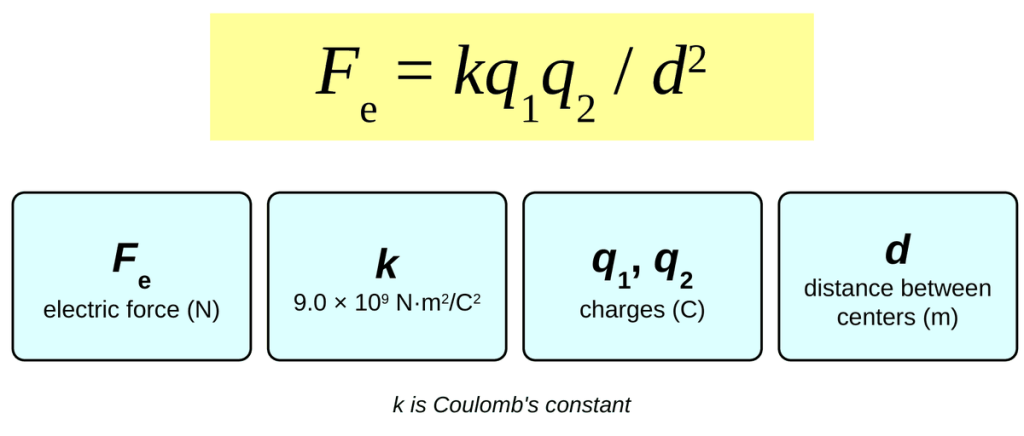
Coulomb’s law gives the size of the electric force between two charges. The constant k is huge, which tells you electric forces can be very strong even for small charges. The units of k are chosen so that coulombs and meters cancel, leaving newtons.
More Charge, More Force
- Force depends on both charges
- Double one charge: 2× force
- Double both: 4× force
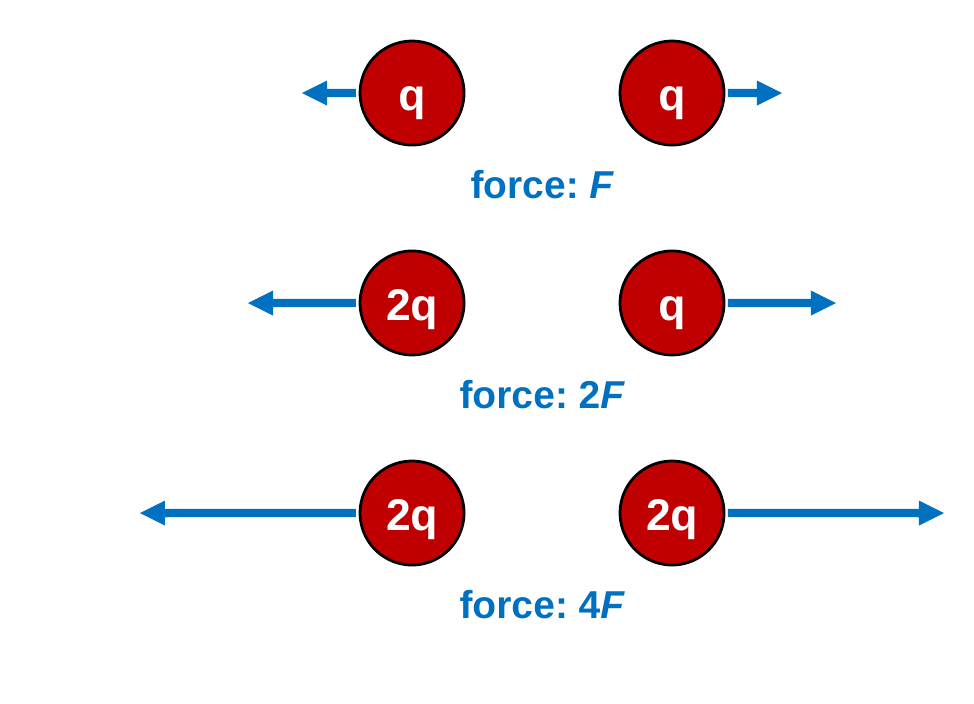
The force is proportional to each charge. If you double one charge, the force doubles. If you double both charges, the force doubles twice, so it becomes 4 times as large. Notice that the two arrows in each pair are always equal in size. Each charge pushes on the other just as hard, which is Newton’s third law.
Inverse Square Law
- Force drops fast with distance
- Double d: ¼ the force
- Triple d: 1/9 the force
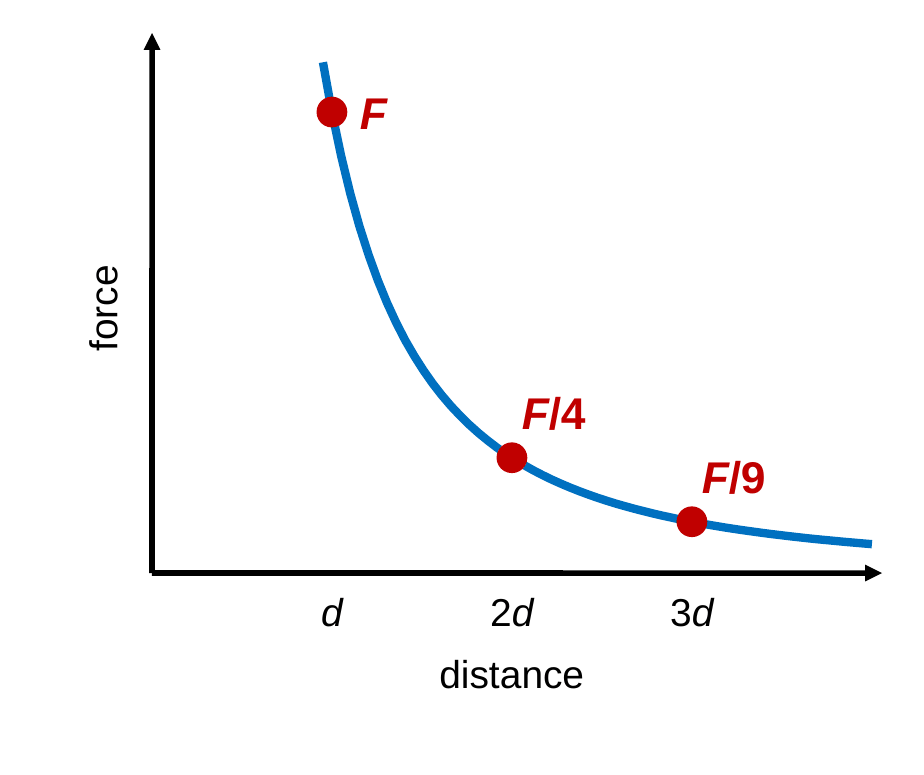
The distance is squared in the bottom of the fraction, so the force drops off quickly as charges move apart. This is called an inverse square law. Doubling the distance makes the force 22 = 4 times smaller. Tripling the distance makes it 32 = 9 times smaller. Cutting the distance in half makes the force 4 times bigger.
Direction of the Force
- Like charges: repel
- Opposite charges: attract
- Plug in sizes, not signs
- Use the signs for direction
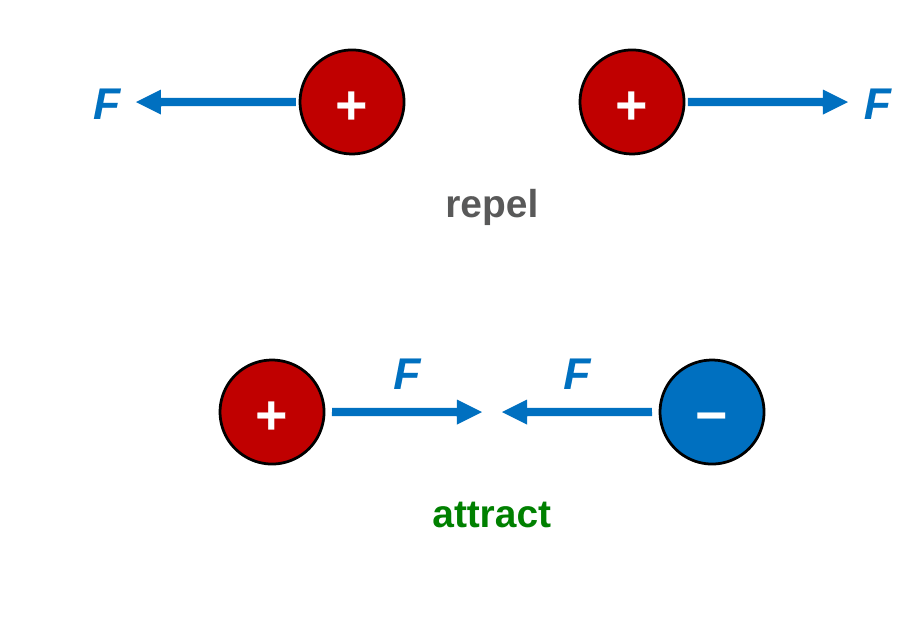
Coulomb’s law gives the size of the force. To find its direction, look at the signs. Like charges repel, so each one is pushed away from the other. Opposite charges attract, so each one is pulled toward the other. Plug in the sizes of the charges without their signs, then state the direction in words.
Scientific Notation Tips
- Multiply: add exponents
- Divide: subtract exponents
- Square: double the exponent
- Use the EE or ×10x key
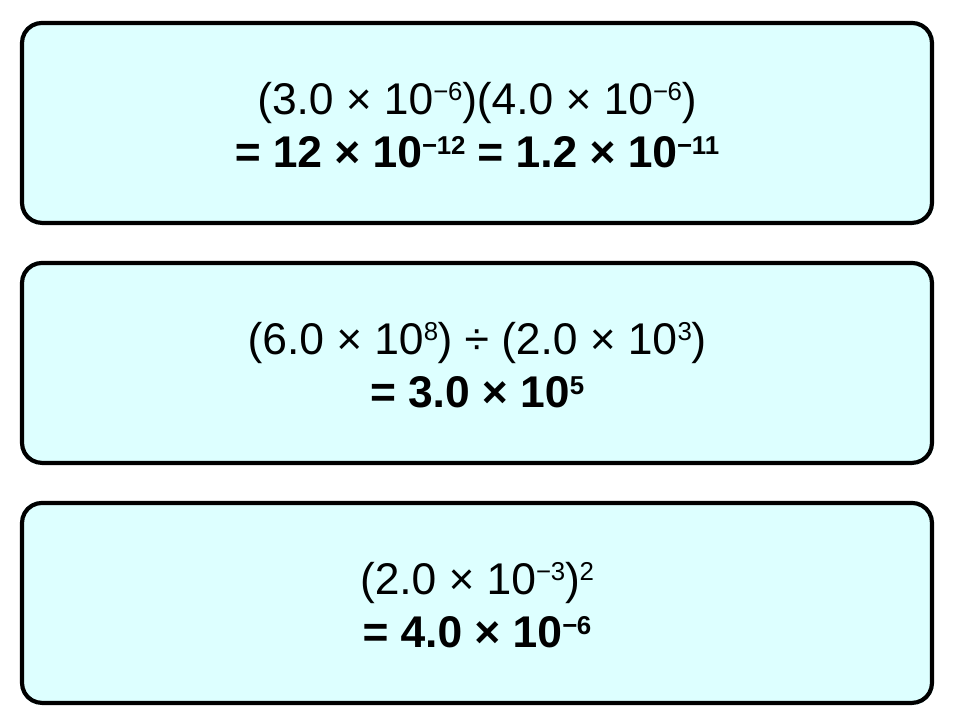
Charges in coulombs are usually tiny and k is huge, so Coulomb’s law problems are full of scientific notation. To multiply, multiply the front numbers and add the exponents. To divide, divide the front numbers and subtract the exponents. To square, square the front number and double the exponent. On a calculator, type the power of ten with the EE or ×10x key, not with “× 10 ^”, so the calculator keeps each number together.
Worked Examples
Try each problem on your own first, then check your work against the solution.
Example 1: Finding the Force
A charge of +3.0 × 10⁻⁶ C is 0.20 m from a charge of −4.0 × 10⁻⁶ C. What is the electric force between them?
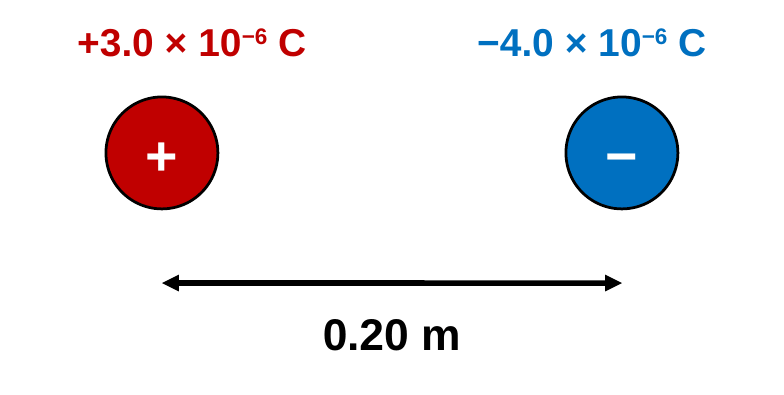
- Knowns: q1 = 3.0 × 10⁻⁶ C, q2 = 4.0 × 10⁻⁶ C (sizes only), d = 0.20 m, k = 9.0 × 10⁹ N·m2/C2
- Equation: Fe = kq1q2/d2
- Substitute: Fe = (9.0 × 10⁹ N·m2/C2)(3.0 × 10−6 C)(4.0 × 10⁻⁶ C) / (0.20 m)2
- Top: 9.0 × 3.0 × 4.0 = 108 and 109 × 10−6 × 10−6 = 10−3, so the top is 0.108 N·m2
- Bottom: (0.20 m)2 = 0.040 m2
- Answer: Fe = 0.108 ÷ 0.040 = 2.7 N, attractive (opposite charges pull toward each other)
Example 2: Finding the Distance
Two charges of +2.0 × 10⁻⁶ C each repel with a force of 3.6 N. How far apart are they?
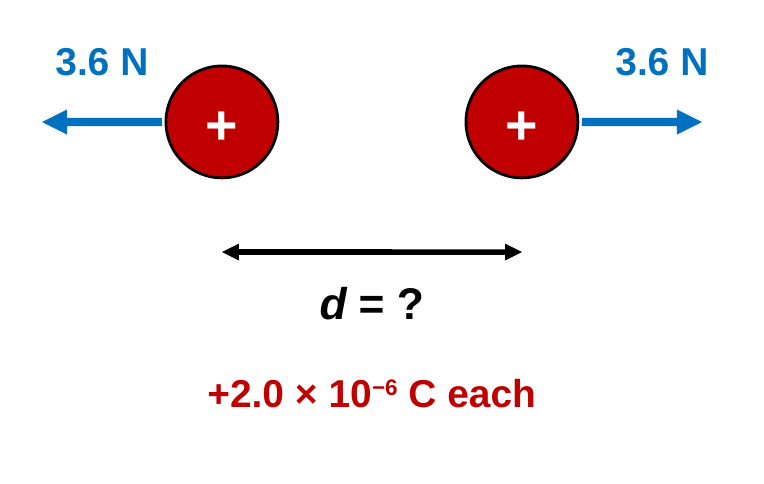
- Knowns: q1 = q2 = 2.0 × 10⁻⁶ C, Fe = 3.6 N, k = 9.0 × 10⁹ N·m2/C2
- Rearrange: Fe = kq1q2/d2, so d2 = kq1q2/Fe
- Substitute: d2 = (9.0 × 10⁹)(2.0 × 10⁻⁶)(2.0 × 10⁻⁶) / 3.6 = 0.036 / 3.6
- Simplify: d2 = 0.010 m2
- Answer: d = √(0.010 m2) = 0.10 m
Example 3: Finding a Charge
Two identical charges are 0.30 m apart and repel with a force of 0.40 N. What is the size of each charge?
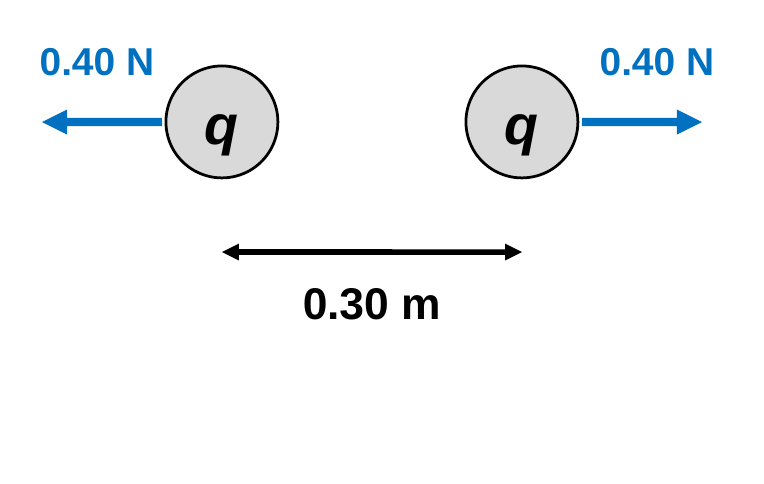
- Knowns: q1 = q2 = q, d = 0.30 m, Fe = 0.40 N, k = 9.0 × 10⁹ N·m2/C2
- Rearrange: Fe = kq2/d2, so q2 = Fed2/k
- Substitute: q2 = (0.40 N)(0.30 m)2 / (9.0 × 10⁹ N·m2/C2) = 0.036 / (9.0 × 10⁹)
- Simplify: q2 = 4.0 × 10⁻¹² C2
- Answer: q = √(4.0 × 10⁻¹² C2) = 2.0 × 10⁻⁶ C on each. They repel, so they have the same sign, but we can’t tell if both are + or both are −.
Example 4: Changing the Distance
Two charged spheres push on each other with a force of 18 N. If the distance between them is tripled, what is the new force?
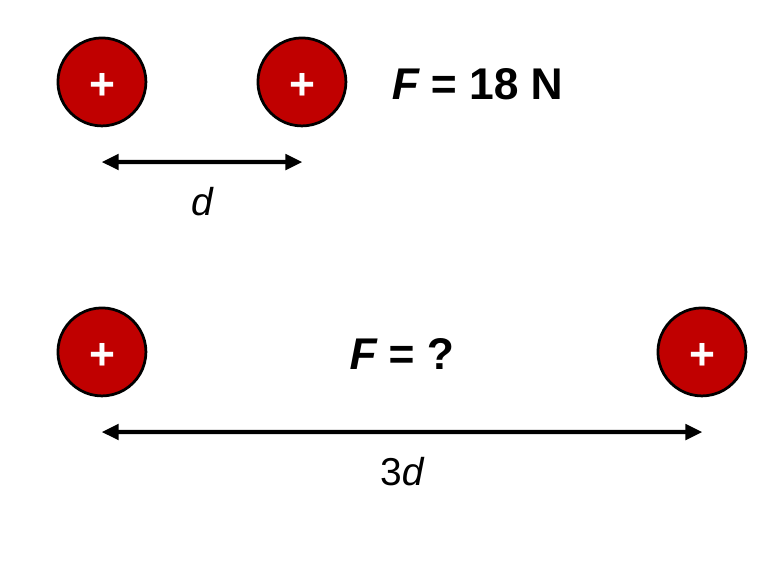
- Pattern: force depends on 1/d2, so tripling d divides the force by 32 = 9
- Set up: Fnew = 18 N ÷ 9
- Answer: Fnew = 2.0 N
Common mistake: dividing by 3 instead of 9. Distance is squared, so its effect is squared too.
Big Ideas
- Fe = kq1q2/d2, k = 9.0 × 10⁹ N·m2/C2
- More charge, more force
- Inverse square: 2× distance, ¼ force
- Like charges repel, opposites attract
Back to the essential question: the strength of the push or pull between two charges is given by Coulomb’s law, Fe = kq1q2/d2. The force grows with the size of each charge and drops with the square of the distance. Like charges repel and opposite charges attract. Next up, Electric Fields explains how a charge can push on something it never touches.

