
The video lesson for this topic is coming soon.
Essential Question
How can a charge push on something it never touches?
In Coulomb’s law, charges push and pull on each other across empty space, without touching. By the end of this lesson, you should be able to explain what an electric field is, draw field lines for single charges and pairs, and use E = F/q to find field strength and the force on a charge.
What Is a Field?
- A value at every point
- Like a temperature map
- Electric field: a force at every point
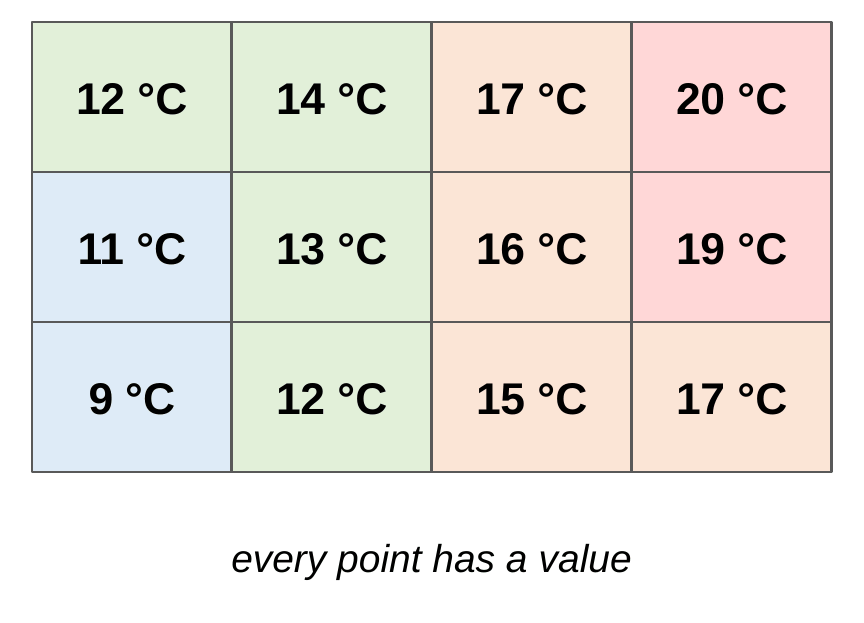
A field gives a value to every point in space. A weather map is a good example: every spot on the map has a temperature. An electric field works the same way, except the value at each point is the force a charge would feel there, which has both a size and a direction. A charge creates an electric field around itself, and any other charge placed in that field gets pushed or pulled by it. That’s how charges affect each other without touching.
Electric Field Lines
- Point away from + charges
- Point toward − charges
- Closer lines = stronger field
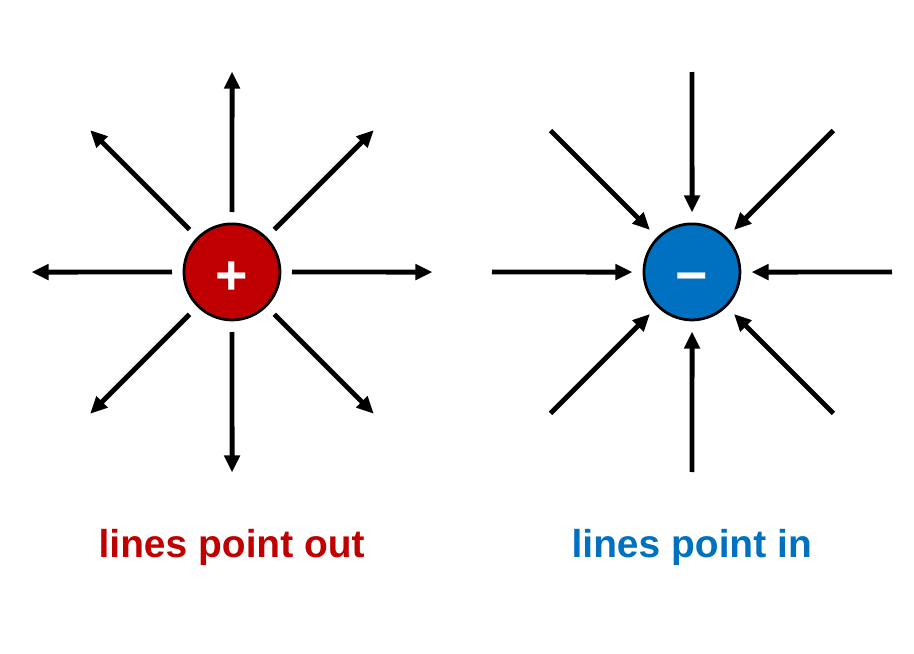
We draw an electric field with field lines. The arrows show the direction a positive charge would be pushed. A positive charge pushes other positive charges away, so its field lines point outward. A negative charge pulls positive charges in, so its field lines point inward. Near the charge the lines are crowded together, where the field is strong. Farther away they spread out, where the field is weaker.
Opposite Charges
- Lines start on + and end on −
- Lines never cross
- Field is strongest between them
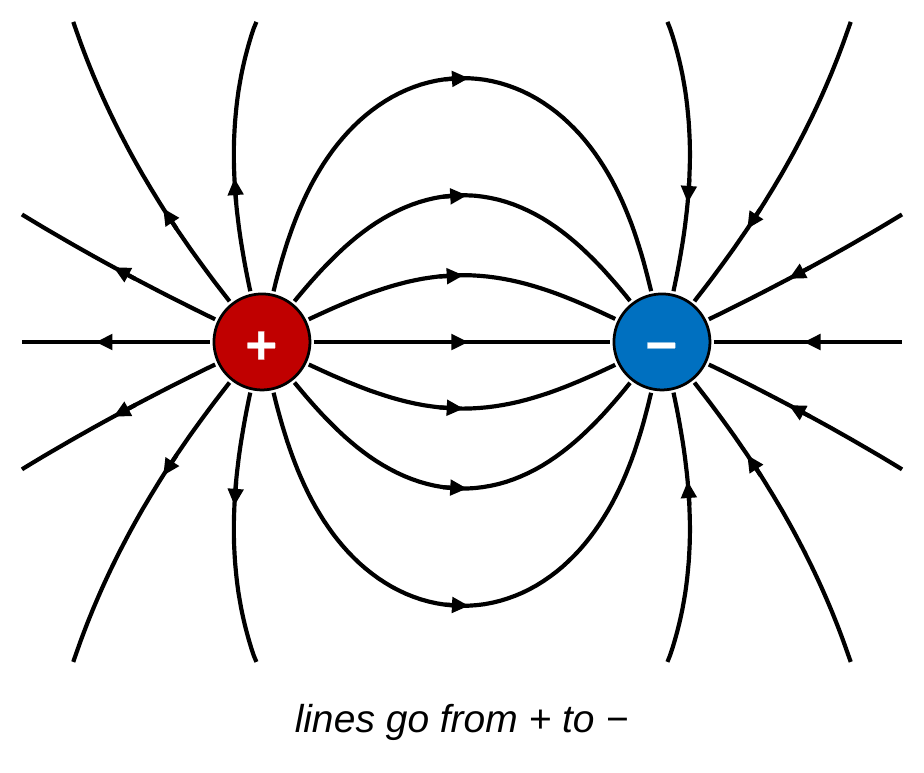
When a positive and a negative charge are near each other, field lines leave the positive charge and curve around to end on the negative charge. The arrows still point away from + and toward −. Field lines never cross, because the field can only point in one direction at each point. The lines are crowded between the charges, so the field is strongest there.
Like Charges
- All lines point outward
- Lines bend away from each other
- Zero field at the midpoint
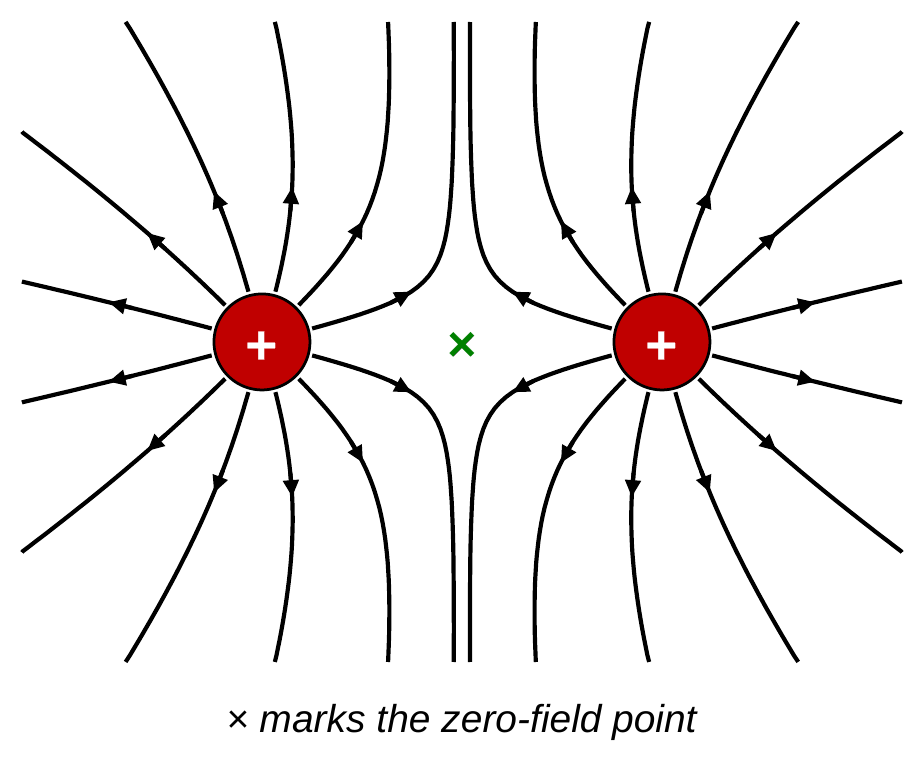
With two positive charges, every field line points outward, away from both charges. The lines between the charges bend away from each other, as if the two fields are pushing apart. Exactly halfway between two equal charges, the two pushes cancel, so the field there is zero. A charge placed at that point would feel no force.
Field Strength
E = F / q
- E = electric field strength, in newtons per coulomb (N/C)
- F = force on the test charge, in newtons (N)
- q = test charge, in coulombs (C)
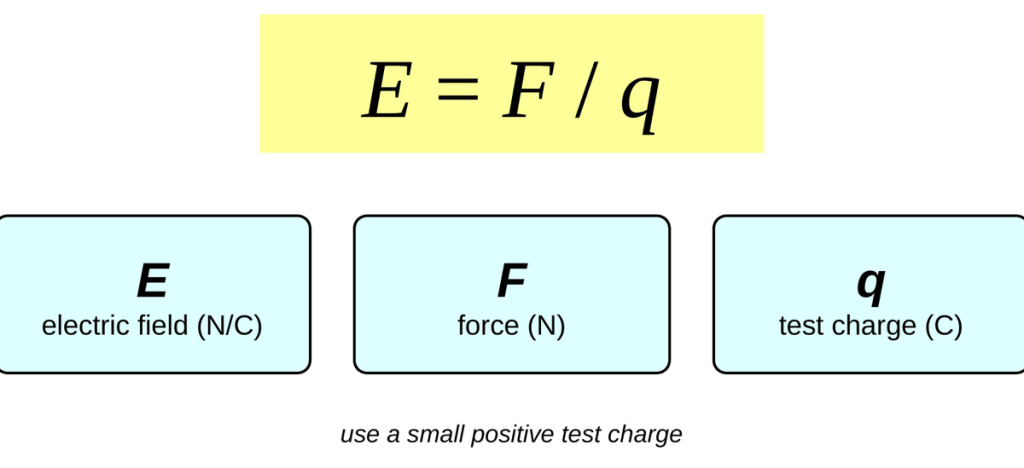
To measure a field, place a small positive test charge at a point and measure the force on it. Dividing the force by the charge gives the field strength: how many newtons of force each coulomb of charge would feel there. The direction of the field is the direction of the force on a positive test charge.
Force from a Field
- F = qE
- + charge: force along the field
- − charge: force against the field
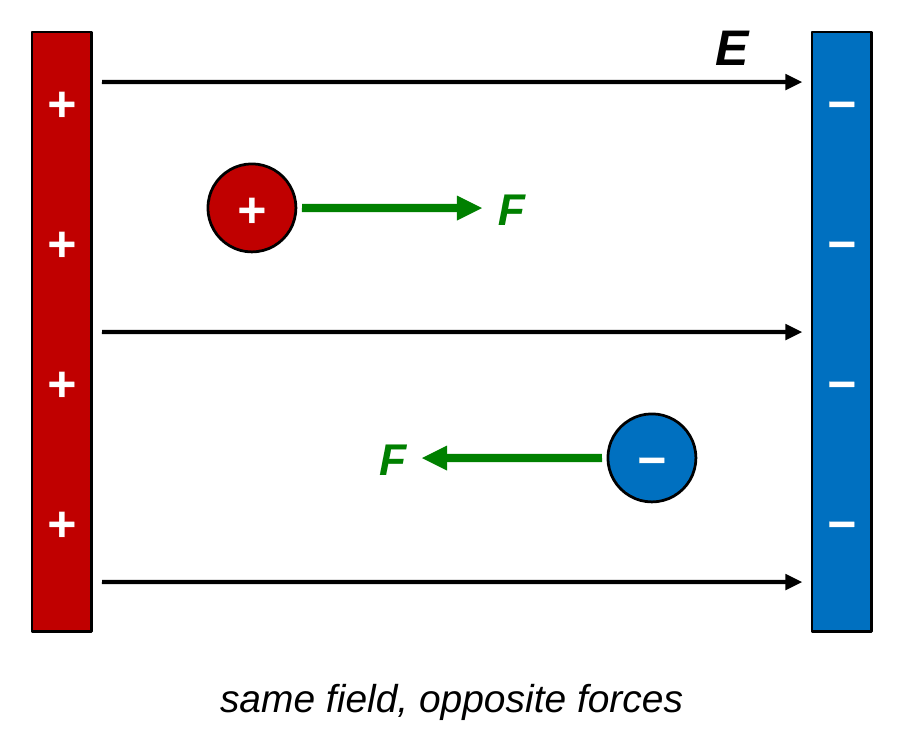
Rearranging E = F/q gives F = qE, the force on any charge in a field. Between a positive plate and a negative plate, the field points from + to −. A positive charge is pushed in the same direction as the field. A negative charge, such as an electron, is pushed in the opposite direction. The size of the force is the size of the charge times the field strength.
Energy in the Field
- Fields can store energy
- Work against force: energy stored
- Let go: stored energy → motion
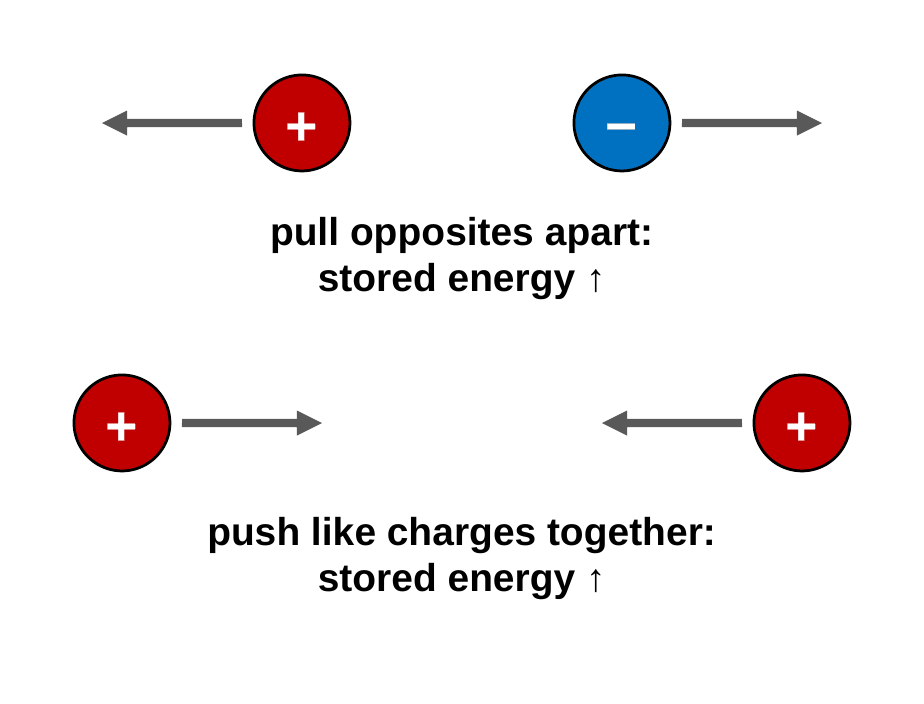
A field can store energy, a lot like a stretched rubber band or a squeezed spring. Pulling a positive and a negative charge apart takes work, because they attract, and that work is stored in the field. Pushing two like charges together also takes work, because they repel, so that also stores energy. When you let go, the charges speed up and the stored energy turns into kinetic energy.
Worked Examples
Try each problem on your own first, then check your work against the solution.
Example 1: Finding the Field
A +2.0 × 10⁻⁶ C test charge feels a force of 0.050 N east. What is the electric field at that point?
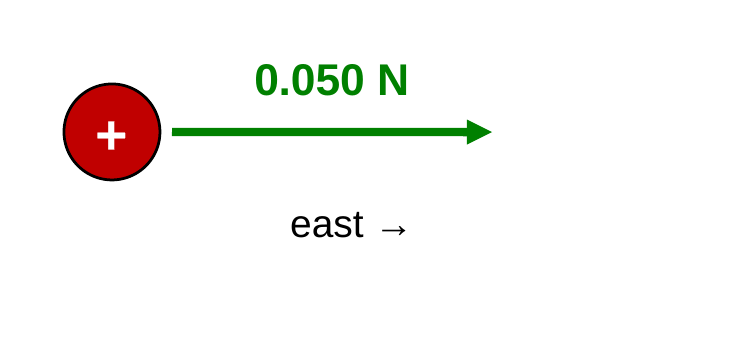
- Knowns: q = 2.0 × 10⁻⁶ C, F = 0.050 N east
- Equation: E = F/q
- Substitute: E = 0.050 N / 2.0 × 10⁻⁶ C
- Divide: 0.050 ÷ 2.0 = 0.025, so E = 0.025 × 10⁶ N/C
- Answer: E = 2.5 × 10⁴ N/C east. The test charge is positive, so the field points the same way as the force.
Example 2: Force on an Electron
An electron (charge −1.6 × 10⁻¹⁹ C) is in an electric field of 3.0 × 10⁴ N/C pointing east. What force acts on the electron?
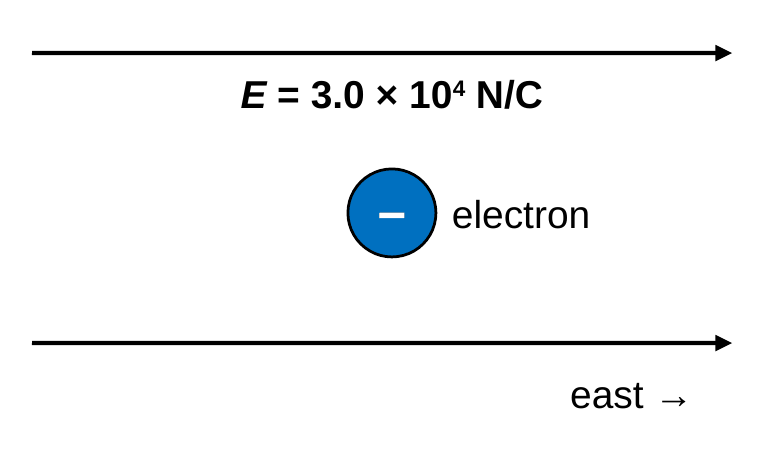
- Knowns: q = 1.6 × 10⁻¹⁹ C (size), E = 3.0 × 10⁴ N/C east
- Equation: E = F/q, so F = qE
- Substitute: F = (1.6 × 10⁻¹⁹ C)(3.0 × 10⁴ N/C)
- Multiply: 1.6 × 3.0 = 4.8, and 10−19 × 104 = 10−15
- Answer: F = 4.8 × 10⁻¹⁵ N west. An electron is negative, so it is pushed opposite the field.
Example 3: Finding the Charge
A charge sits in a 4.0 × 10³ N/C electric field that points up. It feels a 0.12 N force that points down. What is the charge, including its sign?
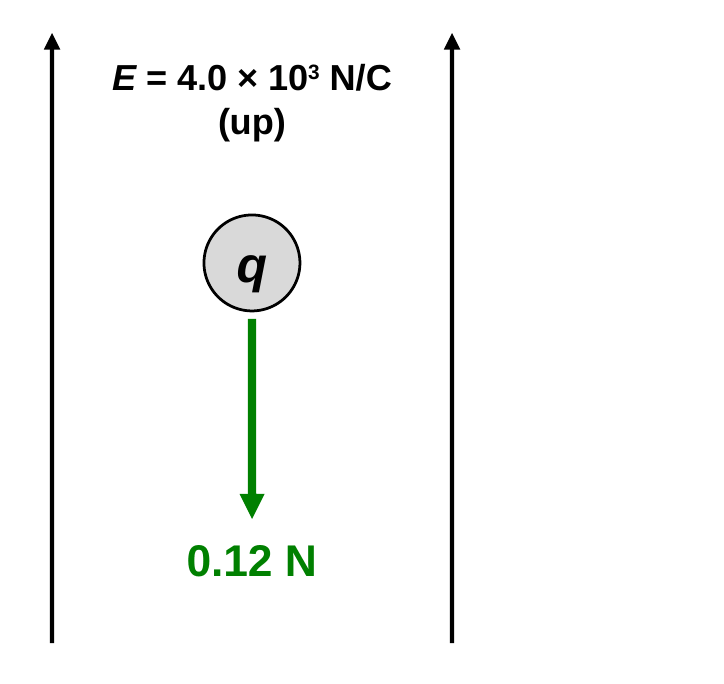
- Knowns: E = 4.0 × 10³ N/C up, F = 0.12 N down
- Equation: E = F/q, so q = F/E
- Substitute: q = 0.12 N / 4.0 × 10³ N/C
- Divide: 0.12 ÷ 4.0 = 0.030, so q = 0.030 × 10⁻³ C = 3.0 × 10⁻⁵ C
- Sign: the force points opposite the field, so the charge is negative
- Answer: q = −3.0 × 10⁻⁵ C
Big Ideas
- A charge makes a field; the field pushes charges
- Field lines: out of +, into −
- E = F/q, in N/C
- + pushed with E, − pushed against E
Back to the essential question: a charge sets up an electric field in the space around it, and any other charge in that field feels a force, F = qE. Field lines point away from positive charges and toward negative charges, and the field is stronger where the lines are closer together. Next up, Universal Gravitation shows that masses pull on each other across space in a very similar way.

