
The video lesson for this topic is coming soon.
Essential Question
What is electric charge, and how do objects get charged?
Rub a balloon on your hair and it sticks to the wall. Walk across a carpet and a doorknob zaps you. By the end of this lesson, you should be able to explain where charge comes from, describe how objects become charged, and use q = ne to connect charge to a number of electrons.
Inside an Atom
- Protons (+) in the nucleus
- Neutrons have no charge
- Electrons (−) orbit outside
- Neutral: equal + and −
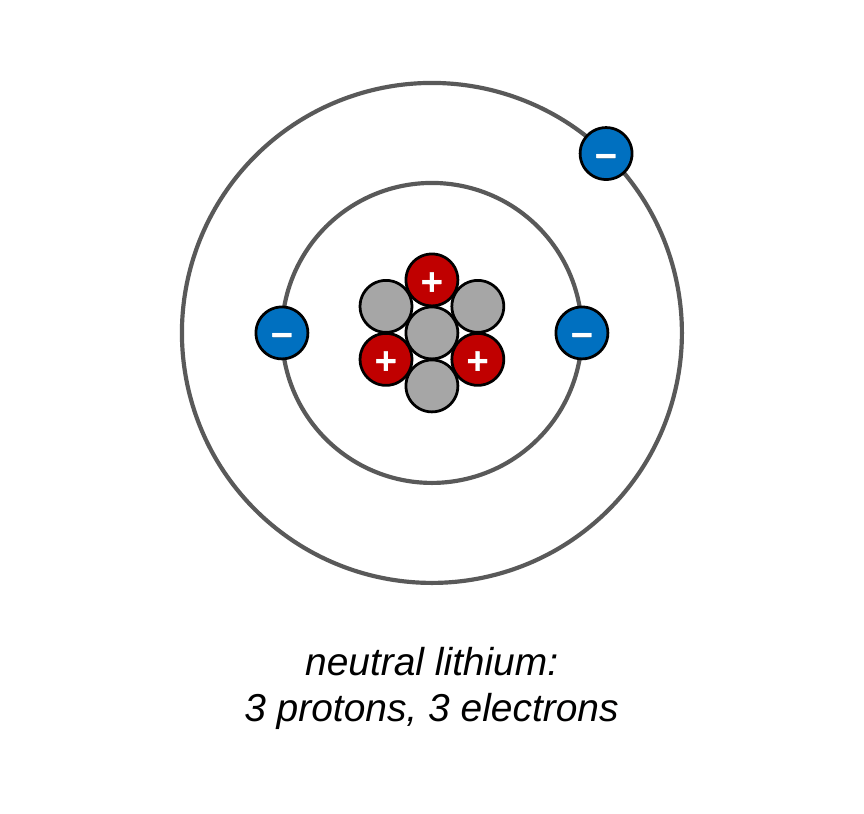
In the Bohr model, an atom has a tiny nucleus in the center made of protons and neutrons, with electrons moving in orbits around it. Protons carry a positive charge, electrons carry a negative charge, and neutrons have no charge. This lithium atom has 3 protons and 3 electrons. The positives and negatives balance, so the atom is neutral.
Neutral and Charged
- Neutral: equal + and −
- Extra electrons: negative
- Missing electrons: positive
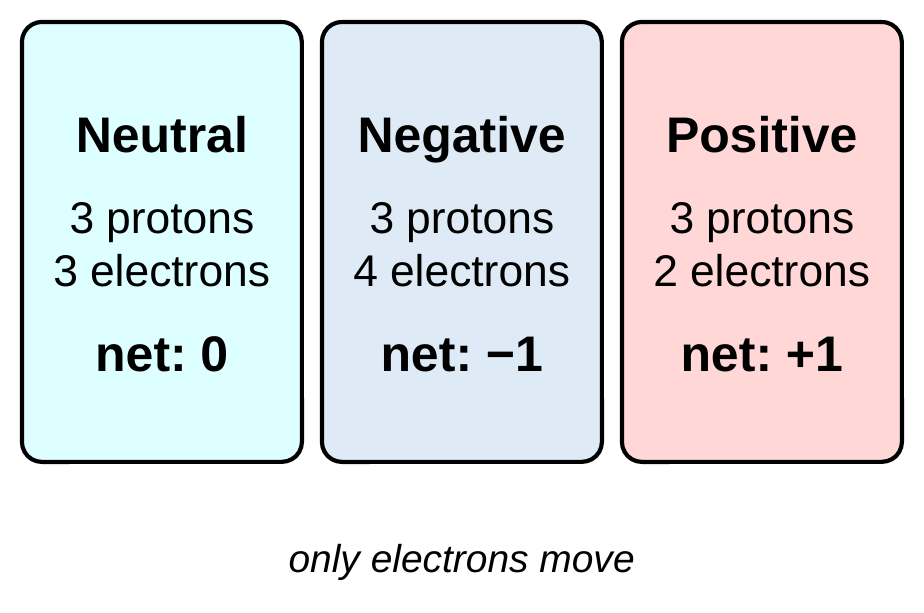
An object is neutral when it has the same number of protons and electrons. If it gains extra electrons, it has more negative than positive, so it is negatively charged. If it loses electrons, it has more positive than negative, so it is positively charged. Protons are locked in the nucleus, so charging an object always means moving electrons.
Two Types of Charge
- Like charges repel
- Opposite charges attract
- Evidence: some pairs push, some pull
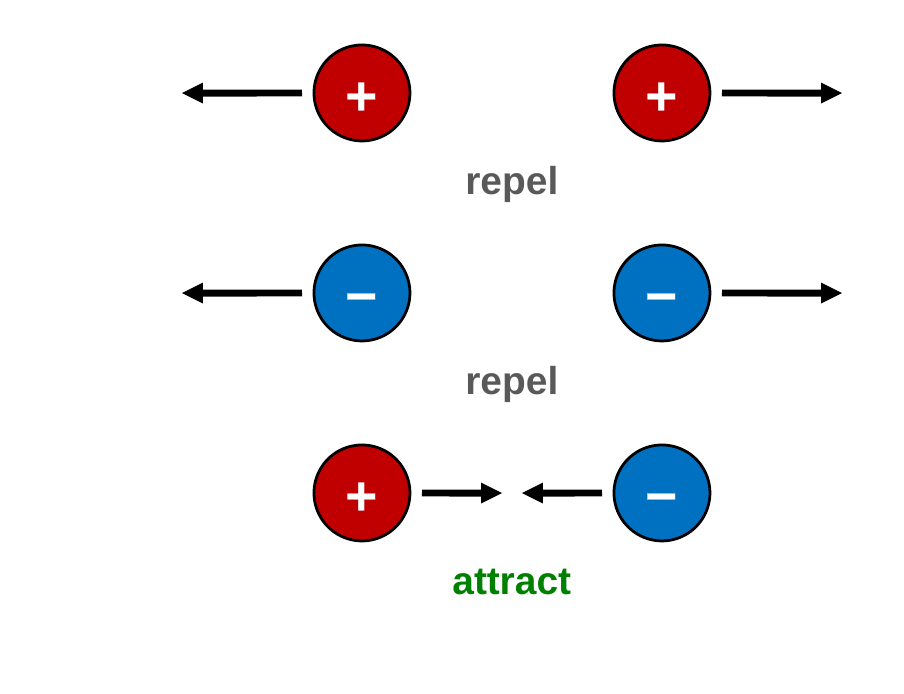
Two positive charges push each other away, and so do two negative charges: like charges repel. A positive and a negative charge pull toward each other: opposite charges attract. This is the evidence that there are two types of charge. Two balloons rubbed on hair push apart, but a balloon and the hair it was rubbed on pull together. If there were only one type of charge, every pair would act the same way.
Charging by Friction
- Rubbing moves electrons
- One object gains electrons
- The other loses the same number
- Total charge stays the same
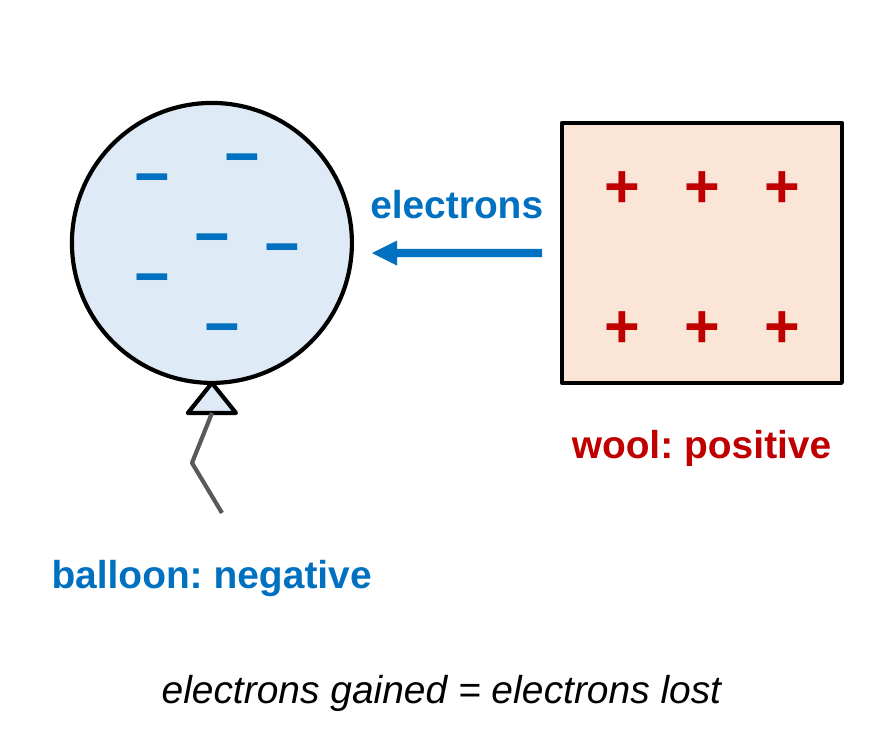
When you rub a rubber balloon with wool, electrons are scraped off the wool and onto the balloon. The balloon ends up with extra electrons, so it is negative. The wool is missing exactly that many electrons, so it is positive by the same amount. No charge is created or destroyed. It just moves from one object to the other. This is called conservation of charge.
Conduction and Induction
- Conduction: touch and share charge
- Induction: bring charge near, no touch
- Nearby charge pushes electrons away
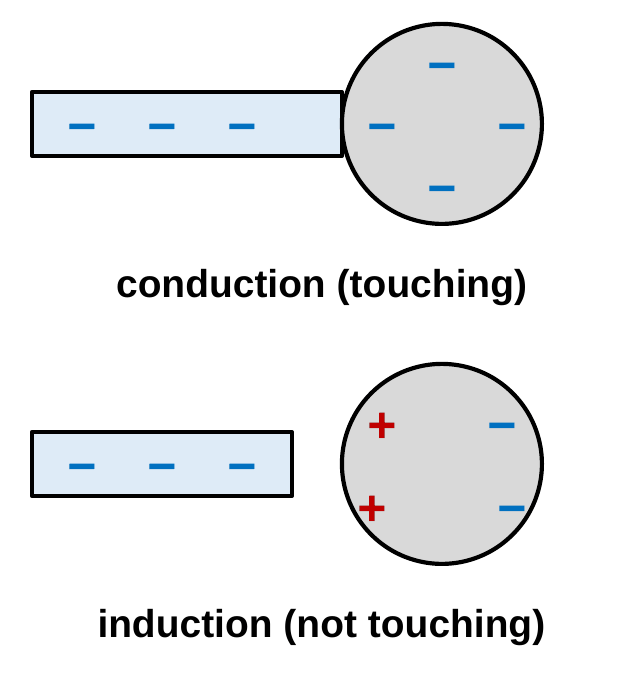
In conduction, a charged object touches a neutral conductor, and some of its charge flows onto it. The conductor ends up with the same sign of charge. In induction, the charged object only comes close. Its charge pushes or pulls electrons inside the conductor, so one side becomes positive and the other negative. If the far side is connected to the ground for a moment, electrons can leave, and the conductor keeps a charge opposite to the rod, without ever being touched.
Charge Is Quantized
q = ne
- q = charge, in coulombs (C)
- n = number of extra or missing electrons
- e = elementary charge, 1.6 × 10⁻¹⁹ C
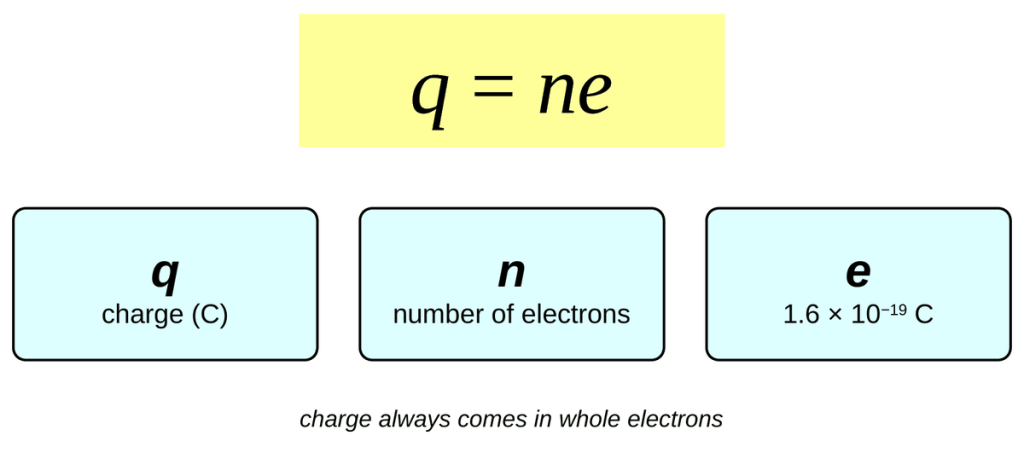
Charge is measured in coulombs (C). An object can only gain or lose whole electrons, never half of one, so charge always comes in multiples of the elementary charge e. We say charge is quantized. Because e is so tiny, even a small static shock involves billions of electrons.
Worked Examples
Try each problem on your own first, then check your work against the solution.
Example 1: Counting Charge
A balloon rubbed on your hair picks up 5.0 × 10¹² extra electrons. What is the charge on the balloon?
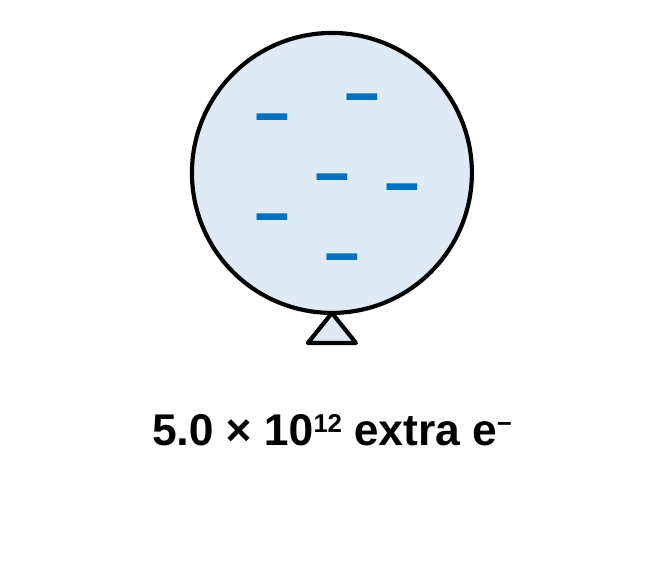
- Knowns: n = 5.0 × 10¹² electrons, e = 1.6 × 10⁻¹⁹ C
- Equation: q = ne
- Substitute: q = (5.0 × 10¹²)(1.6 × 10⁻¹⁹ C)
- Multiply: 5.0 × 1.6 = 8.0, and 1012 × 10−19 = 10−7
- Answer: q = −8.0 × 10⁻⁷ C. It is negative because the balloon gained electrons.
Example 2: Counting Electrons
A metal sphere has a charge of +3.2 × 10⁻⁹ C. How many electrons did it lose?
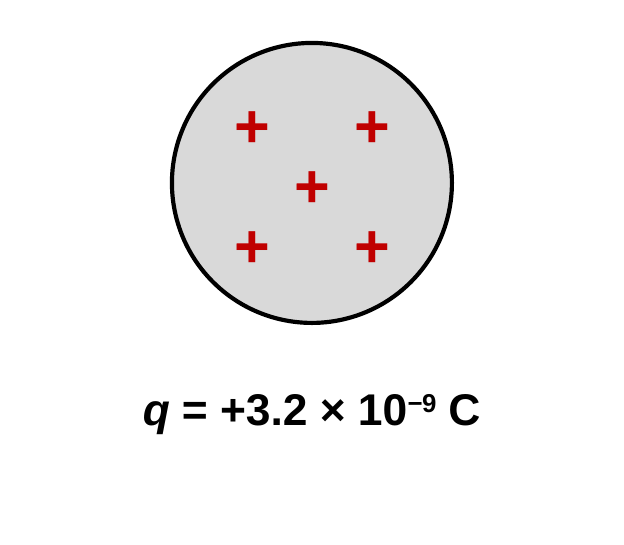
- Knowns: q = 3.2 × 10⁻⁹ C, e = 1.6 × 10⁻¹⁹ C
- Equation: q = ne, so n = q/e
- Substitute: n = (3.2 × 10⁻⁹ C) / (1.6 × 10⁻¹⁹ C). The coulombs cancel.
- Divide: 3.2 ÷ 1.6 = 2.0, and 10−9 ÷ 10−19 = 1010
- Answer: n = 2.0 × 10¹⁰ electrons lost. The sphere is positive, so it lost electrons.
Example 3: Touching Spheres
Two identical metal spheres touch, then separate. Sphere A starts at +6.0 × 10⁻⁹ C and sphere B at −2.0 × 10⁻⁹ C. What is the charge on each sphere afterward?
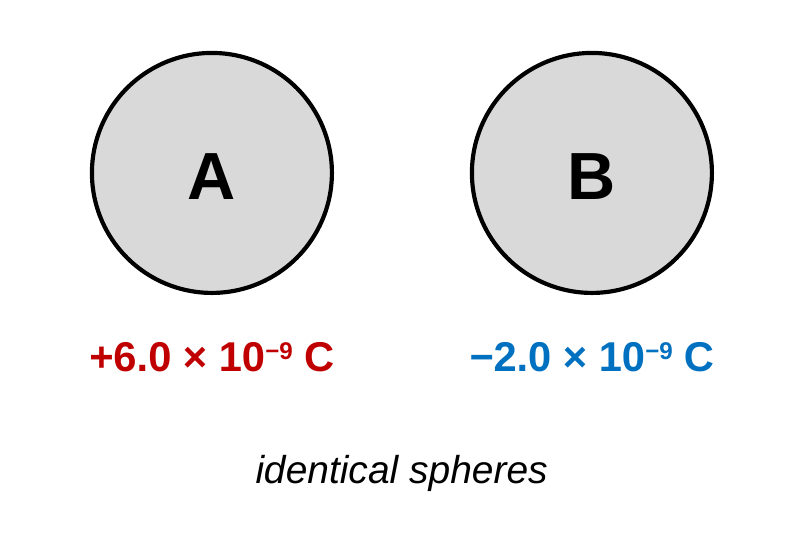
- Total charge: qtotal = (+6.0 × 10⁻⁹ C) + (−2.0 × 10⁻⁹ C) = +4.0 × 10⁻⁹ C
- Conservation: touching does not create or destroy charge, so the total is still +4.0 × 10⁻⁹ C afterward
- Share equally: identical spheres split the total evenly: (+4.0 × 10⁻⁹ C) ÷ 2
- Answer: each sphere has +2.0 × 10⁻⁹ C
Check: +2.0 × 10⁻⁹ C + 2.0 × 10⁻⁹ C = +4.0 × 10⁻⁹ C, the same total we started with.
Big Ideas
- Protons +, electrons −, neutral = equal
- Like charges repel, opposites attract
- Charging moves electrons; charge is conserved
- q = ne, with e = 1.6 × 10⁻¹⁹ C
Back to the essential question: electric charge is a property of protons (+) and electrons (−). Objects become charged when electrons move from one object to another by friction, conduction, or induction, and the total charge is always conserved. Charge comes in whole-number packets of e = 1.6 × 10⁻¹⁹ C. Next up, Coulomb’s Law shows how strongly two charges push or pull on each other.

