
Essential Question
How do we write an electron configuration?
Orbital filling diagrams show a lot of detail, but they take a long time to draw. Shorthand notation shows the same information in a single line. By the end of this lesson, you should be able to write the electron configuration for any element and read one to identify the element.
From Boxes to Notation
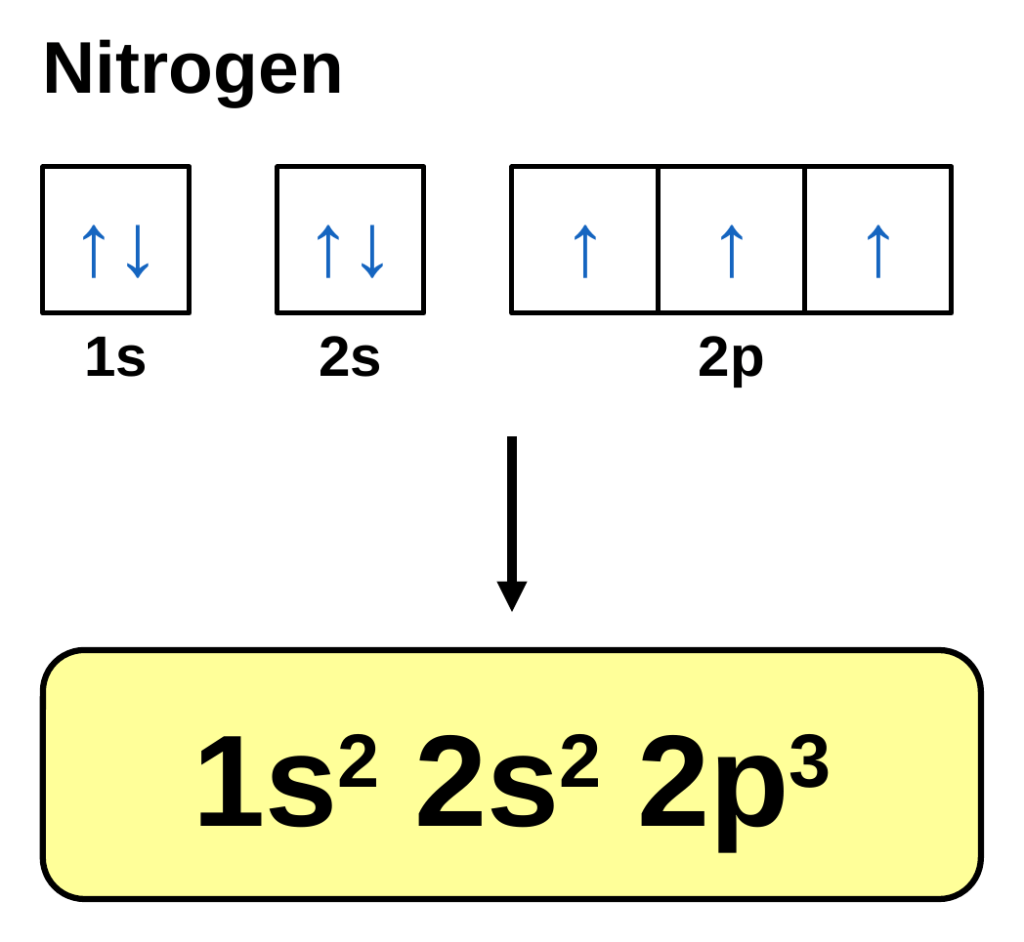
- Shorthand notation is a way of writing an atom’s electron configuration: where its electrons are, in one line.
- List each sublevel in filling order.
- Instead of drawing arrows, write how many electrons are in each sublevel. Nitrogen’s diagram becomes 1s2 2s2 2p3.
Reading the Notation
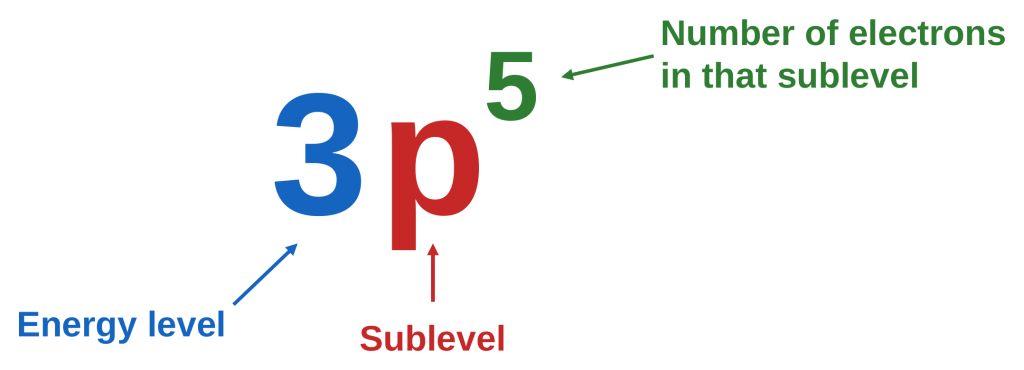
- The big number is the energy level.
- The letter is the sublevel: s, p, d, or f.
- The superscript is the number of electrons in that sublevel. It’s a count, not an exponent.
So 3p5 (read “three p five”) means 5 electrons in the 3p sublevel.
Maximum Electrons

- Each sublevel has 1, 3, 5, or 7 orbitals, and each orbital holds 2 electrons. So the max is s2, p6, d10, f14.
- A superscript can never be bigger than the max. If you ever write 2p7, something went wrong.
- Built-in check: all the superscripts add up to the total number of electrons. For a neutral atom, that’s the atomic number.
Filling Order
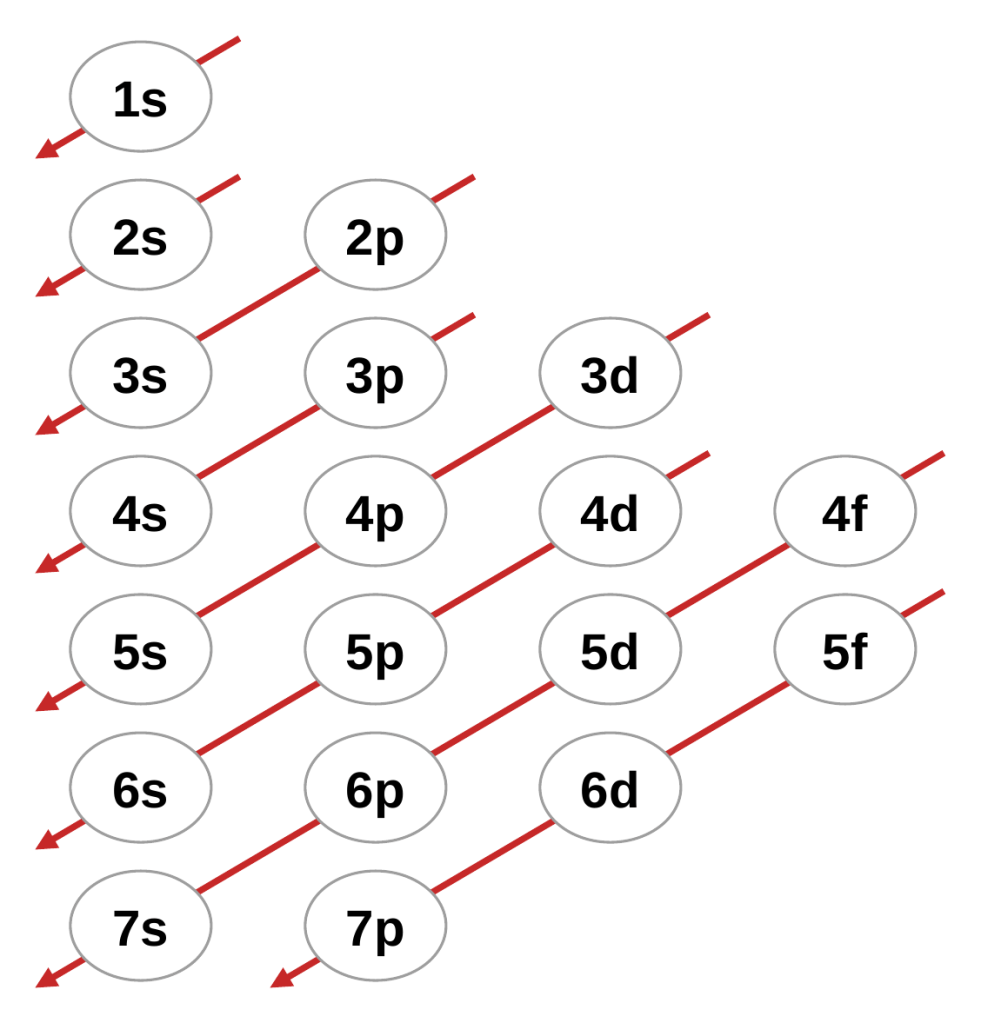
Electron configurations follow the same filling order as orbital filling diagrams (the Aufbau principle). Use the diagonal rule: follow each arrow from top to bottom.
Filling order: 1s → 2s → 2p → 3s → 3p → 4s → 3d → 4p → 5s → 4d → 5p → 6s → 4f → 5d → 6p → 7s → 5f → 6d → 7p
Periodic Table Blocks
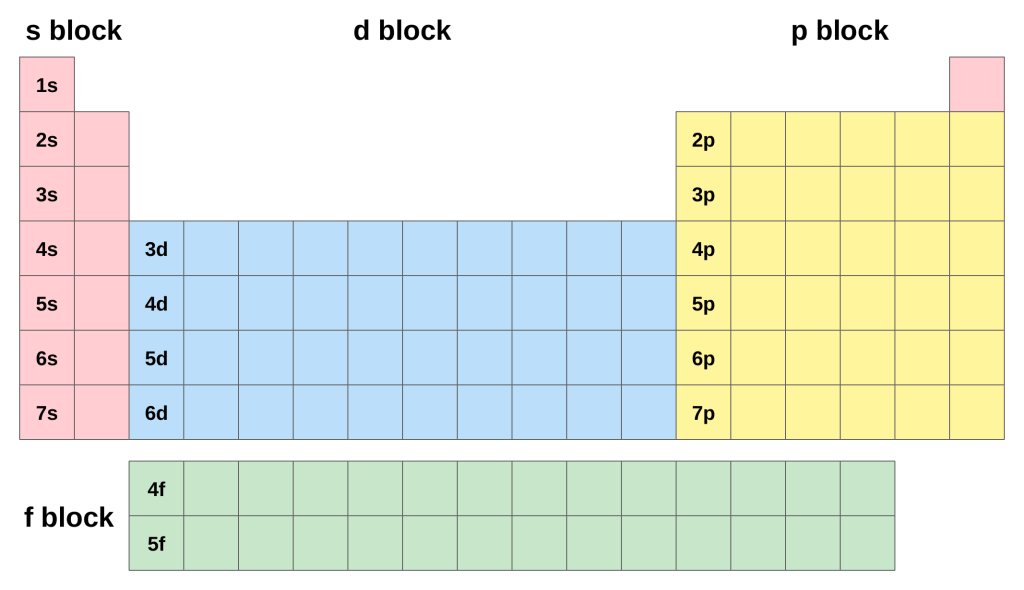
- The periodic table is a map of electron configurations. It has four blocks: s (first two columns plus helium), p (last six columns), d (middle ten columns), and f (the two rows at the bottom).
- The blocks are 2, 6, 10, and 14 columns wide, which matches the max electrons for each sublevel.
- The row number is the energy level, with one catch: the d block is one level behind its row (row 4 fills 3d), and the f block is two levels behind (row 6 fills 4f).
Using the Periodic Table
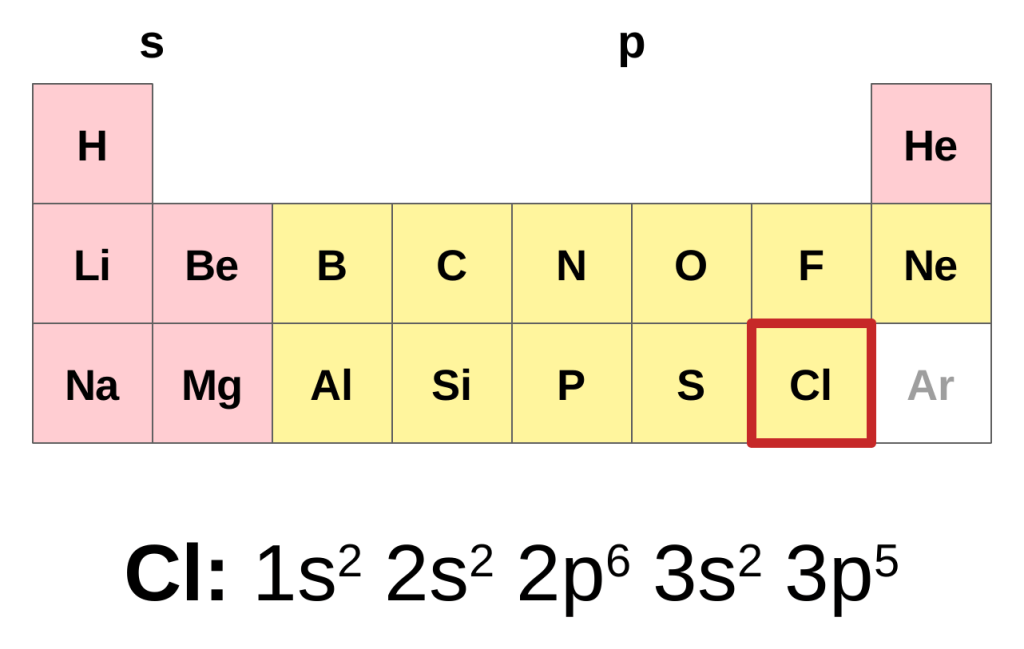
- Start at hydrogen and read each row from left to right, like reading a book.
- Each box you pass is one electron.
- Stop at your element.
For chlorine: row 1 gives 1s2. Row 2 gives 2s2 2p6. Row 3 gives 3s2, then 5 boxes into the p block to reach chlorine, so 3p5. Cl: 1s2 2s2 2p6 3s2 3p5. Check: 2 + 2 + 6 + 2 + 5 = 17.
Writing a Configuration
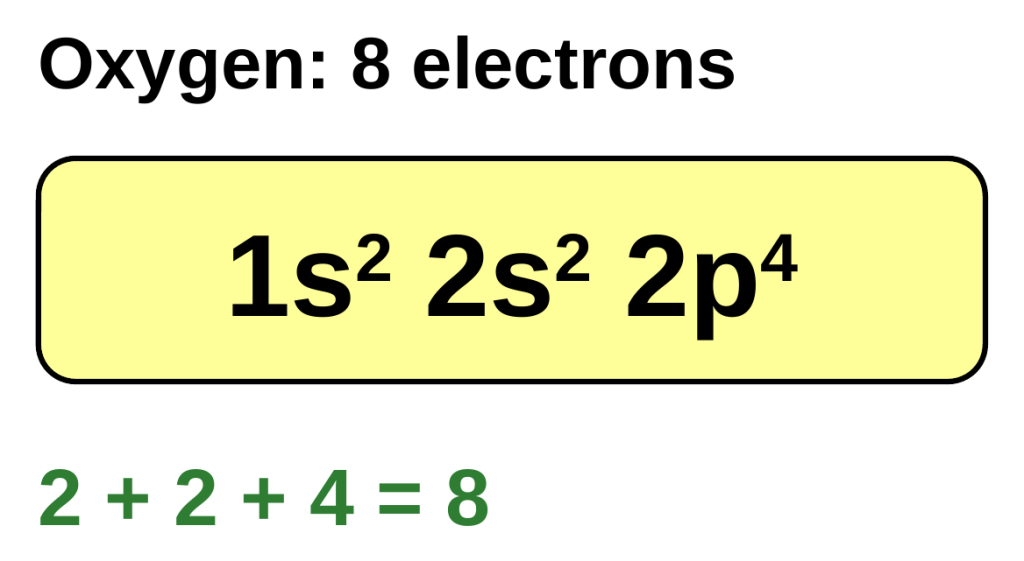
- Count the electrons. Oxygen’s atomic number is 8, so it has 8 electrons.
- Fill sublevels in order: 1s, 2s, 2p, …
- Fill each one to its max before moving on. 1s takes 2 (6 left), 2s takes 2 (4 left), and 2p gets the last 4.
- Check the total: 2 + 2 + 4 = 8.
Only the last sublevel can be partly filled. Every sublevel before it is full.
4s Before 3d

- After 3p comes 4s, then 3d, then 4p.
- Row 4 starts with potassium and calcium in the s block (4s). The ten d block elements in row 4 fill 3d, because the d block is one level behind its row.
Titanium (22 electrons): 1s2 2s2 2p6 3s2 3p6 4s2 3d2. After 3p6, 18 electrons are placed. 4s takes 2 more, and the last 2 go in 3d. Titanium is the second box in the d block, so 3d2 matches its position.
Worked Examples
Try each problem on your own first, then check your work against the solution.
Example 1: Write a Configuration
Write the electron configuration for phosphorus.
- Count the electrons: phosphorus’s atomic number is 15, so it has 15 electrons.
- Fill in order: 1s2 (13 left), 2s2 (11 left), 2p6 (5 left), 3s2 (3 left), and the last 3 go in 3p.
- Check: 2 + 2 + 6 + 2 + 3 = 15. Phosphorus is the third box in the p block of row 3, which matches 3p3.
Answer: 1s2 2s2 2p6 3s2 3p3
Example 2: Identify the Element
Which element has this electron configuration?
1s2 2s2 2p6 3s2 3p6 4s2 3d10 4p2
- Add the superscripts: 2 + 2 + 6 + 2 + 6 + 2 + 10 + 2 = 32 electrons.
- Find the element: for a neutral atom, electrons = atomic number. Atomic number 32 is germanium.
- Check with the table: the last sublevel is 4p2, so the element is in row 4, the second box of the p block. That’s germanium.
Answer: germanium (Ge)
Example 3: Find the Mistake
Each configuration has a mistake. Find it and fix it.
- A. Sodium: 1s2 2s2 2p7
- B. Calcium: 1s2 2s2 2p6 3s2 3p6 3d2
- C. Magnesium: 1s2 2s2 2p6 3s1
- A: 2p can hold at most 6 electrons, so 2p7 is impossible. The 11th electron goes in 3s. Fix: 1s2 2s2 2p6 3s1
- B: after 3p comes 4s, not 3d. Calcium is in the s block of row 4. Fix: 1s2 2s2 2p6 3s2 3p6 4s2
- C: the superscripts add up to 11, but magnesium has 12 electrons. Fix: 1s2 2s2 2p6 3s2
Example 4: Past the d Block
Write the electron configuration for bromine.
- Count the electrons: bromine’s atomic number is 35, so it has 35 electrons.
- Fill through 3p: 1s2 2s2 2p6 3s2 3p6 places 18 electrons (17 left).
- Row 4: 4s2 (15 left), then the full 3d10 (5 left), then the last 5 go in 4p.
- Check: 2 + 2 + 6 + 2 + 6 + 2 + 10 + 5 = 35. Bromine is the fifth box in the p block of row 4, which matches 4p5.
Answer: 1s2 2s2 2p6 3s2 3p6 4s2 3d10 4p5
Big Ideas
- Superscript = electrons in that sublevel.
- Max: s2, p6, d10, f14.
- Order: use the diagonal rule or the periodic table.
- Superscripts add up to the total electrons.
Back to the essential question: to write an electron configuration, count the electrons, fill the sublevels in order, fill each one to its max, and check the total. Next, you’ll learn an even shorter way to write these with noble gas notation.

