
The video lesson for this topic is coming soon.
Essential Question
How do objects move after they collide?
Sometimes colliding objects bounce apart, and sometimes they stick together. By the end of this lesson, you should be able to tell elastic, inelastic, and perfectly inelastic collisions apart and use pbefore = pafter to solve for a missing mass or velocity.
Types of Collisions
- Momentum: always conserved
- Kinetic energy: not always
- Three types of collisions
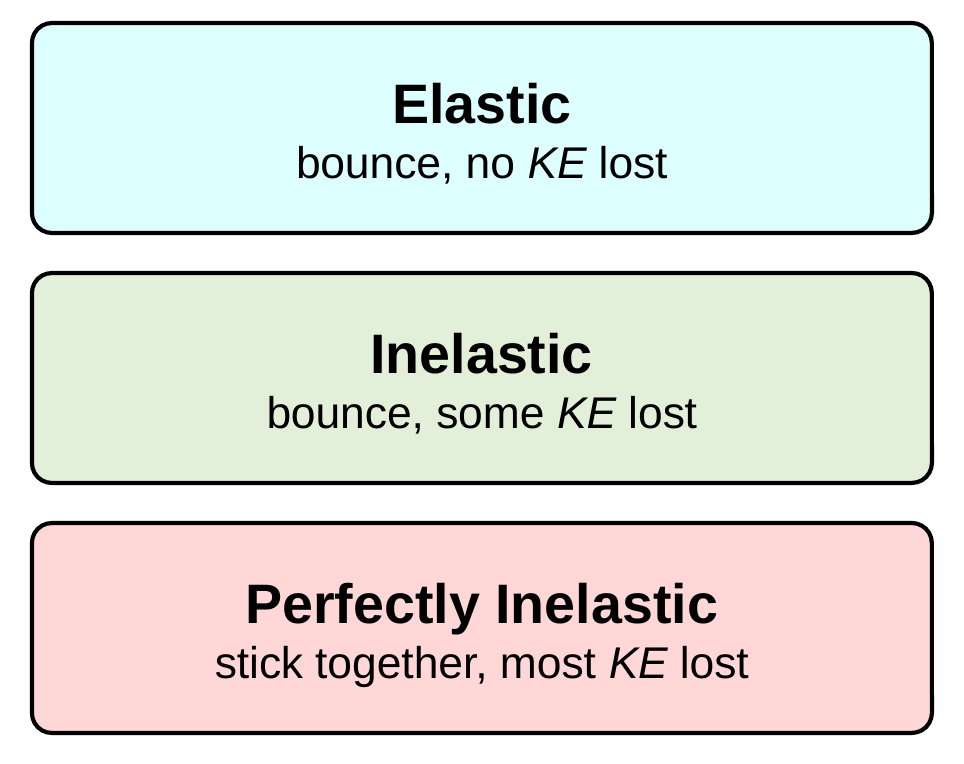
In every collision in an isolated system, momentum is conserved. What changes from one collision to another is what happens to the kinetic energy, the energy of motion. In an elastic collision, the objects bounce apart and no kinetic energy is lost. In an inelastic collision, they bounce apart but some kinetic energy turns into heat, sound, and bent material. In a perfectly inelastic collision, they stick together and the most kinetic energy is lost.
Kinetic Energy
KE = ½mv2
- KE = kinetic energy, in joules (J)
- m = mass, in kilograms (kg)
- v = speed, in meters per second (m/s)
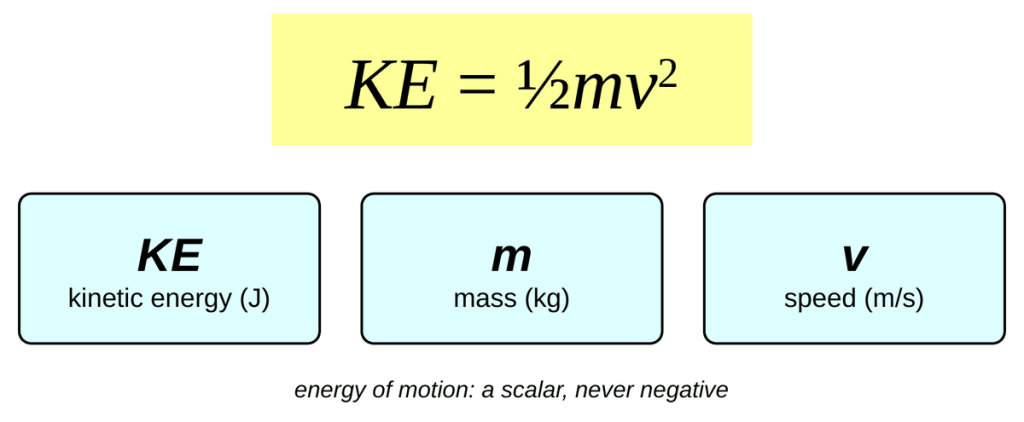
Kinetic energy is the energy an object has because it is moving. We’ll study energy in depth in the next unit. For now, you only need this equation to check whether a collision is elastic. Kinetic energy is a scalar: because the speed is squared, it is never negative, so you add the kinetic energies of objects without worrying about direction.
Elastic Collisions
- Objects bounce apart
- Total KE stays the same
- Close: pool balls, steel balls
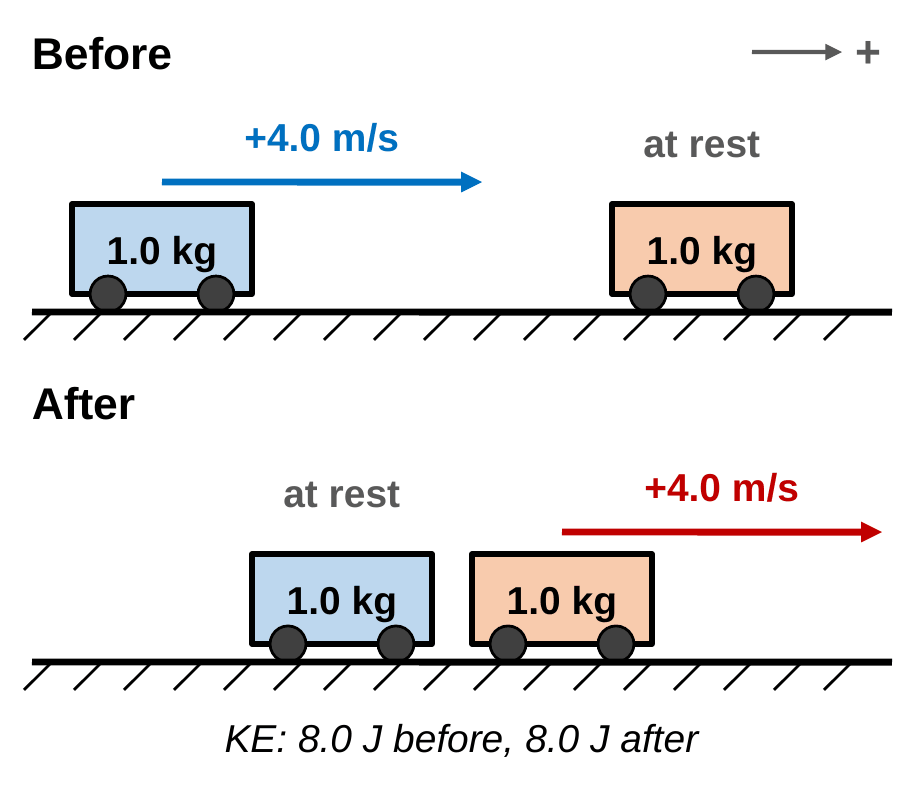
In an elastic collision, the objects bounce apart and the total kinetic energy after equals the total kinetic energy before. Here a 1.0 kg cart at 4.0 m/s hits an identical cart at rest, stops, and the second cart moves off at 4.0 m/s. Momentum is 4.0 kg·m/s before and after, and kinetic energy is 8.0 J before and after. Perfectly elastic collisions are rare in everyday life, but collisions between pool balls, steel balls, and carts with magnetic bumpers come close.
Inelastic Collisions
- Objects bounce apart
- Some KE becomes heat, sound
- Most real collisions
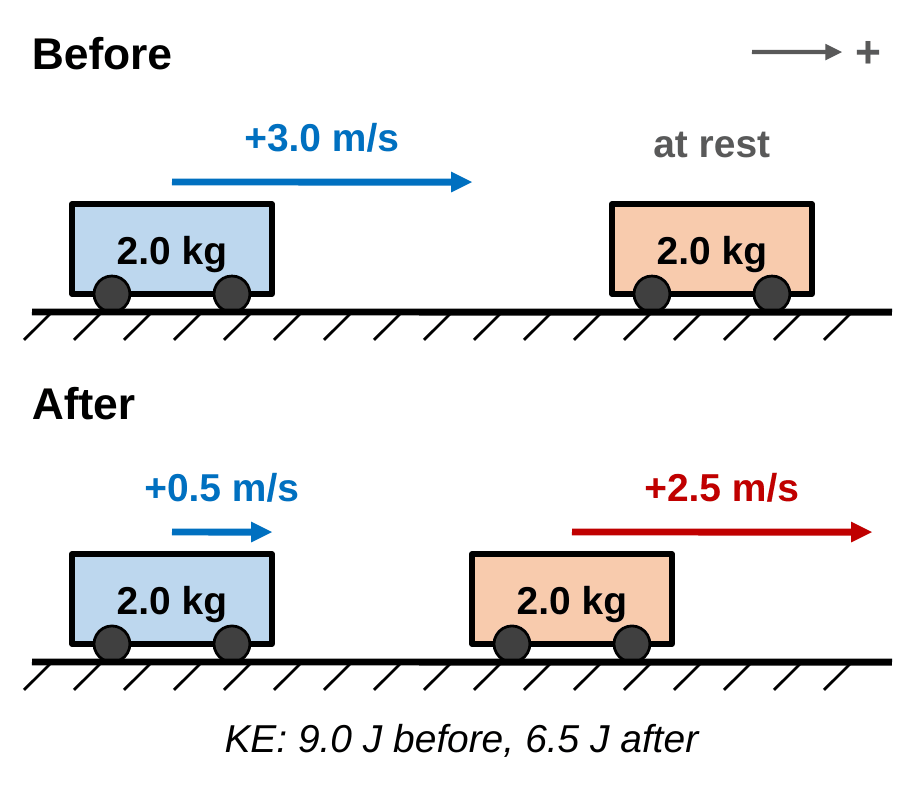
In an inelastic collision, the objects still bounce apart, but some kinetic energy is turned into heat, sound, and the energy it takes to dent or bend things. Here momentum is 6.0 kg·m/s before and after, but kinetic energy drops from 9.0 J to 6.5 J. Most real collisions, like a car bumper tap or a basketball bounce, are inelastic.
Perfectly Inelastic Collisions
- Objects stick together
- Move with one shared velocity
- Loses the most KE
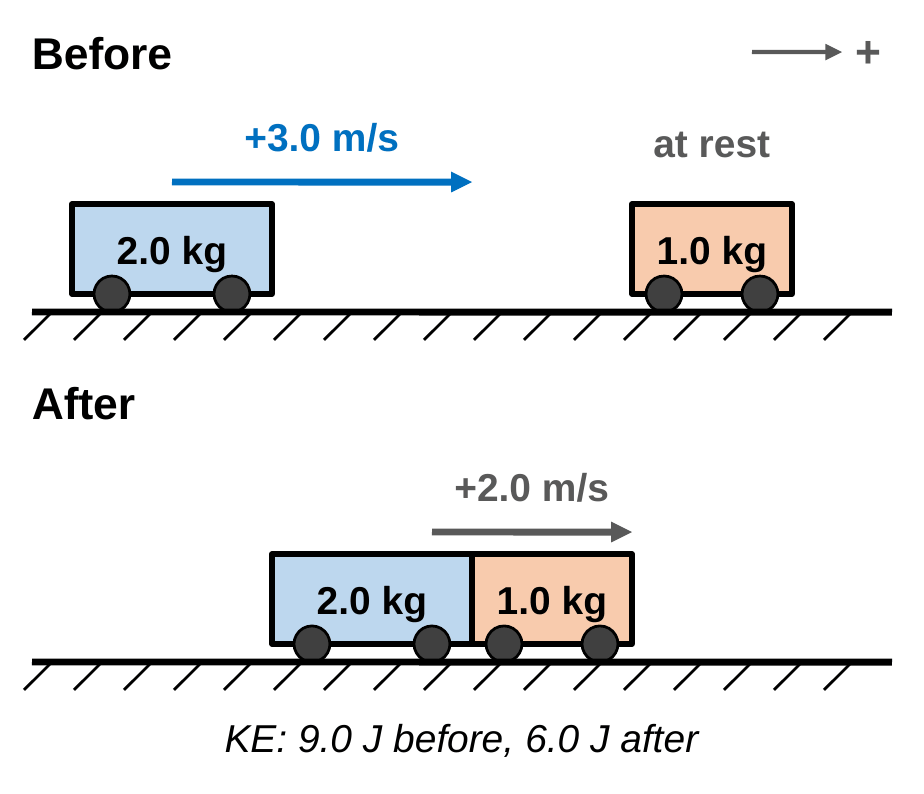
In a perfectly inelastic collision, the objects stick together and move off with one shared velocity. That makes the math simpler: m1v1 + m2v2 = (m1 + m2)v′. Here a 2.0 kg cart at 3.0 m/s sticks to a 1.0 kg cart at rest, and the 3.0 kg pair moves at 2.0 m/s. Momentum is 6.0 kg·m/s before and after, but kinetic energy drops from 9.0 J to 6.0 J. Sticking together always loses the most kinetic energy.
Solving Collision Problems
- Draw before and after
- Right is positive
- Set pbefore = pafter
- Solve for the unknown
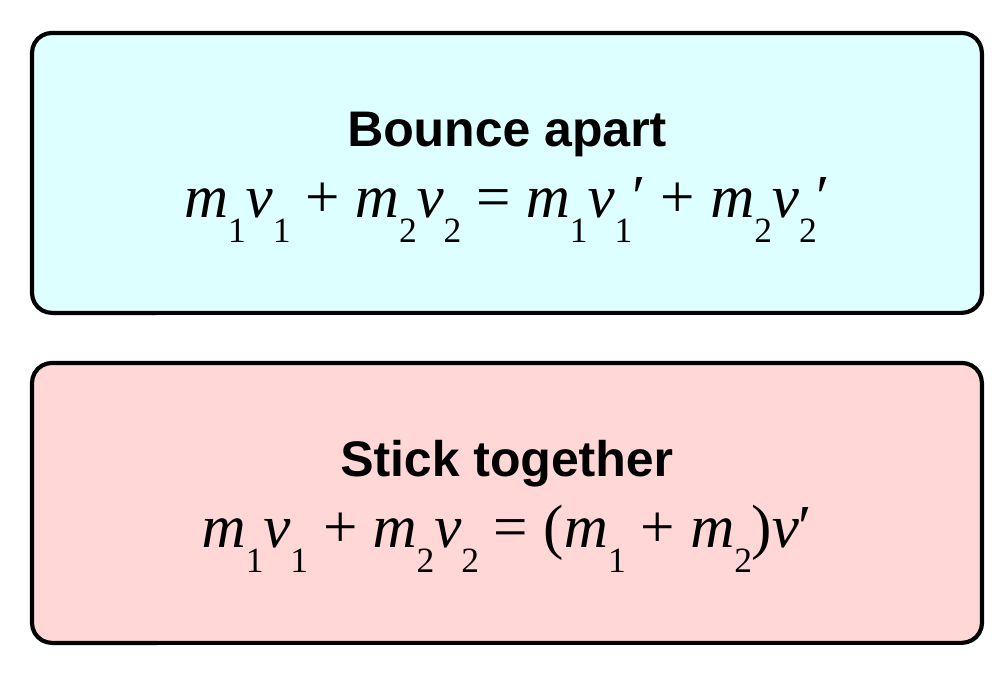
Every collision problem uses the same plan. Sketch the objects before and after, choose right as positive and give every velocity a sign, write conservation of momentum, and solve for the one unknown. If the objects bounce apart, each one has its own final velocity. If they stick together, they share one final velocity, so the masses add.
Worked Examples
Try each problem on your own first, then check your work against the solution.
Example 1: Sticking Together
A 0.30 kg ball of clay moving right at 5.0 m/s hits a 0.20 kg ball of clay moving left at 2.5 m/s. They stick together. What is their velocity right after the collision?
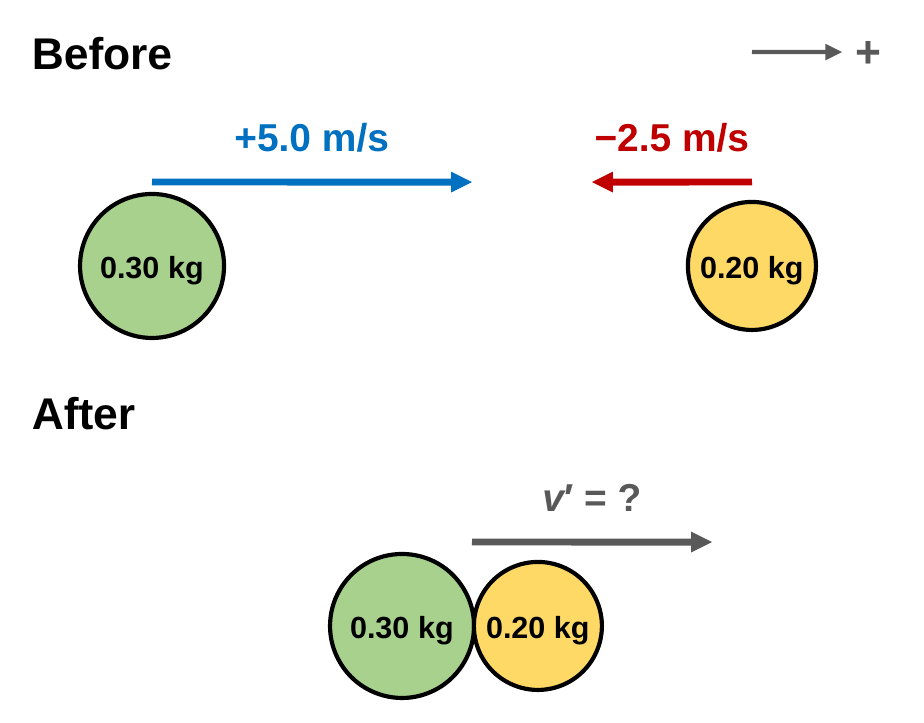
- Signs: Right is positive: v1 = +5.0 m/s, v2 = −2.5 m/s
- Equation: They stick, so m1v1 + m2v2 = (m1 + m2)v′
- Momentum before: (0.30 kg)(+5.0 m/s) + (0.20 kg)(−2.5 m/s) = 1.5 − 0.50 = +1.0 kg·m/s
- Solve: v′ = (1.0 kg·m/s) / (0.30 kg + 0.20 kg) = (1.0 kg·m/s) / (0.50 kg)
- Answer: v′ = +2.0 m/s, or 2.0 m/s to the right
Example 2: Bouncing Back
A 0.50 kg cart moving right at 4.0 m/s hits a 1.5 kg cart at rest. Afterward, the 1.5 kg cart moves right at 1.5 m/s. What is the velocity of the 0.50 kg cart?
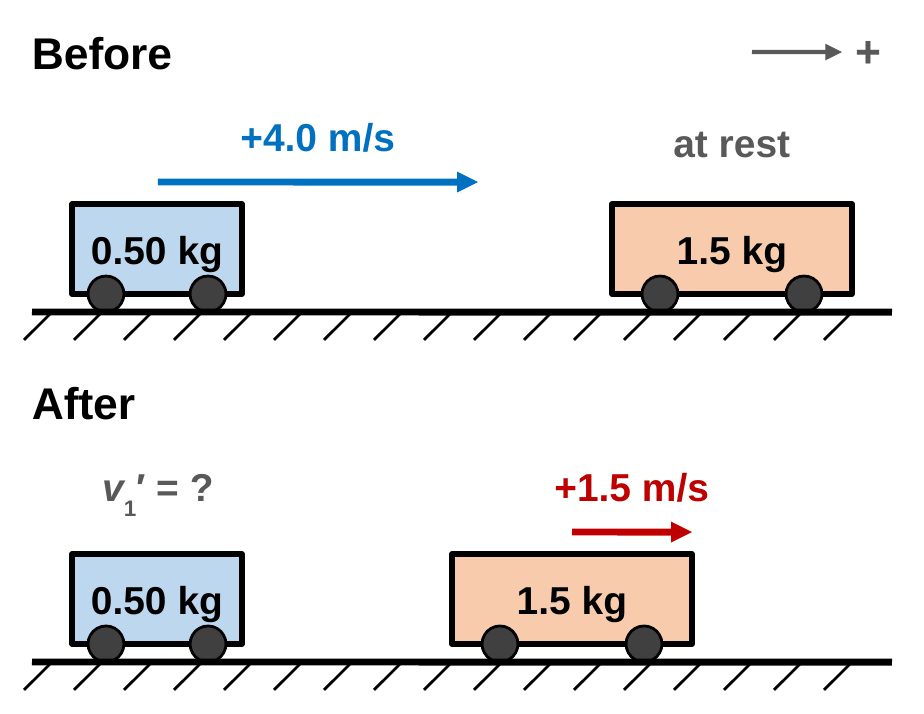
- Knowns: m1 = 0.50 kg, v1 = +4.0 m/s, m2 = 1.5 kg, v2 = 0, v2′ = +1.5 m/s
- Equation: m1v1 + m2v2 = m1v1′ + m2v2′
- Substitute: (0.50)(+4.0) + (1.5)(0) = (0.50)v1′ + (1.5)(+1.5), so 2.0 = (0.50 kg)v1′ + 2.25
- Solve: (0.50 kg)v1′ = 2.0 − 2.25 = −0.25 kg·m/s, so v1′ = −0.25 ÷ 0.50
- Answer: v1′ = −0.50 m/s, or 0.50 m/s to the left. The light cart bounces back.
Example 3: Elastic or Not?
A 2.0 kg cart moving right at 3.0 m/s hits a 4.0 kg cart at rest. Afterward, the 2.0 kg cart moves left at 1.0 m/s and the 4.0 kg cart moves right at 2.0 m/s. Is this collision elastic?
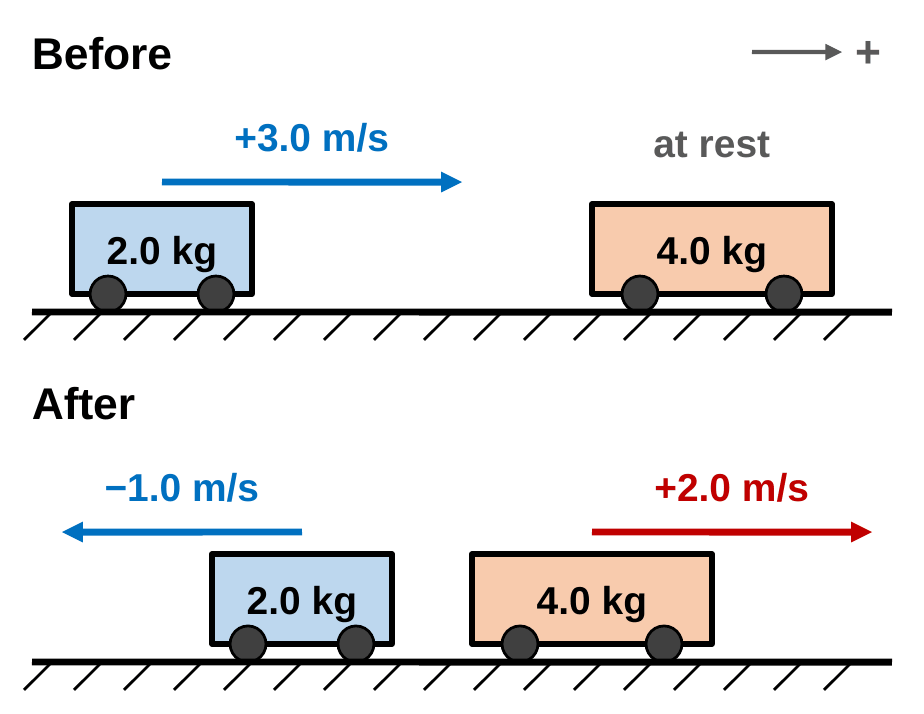
- Momentum before: (2.0 kg)(+3.0 m/s) + (4.0 kg)(0) = +6.0 kg·m/s
- Momentum after: (2.0 kg)(−1.0 m/s) + (4.0 kg)(+2.0 m/s) = −2.0 + 8.0 = +6.0 kg·m/s, so momentum is conserved
- KE before: ½(2.0 kg)(3.0 m/s)2 + 0 = 9.0 J
- KE after: ½(2.0 kg)(1.0 m/s)2 + ½(4.0 kg)(2.0 m/s)2 = 1.0 J + 8.0 J = 9.0 J
- Answer: Yes, it is elastic, because kinetic energy is 9.0 J before and after.
Example 4: Finding a Mass
A 2.0 kg cart moving right at 6.0 m/s hits a cart at rest. They stick together and move right at 1.5 m/s. What is the mass of the second cart?
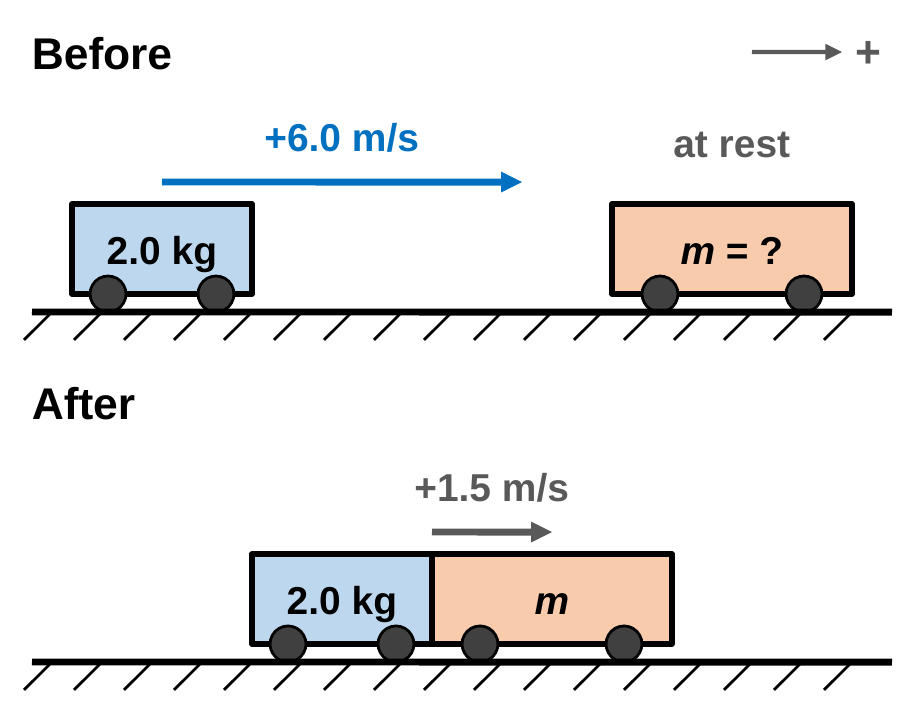
- Knowns: m1 = 2.0 kg, v1 = +6.0 m/s, v2 = 0, v′ = +1.5 m/s, m2 = ?
- Equation: They stick, so m1v1 + m2v2 = (m1 + m2)v′
- Substitute: (2.0 kg)(6.0 m/s) + 0 = (2.0 kg + m2)(1.5 m/s), so 12 = (2.0 + m2)(1.5)
- Solve: 2.0 kg + m2 = 12 ÷ 1.5 = 8.0 kg, so m2 = 8.0 kg − 2.0 kg
- Answer: m2 = 6.0 kg
Big Ideas
- Momentum is conserved in every collision
- Elastic: bounce, KE conserved
- Inelastic: bounce, some KE lost
- Perfectly inelastic: stick, share one v′
Back to the essential question: objects move after a collision so that the total momentum stays the same. They bounce apart in elastic and inelastic collisions, or stick together and share one velocity in perfectly inelastic collisions. Only elastic collisions keep the kinetic energy too. Next up, we’ll look at explosions and recoil, where objects start together and fly apart.

