
The video lesson for this topic is coming soon.
Essential Question
Where does momentum go when objects collide?
When a moving pool ball hits a still one, the first ball slows down and the second takes off. By the end of this lesson, you should be able to explain why the total momentum stays the same and use pbefore = pafter to check or predict what happens.
Systems
- System: the objects we choose
- Internal forces: between objects inside
- External forces: from outside
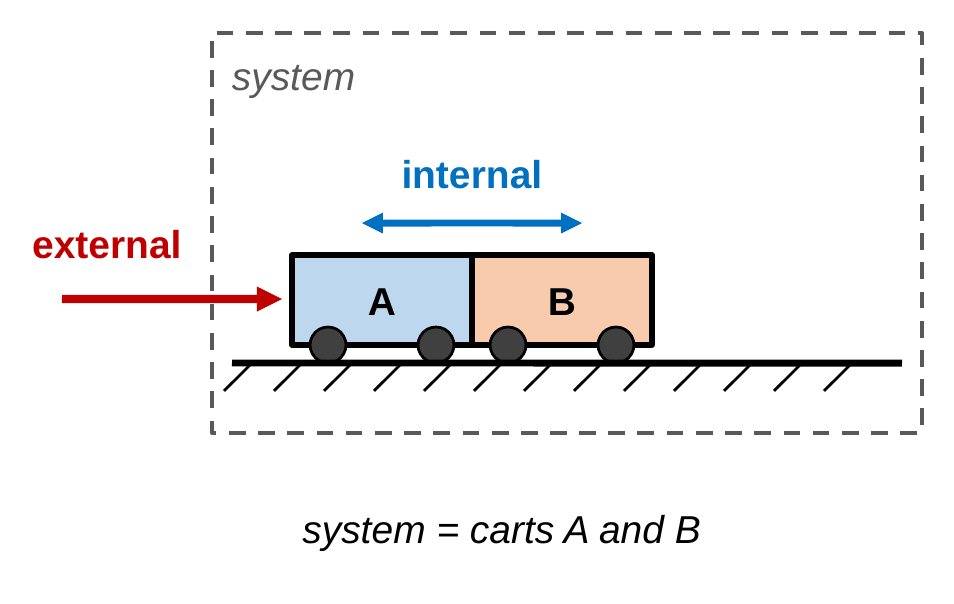
A system is the set of objects we choose to study. Forces between objects inside the system, like two carts pushing on each other during a collision, are internal forces. Forces from anything outside the system, like a hand pushing one cart, are external forces. Only external forces can change the total momentum of a system.
Isolated Systems
- No net external force
- Outside forces cancel or are tiny
- Example: carts on a smooth track
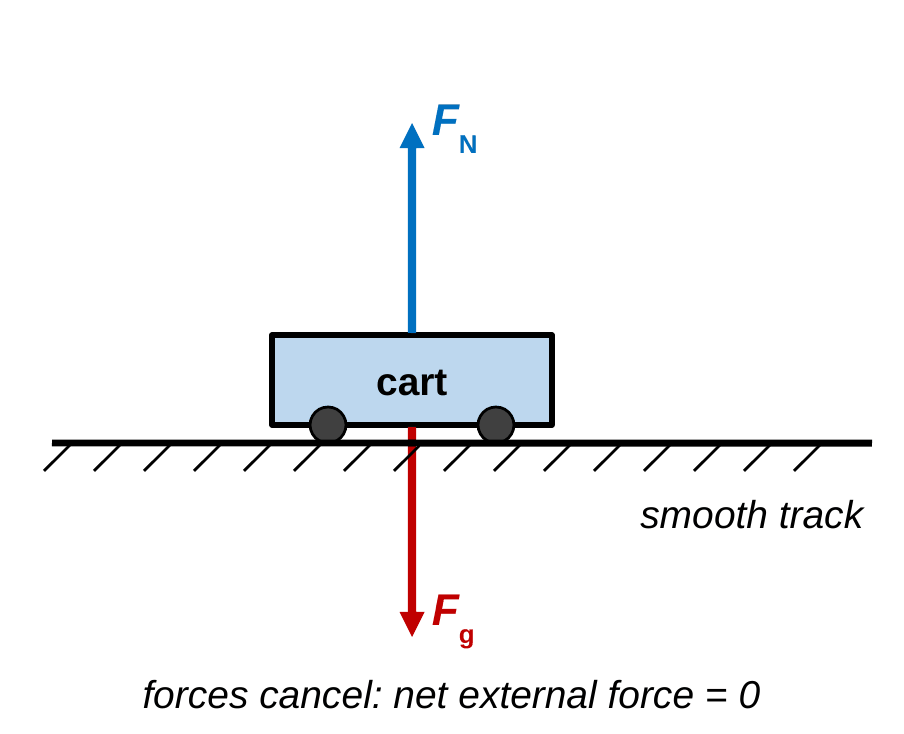
An isolated system (also called a closed system) has no net external force on it. The outside forces either cancel out or are too small to matter during the collision. For carts on a smooth, level track, gravity pulls down and the track pushes up with an equal force, and friction is tiny. Only in an isolated system is the total momentum conserved.
Conservation of Momentum
pbefore = pafter
- For two objects: m1v1 + m2v2 = m1v1′ + m2v2′
- The prime mark (′) means “after the collision”
- Right is positive and left is negative
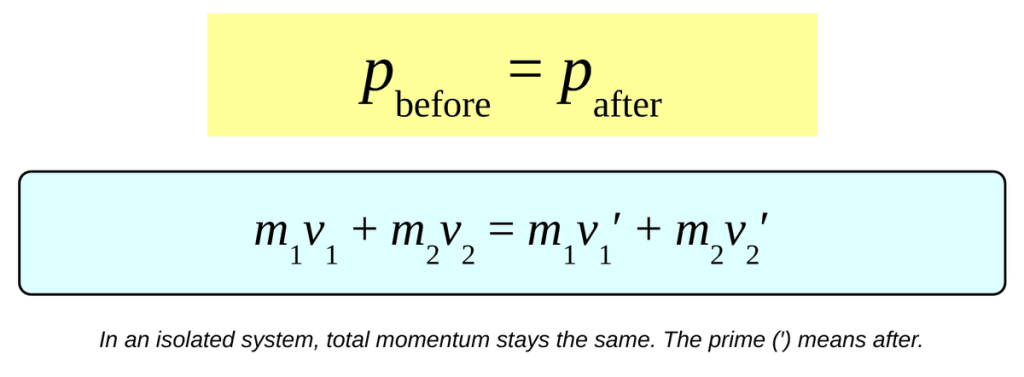
The law of conservation of momentum says that in an isolated system, the total momentum before an interaction equals the total momentum after it. Individual objects can speed up, slow down, or reverse, but the sum of all their momenta stays the same.
Why? Newton’s Third Law
- A pushes B, B pushes A back
- Equal forces, same time
- Equal and opposite impulses
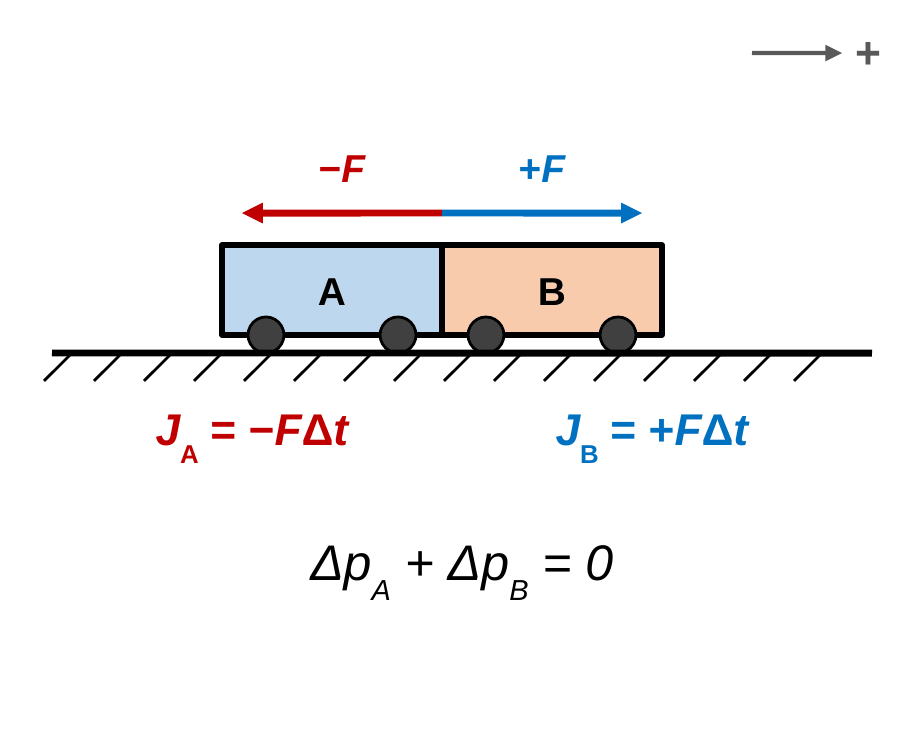
Momentum is conserved because of Newton’s third law. During a collision, cart A pushes on cart B, and cart B pushes back on cart A with a force of the same size in the opposite direction. The forces last for exactly the same time, because they only act while the carts touch. So the impulses are equal and opposite: whatever momentum A loses, B gains, and the total change is zero.
Momentum Trades Places
- One object gains what the other loses
- ΔpA = −ΔpB
- The total stays the same
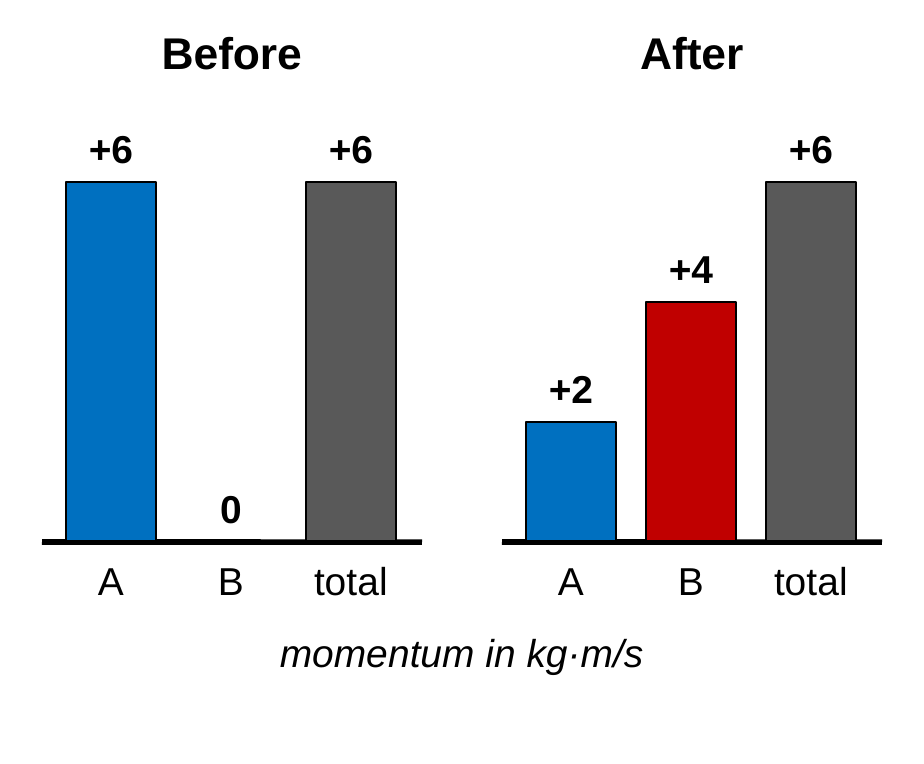
Momentum bar charts make conservation easy to see. Before the collision, cart A has all of the momentum, +6 kg·m/s, and cart B has none. After, A has +2 and B has +4. Cart A lost 4 kg·m/s and cart B gained exactly 4 kg·m/s, so the total is +6 kg·m/s both before and after.
Evidence
- Newton’s cradle
- Pool and billiard balls
- Lab carts with motion sensors
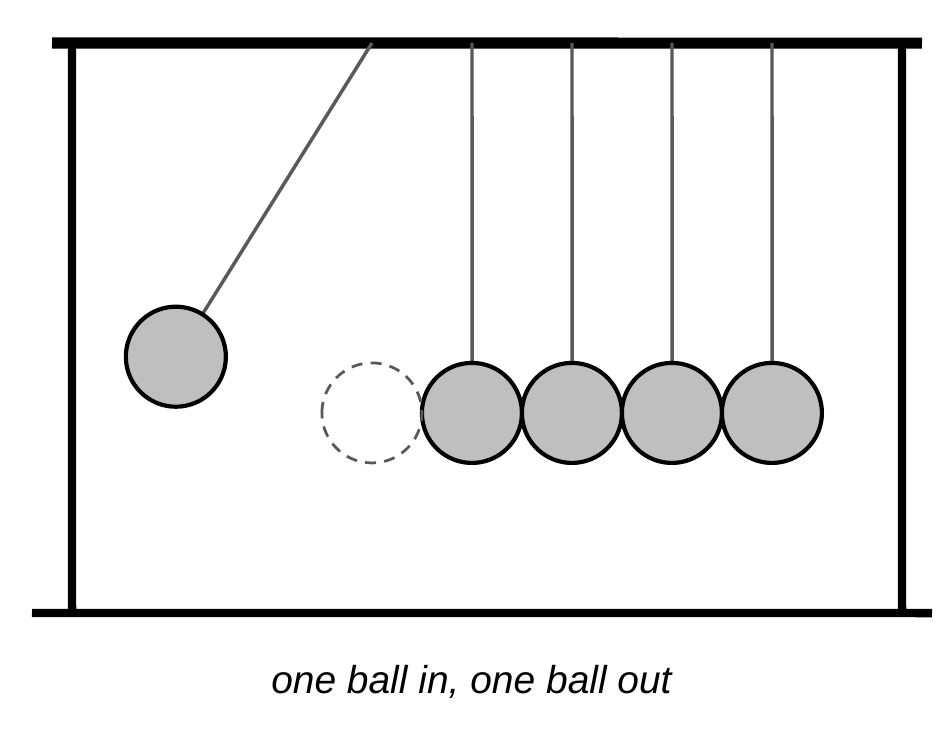
We see momentum conservation everywhere. In a Newton’s cradle, pull back one ball and let it go, and exactly one ball swings out the other side with about the same speed. In pool, the cue ball can stop dead and pass all of its momentum to the ball it hits. In the lab, motion sensors on carts show that the total momentum before and after a collision matches within a small experimental error.
Worked Examples
Try each problem on your own first, then check your work against the solution.
Example 1: Checking Conservation
A 2.0 kg cart moving right at 3.0 m/s hits a 1.0 kg cart at rest. Afterward, the 2.0 kg cart moves right at 1.0 m/s and the 1.0 kg cart moves right at 4.0 m/s. Was momentum conserved?
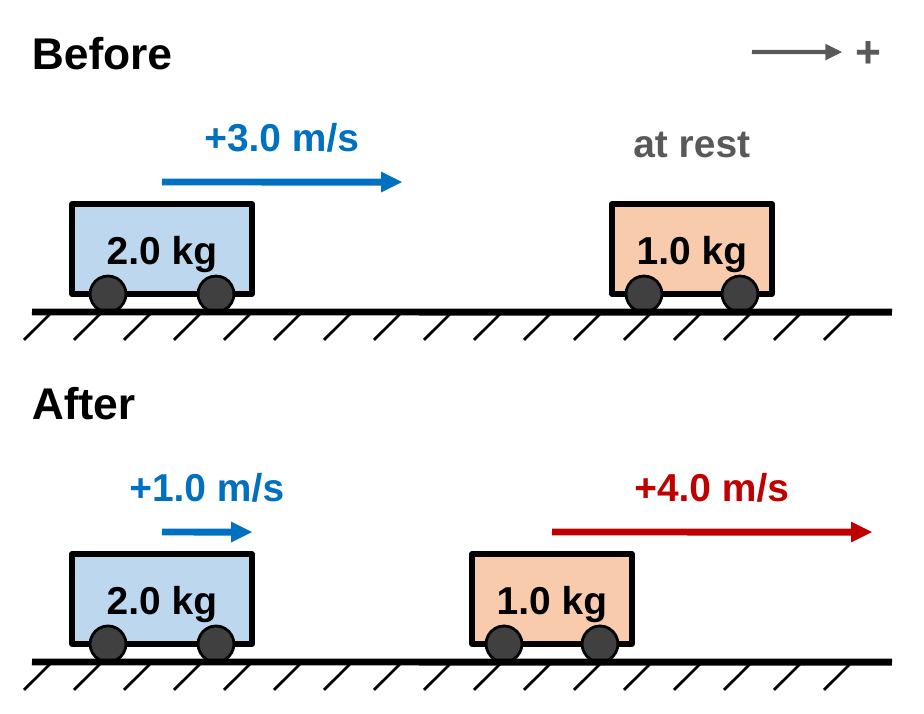
- Signs: Right is positive. Before: v1 = +3.0 m/s, v2 = 0. After: v1′ = +1.0 m/s, v2′ = +4.0 m/s
- Momentum before: (2.0 kg)(+3.0 m/s) + (1.0 kg)(0) = +6.0 kg·m/s
- Momentum after: (2.0 kg)(+1.0 m/s) + (1.0 kg)(+4.0 m/s) = +2.0 + 4.0 = +6.0 kg·m/s
- Answer: Yes, momentum was conserved: +6.0 kg·m/s before and +6.0 kg·m/s after.
Example 2: Finding a Final Velocity
A 3.0 kg cart moving right at 2.0 m/s hits a 1.0 kg cart at rest. Afterward, the 3.0 kg cart moves right at 1.0 m/s. What is the velocity of the 1.0 kg cart?
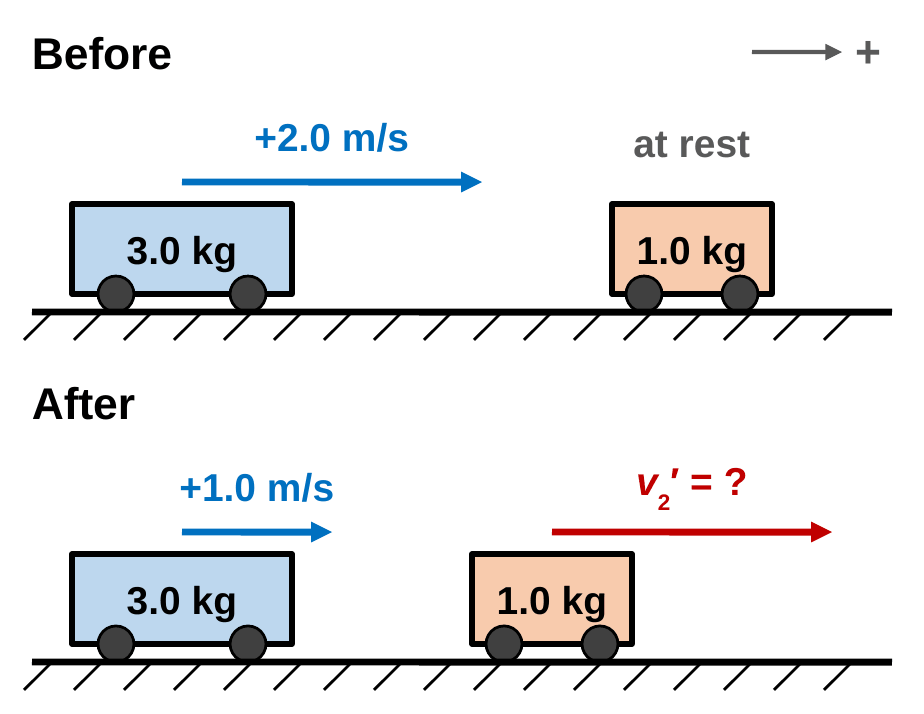
- Knowns: m1 = 3.0 kg, v1 = +2.0 m/s, m2 = 1.0 kg, v2 = 0, v1′ = +1.0 m/s, v2′ = ?
- Conservation: m1v1 + m2v2 = m1v1′ + m2v2′
- Substitute: (3.0)(+2.0) + (1.0)(0) = (3.0)(+1.0) + (1.0)v2′, so 6.0 = 3.0 + (1.0 kg)v2′
- Solve: (1.0 kg)v2′ = 3.0 kg·m/s, so v2′ = 3.0 kg·m/s ÷ 1.0 kg
- Answer: v2′ = +3.0 m/s, or 3.0 m/s to the right
Example 3: Equal and Opposite Impulses
During a collision, a 2.0 kg cart A slows from 5.0 m/s to 2.0 m/s, still moving right. Find the impulse on cart A and the impulse on cart B.
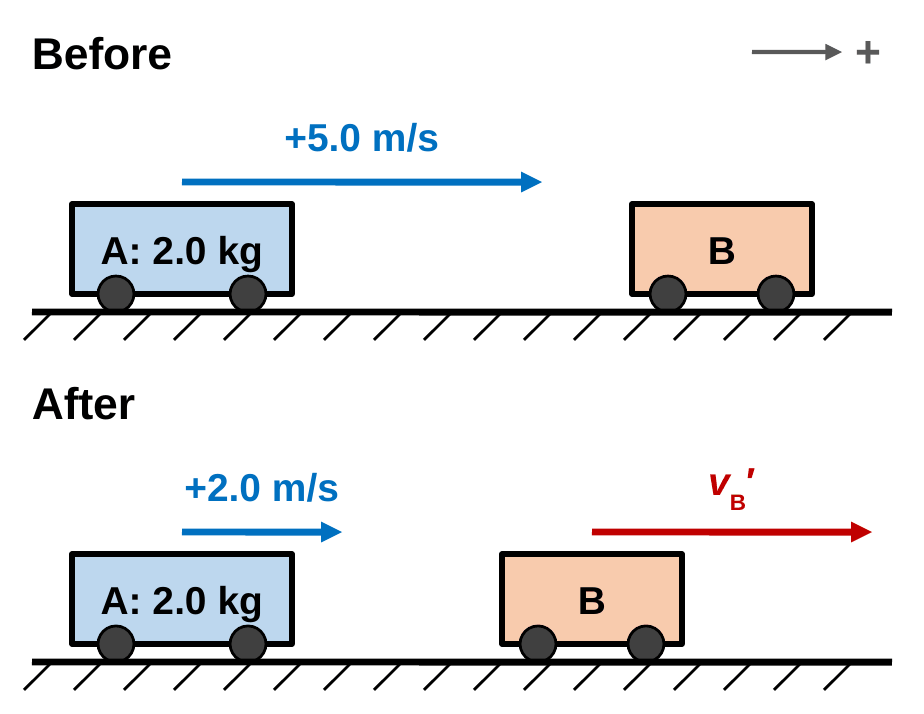
- Knowns: mA = 2.0 kg, vi = +5.0 m/s, vf = +2.0 m/s
- Impulse on A: JA = ΔpA = m(vf − vi) = (2.0 kg)(2.0 m/s − 5.0 m/s) = (2.0 kg)(−3.0 m/s)
- Answer for A: JA = −6.0 N·s, or 6.0 N·s to the left
- Newton’s third law: B pushes on A as hard as A pushes on B, for the same time, so the impulses are equal and opposite.
- Answer for B: JB = +6.0 N·s, or 6.0 N·s to the right
We didn’t need cart B’s mass at all. Newton’s third law tells us its impulse directly.
Big Ideas
- Isolated system: no net external force
- pbefore = pafter
- Third law: equal and opposite impulses
- One object gains what the other loses
Back to the essential question: momentum moves from one object to another, but in an isolated system the total momentum before a collision equals the total momentum after. Newton’s third law guarantees it, because the objects give each other equal and opposite impulses. Next up, we’ll use this to sort out different kinds of collisions.

