
The video lesson for this topic is coming soon.
Essential Question
How does a force change an object’s momentum?
Momentum only changes when a force acts, and it matters how long that force acts. By the end of this lesson, you should be able to use J = FΔt = Δp to find impulse, force, time, or a change in velocity, and explain why airbags and helmets keep people safe.
What Is Impulse?
- A force acting over time
- Impulse = force × time
- Unit: newton-seconds (N·s)
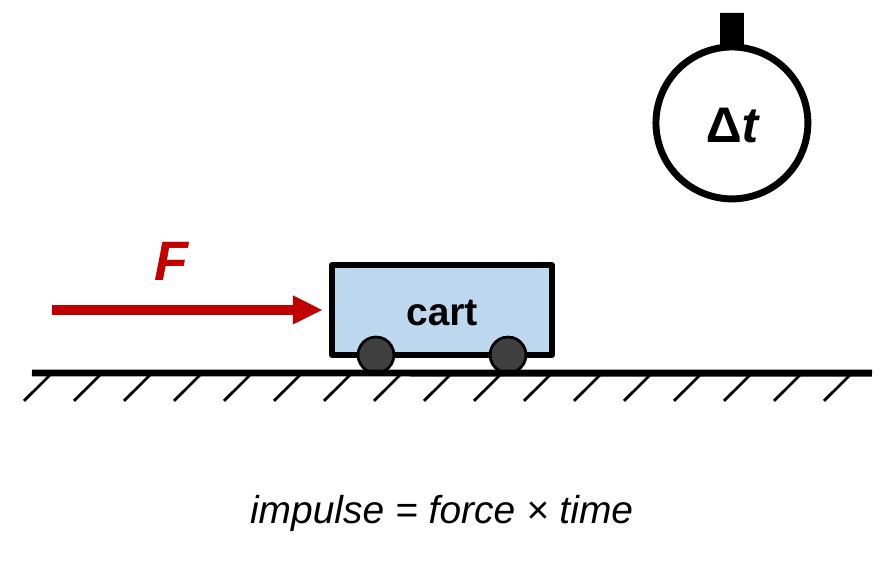
An impulse is a force acting over a period of time. Impulse equals the force times the time it acts, so a big force for a short time can give the same impulse as a small force for a long time. Because it is a force in newtons times a time in seconds, impulse is measured in newton-seconds, N·s.
Impulse Changes Momentum
J = FΔt = Δp
- J = impulse, in newton-seconds (N·s)
- F = average force, in newtons (N)
- Δt = time the force acts, in seconds (s)
- Δp = change in momentum, in kg·m/s, where Δp = mΔv = m(vf − vi)
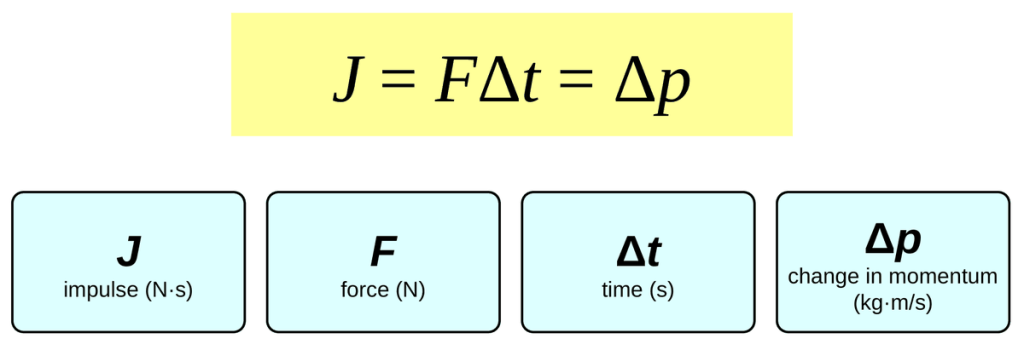
This is the impulse-momentum theorem. The impulse on an object equals its change in momentum. A force that acts in the direction of motion speeds the object up, and a force against the motion slows it down. Since mass usually stays the same, Δp = mΔv.
Where It Comes From
- Start with Newton’s 2nd law
- Acceleration: a = Δv/Δt
- Multiply both sides by Δt
- So N·s = kg·m/s
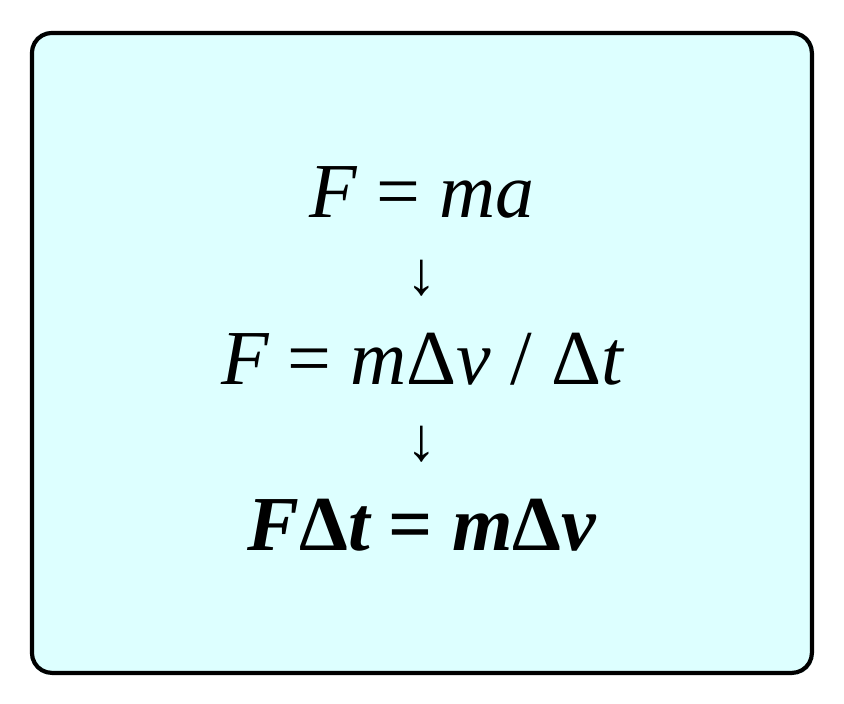
The impulse-momentum theorem is really Newton’s second law in disguise. Start with F = ma. Acceleration is the change in velocity divided by time, so F = mΔv/Δt. Multiply both sides by Δt and you get FΔt = mΔv. This also shows that a newton-second is the same unit as a kilogram meter per second.
Solving for Any Variable
- Impulse: J = FΔt
- Force: F = Δp/Δt
- Time: Δt = Δp/F
- Δp = m(vf − vi)
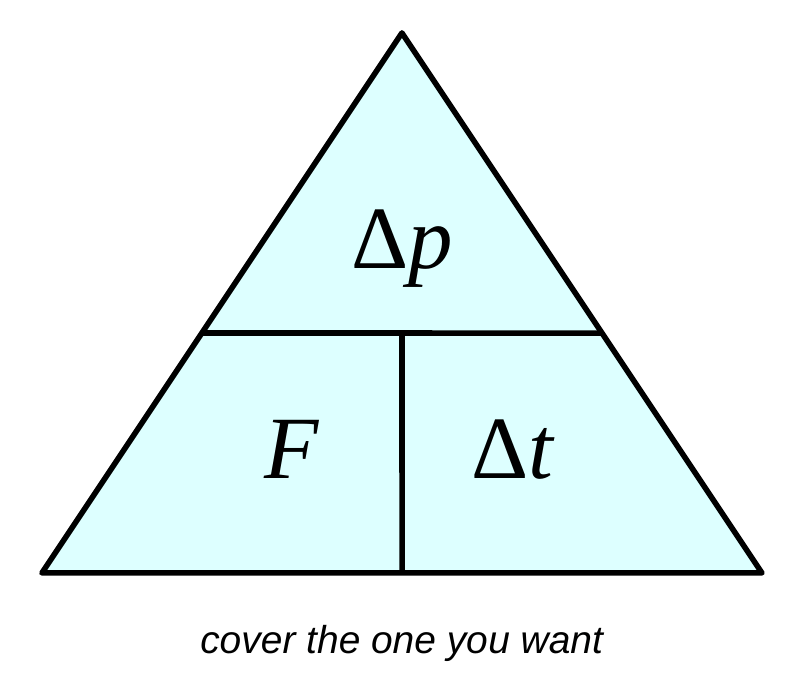
Rearrange FΔt = Δp for whatever the problem asks for. Cover the quantity you want in the triangle: covering Δp leaves F next to Δt, so multiply. Covering F leaves Δp over Δt, so divide. To find Δp from velocities, use Δp = m(vf − vi).
More Time, Less Force
- Stopping needs the same Δp
- Longer time: smaller force
- Shorter time: bigger force
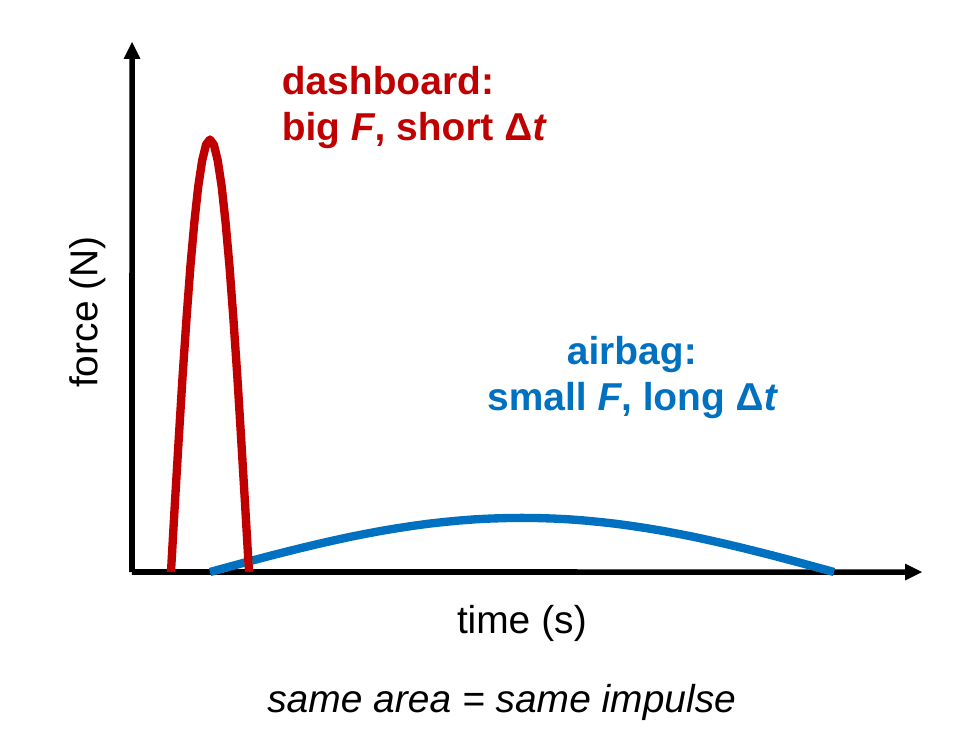
To stop a moving person, you have to take away all of their momentum, so Δp is fixed. Since FΔt = Δp, stretching the stopping time makes the force smaller. On a force-time graph, a dashboard gives a tall, narrow spike and an airbag gives a low, wide hump. The areas are the same, because the impulse is the same, but the airbag’s force is much smaller.
Stretching the Time
- Airbags and crumple zones
- Helmet foam
- Bend your knees when you land
- Catch an egg gently
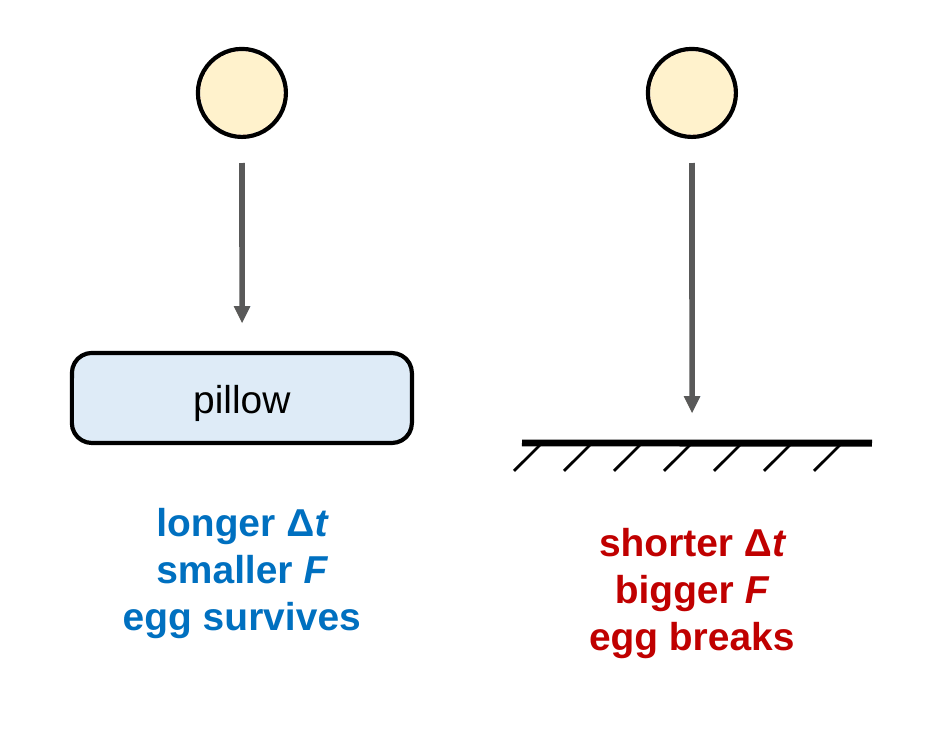
Safety gear works by stretching out the time it takes to stop. An airbag, the crumple zone of a car, and the foam in a helmet all make a collision last longer, so the force on your body is smaller. Bending your knees when you land from a jump does the same thing. An egg dropped on a pillow survives for the same reason, while the same egg dropped on a hard floor stops almost instantly and breaks.
Force-Time Graphs
- Area under the curve = impulse
- Rectangle: F × Δt
- Triangle: ½ × base × height
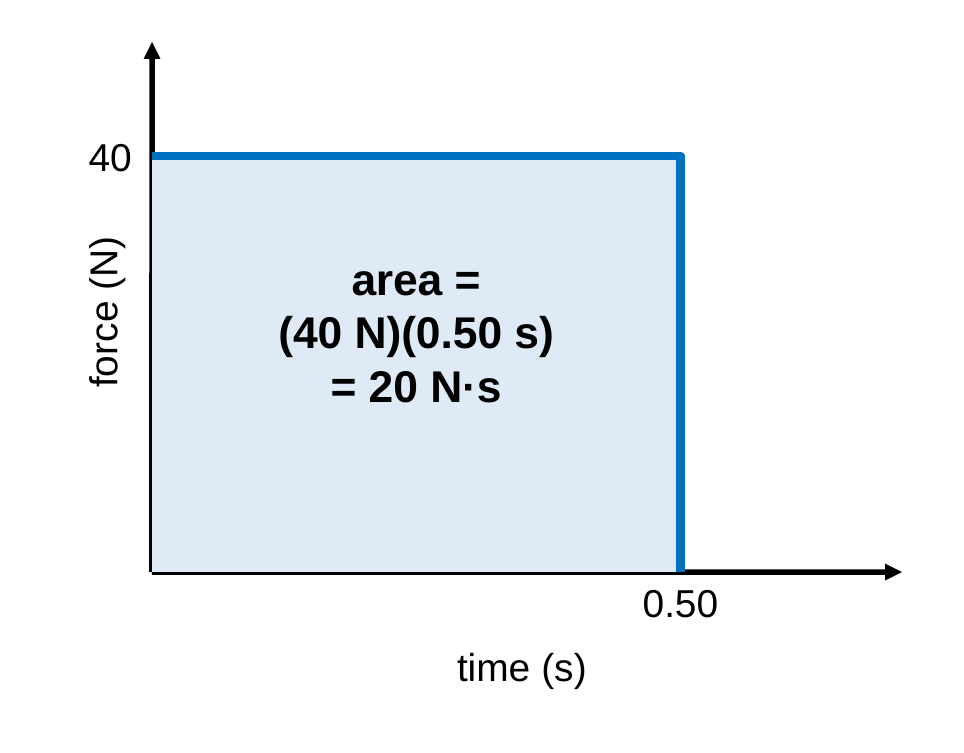
When force changes during a collision, use a force-time graph. The area under the curve equals the impulse. For a constant force, the area is a rectangle: here 40 N for 0.50 s gives 20 N·s. For a force that rises and falls in a straight line, the area is a triangle, ½ × base × height.
Worked Examples
Try each problem on your own first, then check your work against the solution.
Example 1: Finding Impulse
A hockey stick pushes a puck with an average force of 150 N for 0.080 s. What impulse does the stick give the puck?
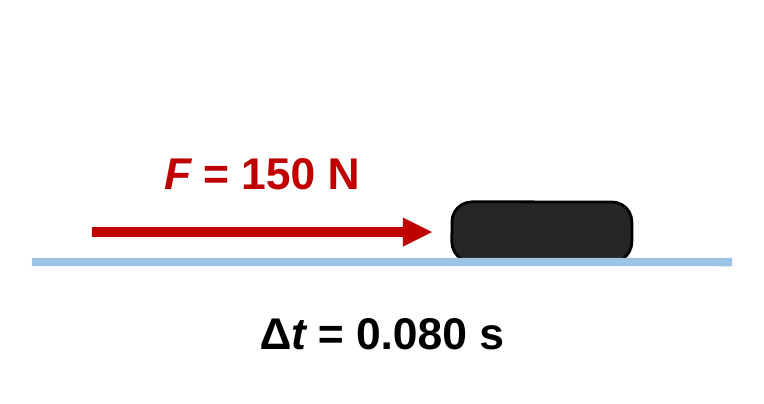
- Knowns: F = 150 N, Δt = 0.080 s
- Equation: J = FΔt
- Substitute: J = (150 N)(0.080 s)
- Answer: J = 12 N·s in the direction of the push. Two significant figures, because 0.080 s has two.
Example 2: Catching a Baseball
A 0.150 kg baseball moving right at 30.0 m/s is caught and stopped by a glove in 0.0500 s. What average force does the glove exert on the ball?
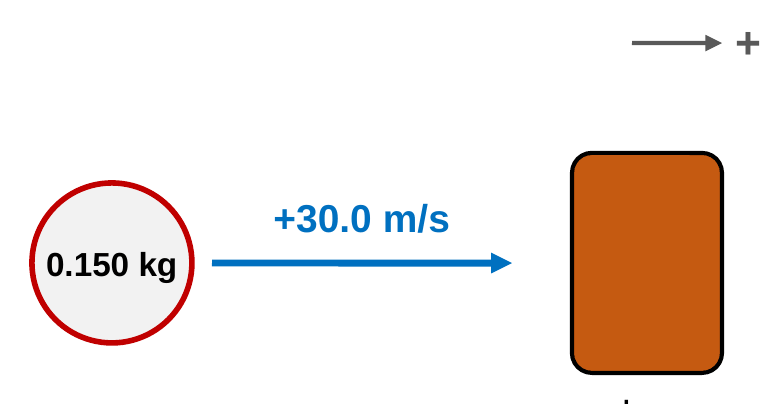
- Knowns: m = 0.150 kg, vi = +30.0 m/s, vf = 0 m/s, Δt = 0.0500 s
- Change in momentum: Δp = m(vf − vi) = (0.150 kg)(0 − 30.0 m/s) = −4.50 kg·m/s
- Equation: FΔt = Δp, so F = Δp/Δt
- Substitute: F = (−4.50 kg·m/s) / (0.0500 s)
- Answer: F = −90.0 N, or 90.0 N to the left. The glove pushes opposite the ball’s motion.
Example 3: Airbag vs. Dashboard
A 70.0 kg driver moving at 15.0 m/s is brought to a stop. Find the size of the average force on the driver if an airbag stops him in 0.300 s, and if the dashboard stops him in 0.0150 s.
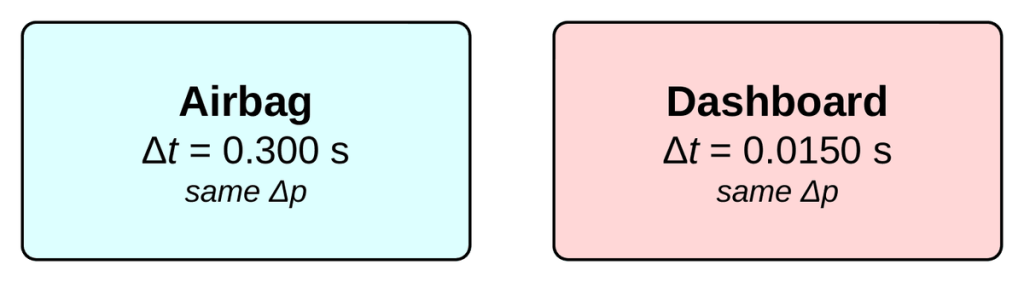
- Change in momentum: Δp = m(vf − vi) = (70.0 kg)(0 − 15.0 m/s) = −1,050 kg·m/s, so its size is 1,050 kg·m/s
- Equation: F = Δp/Δt
- Airbag: F = (1,050 kg·m/s) / (0.300 s) = 3.50 × 10³ N
- Dashboard: F = (1,050 kg·m/s) / (0.0150 s) = 7.00 × 10⁴ N
- Compare: The dashboard force is 20 times bigger, because the stop takes 1/20 of the time.
Example 4: Force-Time Graph
A 0.40 kg soccer ball at rest is kicked. The graph shows the force on the ball: it rises in a straight line from 0 N to 600 N at 0.010 s, then falls back to 0 N at 0.020 s. Find the impulse and the ball’s final speed.
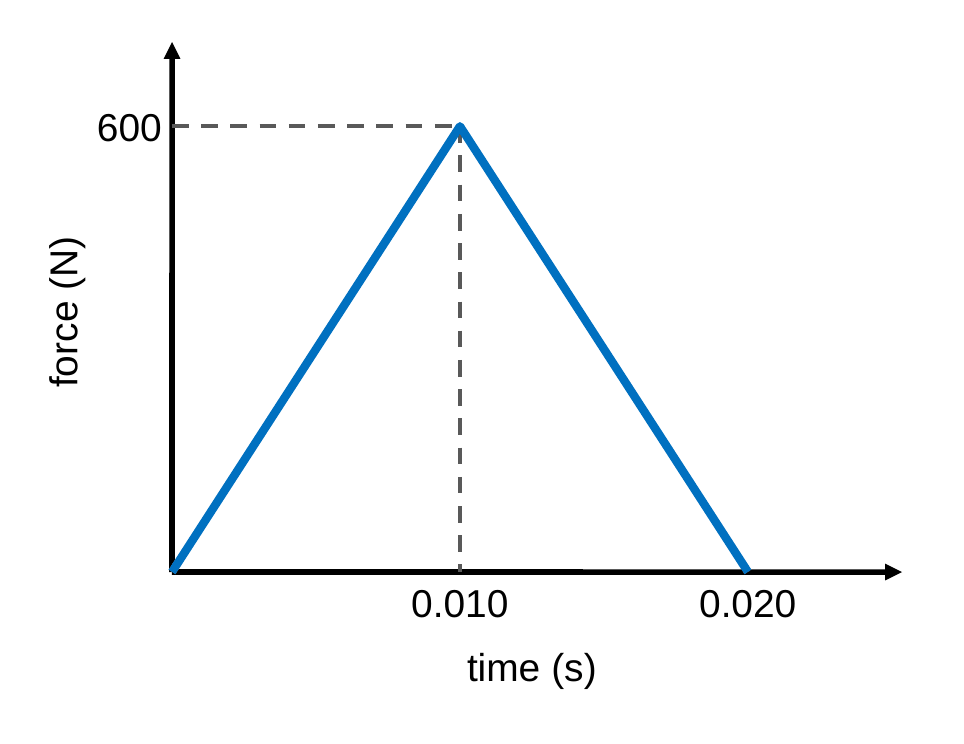
- Impulse is the area: The graph is a triangle with base 0.020 s and height 600 N.
- Area: J = ½ × base × height = ½ × (0.020 s)(600 N) = 6.0 N·s
- Change in momentum: J = Δp = m(vf − vi), and vi = 0, so vf = J/m
- Answer: vf = (6.0 N·s) / (0.40 kg) = 15 m/s
Big Ideas
- Impulse = force × time, J = FΔt
- Impulse = change in momentum, Δp
- More time means less force
- Area under F–t graph = impulse
Back to the essential question: a force changes an object’s momentum by giving it an impulse, the force times the time it acts, J = FΔt = Δp. Spreading a change in momentum over more time means a smaller force. Next up, we’ll see what happens to momentum when objects push on each other in conservation of momentum.

