
The video lesson for this topic is coming soon.
Essential Question
Why does a cannon roll backward when it fires?
When a cannon fires, the ball flies forward and the cannon jerks backward. By the end of this lesson, you should be able to explain this recoil with conservation of momentum and solve for a missing velocity or mass when objects that start at rest push apart.
Explosions
- Objects start together at rest
- Total p = 0 before
- Total p still = 0 after
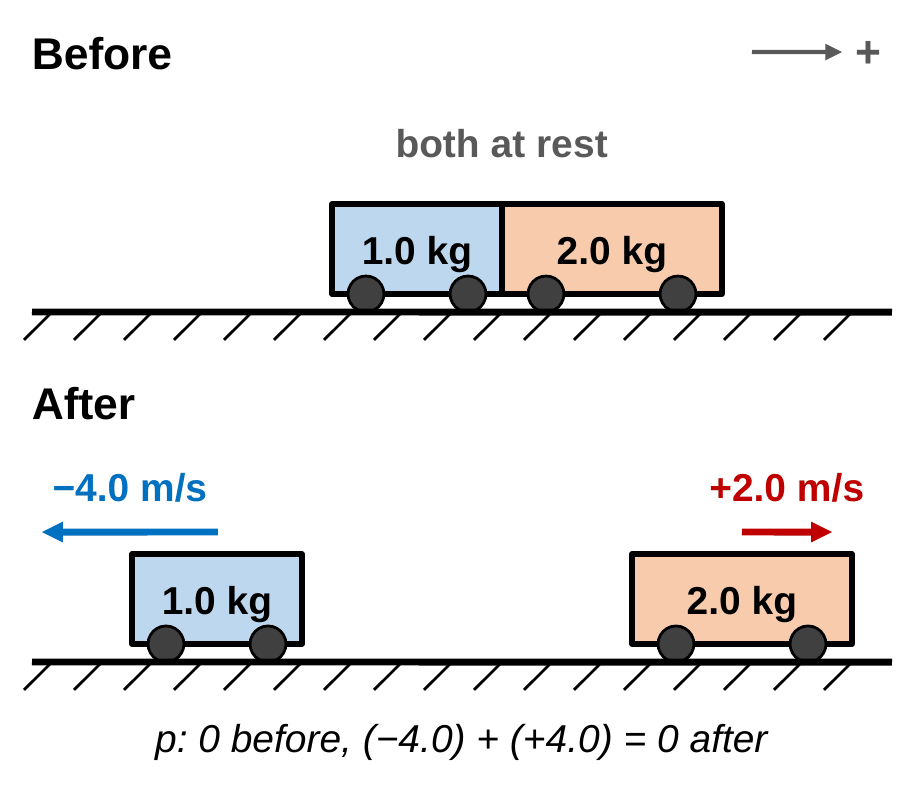
In physics, an explosion is any interaction where objects start together and push apart: a firework bursting, a spring shoving two carts apart, or two skaters pushing off each other. If the system starts at rest, its total momentum is zero, and by conservation of momentum the total must still be zero afterward. Here the 1.0 kg cart has −4.0 kg·m/s and the 2.0 kg cart has +4.0 kg·m/s, which add to zero.
The Explosion Equation
0 = m1v1′ + m2v2′
- The left side is zero because everything starts at rest
- Rearranged: m1v1′ = −m2v2′
- The minus sign means the pieces move in opposite directions
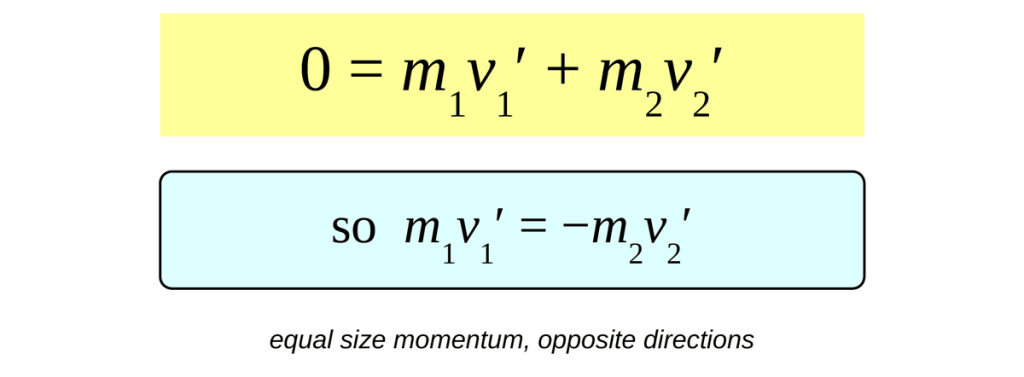
For a system that starts at rest, conservation of momentum becomes 0 = m1v1′ + m2v2′. Moving one term to the other side shows that the two pieces have momenta of equal size but opposite sign. So the pieces always fly apart in opposite directions, and the lighter piece moves faster.
Skater Push-Off
- They push on each other
- Equal and opposite impulses
- Lighter skater moves faster
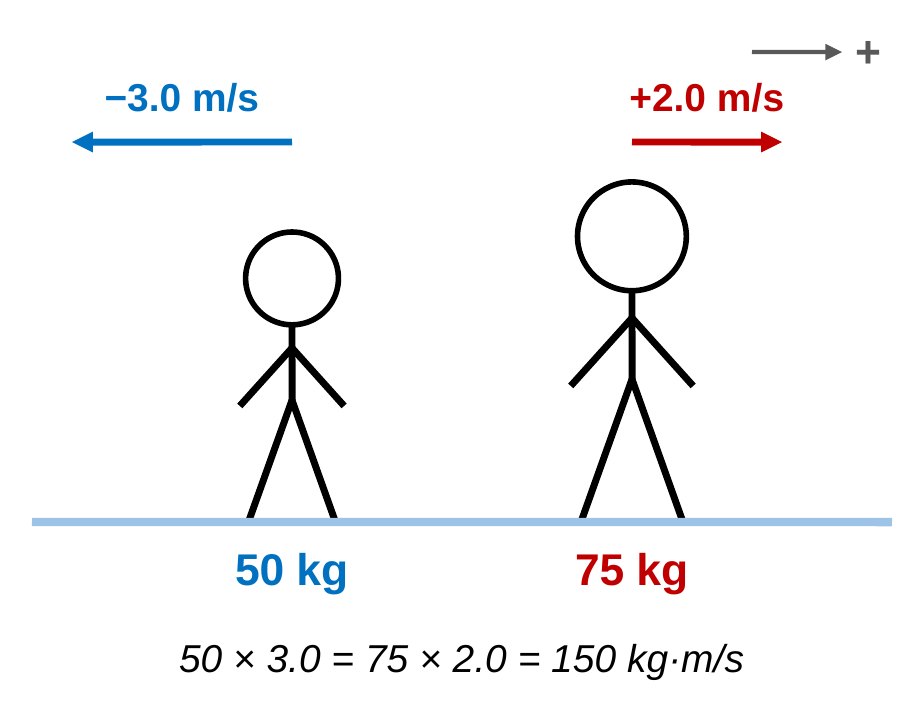
Two skaters standing still on ice push off each other. They push with equal and opposite forces for the same time, so they get equal and opposite impulses and move apart with equal and opposite momenta. The 50 kg skater moves left at 3.0 m/s and the 75 kg skater moves right at 2.0 m/s. Both have 150 kg·m/s of momentum, but the lighter skater moves faster.
Recoil
- The kick back from a launch
- Cannons, rifles, fire hoses
- Heavy launcher: slow recoil
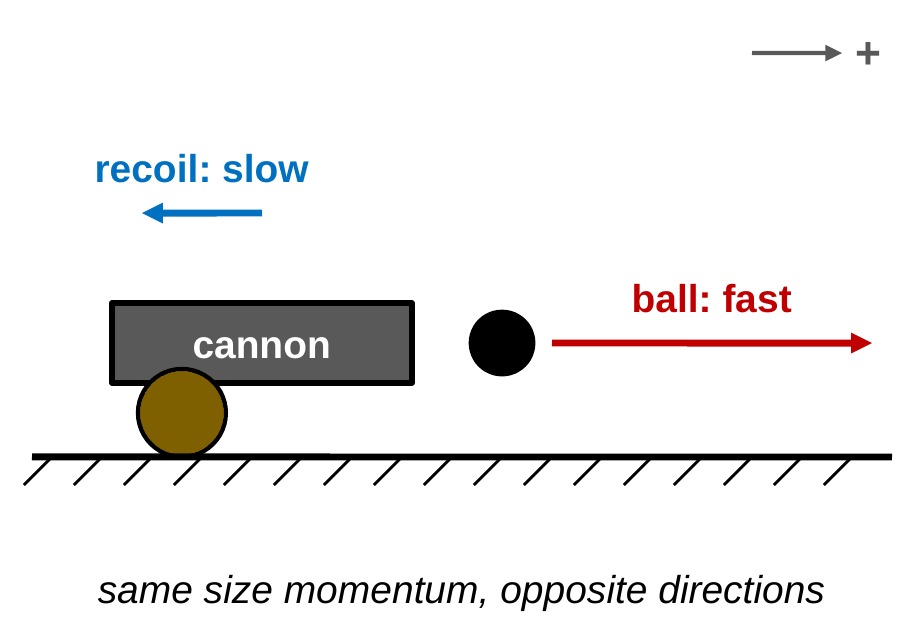
Recoil is the backward motion of an object that launches something forward. The cannon and ball start at rest, so their total momentum is zero. When the ball shoots forward, the cannon must get an equal amount of momentum backward. Because the cannon has far more mass than the ball, its recoil speed is much smaller. Rifles kick back against your shoulder, and fire hoses push back on firefighters, for the same reason.
Rockets
- Rocket pushes gas backward
- Gas pushes rocket forward
- Works in space: no air needed
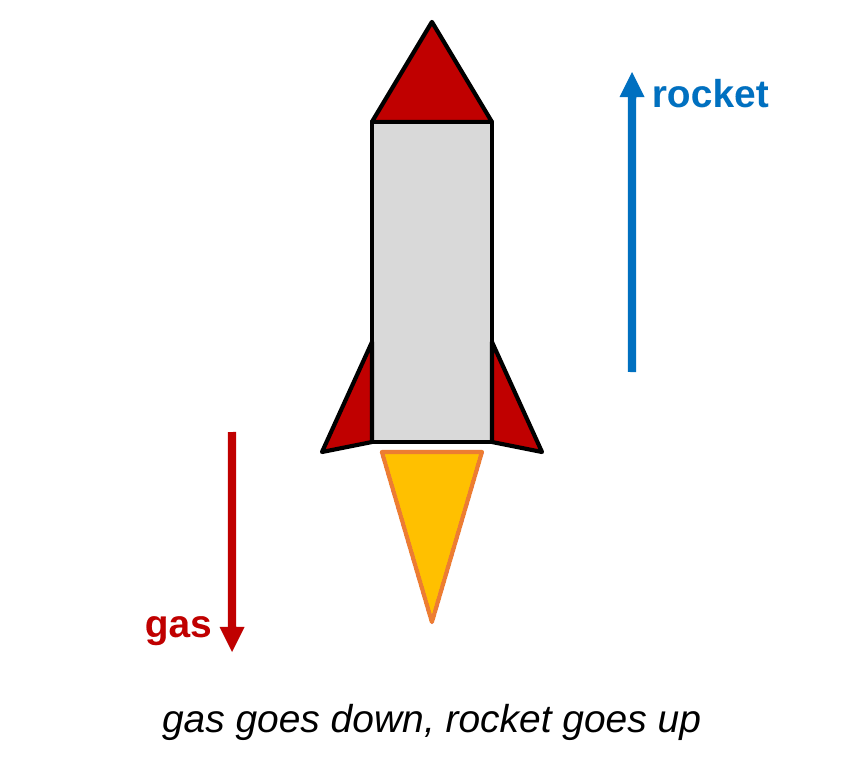
A rocket is a recoil machine. It shoves hot exhaust gas out the back at high speed, giving the gas momentum downward. The gas pushes back on the rocket, giving the rocket an equal amount of momentum upward. Because the rocket pushes on its own exhaust and not on the air, rockets work in the vacuum of space.
Worked Examples
Try each problem on your own first, then check your work against the solution.
Example 1: Cannon Recoil
An 800. kg cannon at rest fires a 15.0 kg cannonball to the right at 240 m/s. What is the recoil velocity of the cannon?
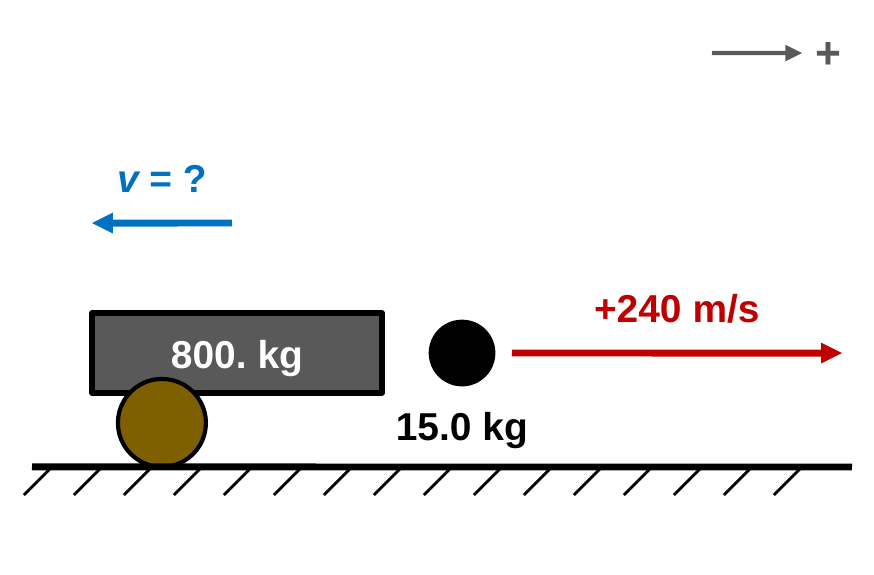
- Knowns: mc = 800. kg, mb = 15.0 kg, vb′ = +240 m/s, everything starts at rest
- Equation: 0 = mcvc′ + mbvb′, so vc′ = −mbvb′ / mc
- Ball’s momentum: mbvb′ = (15.0 kg)(+240 m/s) = +3,600 kg·m/s
- Substitute: vc′ = −(3,600 kg·m/s) / (800. kg)
- Answer: vc′ = −4.50 m/s, or 4.50 m/s to the left
Example 2: Skaters Pushing Off
A 45.0 kg skater and a 60.0 kg skater stand at rest on ice and push off each other. The 45.0 kg skater moves left at 2.40 m/s. What is the velocity of the 60.0 kg skater?
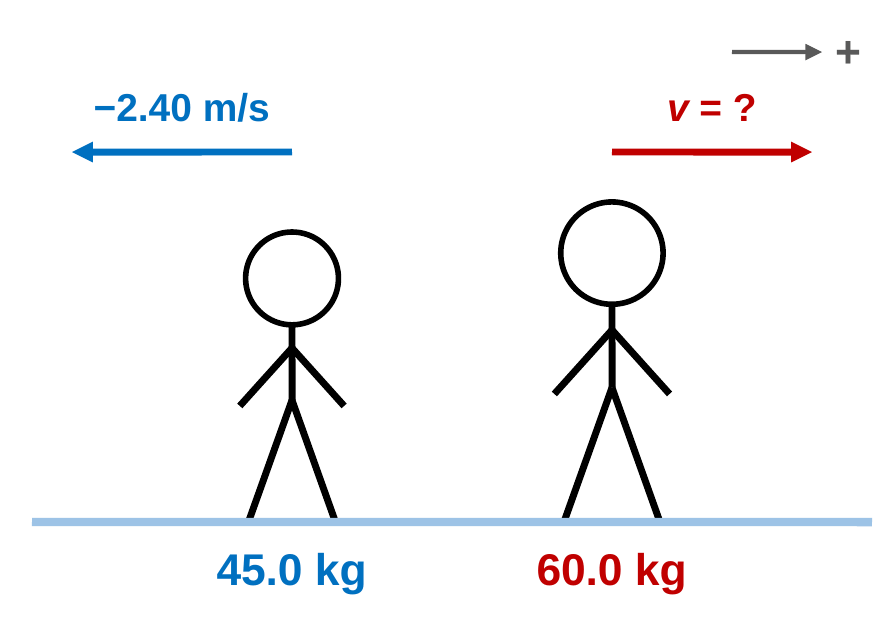
- Knowns: m1 = 45.0 kg, v1′ = −2.40 m/s, m2 = 60.0 kg, both start at rest
- Equation: 0 = m1v1′ + m2v2′, so v2′ = −m1v1′ / m2
- First skater’s momentum: (45.0 kg)(−2.40 m/s) = −108 kg·m/s
- Substitute: v2′ = −(−108 kg·m/s) / (60.0 kg) = +108 / 60.0
- Answer: v2′ = +1.80 m/s, or 1.80 m/s to the right
Example 3: Finding a Mass
A compressed spring pushes two carts apart from rest. The 1.5 kg cart moves left at 2.0 m/s, and the other cart moves right at 0.75 m/s. What is the mass of the other cart?
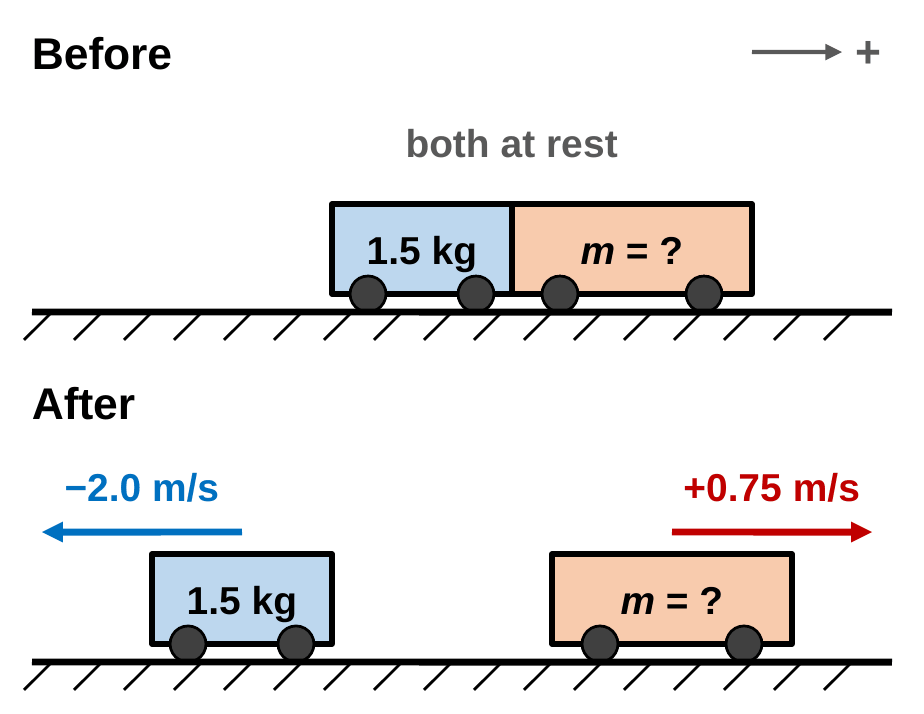
- Knowns: m1 = 1.5 kg, v1′ = −2.0 m/s, v2′ = +0.75 m/s, both start at rest
- Equation: 0 = m1v1′ + m2v2′, so m2 = −m1v1′ / v2′
- First cart’s momentum: (1.5 kg)(−2.0 m/s) = −3.0 kg·m/s
- Substitute: m2 = −(−3.0 kg·m/s) / (+0.75 m/s) = 3.0 / 0.75
- Answer: m2 = 4.0 kg
Example 4: Throwing from a Canoe
A 60.0 kg student stands in a 40.0 kg canoe at rest. She throws a 5.0 kg backpack to the right at 8.0 m/s. What is the velocity of the student and canoe? (Ignore the water.)
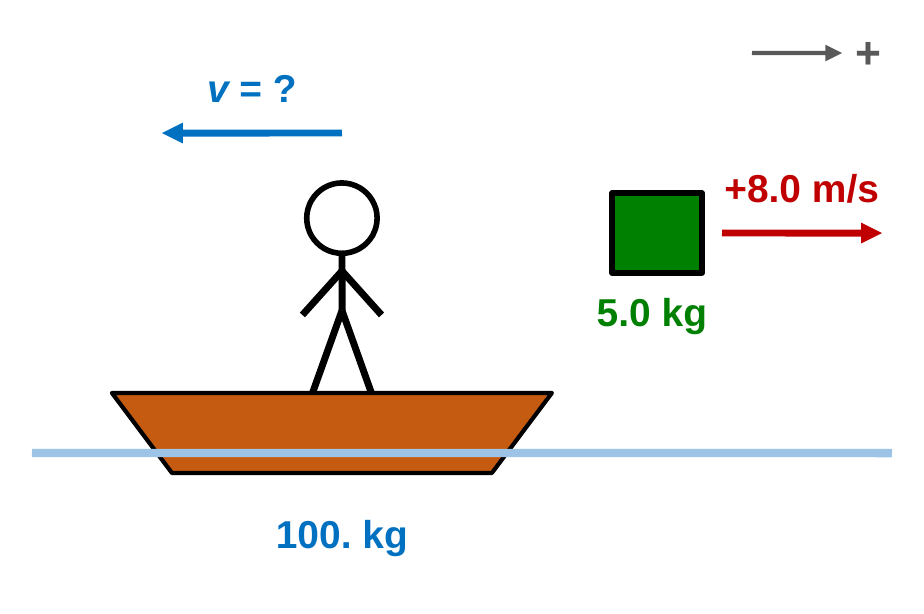
- System: Student + canoe + backpack, all starting at rest. Student and canoe move together: m1 = 60.0 kg + 40.0 kg = 100. kg
- Equation: 0 = m1v1′ + m2v2′, so v1′ = −m2v2′ / m1
- Backpack’s momentum: (5.0 kg)(+8.0 m/s) = +40. kg·m/s
- Substitute: v1′ = −(40. kg·m/s) / (100. kg)
- Answer: v1′ = −0.40 m/s, or 0.40 m/s to the left
Big Ideas
- Start at rest: total p = 0
- Pieces move in opposite directions
- Lighter piece moves faster
- Recoil: launcher kicks backward
Back to the essential question: a cannon rolls backward because the system starts at rest with zero momentum, and the total must still be zero after it fires. The ball’s forward momentum is balanced by the cannon’s backward momentum, and because the cannon is so heavy, it moves much more slowly. This wraps up our unit on impulse and momentum. Next, we’ll start a new unit on energy, beginning with work.

