
The video lesson for this topic is coming soon.
Essential Question
What makes a moving object hard to stop?
A bowling ball is harder to stop than a baseball, and a fast ball is harder to stop than a slow one. By the end of this lesson, you should be able to calculate momentum with p = mv and explain why its direction matters.
What Is Momentum?
- Mass in motion
- Depends on mass and velocity
- Big momentum = hard to stop
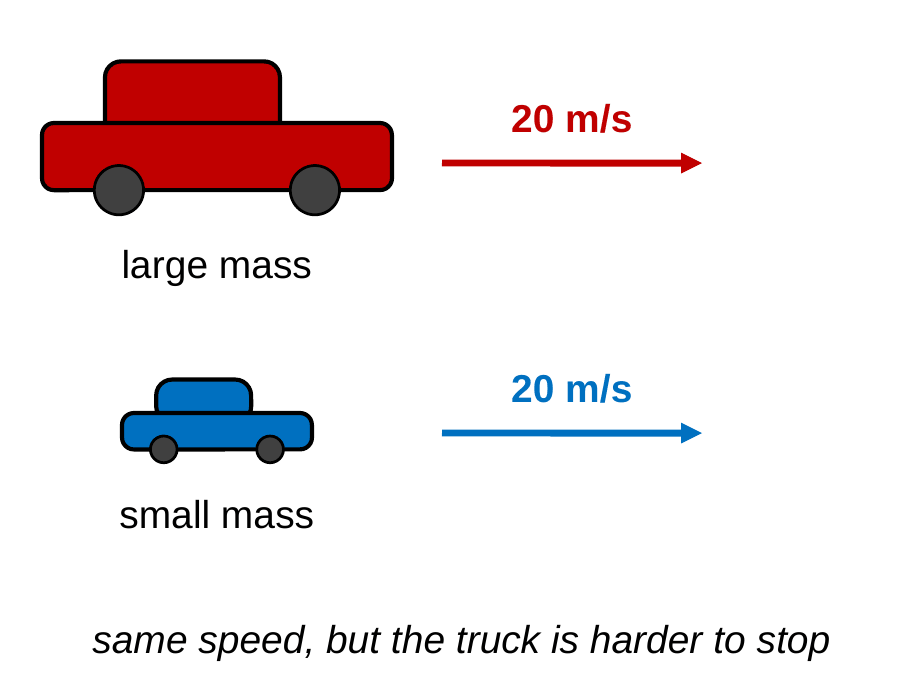
Momentum is mass in motion. A truck and a small car moving at the same speed do not have the same momentum, because the truck has much more mass. The more momentum an object has, the harder it is to stop. A fast object also has more momentum than the same object moving slowly.
The Momentum Equation
p = mv
- p = momentum, in kilogram meters per second (kg·m/s)
- m = mass, in kilograms (kg)
- v = velocity, in meters per second (m/s)
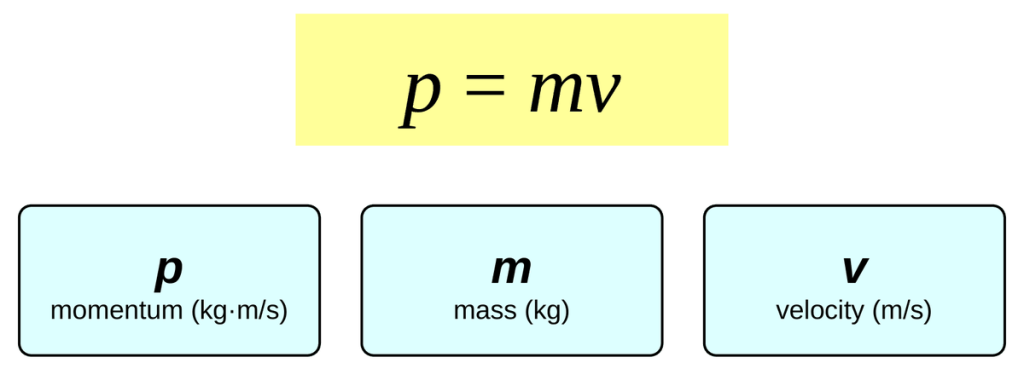
Momentum is mass times velocity. Multiplying kilograms by meters per second gives kilogram meters per second, kg·m/s. Momentum does not have its own special unit name, so we just write the units out.
Mass vs. Velocity
- Double the mass: double p
- Double the velocity: double p
- Light and fast can match heavy and slow
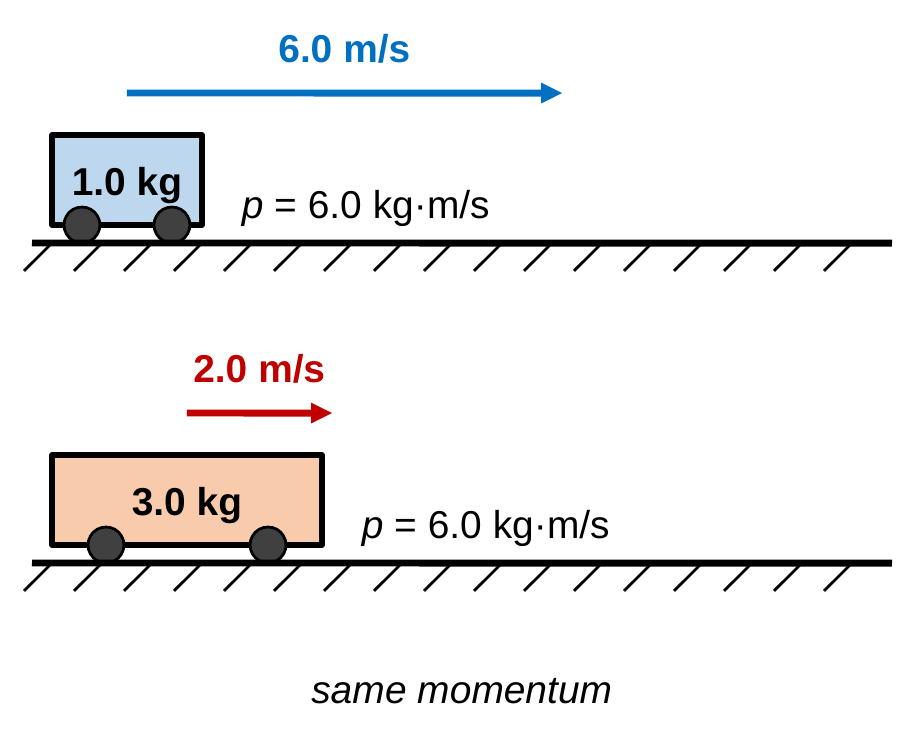
Mass and velocity count equally in momentum. A 1.0 kg cart moving at 6.0 m/s has a momentum of 6.0 kg·m/s. A 3.0 kg cart moving at only 2.0 m/s has the same momentum, 6.0 kg·m/s. Three times the mass makes up for one third of the velocity.
Momentum Is a Vector
- Points the same way as v
- Pick right as positive
- Moving left: negative p
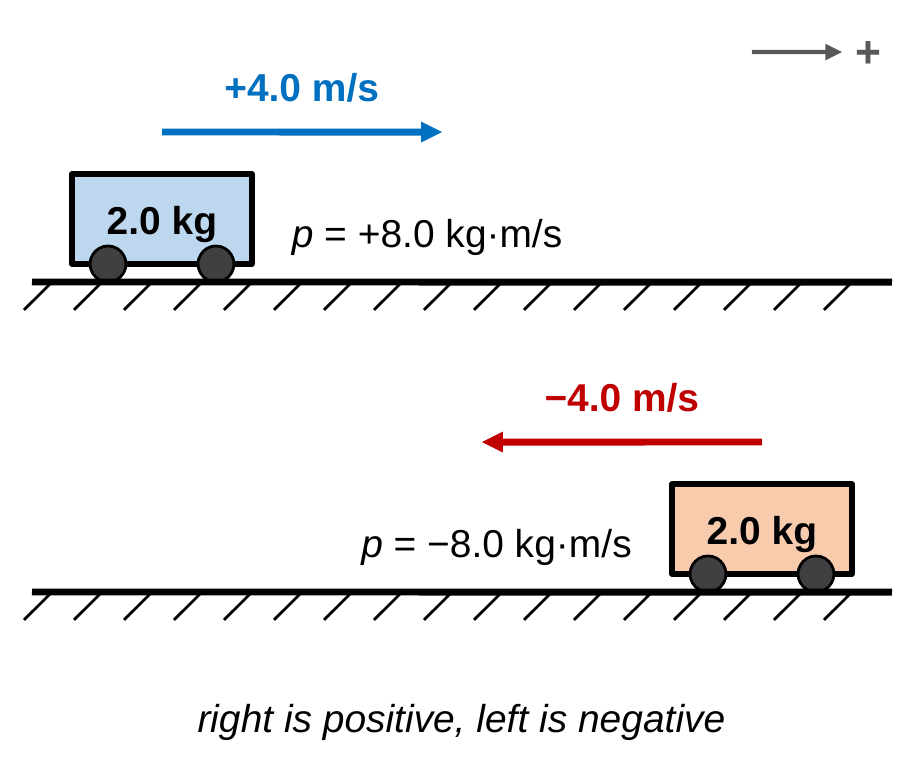
Momentum is a vector, so it has a direction, the same direction as the velocity. In one dimension we pick a positive direction. In this unit, right is positive. A 2.0 kg cart moving right at 4.0 m/s has a momentum of +8.0 kg·m/s. The same cart moving left has a momentum of −8.0 kg·m/s. The minus sign just means “to the left.”
Object vs. System Momentum
- System: the objects we choose
- Total p = add each p
- Keep the signs!
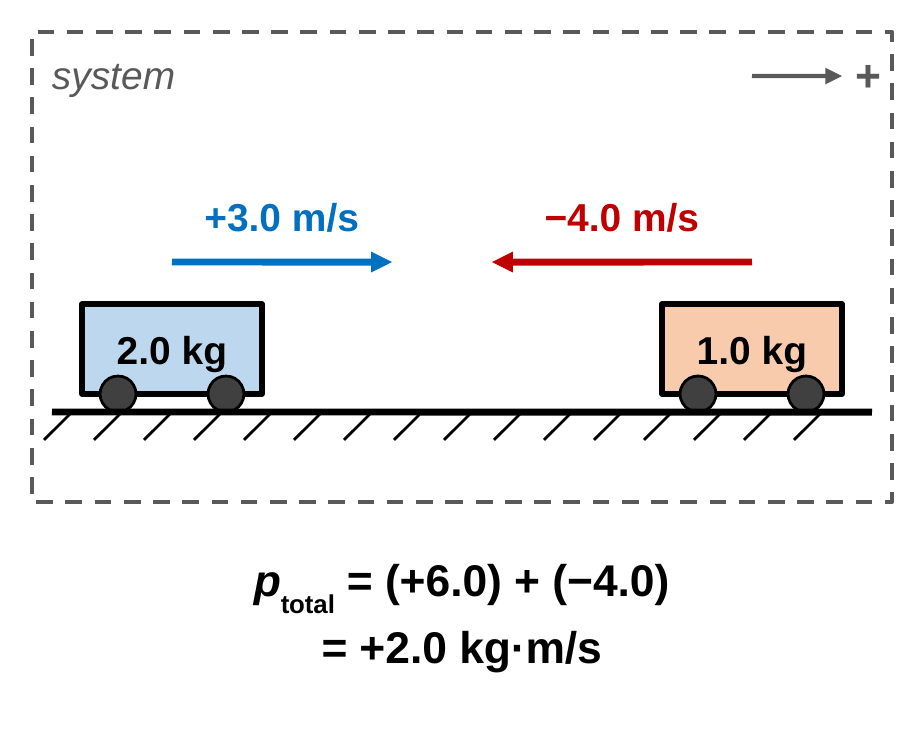
A system is the group of objects we decide to study. The momentum of the system is the sum of the momenta of every object in it, and because momentum is a vector, the signs matter. Here the 2.0 kg cart has +6.0 kg·m/s and the 1.0 kg cart has −4.0 kg·m/s, so the system’s total momentum is +2.0 kg·m/s.
Worked Examples
Try each problem on your own first, then check your work against the solution.
Example 1: Momentum of a Baseball
A pitcher throws a 0.145 kg baseball at 40.0 m/s toward home plate, which is east. What is the ball’s momentum?
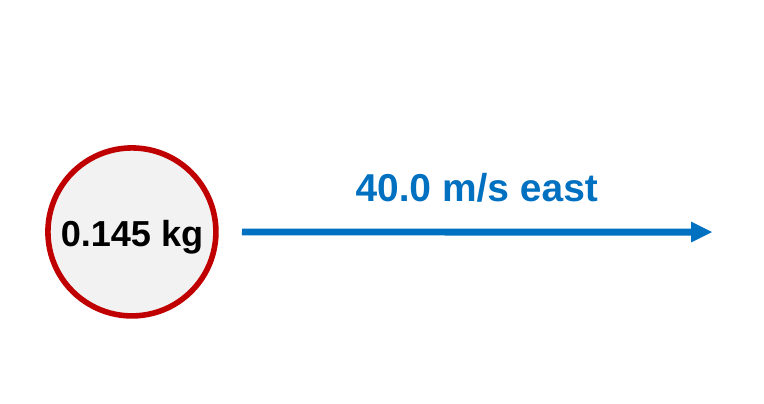
- Knowns: m = 0.145 kg, v = 40.0 m/s east
- Equation: p = mv
- Substitute: p = (0.145 kg)(40.0 m/s)
- Answer: p = 5.80 kg·m/s east. Momentum is a vector, so include the direction.
Example 2: Finding Velocity
A 1,250 kg car has a momentum of 3.00 × 10⁴ kg·m/s north. How fast is it going?
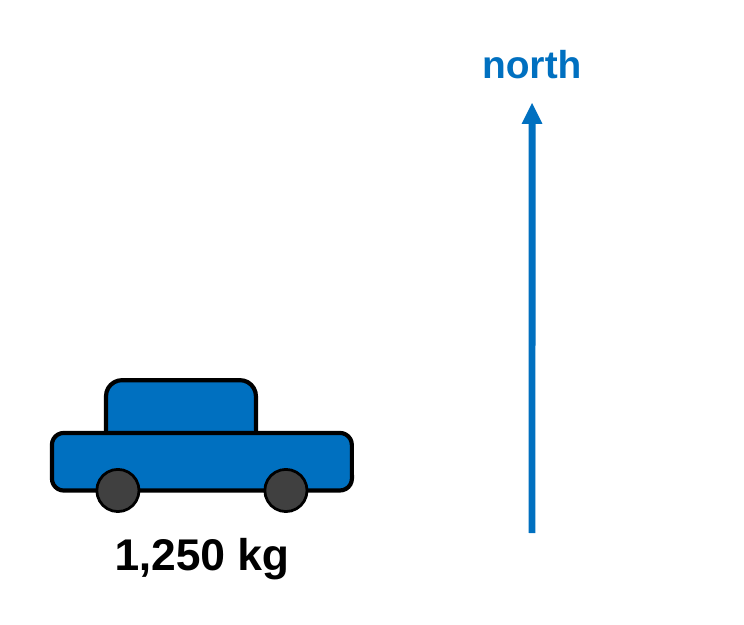
- Knowns: m = 1,250 kg, p = 3.00 × 10⁴ kg·m/s north
- Equation: p = mv, so v = p/m
- Substitute: v = (3.00 × 10⁴ kg·m/s) / 1,250 kg. Kilograms cancel, leaving m/s.
- Answer: v = 24.0 m/s north
Example 3: Finding Mass
A bowling ball rolls down the lane at 3.50 m/s. Its momentum is 21.0 kg·m/s. What is its mass?
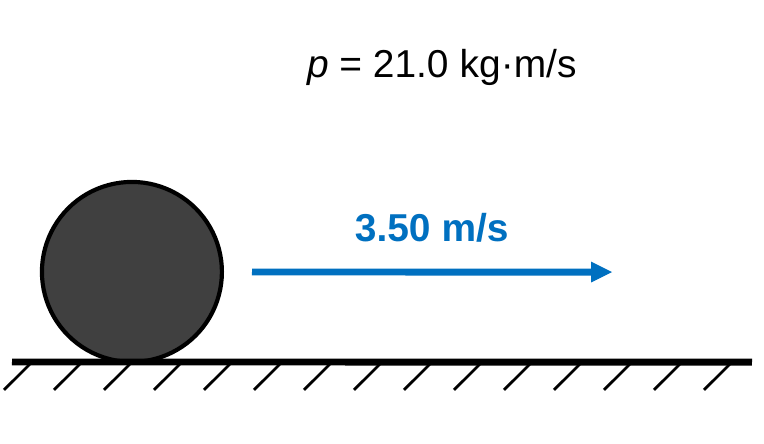
- Knowns: v = 3.50 m/s, p = 21.0 kg·m/s
- Equation: p = mv, so m = p/v
- Substitute: m = (21.0 kg·m/s) / (3.50 m/s). The m/s cancels, leaving kg.
- Answer: m = 6.00 kg
Example 4: Total Momentum
A 2.0 kg cart rolls right at 3.0 m/s. A 4.0 kg cart rolls left at 2.5 m/s. What is the total momentum of the two-cart system?
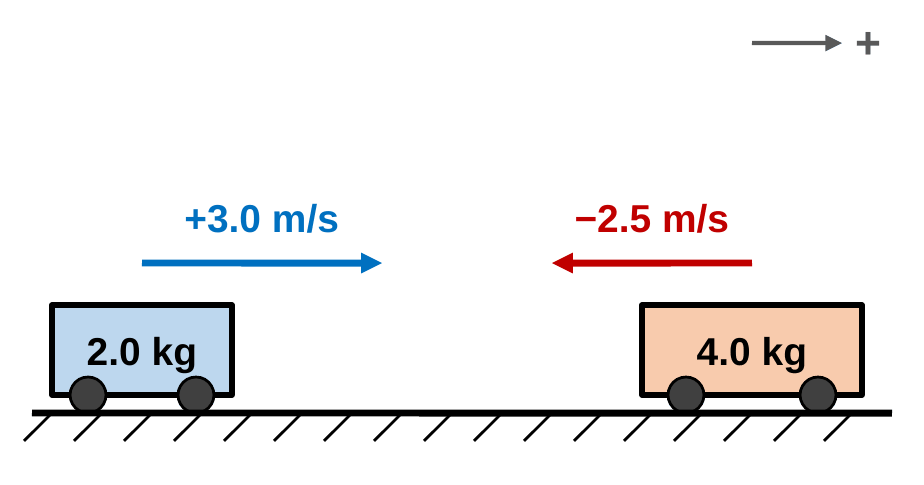
- Signs: Right is positive, so v1 = +3.0 m/s and v2 = −2.5 m/s
- Each momentum: p1 = (2.0 kg)(+3.0 m/s) = +6.0 kg·m/s and p2 = (4.0 kg)(−2.5 m/s) = −10. kg·m/s
- Add: ptotal = (+6.0) + (−10.) = −4.0 kg·m/s
- Answer: ptotal = 4.0 kg·m/s to the left. The negative sign means left.
Big Ideas
- Momentum = mass × velocity, p = mv
- Units: kg·m/s
- Vector: right +, left −
- System p = sum of each p, with signs
Back to the essential question: a moving object is hard to stop when it has a lot of momentum, which depends on both its mass and its velocity, p = mv. Next up, we’ll look at impulse, which explains how a force changes an object’s momentum.

