
The video lesson for this topic is coming soon.
Essential Question
How do we combine quantities that have a direction?
Many quantities in physics, like force, velocity, and displacement, have a direction as well as a size, and direction changes how they add together. By the end of this lesson, you should be able to add vectors tip to tail and break a vector into horizontal and vertical components.
Vector or Scalar?
- Scalar: size only
- Vector: size and direction
- Force, velocity, displacement are vectors
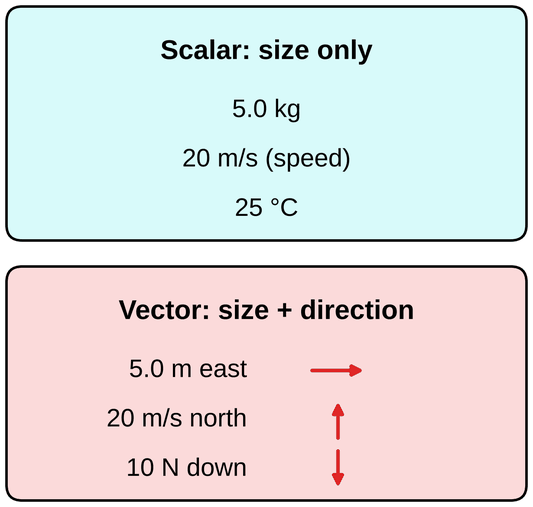
A scalar has only a size, such as a mass of 5.0 kg or a temperature of 25 °C. A vector has a size, called its magnitude, and a direction, such as a displacement of 5.0 m east or a force of 10 N down. Speed is a scalar, but velocity, which includes direction, is a vector. Force, velocity, and displacement are the vectors you will use most in physics.
Drawing Vectors as Arrows
- Arrow length shows the size
- Arrow points in the direction
- Use a scale, like 1 square = 10 N
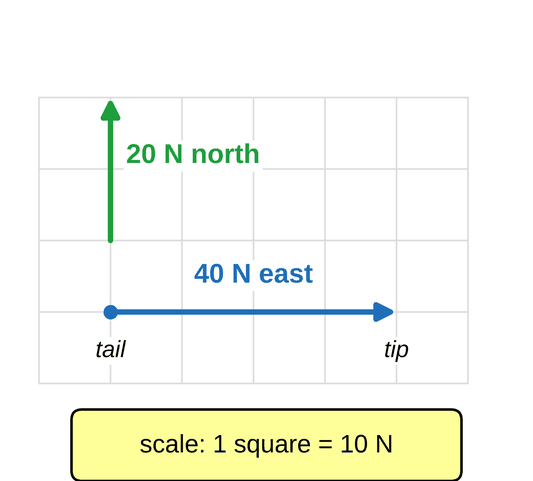
A vector is drawn as an arrow. The arrow points in the vector’s direction, and its length shows the magnitude using a scale. With a scale of 1 square = 10 N, a 40 N force east is an arrow 4 squares long pointing right, and a 20 N force north is 2 squares long pointing up. The start of the arrow is the tail and the pointed end is the tip.
Adding Vectors Tip to Tail
- Put the tail of B at the tip of A
- Resultant: start of A to end of B
- Order does not matter
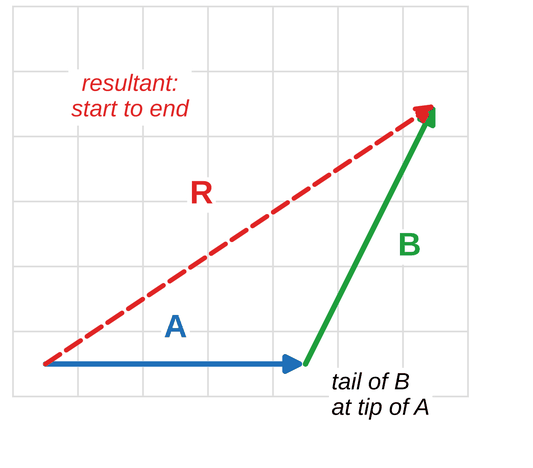
To add vectors, place them tip to tail: draw the first vector, then move the second one, without changing its length or direction, so its tail starts at the first vector’s tip. The resultant, R, is the arrow from the tail of the first vector to the tip of the last. It shows the overall effect, such as where you end up after two moves. Adding the vectors in a different order gives the same resultant.
Same or Opposite Directions
- Same direction: add the sizes
- Opposite directions: subtract, keep the bigger direction
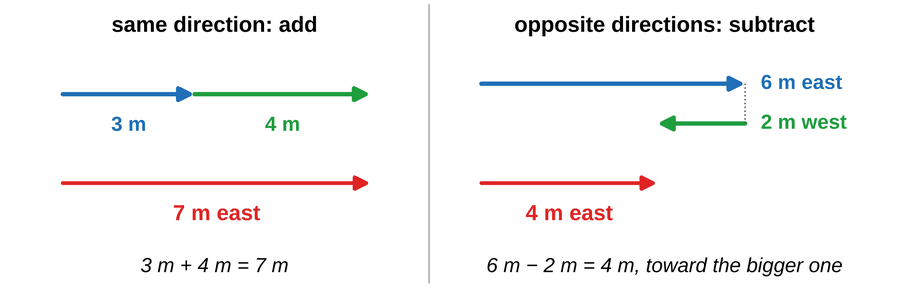
When two vectors point in the same direction, add their sizes: 3 m east + 4 m east = 7 m east. When they point in opposite directions, subtract the smaller size from the larger, and the resultant points in the direction of the larger vector: 6 m east + 2 m west = 4 m east. This is how you find the net force when two forces pull against each other.
Perpendicular Vectors
- 90° apart: a right triangle
- Resultant is the hypotenuse
- Use the Pythagorean theorem
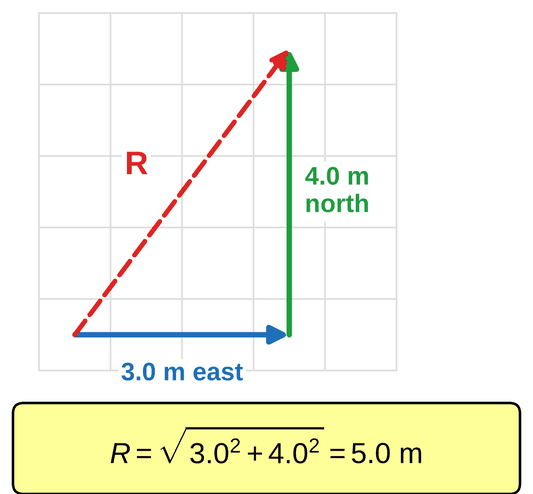
When two vectors are perpendicular (90° apart), placing them tip to tail makes a right triangle, and the resultant is the hypotenuse. Use the Pythagorean theorem to find its size: R = √(A2 + B2). For 3.0 m east and 4.0 m north, R = √(9.0 + 16) = 5.0 m, not 7.0 m. The direction of the resultant can be found with inverse tangent: tan−1(4.0 ÷ 3.0) ≈ 53° north of east.
Breaking a Vector into Parts
- Horizontal part: R cos θ
- Vertical part: R sin θ
- θ measured from the horizontal
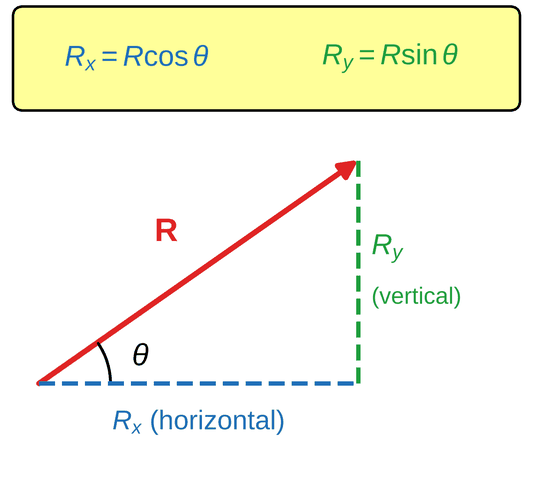
Any vector can be split into two perpendicular components: a horizontal part Rx and a vertical part Ry. The vector is the hypotenuse of the right triangle they form, so when the angle θ is measured from the horizontal, Rx = R cos θ and Ry = R sin θ. For example, 10 m at 30° has Rx = 10 cos 30° = 8.7 m and Ry = 10 sin 30° = 5.0 m. If the angle is measured from the vertical instead, sine and cosine switch places.
Worked Examples
Try each problem on your own first, then check your work against the solution.
Example 1: Tug of War
In a tug of war, one team pulls the rope west with 380 N. The other team pulls east with 425 N. What is the net force on the rope?
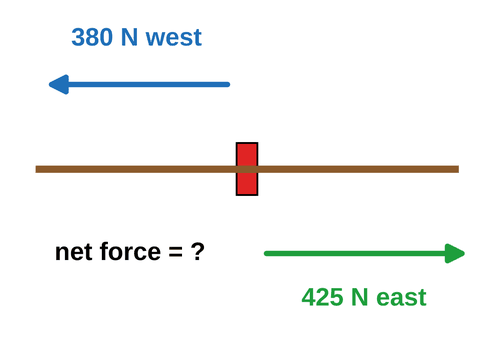
- Check directions: 380 N west and 425 N east point in opposite directions
- Subtract: 425 N − 380 N = 45 N
- Direction: the larger force points east
- Answer: 45 N east
Example 2: Walk to School
A student walks 1.5 km east, then 0.80 km north. What is the size of the student’s displacement from home?
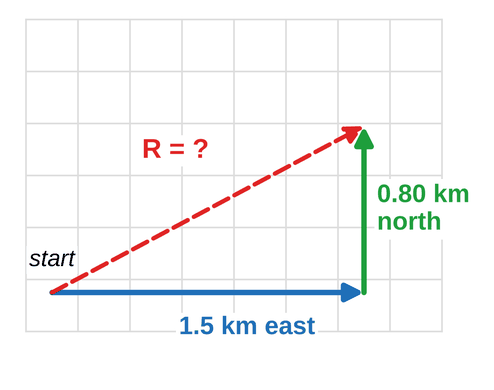
- Check directions: east and north are perpendicular, so use the Pythagorean theorem
- Set up: R = √((1.5 km)2 + (0.80 km)2)
- Square and add: 2.25 km2 + 0.64 km2 = 2.89 km2
- Square root: R = √(2.89 km2) = 1.7 km
- Check: longer than 1.5 km, shorter than 1.5 km + 0.80 km = 2.3 km
- Answer: 1.7 km (about 28° north of east)
Example 3: Kicked Soccer Ball
A soccer ball is kicked at 22 m/s at an angle of 40° above the ground. Find the horizontal and vertical components of its velocity.
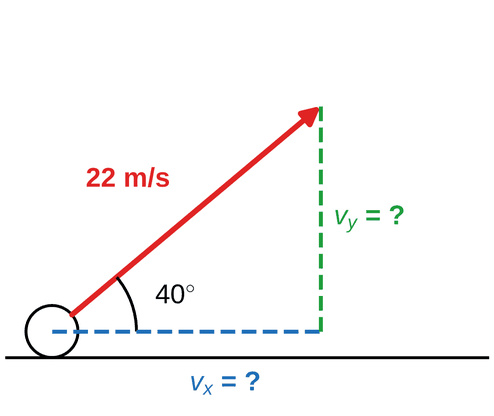
- Identify: v = 22 m/s at θ = 40° above the horizontal
- Horizontal component: vx = (22 m/s)(cos 40°) = 16.85 m/s
- Vertical component: vy = (22 m/s)(sin 40°) = 14.14 m/s
- Check: both are less than 22 m/s, and vx > vy because 40° is less than 45°
- Answer: vx = 17 m/s, vy = 14 m/s
Big Ideas
- Vectors have size and direction
- Add vectors tip to tail
- Perpendicular: Pythagorean theorem
- Components: R cos θ and R sin θ
Back to the essential question: quantities with direction are combined as vectors, by placing them tip to tail and drawing the resultant from start to finish. Same-direction vectors add, opposite ones subtract, and perpendicular ones combine with the Pythagorean theorem, while components (R cos θ and R sin θ) let you split a vector back into horizontal and vertical parts.
Practice Problems
Choose an answer. If it is not right, read the hint and try again. You can skip any question.
Question 1 of 5
Which of these quantities is a vector?
AA speed of 25 m/s
Not quite. Speed has only a size. It becomes a vector, velocity, only when a direction is included.
BA mass of 3.0 kg
Not quite. Mass has a size but no direction, so it is a scalar.
CA temperature of 20 °C
Not quite. Temperature has no direction, so it is a scalar. Look for a quantity that includes a direction.
DA force of 15 N upward
Correct! This quantity has both a magnitude (15 N) and a direction (upward), so it is a vector.
Next question
Skip this question
Question 2 of 5
Two forces act on a box: 12 N east and 5 N west. What is the net force?
A7 N east
Correct! The forces point in opposite directions, so subtract (12 N − 5 N) and use the direction of the larger force.
B17 N east
Not quite. Adding sizes only works when vectors point the same way. These forces pull against each other.
C7 N west
Not quite. The size is right, but the resultant points in the direction of the larger force.
D13 N
Not quite. The Pythagorean theorem is for perpendicular vectors. East and west are opposite directions on the same line.
Next question
Skip this question
Question 3 of 5
A hiker walks 2.4 km north, then 1.0 km east. What is the size of the hiker’s displacement from the start?
A3.4 km
Not quite. Adding the sizes only works for vectors in the same direction. North and east are perpendicular, so they form a right triangle.
B2.6 km
Correct! North and east are perpendicular, so R = √((2.4 km)2 + (1.0 km)2) = √(6.76 km2) = 2.6 km.
C1.4 km
Not quite. Subtracting is for vectors pointing in opposite directions. North and east are 90° apart.
D6.8 km
Not quite. You squared and added correctly, but there is one more step in the Pythagorean theorem to get back to km.
Next question
Skip this question
Question 4 of 5
A ball is thrown at 15 m/s at an angle of 35° above the horizontal. What is the vertical component of its velocity?
A12 m/s
Not quite. This is the horizontal component. When the angle is measured from the horizontal, the vertical part uses a different trig function.
B−6.4 m/s
Not quite. A negative answer for an upward throw is a sign the calculator is in radian mode. Switch to degree mode.
C8.6 m/s
Correct! With the angle measured from the horizontal, vy = (15 m/s)(sin 35°) = 8.6 m/s.
D26 m/s
Not quite. A component can never be larger than the vector itself. Multiply the speed by the trig ratio instead of dividing.
Next question
Skip this question
Question 5 of 5
A boat heads east at 4.0 m/s while the river current pushes it south at 3.0 m/s. At what angle south of east does the boat actually move?
A37°
Correct! Measured from east, south is opposite and east is adjacent, so θ = tan−1(3.0 ÷ 4.0) = 37°.
B53°
Not quite. The ratio is flipped, which gives the angle measured from south. For an angle south of east, put the south part on top.
C0.64°
Not quite. This answer is in radians. Set the calculator to degree mode and use inverse tangent again.
D49°
Not quite. Sine needs the hypotenuse, which is the resultant here, not the 4.0 m/s part. Use the ratio of the two perpendicular parts.
Finish
Skip this question
Nice work! You reached the end of the practice problems.
Reload the page to try them again, including any questions you skipped.

