
The video lesson for this topic is coming soon.
Essential Question
How do objects move when only gravity acts on them?
Drop your phone or toss a ball straight up, and gravity takes over the moment it leaves your hand. By the end of this lesson, you should be able to describe free fall with words, graphs, and the kinematic equations, using g = 9.8 m/s2.
What Is Free Fall?
- Only gravity acts on the object
- We ignore air resistance
- Heavy and light objects fall together
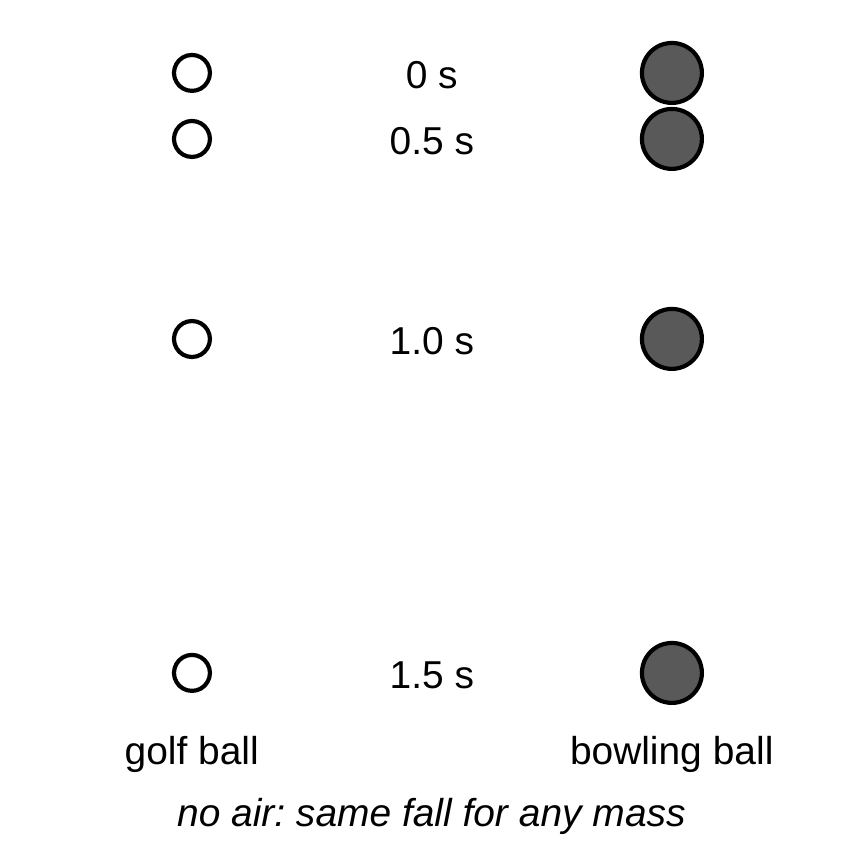
An object is in free fall when gravity is the only force acting on it. In real life air pushes back a little, but for dense objects over short drops we can ignore air resistance. Without air, a golf ball and a bowling ball dropped together stay side by side the whole way down. The growing gaps in the picture show that both balls speed up as they fall.
Acceleration Due to Gravity
- g = 9.8 m/s2 downward
- Falling speed grows 9.8 m/s each second
- Up is positive, so a = −9.8 m/s2
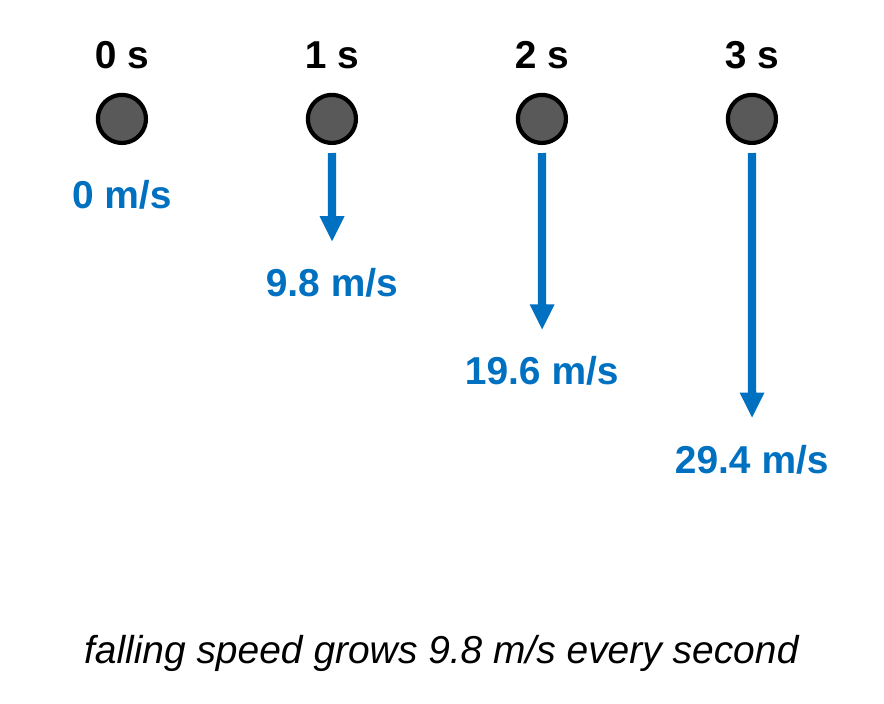
Near Earth’s surface, gravity makes every freely falling object accelerate at 9.8 m/s2 downward. That number is called g. It means a falling object’s speed grows by 9.8 m/s every second. In this unit we treat up as positive, so the acceleration of any object in free fall is a = −9.8 m/s2. The minus sign means the acceleration points down.
Dropped from Rest
- Starts at vi = 0 m/s
- Speeds up as it falls
- Graph: a straight line sloping down
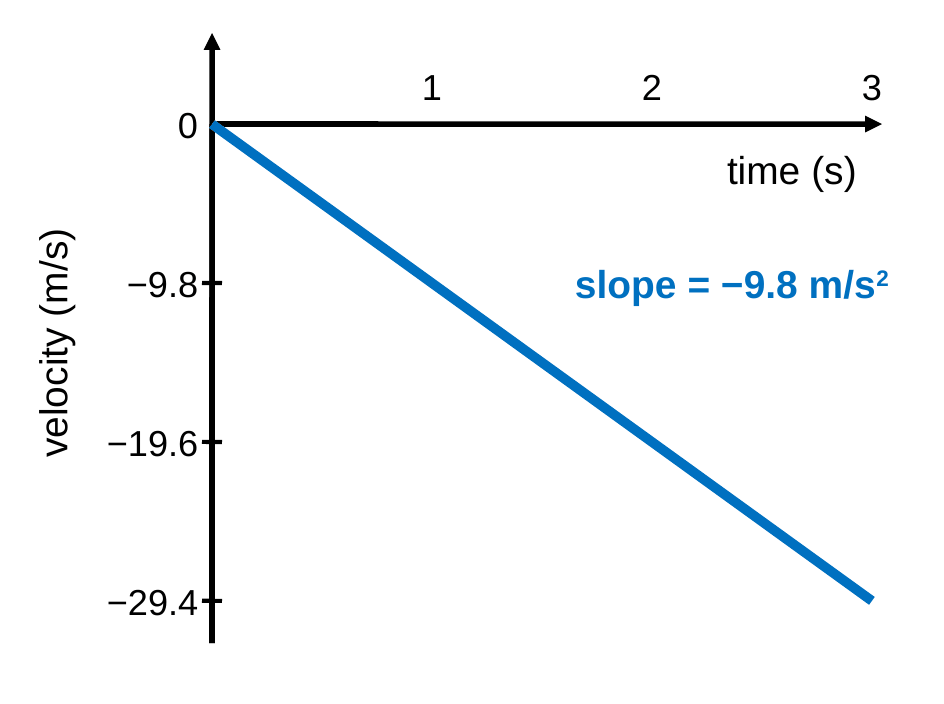
When you drop something, it starts from rest, so vi = 0 m/s. As it falls, its velocity becomes more and more negative (faster and faster downward). On a velocity-time graph this is a straight line sloping down, because the slope of a v-t graph is acceleration and the acceleration is a constant −9.8 m/s2.
Tossed Straight Up
- Slows down on the way up
- Stops for an instant at the top
- Speeds up on the way down
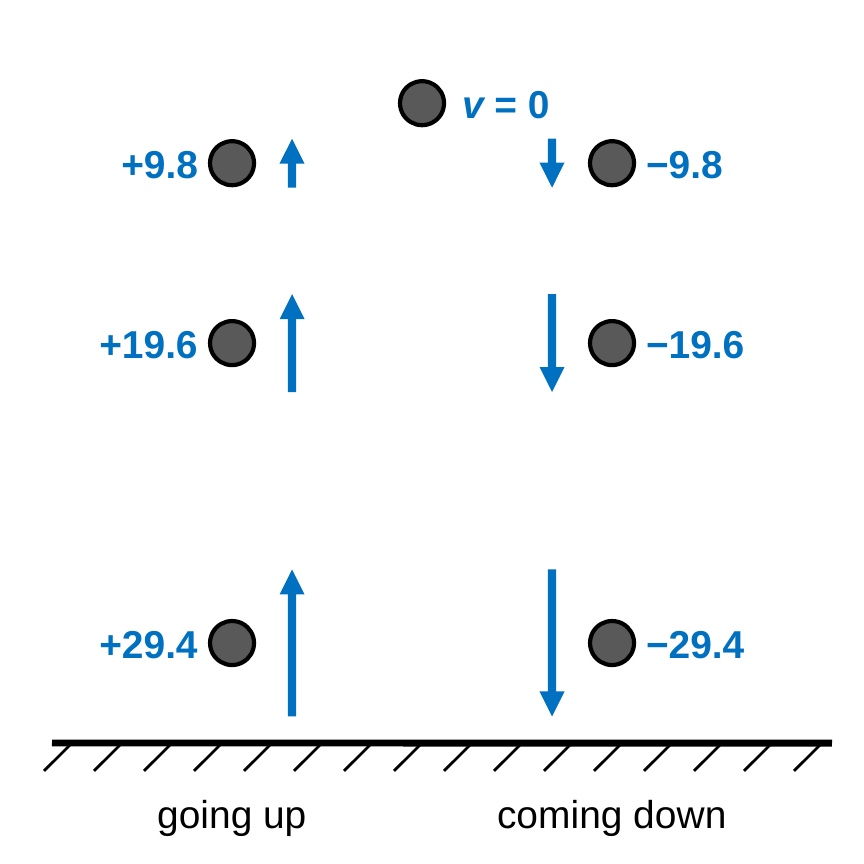
Toss a ball straight up at 29.4 m/s and look at it once every second. On the way up, gravity takes away 9.8 m/s each second, so it slows from +29.4 to +19.6 to +9.8 m/s. After 3 s it stops for an instant at the top. Then it falls, gaining 9.8 m/s of downward speed each second: −9.8, −19.6, −29.4 m/s. The trip down is a mirror image of the trip up, and it gets back to your hand at the same speed it left.
The Top of the Path
- At the top, v = 0
- Gravity is still pulling down
- a = −9.8 m/s2 the whole time
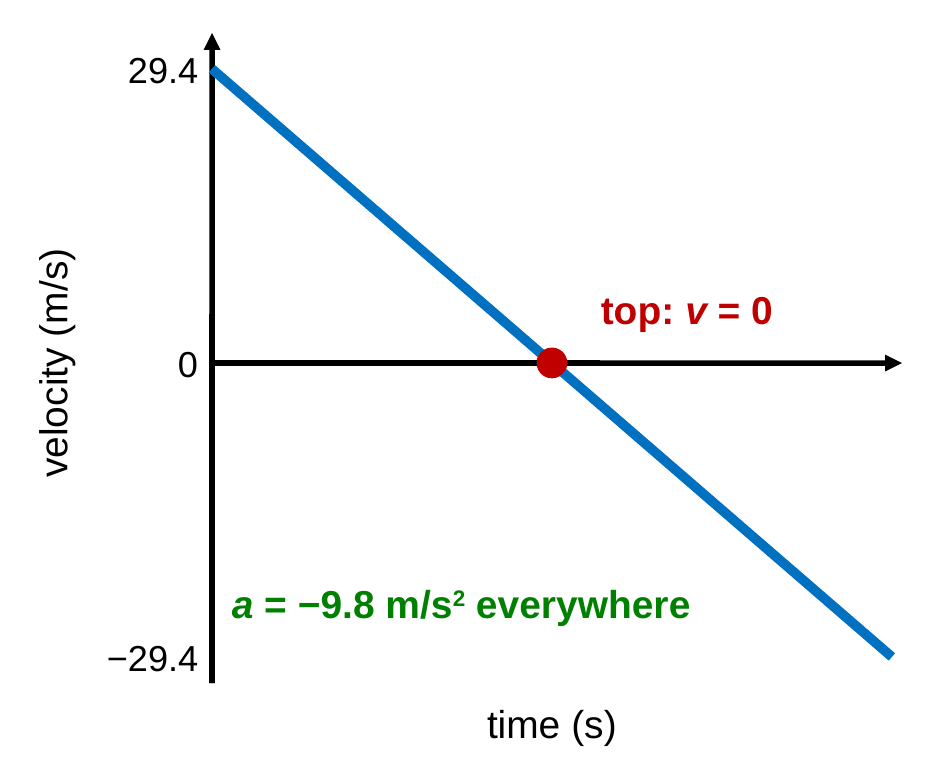
This velocity-time graph is for a ball tossed up at +29.4 m/s. The line crosses zero at 3 s. That is the top of the path, where the ball is momentarily at rest. But the line keeps the same slope right through that point, so the acceleration is still −9.8 m/s2. Gravity never switches off. If the acceleration were zero at the top, the ball would just hang there forever.
Free-Fall Equations
Free fall is just constant acceleration, so the kinematic equations from Unit 1 work. Use y for vertical positions and plug in a = −9.8 m/s2:
- vf = vi + at
- Δy = vit + ½at2
- vf2 = vi2 + 2aΔy
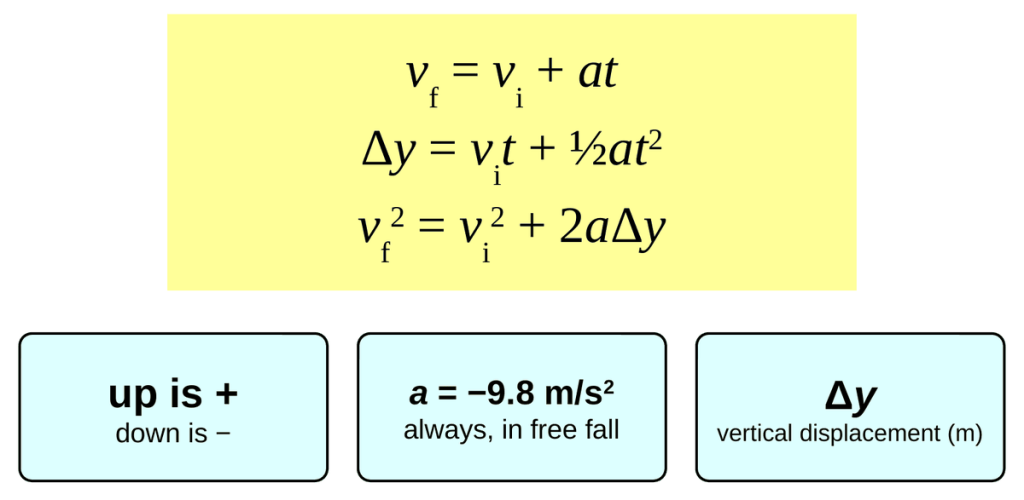
Up is positive. A velocity pointing down is negative, and a displacement that ends below the starting point is negative. “Dropped” tells you vi = 0 m/s, and “at the top” tells you v = 0 m/s.
Worked Examples
Try each problem on your own first, then check your work against the solution.
Example 1: Height of a Bridge
A rock is dropped from rest off a bridge. It hits the water 3.0 s later. How high is the bridge above the water?
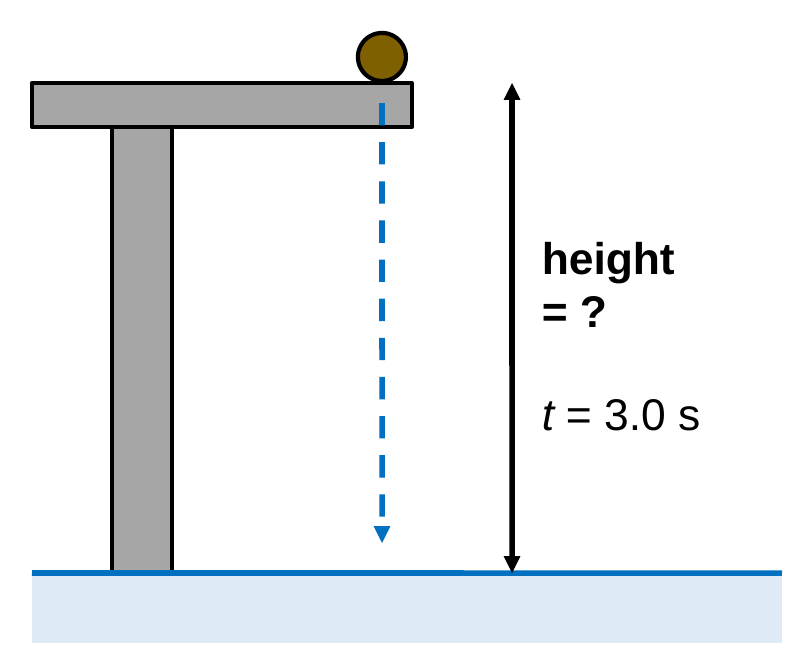
- Knowns: vi = 0 m/s (dropped), t = 3.0 s, a = −9.8 m/s2, Δy = ?
- Equation: Δy = vit + ½at2
- Substitute: Δy = (0)(3.0 s) + ½(−9.8 m/s2)(3.0 s)2
- Calculate: Δy = ½(−9.8 m/s2)(9.0 s2) = −44.1 m. The minus sign means the rock ends up below where it started.
- Answer: The bridge is 44 m above the water (2 significant figures).
Example 2: Speed at Impact
A stone is dropped from rest from a cliff 20.0 m above the water. How fast is it moving just before it hits the water?
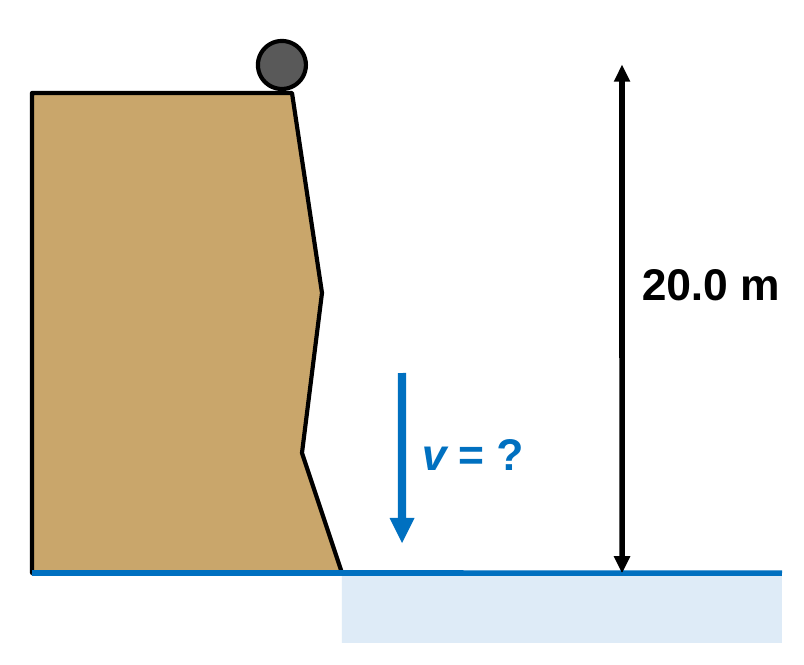
- Knowns: vi = 0 m/s, Δy = −20.0 m (it ends below the start), a = −9.8 m/s2, vf = ?
- Equation: No time is given, so use vf2 = vi2 + 2aΔy
- Substitute: vf2 = 0 + 2(−9.8 m/s2)(−20.0 m) = 392 m2/s2
- Square root: vf = √392 = 19.8 m/s. It is moving down, so vf = −19.8 m/s.
- Answer: 19.8 m/s downward
Example 3: Maximum Height
A volleyball player tosses a ball straight up at 7.0 m/s. How high above her hands does the ball rise?
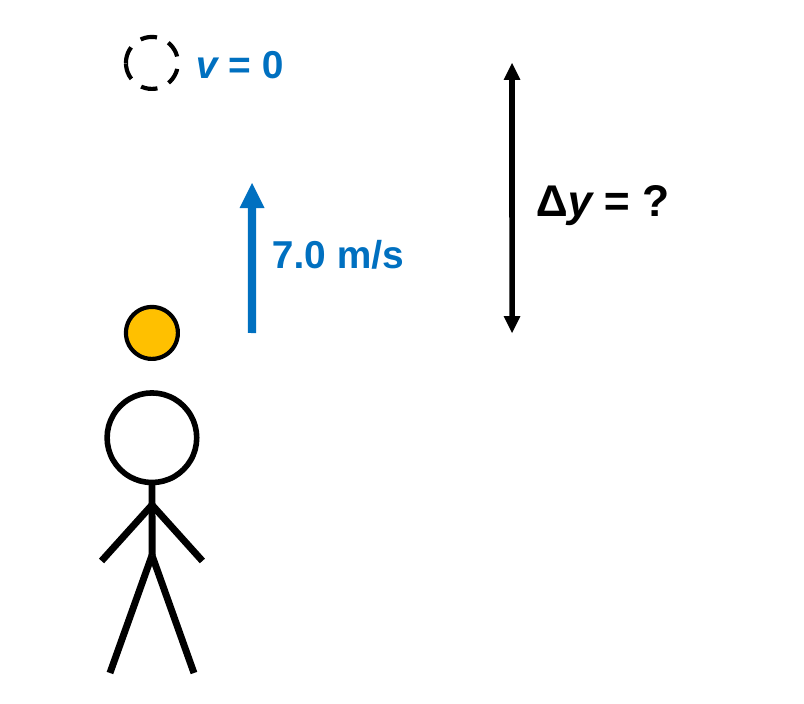
- Knowns: vi = +7.0 m/s, vf = 0 m/s at the top, a = −9.8 m/s2, Δy = ?
- Equation: vf2 = vi2 + 2aΔy, rearranged to Δy = (vf2 − vi2) / 2a
- Substitute: Δy = (0 − (7.0 m/s)2) / 2(−9.8 m/s2) = (−49 m2/s2) / (−19.6 m/s2)
- Answer: Δy = 2.5 m above her hands. The answer is positive because the ball ends up above where it started.
Example 4: Time in the Air
A ball is thrown straight up at 14.7 m/s and caught at the same height it was thrown from. How long is it in the air?
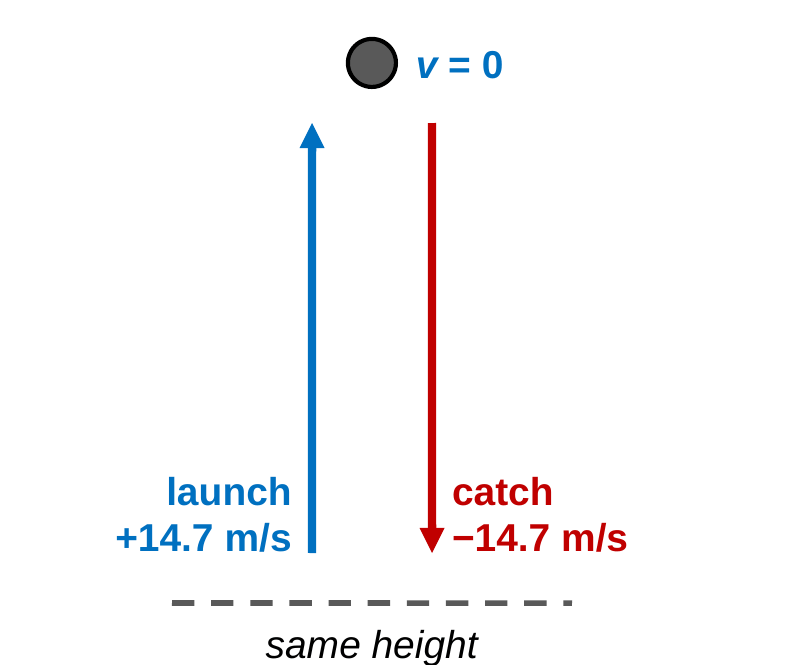
- Knowns: vi = +14.7 m/s, vf = −14.7 m/s (same speed, now moving down), a = −9.8 m/s2, t = ?
- Equation: vf = vi + at, rearranged to t = (vf − vi) / a
- Substitute: t = (−14.7 m/s − 14.7 m/s) / (−9.8 m/s2) = (−29.4 m/s) / (−9.8 m/s2)
- Answer: t = 3.00 s
Check: going up takes 14.7 ÷ 9.8 = 1.50 s, and coming down takes the same time, so the total is 3.00 s.
Big Ideas
- Free fall: only gravity acts
- a = −9.8 m/s2 (up is positive)
- At the top: v = 0, but a is still −9.8 m/s2
- Use the kinematic equations with Δy
Back to the essential question: when gravity is the only force, an object accelerates at 9.8 m/s2 downward, whether it is dropped, falling, rising, or sitting at the very top of its path. With up as positive, a = −9.8 m/s2, and the kinematic equations do the rest. Next up, we’ll learn how to split a vector into horizontal and vertical components.

