
The video lesson for this topic is coming soon.
Essential Question
When does a force do work on an object?
In everyday life, “work” means anything that takes effort. In physics, work has a precise meaning. By the end of this lesson, you should be able to tell when a force does work and calculate it with W = Fd.
Energy and Work
- Energy: the ability to do work
- Work transfers energy
- Unit: joule (J)
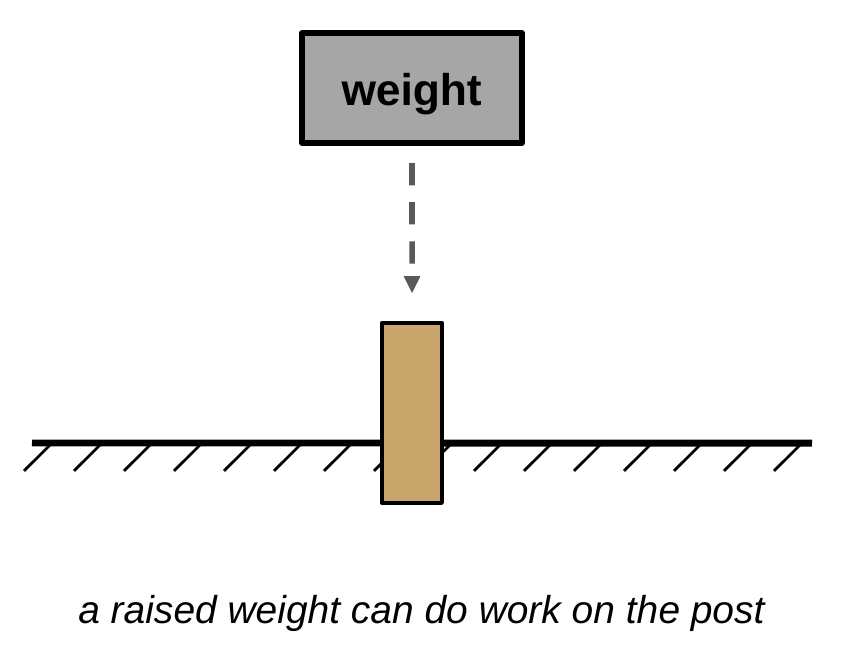
Energy is the ability to do work. A heavy weight held high above a post has energy: if you let it fall, it can hammer the post into the ground. When a force does work on an object, it transfers energy to that object. Work and energy are both measured in joules (J).
What Is Work?
- A force makes an object move
- Force and motion: same direction
- No motion means no work
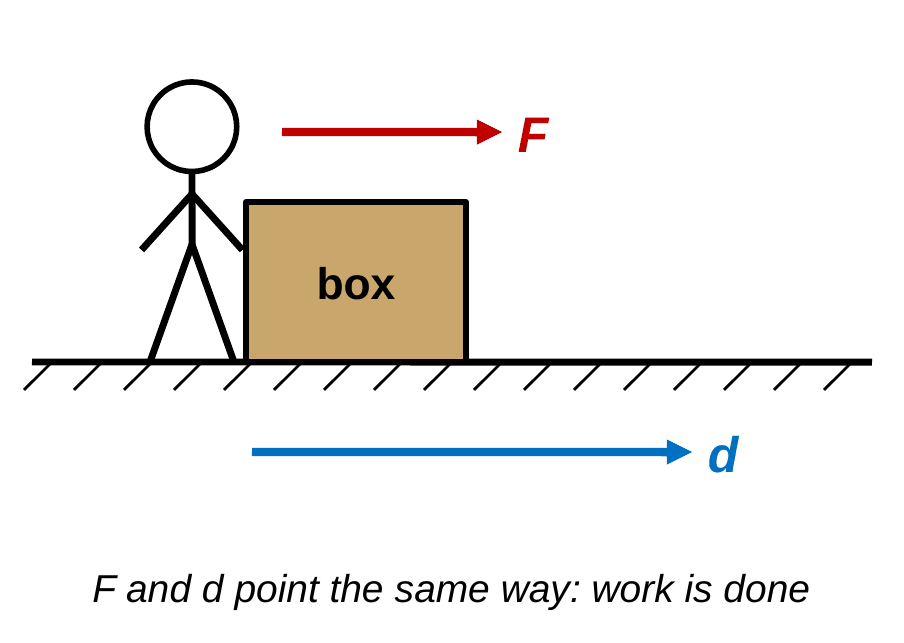
In physics, a force does work when it makes an object move, and the force points in the same direction as the motion. Here the push (F) points right and the box moves right (d), so the push does work on the box. If the box does not move, no work is done, no matter how hard you push.
The Work Equation
W = Fd
- W = work, in joules (J)
- F = force in the direction of motion, in newtons (N)
- d = displacement, in meters (m)
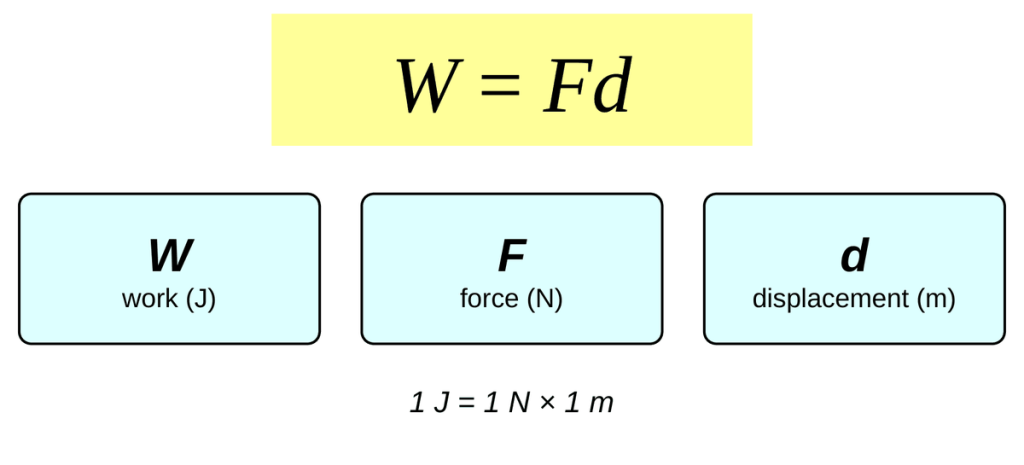
A newton times a meter is a joule, so 1 J = 1 N × 1 m. One joule is about the work you do lifting an apple from your waist to your chin. Only the part of the force that points along the motion counts, so in this course we use W = Fd when the force and displacement point the same way.
No Work: Pushing a Wall
- Big force, but no motion
- d = 0, so W = 0
- Tired does not mean work
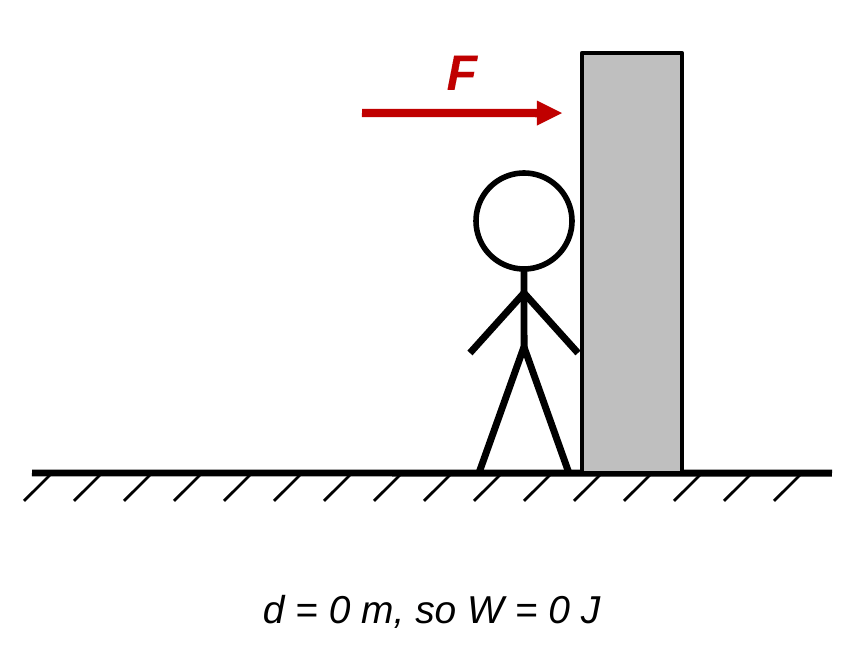
You can push on a wall until your arms ache, but the wall does not move. The displacement is zero, so the work done on the wall is zero: W = F × 0 = 0 J. Your muscles still get tired because they use energy inside your body, but no energy is transferred to the wall.
No Work: Carrying Sideways
- Your hands push up
- The box moves sideways
- Up force, sideways motion: W = 0
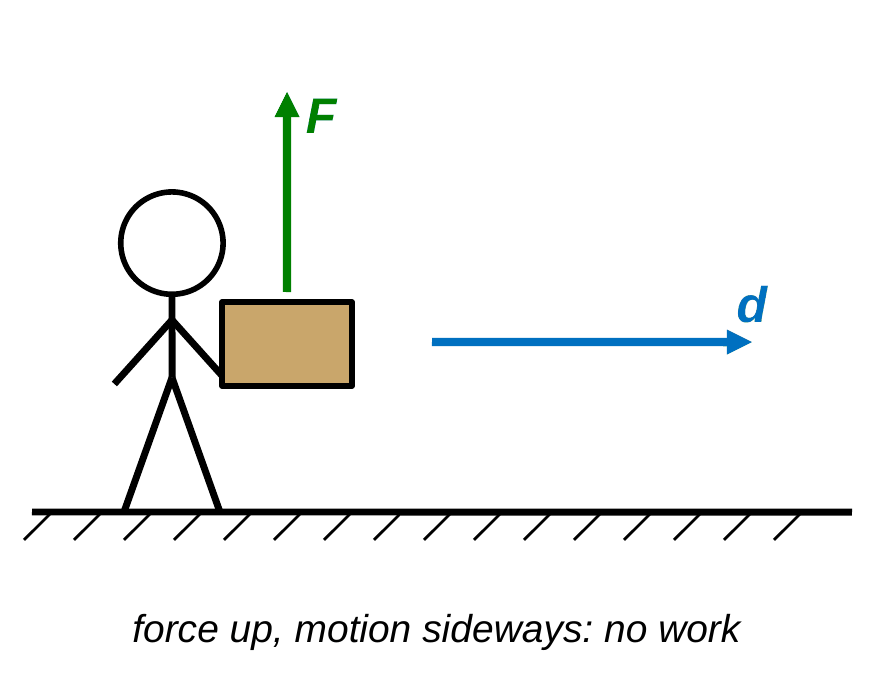
When you carry a box across a room at a steady height, your hands push up on it to hold it against gravity. But the box moves sideways. The upward force is not causing the sideways motion, so it does no work on the box. This surprises a lot of people, but it follows directly from the rule: the force has to point along the motion.
System vs. Object
- Object: a single thing
- System: objects we choose to study
- Outside work adds energy
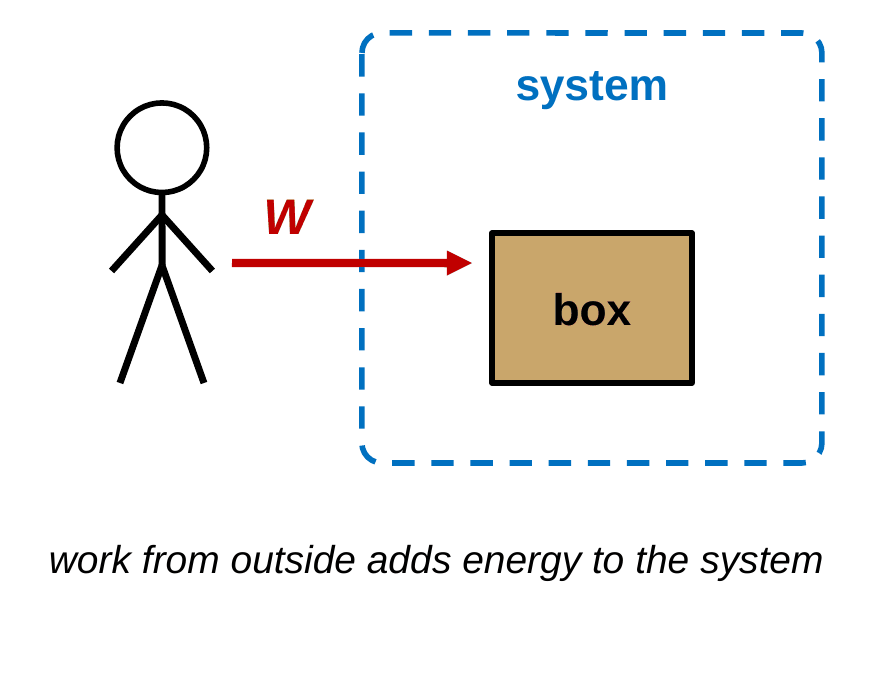
An object is a single thing, like one box. A system is the object or group of objects we choose to study, and everything else is the surroundings. Drawing a boundary around the system helps us track energy. When a force from outside the system does work on it, energy crosses the boundary and the system gains energy.
Worked Examples
Try each problem on your own first, then check your work against the solution.
Example 1: Pushing a Cart
A student pushes a shopping cart with a 45 N force for 12 m in the direction of the force. How much work does she do on the cart?
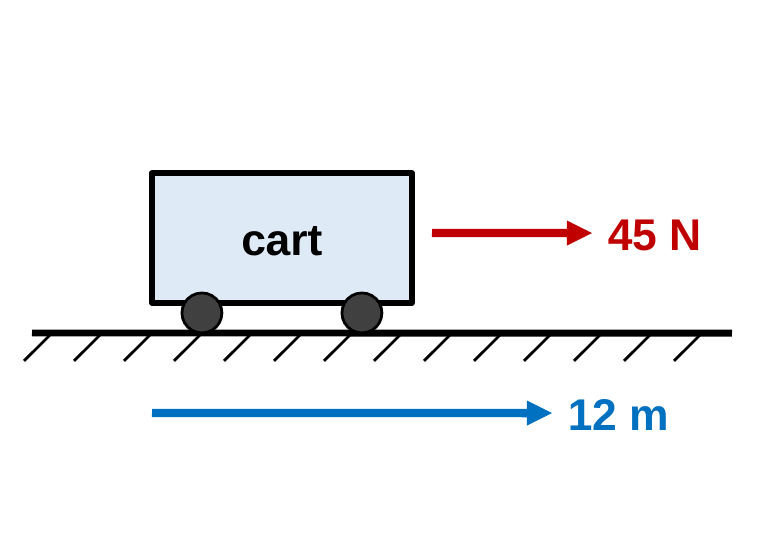
- Knowns: F = 45 N, d = 12 m, in the same direction
- Equation: W = Fd
- Substitute: W = (45 N)(12 m)
- Answer: W = 540 J. Newtons times meters gives joules.
Example 2: Lifting a Box
A worker lifts a 5.0 kg box of books straight up 2.0 m onto a high shelf at a constant speed. How much work does he do on the box?
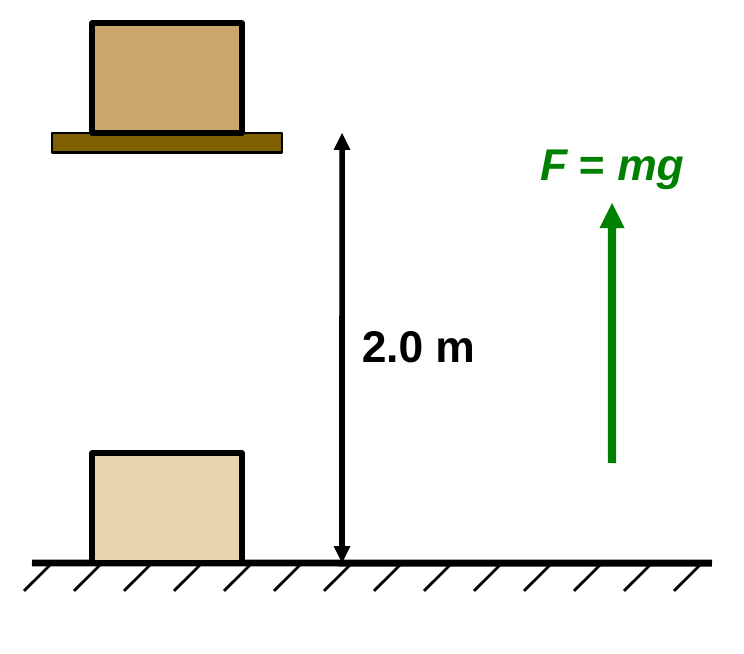
- Knowns: m = 5.0 kg, d = 2.0 m up, g = 9.8 m/s2
- Find the force: At constant speed, the lifting force equals the weight: F = mg = (5.0 kg)(9.8 m/s2) = 49 N up
- Equation: W = Fd = (49 N)(2.0 m)
- Answer: W = 98 J
Example 3: Finding Force
A sled dog pulls a sled 32 m across the snow and does 4,800 J of work. The pull is in the direction of motion. How hard does the dog pull?
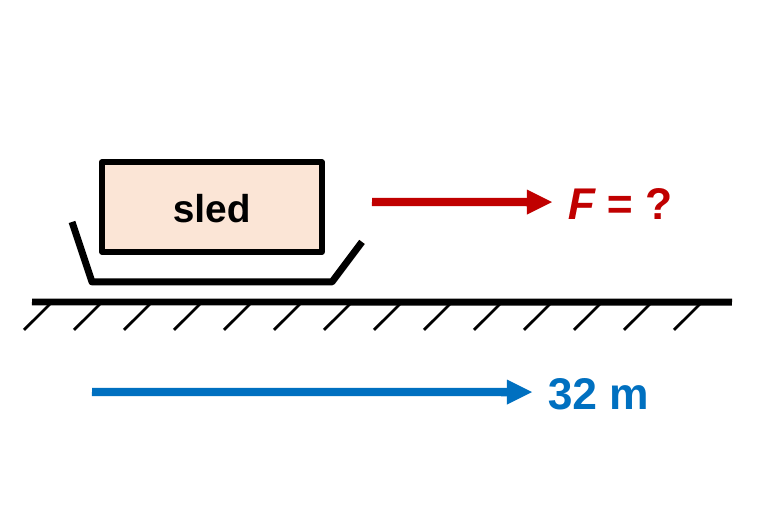
- Knowns: W = 4,800 J, d = 32 m, F = ?
- Equation: W = Fd, so F = W/d
- Substitute: F = 4,800 J / 32 m. A joule is a newton times a meter, so J/m = N.
- Answer: F = 150 N in the direction of motion
Example 4: Carrying a Tray
A server holds a 2.0 kg tray at a steady height while walking 15 m across a restaurant. How much work does her upward push do on the tray?
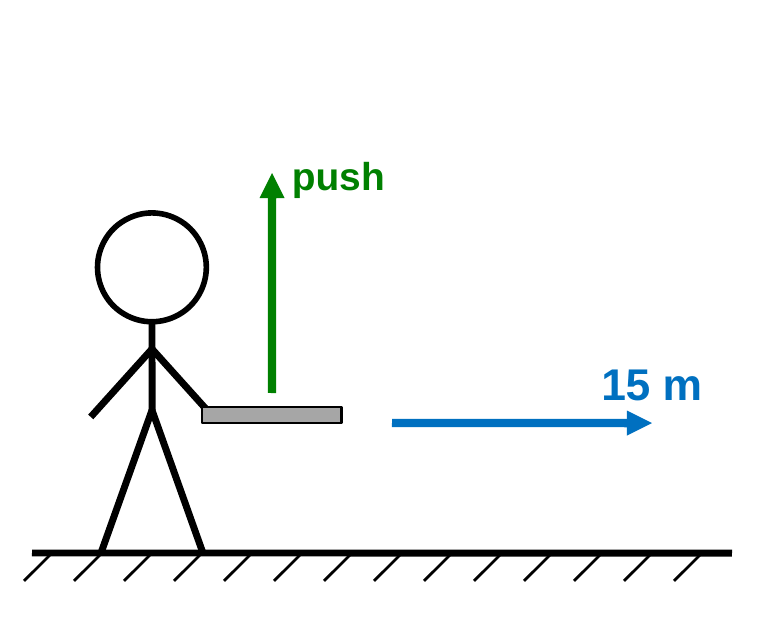
- Direction of the force: To hold the tray up, she pushes up with a force equal to its weight, mg = (2.0 kg)(9.8 m/s2) ≈ 20 N, straight up
- Direction of the motion: the tray moves 15 m sideways, at a steady height
- Compare: the upward force does not point along the sideways motion, so it does not cause the motion
- Answer: W = 0 J
The 2.0 kg and 15 m are there to tempt you into multiplying. Always check the directions first.
Big Ideas
- Energy is the ability to do work
- Work transfers energy, measured in joules (J)
- W = Fd, with F along the motion
- No motion, or sideways force: W = 0
Back to the essential question: a force does work when it pushes or pulls an object through a displacement in the same direction as the force, and we calculate it with W = Fd. If nothing moves, or the force is sideways to the motion, no work is done. Next up, we’ll look at kinetic energy, the energy an object has because it is moving.

