
The video lesson for this topic is coming soon.
Essential Question
How do magnets push and pull without touching?
Two magnets can pull or shove each other across a gap, with nothing touching. By the end of this lesson, you should be able to describe a magnetic field, draw its field lines, and explain why some pieces of metal are magnets and others are not.
Magnetic Poles
- Every magnet has an N and S pole
- Opposite poles attract
- Like poles repel
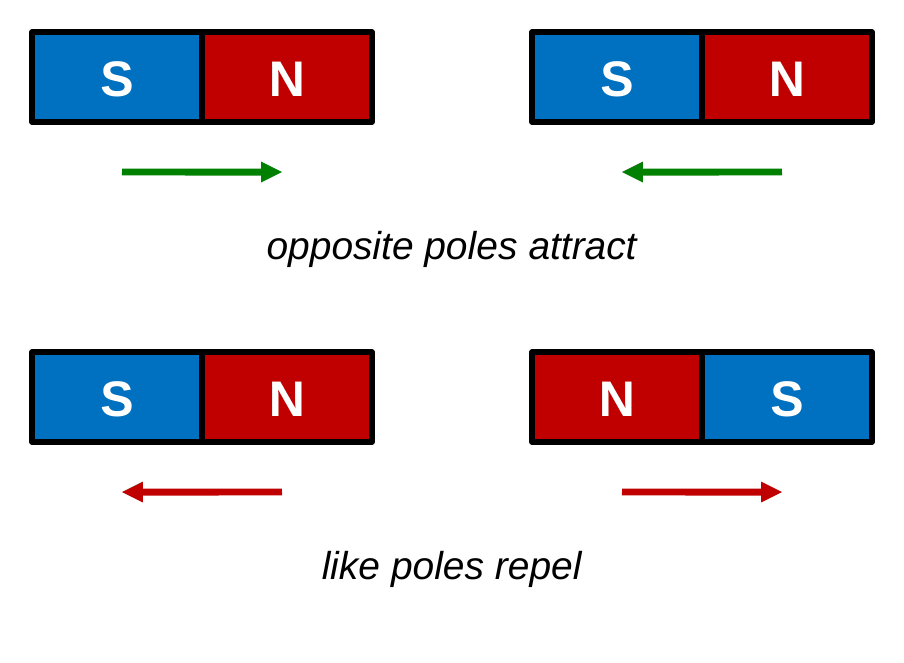
Every magnet has two ends called poles: a north (N) pole and a south (S) pole. When you bring two magnets together, opposite poles (N and S) attract, and like poles (N and N, or S and S) repel. This is a lot like electric charges, where opposites attract and likes repel.
Magnetic Fields
- Space around a magnet where it pushes or pulls
- Drawn with field lines
- Outside the magnet: lines go N to S
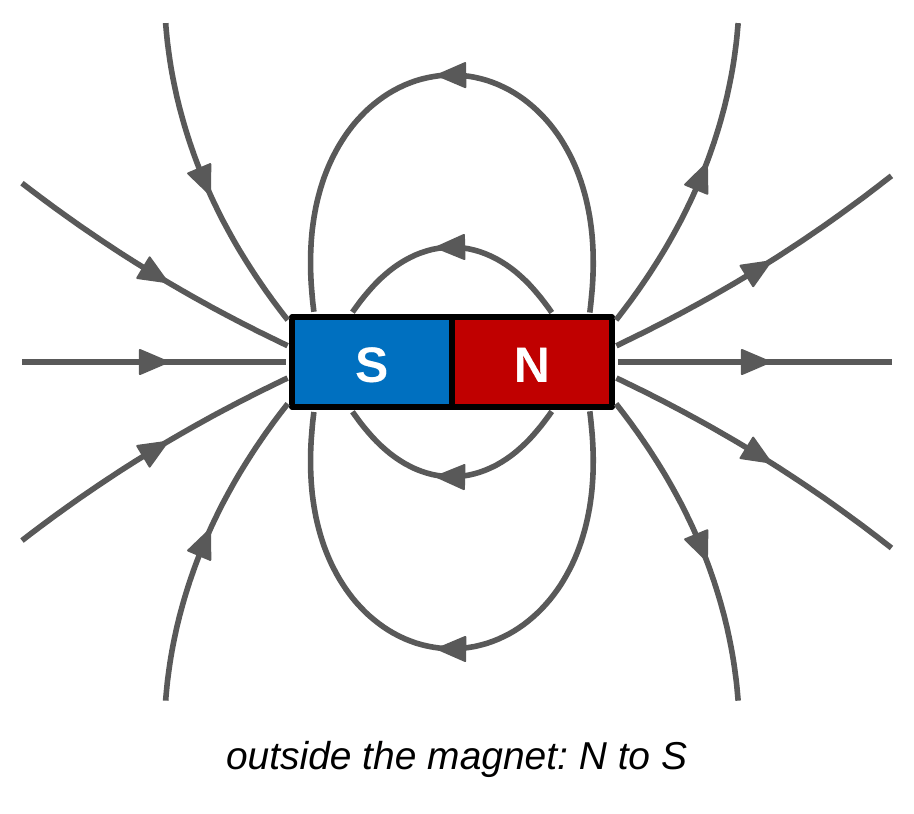
A magnetic field is the region around a magnet where another magnet (or a piece of iron) feels a force. We draw it with field lines. Outside the magnet, the field lines always point away from the N pole and toward the S pole. The arrows on the lines show the direction of the field.
Field Line Rules
- Lines never cross
- Crowded lines: strong field
- Spread-out lines: weak field
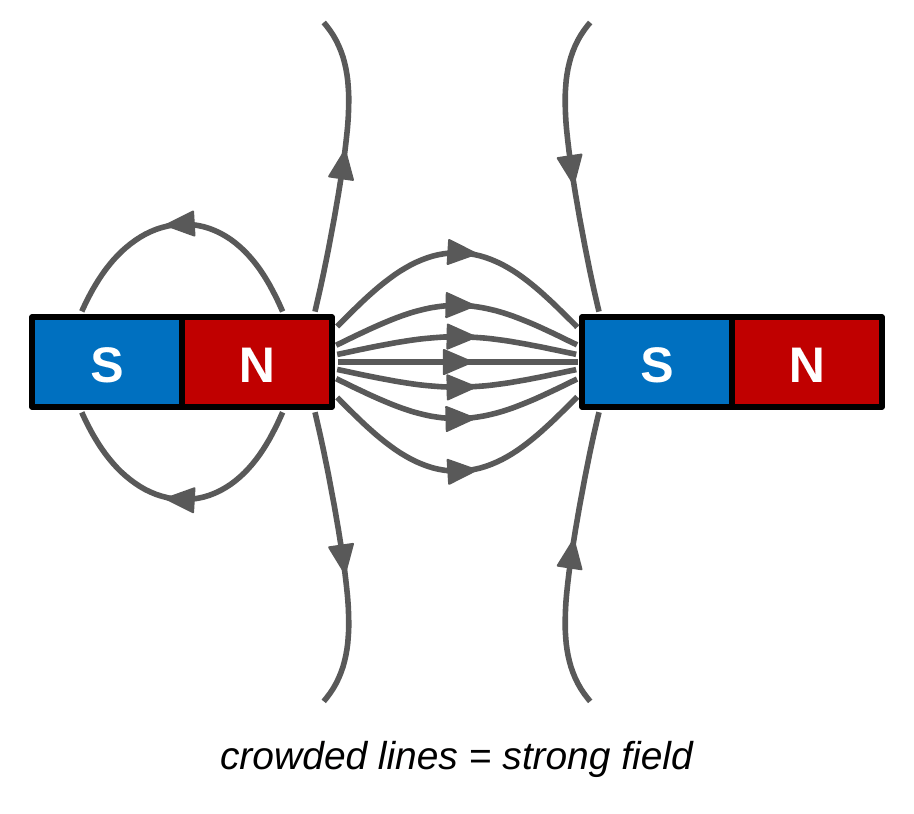
Field lines follow a few rules. They never cross, because the field can only point one way at each spot. Where the lines are crowded together, the field is strong. Where they spread out, the field is weak. In the gap between an N pole and an S pole, the lines are packed tightly, so the field there is strong.
No Single Poles
- Poles always come in pairs
- Cut a magnet: two new magnets
- Every piece has N and S
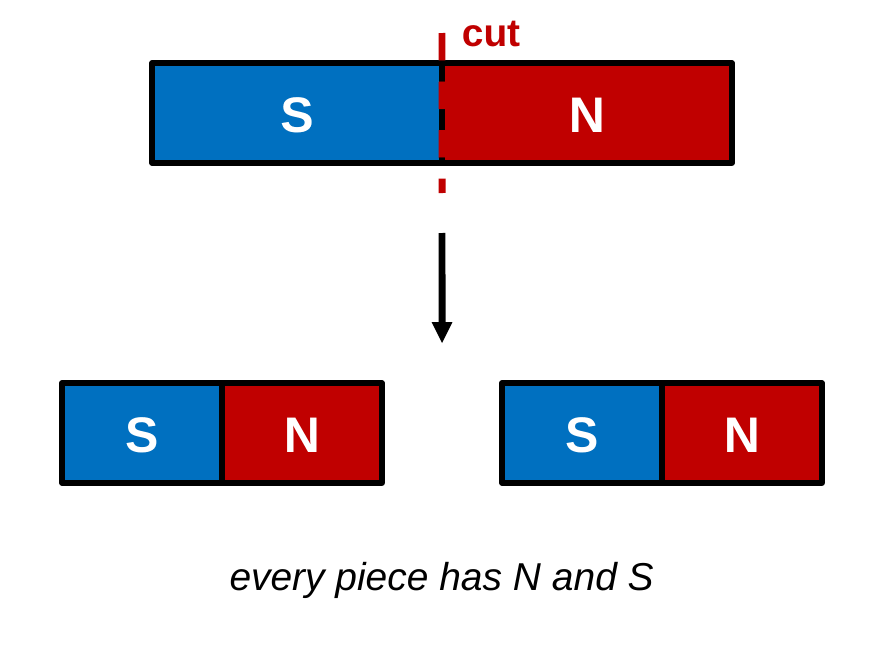
Magnetic poles always come in pairs. If you cut a bar magnet in half, you do not get a lone N pole and a lone S pole. Instead, you get two smaller magnets, and each one has its own N pole and S pole. No matter how many times you cut it, every piece still has both poles. This is a big difference from electric charges, which can exist alone.
Compasses Map the Field
- A compass is a tiny magnet
- Its N end points along the field
- Iron filings work the same way
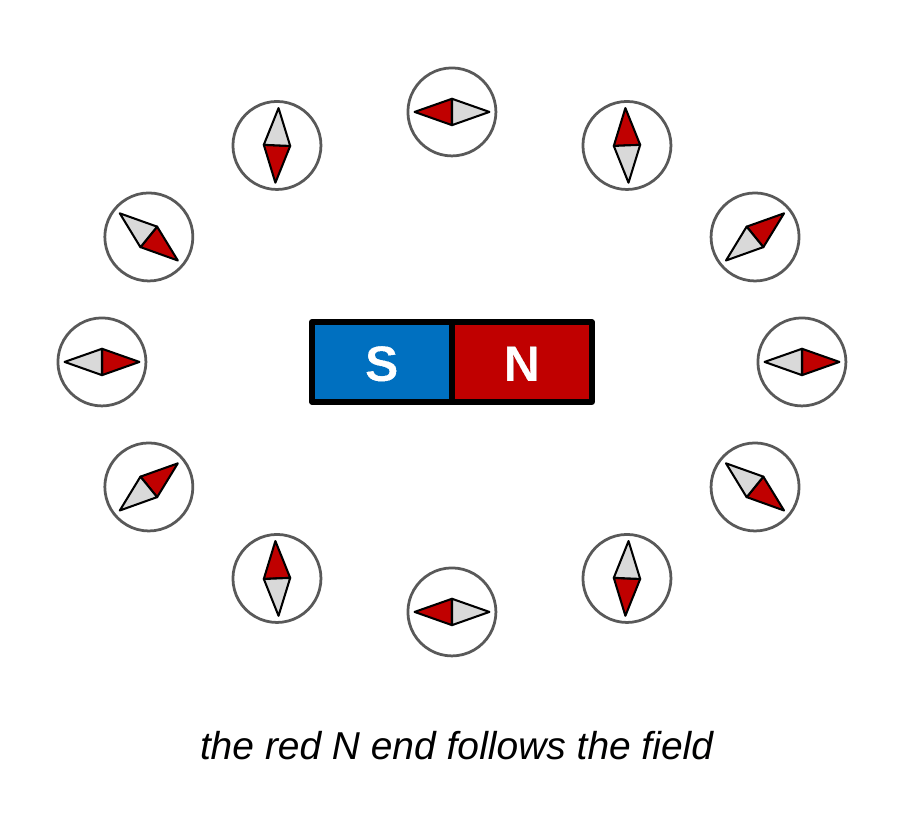
A compass needle is a tiny magnet that is free to spin. Its N end (red here) always turns to point in the direction of the magnetic field at that spot. If you place compasses all around a bar magnet, the needles trace out the field lines: away from the N pole and toward the S pole. Sprinkling iron filings around a magnet works the same way, because each filing becomes a tiny magnet and lines up with the field.
Earth Is a Magnet
- Earth has a magnetic field
- Compass N points to geographic north
- So a magnetic S pole is up north
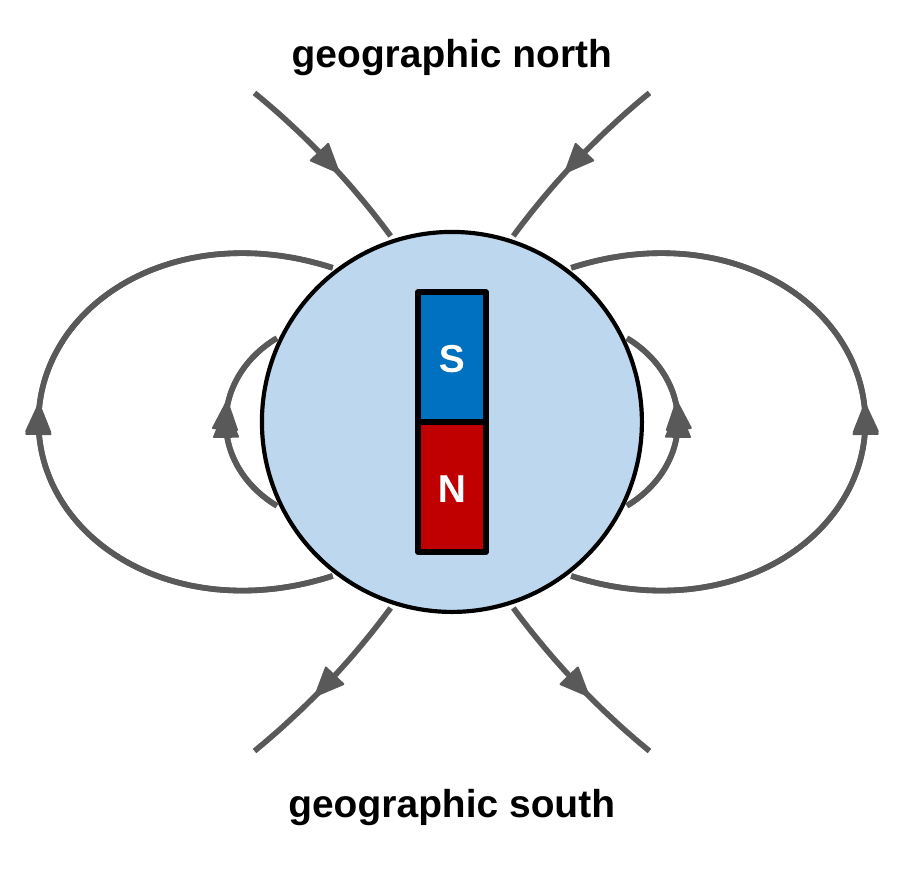
Earth acts like a giant bar magnet buried inside it. A compass’s N end points toward Earth’s geographic North Pole. Since opposite poles attract, the magnetic pole up north must actually be a magnetic south pole. Earth’s field lines leave near the geographic South Pole and enter near the geographic North Pole. (The magnetic poles are also a bit offset from the geographic poles, and they slowly drift.)
Magnetic Domains
- Domains: tiny regions of lined-up atoms
- Random domains: not a magnet
- Aligned domains: a magnet
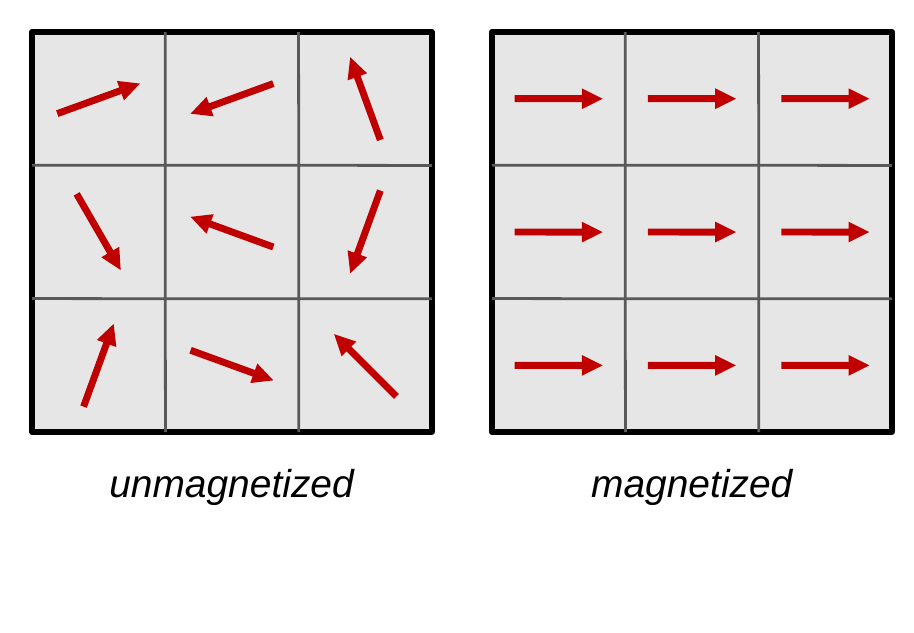
Every atom of iron acts like a tiny magnet. Inside a piece of iron, atoms group into small regions called magnetic domains, where all the atoms point the same way. In an ordinary nail, the domains point in random directions, so their fields cancel and the nail is not a magnet. In a magnet, most domains are lined up, so their fields add together. Rubbing a nail with a magnet or placing it in a strong field can line up its domains and turn it into a magnet.
Worked Examples
Try each problem on your own first, then check your work against the solution.
Example 1: Compass Direction
A compass sits just above the middle of a bar magnet. The magnet’s N pole is on the right. Which way does the compass needle’s N end point?
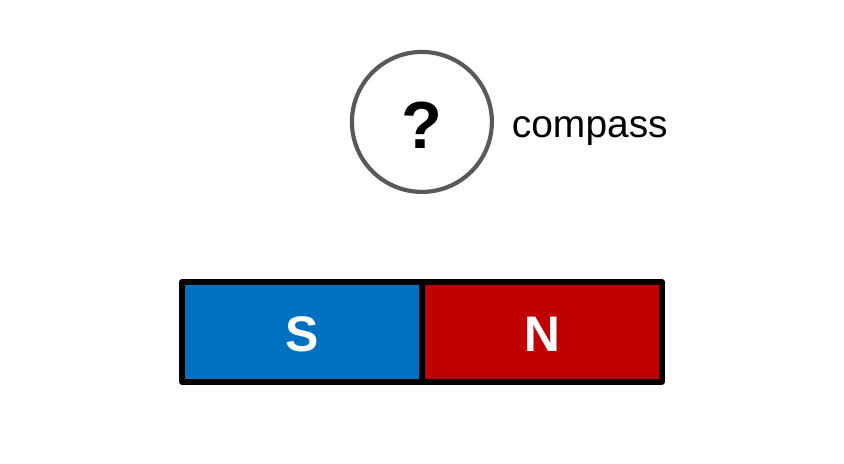
- Field direction outside a magnet: Outside a magnet, field lines go from the N pole to the S pole.
- Field above the middle: Above the middle, the field lines arc from the N end (right) back to the S end (left), so the field there points left.
- Compass rule: A compass needle’s N end points in the direction of the field.
- Answer: The N end points left, toward the magnet’s S pole, parallel to the magnet.
This also makes sense with attraction: the compass’s N end is pulled toward the magnet’s S pole and pushed away from its N pole.
Example 2: Strongest Field
Points A, B, and C are near a bar magnet, as shown. Rank the strength of the magnetic field at the three points, strongest to weakest.
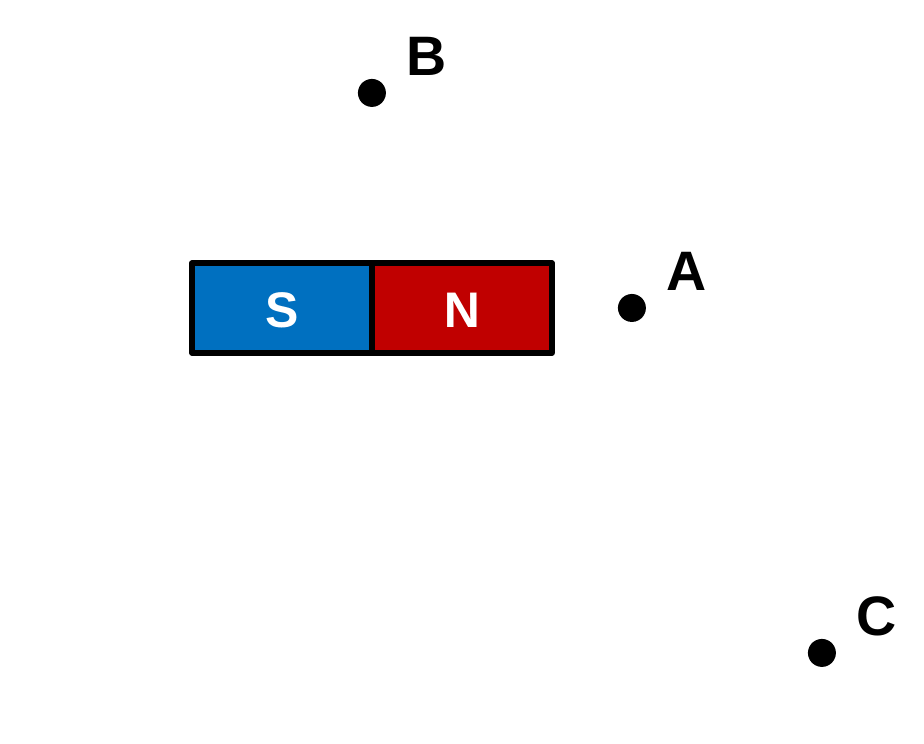
- Where is the field strongest?: Field lines are most crowded right at the poles and spread out as you move away.
- Point A: A is right next to the N pole, where the lines are packed together, so the field is strongest there.
- Point B: B is above the middle, a bit farther from both poles, so the lines are more spread out.
- Point C: C is far from the magnet, where the lines are very spread out, so the field is weakest.
- Answer: A > B > C
Example 3: Cutting a Magnet
A bar magnet with its N pole on the right is cut into three equal pieces. How many N poles are there now? Which pole is on the left end of the middle piece?
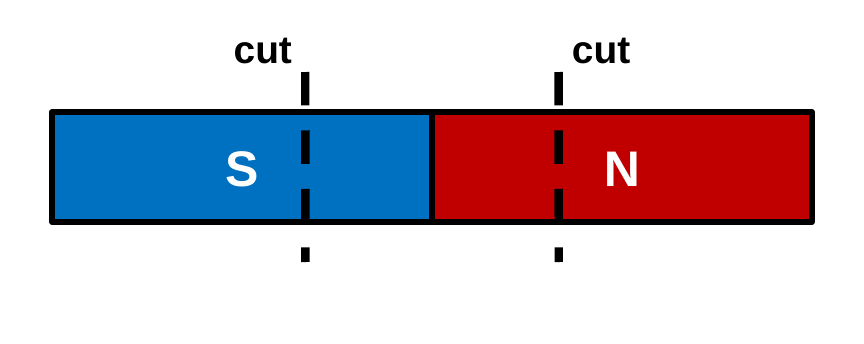
- Poles come in pairs: Cutting a magnet never makes a lone pole. Each piece becomes a complete magnet with its own N and S.
- Count the N poles: There are 3 pieces, and each one has one N pole, so there are 3 N poles (and 3 S poles).
- Orientation: Every piece keeps the same direction as the original magnet: S on the left, N on the right.
- Answer: 3 N poles. The left end of the middle piece is an S pole.
Big Ideas
- Opposite poles attract, like poles repel
- Field lines go N to S outside, never cross
- Crowded lines mean a stronger field
- Poles come in pairs; aligned domains make magnets
Back to the essential question: magnets push and pull without touching because every magnet is surrounded by a magnetic field. Field lines leave the N pole, curve around, and enter the S pole, and another magnet or a compass placed in that field feels a force. Next up, we’ll discover that electric currents make magnetic fields too.

