
The video lesson for this topic is coming soon.
Essential Question
What does it take to make a bulb light up?
You flip switches and plug things in every day, but what is actually happening inside the wires? By the end of this lesson, you should be able to explain what a complete circuit needs, draw a circuit diagram with the correct symbols, and tell conductors from insulators.
A Complete Circuit
- Charges need a closed loop
- Battery → wire → bulb → back
- Any gap stops the flow
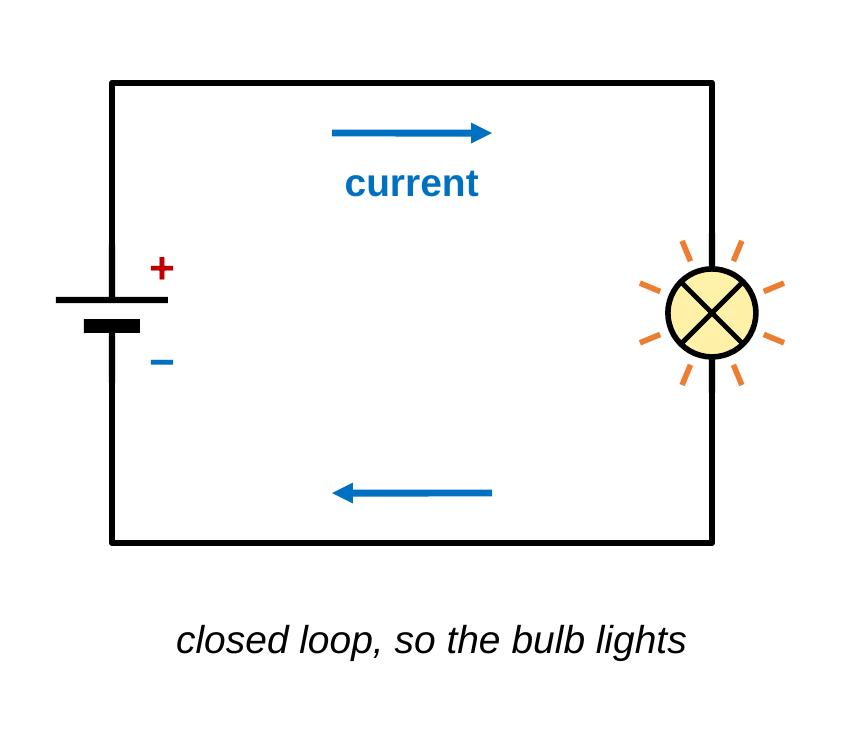
A bulb only lights when charges can travel in a complete, closed loop: out of the battery, through the wires and the bulb, and back into the battery. If there is a gap anywhere in the loop, the charges stop moving everywhere, and the bulb goes out. A loop with a gap is called an open circuit. A complete loop is a closed circuit.
Schematic Symbols
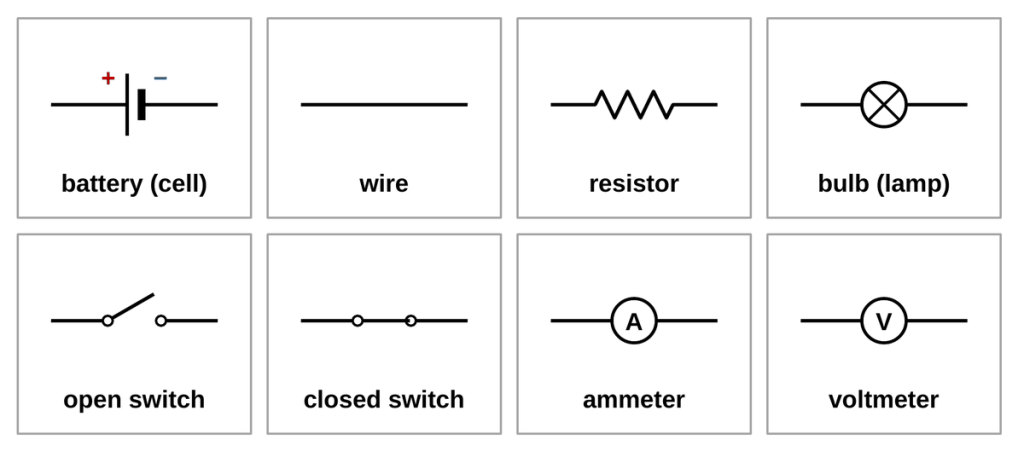
Instead of drawing realistic pictures, physicists draw circuits with simple symbols. The battery’s long plate is the positive (+) terminal and the short, thick plate is the negative (−) terminal. A resistor is a zigzag, a bulb is a circle with an X, and the two meters are circles labeled A (ammeter) and V (voltmeter). An open switch is drawn with its lever lifted, which leaves a gap in the circuit.
Drawing a Circuit Diagram
- Use symbols, not pictures
- Straight wires, square corners
- Same circuit, easier to read
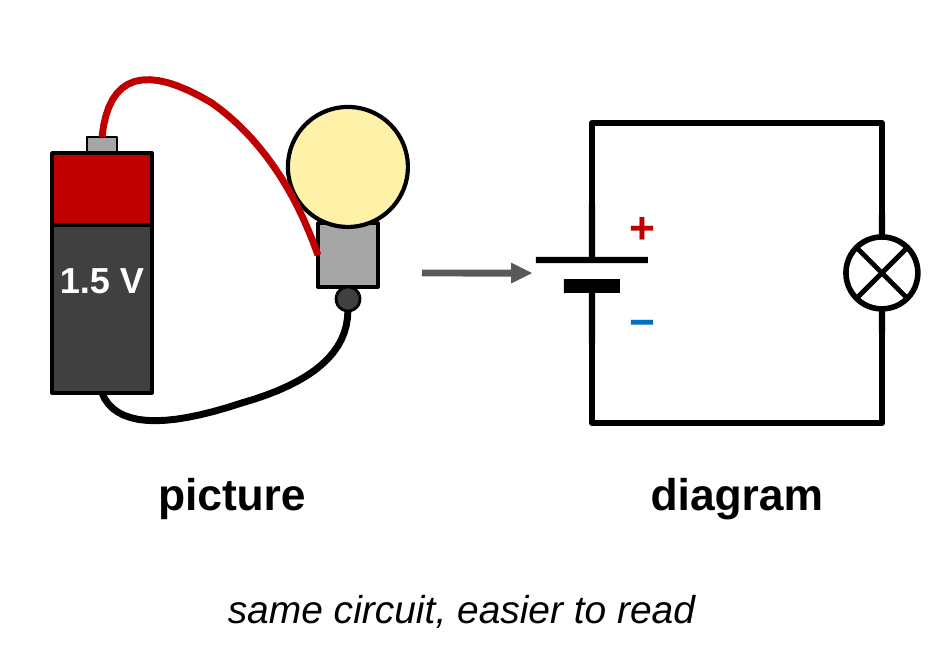
A circuit diagram, or schematic, shows how the parts are connected without trying to look realistic. Draw the wires as straight lines with square corners and use the standard symbols. The picture and the diagram here show exactly the same circuit, but the diagram is faster to draw and easier to read.
Switches
- Open switch: gap, bulb off
- Closed switch: loop complete
- Turns a circuit on and off
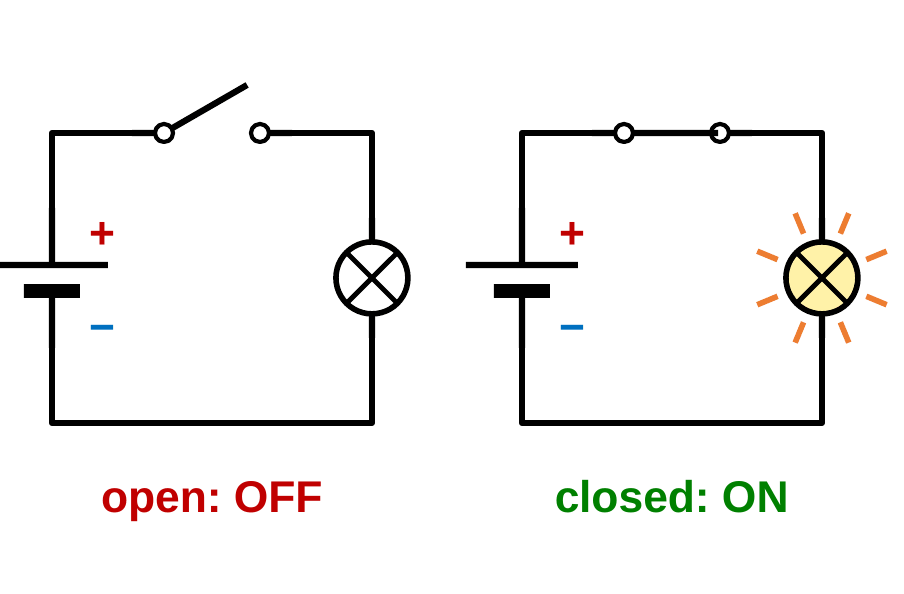
A switch is a controlled gap. When the switch is open, its lever is lifted and the loop is broken, so no charge flows and the bulb stays dark. When the switch is closed, the lever touches the contact, the loop is complete, and the bulb lights. Every light switch in your house works this way.
Measuring with Meters
- Ammeter (A): measures current
- Ammeter goes in the loop
- Voltmeter (V): measures voltage
- Voltmeter goes across a part
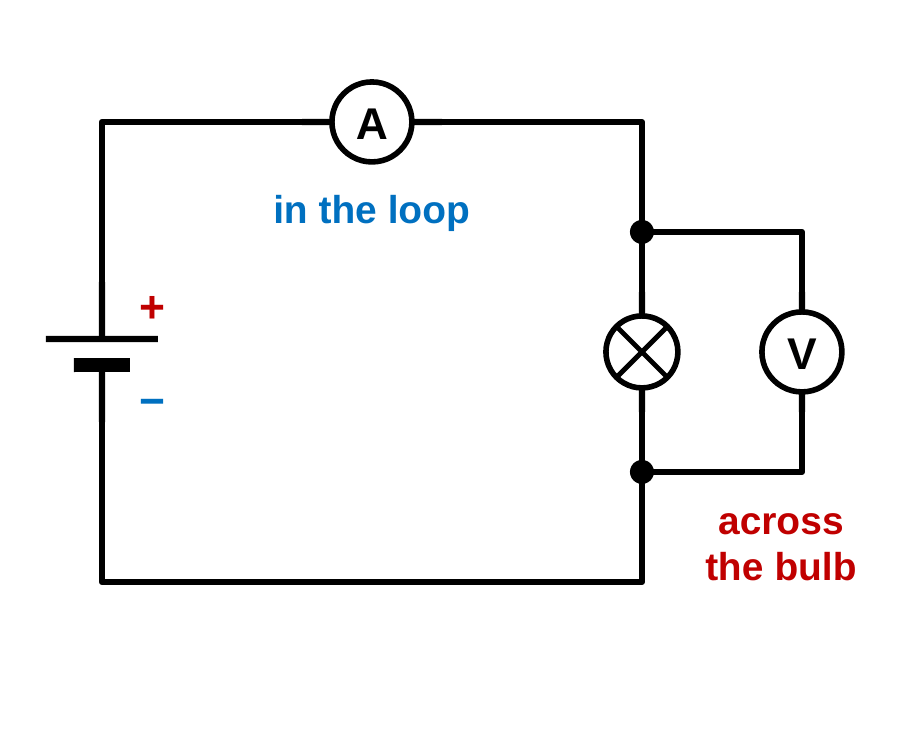
An ammeter measures current, the flow of charge, so the charge has to pass through it. That means it goes right in the loop, in line with the part you are measuring (in series). A voltmeter measures the voltage across a part, so its two wires connect on either side of that part, like a bridge around it (in parallel).
Conductors and Insulators
- Conductors let charge flow
- Metals: copper, aluminum, steel
- Insulators block charge flow
- Rubber, plastic, glass, wood
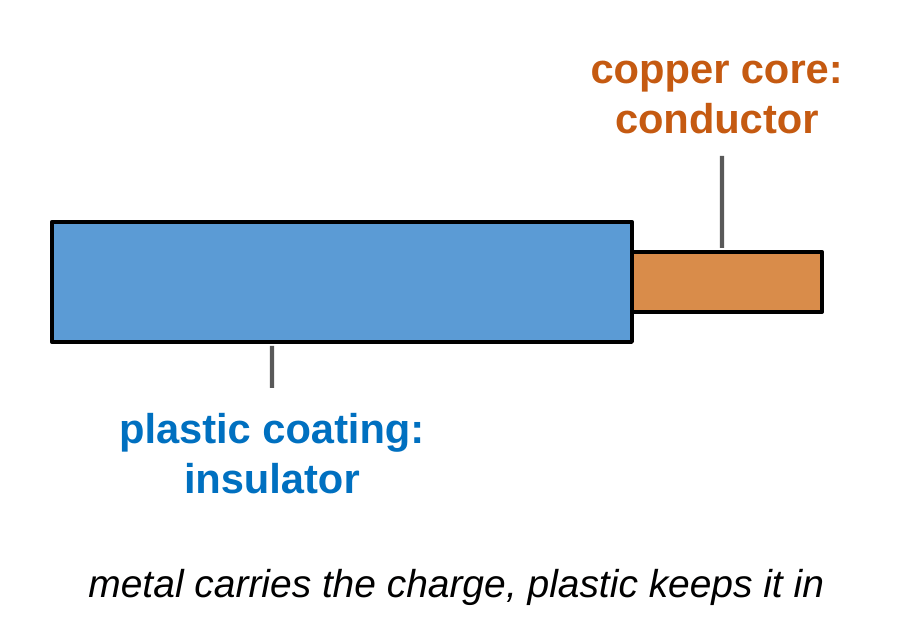
A conductor lets charge move through it easily. Metals like copper, aluminum, and steel are good conductors because some of their electrons are free to move. An insulator holds its charges tightly and blocks the flow. Rubber, plastic, glass, and dry wood are insulators. A household wire uses both: a copper core to carry the charge and a plastic coating to keep it from escaping or shocking you.
Energy in a Circuit
- Battery stores chemical energy
- Moving charges carry energy
- Bulb turns it into light and heat
- Charges are not used up
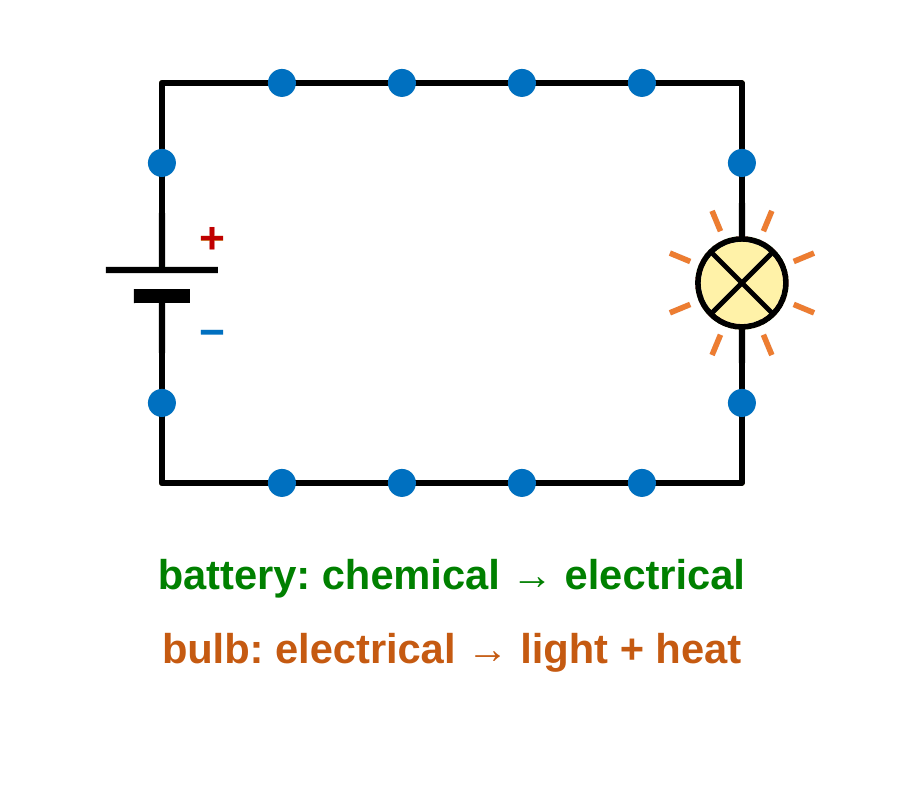
A battery stores chemical energy. When the circuit is closed, the battery pushes charges around the loop, and the moving charges carry electrical energy to the bulb. The bulb changes that energy into light and heat. The charges themselves are not used up. They are already in the wires, and they just keep circling. What gets used up is the battery’s stored energy.
Worked Examples
Try each problem on your own first, then check your work against the solution.
Example 1: Will It Light?
Which of these circuits will light the bulb? Explain why or why not for each one.
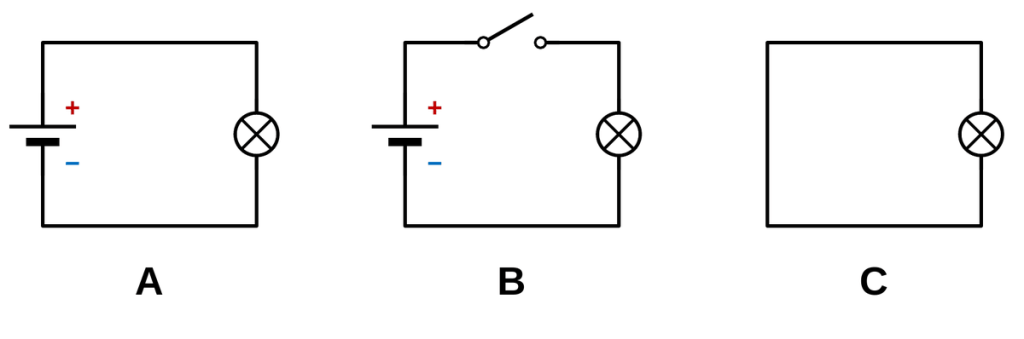
- Circuit A: The battery and bulb form a complete, closed loop, so charge flows and the bulb lights.
- Circuit B: The switch is open, which leaves a gap in the loop. No charge flows, so the bulb does not light.
- Circuit C: The loop is closed, but there is no battery. Nothing gives the charges energy, so the bulb does not light.
- Answer: Only circuit A lights the bulb. A bulb needs both a closed loop and an energy source.
Example 2: Draw the Diagram
A flashlight has two cells, a switch, and one bulb, all connected in a single loop. Draw its circuit diagram.
- List the parts: two cells (a battery), one switch, one bulb, and the connecting wires
- Draw the loop: sketch a rectangle for the wire, with straight sides and square corners
- Add the symbols: put the two-cell battery on the left side (long plate, short plate, long plate, short plate), the switch on the top wire, and the bulb (circle with an X) on the right side
- Answer: a single rectangular loop with a two-cell battery, a switch, and a bulb. Label the + end of the battery at the long plate.
Example 3: Conductor or Insulator?
Sort each item as a conductor or an insulator: copper wire, rubber glove, aluminum foil, plastic ruler, steel paper clip, glass cup
- Look for metals: copper, aluminum, and steel are metals, and metals have electrons that are free to move
- Conductors: copper wire, aluminum foil, steel paper clip
- Insulators: rubber glove, plastic ruler, glass cup, which hold their electrons tightly
- Answer: Conductors: copper wire, aluminum foil, steel paper clip. Insulators: rubber glove, plastic ruler, glass cup.
Example 4: Placing the Meters
A circuit has a battery connected to a single bulb. You want to measure the current through the bulb and the voltage across it. Where does each meter go?
- Ammeter: current is a flow of charge, so the charge must pass through the ammeter. Break the loop and put the ammeter in it, in series with the bulb.
- Voltmeter: voltage compares two points, so connect one voltmeter wire just before the bulb and the other just after it, in parallel with the bulb.
- Answer: The ammeter goes in the loop (series). The voltmeter goes across the bulb (parallel).
A common mistake is putting the voltmeter in the loop. Voltmeters are built to block current, so a voltmeter in the loop would act like a gap and the bulb would go out.
Big Ideas
- A bulb needs a closed loop
- The battery supplies the energy
- Conductors carry charge, insulators block it
- Ammeter in the loop, voltmeter across
Back to the essential question: a bulb lights up when it is part of a complete, closed loop of conductors connected to an energy source like a battery. Moving charges carry energy from the battery to the bulb, where it becomes light and heat. Next up, we’ll measure that flow with current, voltage, and resistance.

