
The video lesson for this topic is coming soon.
Essential Question
What is a wave, and what does it carry?
Ripples on a pond, sound from a speaker, and light from the Sun are all waves. By the end of this lesson, you should be able to explain what a wave carries, tell transverse and longitudinal waves apart, and label the parts of a wave.
What Is a Wave?
- A disturbance that moves
- Carries energy
- Matter stays in place
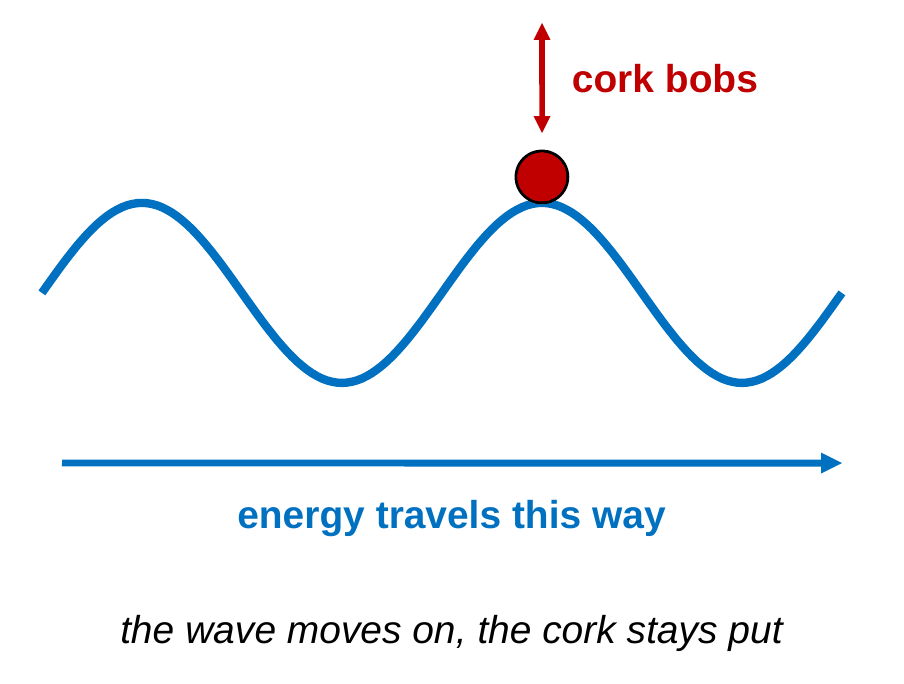
A wave is a disturbance that travels from place to place. When a ripple passes a floating cork, the cork bobs up and down, but it does not ride along with the wave. The water mostly stays where it is. What actually travels is energy. A wave carries energy, not matter.
Mechanical vs. Electromagnetic
- Mechanical waves need a medium
- Medium: the stuff that waves
- EM waves can cross empty space
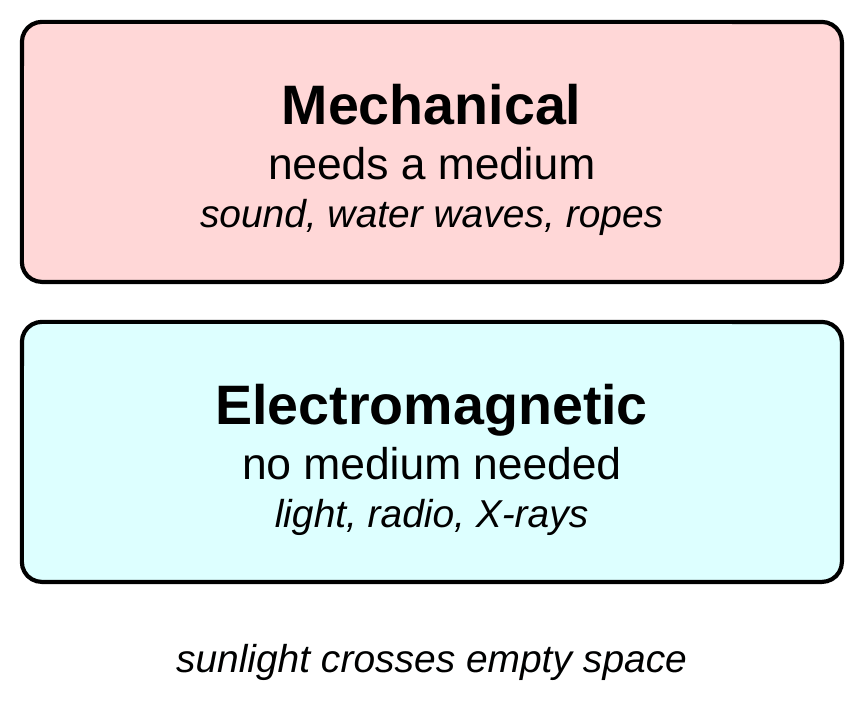
Mechanical waves need a medium, the material the wave travels through. Sound travels through air, water waves travel through water, and rope waves travel along a rope. Without a medium, there is no mechanical wave, which is why there is no sound in space. Electromagnetic (EM) waves, like light and radio, do not need a medium. Sunlight crosses about 150 million kilometers of nearly empty space to reach Earth.
Transverse Waves
- Particles move perpendicular to the wave
- Like flicking a rope up and down
- Light is transverse
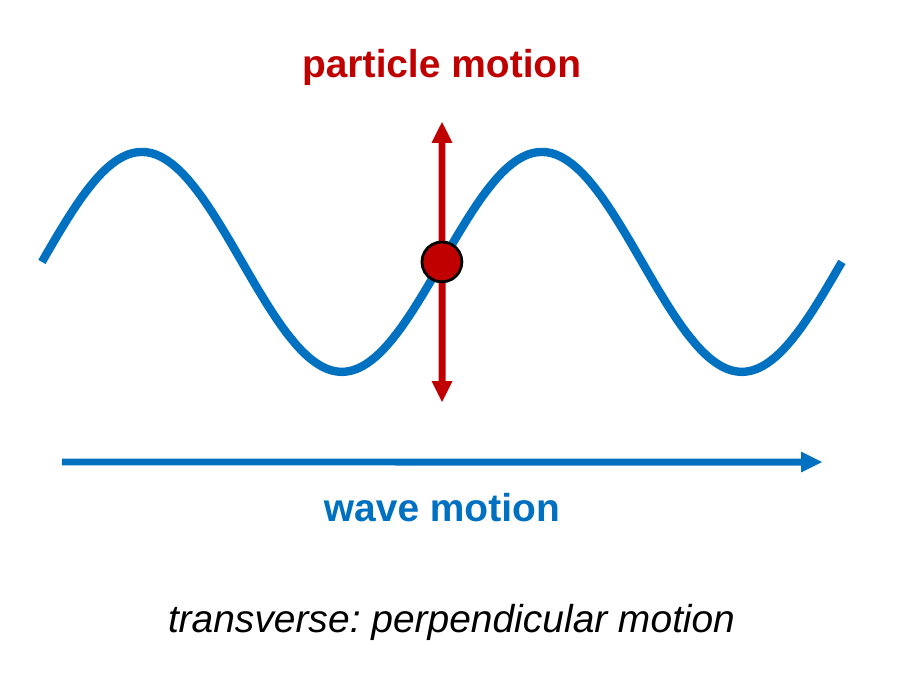
In a transverse wave, the particles of the medium move perpendicular (at right angles) to the direction the wave travels. If you flick a rope up and down, each bit of rope moves up and down while the wave travels sideways along the rope. Light and other EM waves are transverse.
Longitudinal Waves
- Particles move parallel to the wave
- Compressions and rarefactions
- Sound is longitudinal
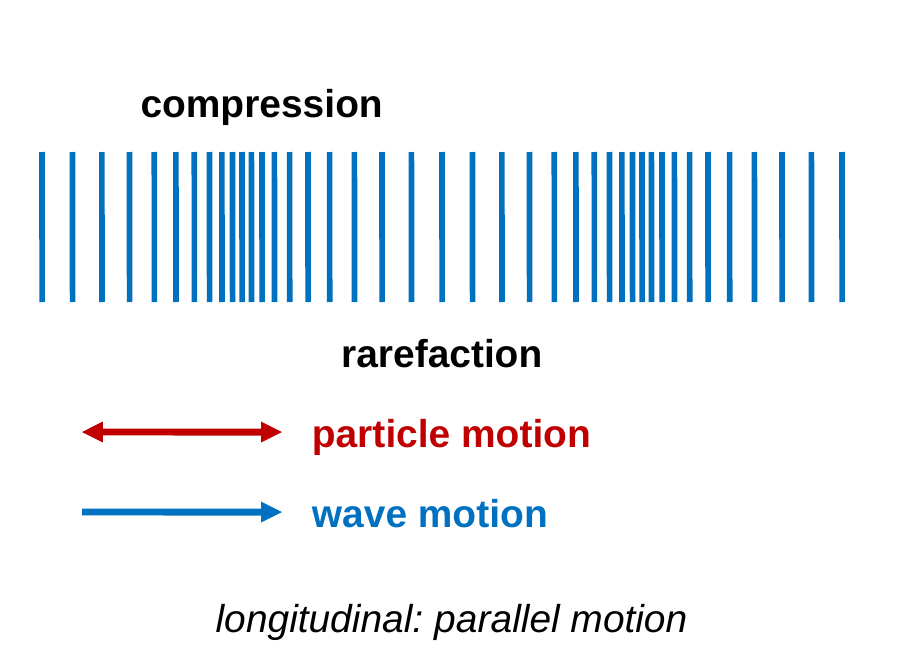
In a longitudinal wave, the particles of the medium move back and forth parallel to the direction the wave travels. Push and pull one end of a spring toy and you’ll see crowded regions called compressions and stretched-out regions called rarefactions travel down the spring. Sound is a longitudinal wave: air molecules are squeezed together and spread apart as the sound passes.
Parts of a Transverse Wave
- Crest: the highest point
- Trough: the lowest point
- Equilibrium: the rest position
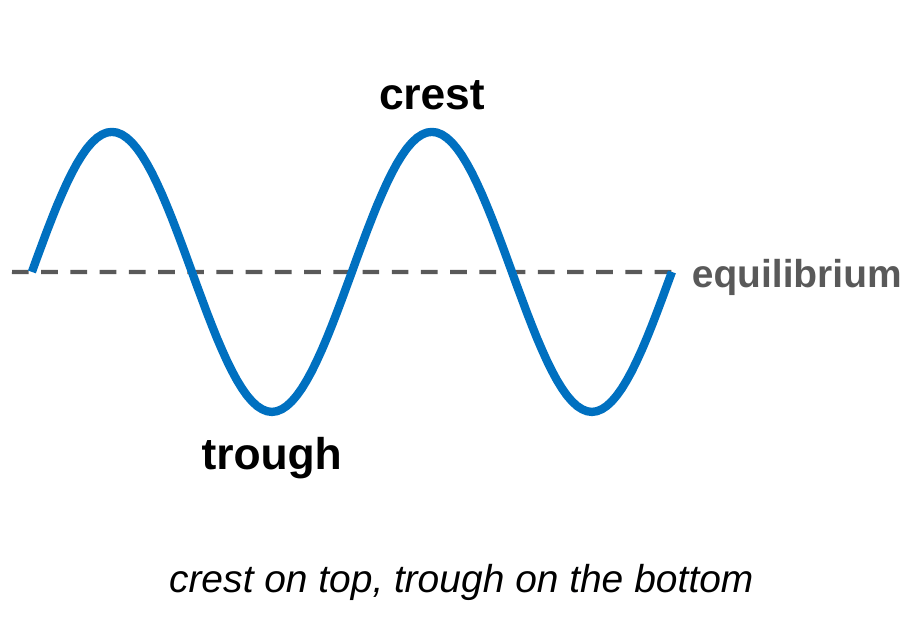
Every transverse wave has the same basic parts. The crest is the highest point of the wave, and the trough is the lowest point. The equilibrium line is where the medium would sit if there were no wave at all. A wave swings above and below its equilibrium line.
Amplitude and Wavelength
- Amplitude A: equilibrium to crest
- Wavelength λ: one full cycle
- Measure λ crest to crest
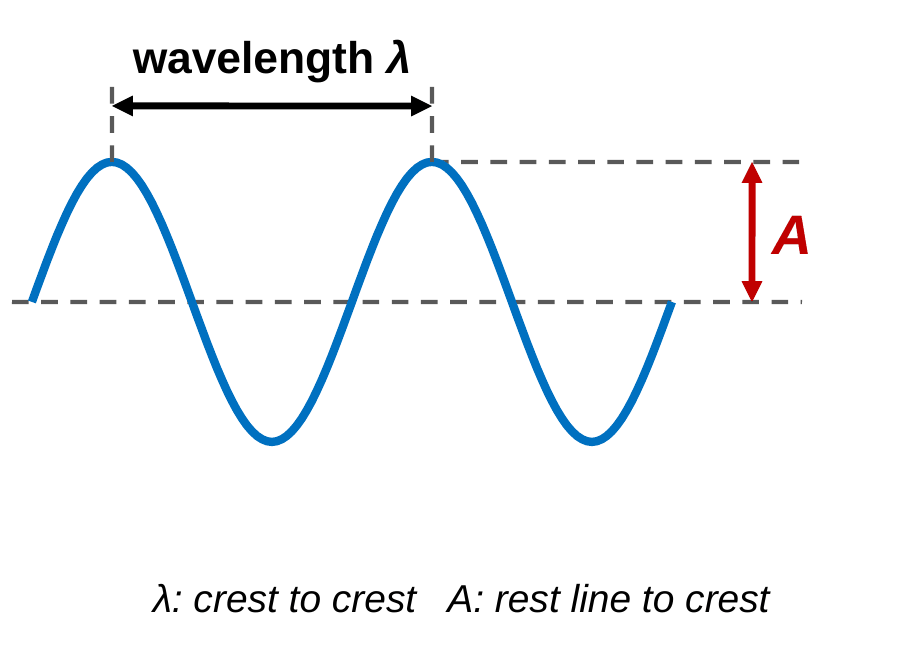
The amplitude (A) is the distance from the equilibrium line to a crest (or to a trough). It is not the distance from crest to trough. The wavelength (λ, the Greek letter lambda) is the length of one full cycle of the wave, measured from one crest to the next crest, or from one trough to the next trough. Wavelength is a length, so it is measured in meters.
Amplitude and Energy
- Bigger amplitude, more energy
- Loud sounds: big amplitude
- Tall ocean waves: big amplitude
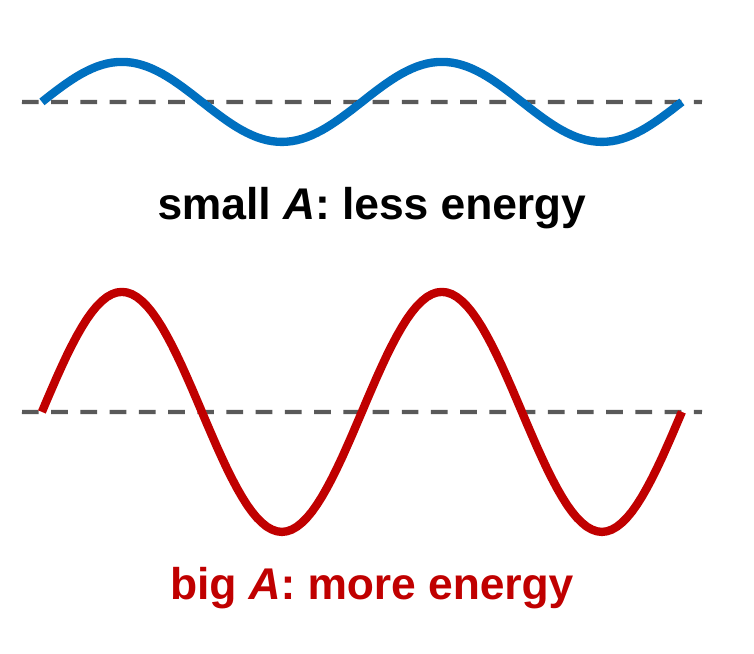
The bigger the amplitude, the more energy the wave carries. A gentle ripple has a small amplitude and little energy, while a storm wave that can knock you over has a large amplitude. For sound, a larger amplitude means a louder sound. Notice that the two waves here have the same wavelength. Amplitude and wavelength are separate properties.
Worked Examples
Try each problem on your own first, then check your work against the solution.
Example 1: Reading a Wave Graph
The graph shows a wave on a rope. The crests reach 3 cm above equilibrium at 0.5 m, 2.5 m, and 4.5 m. Find the amplitude and the wavelength.
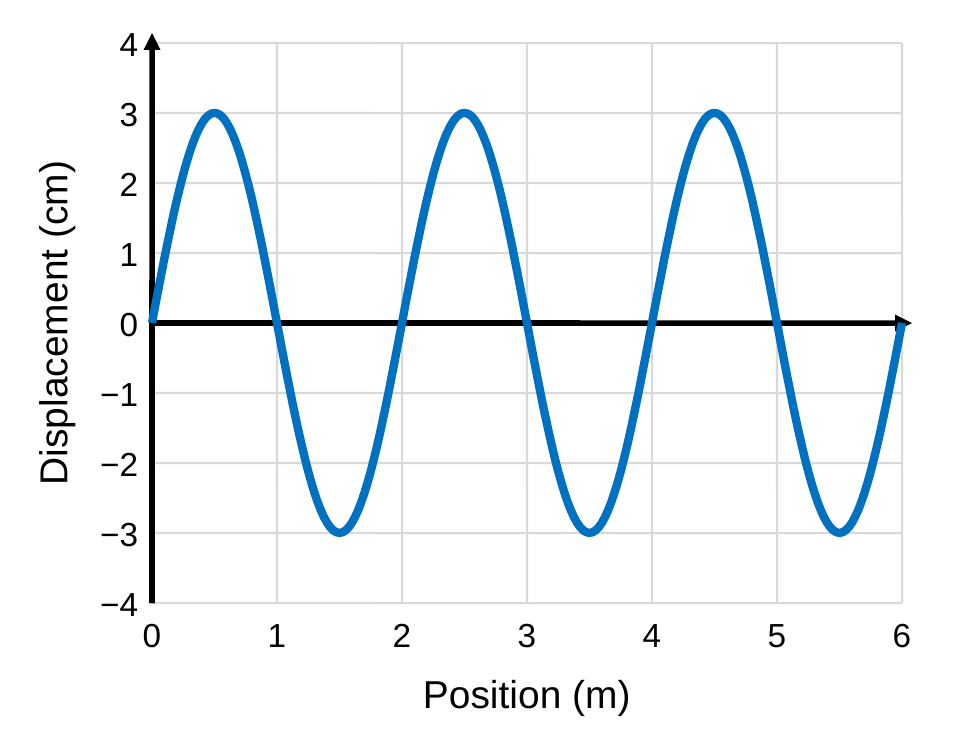
- Amplitude: read the height of a crest above the equilibrium line (0 cm): A = 3 cm
- Wavelength: find two neighboring crests: 0.5 m and 2.5 m
- Subtract: λ = 2.5 m − 0.5 m
- Answer: λ = 2.0 m
You could also measure trough to trough (1.5 m to 3.5 m) and get the same wavelength.
Example 2: Counting Wavelengths
A wave on a rope shows exactly 3 full wavelengths along a 4.5 m section. What is the wavelength?
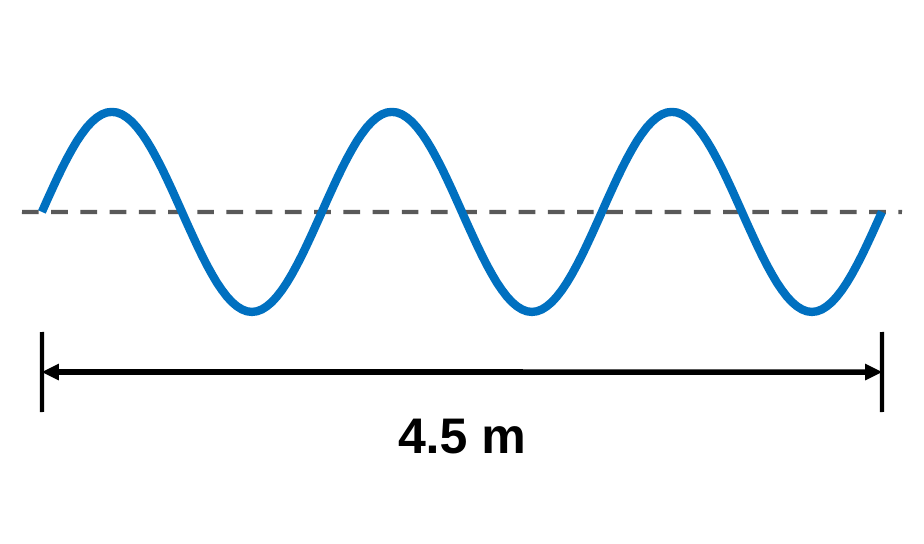
- Knowns: 3 wavelengths fit in 4.5 m
- Equation: λ = total length ÷ number of wavelengths
- Substitute: λ = 4.5 m ÷ 3
- Answer: λ = 1.5 m
Example 3: Crest to Trough
A boat rides over ocean waves. It moves 1.2 m from the top of a crest to the bottom of a trough. What is the amplitude of the waves?
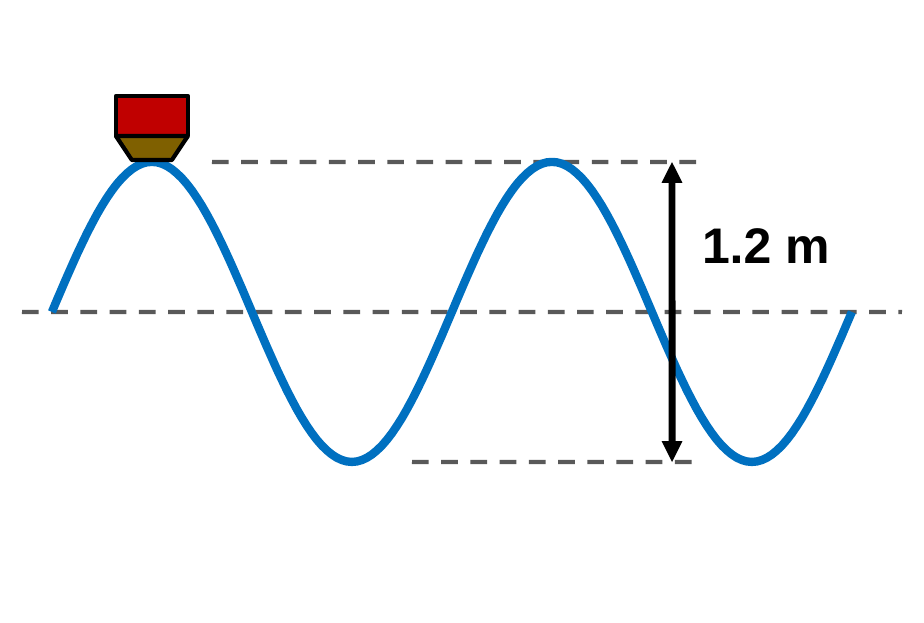
- Knowns: crest to trough = 1.2 m
- Relationship: crest to trough is two amplitudes: one above equilibrium and one below
- Substitute: A = 1.2 m ÷ 2
- Answer: A = 0.60 m
Common mistake: answering 1.2 m. Amplitude is measured from equilibrium, not from crest to trough.
Example 4: The Stadium Wave
Fans do “the wave”: each person stands up and sits down as the wave travels around the stadium. Is it transverse or longitudinal? Does any fan travel around the stadium?
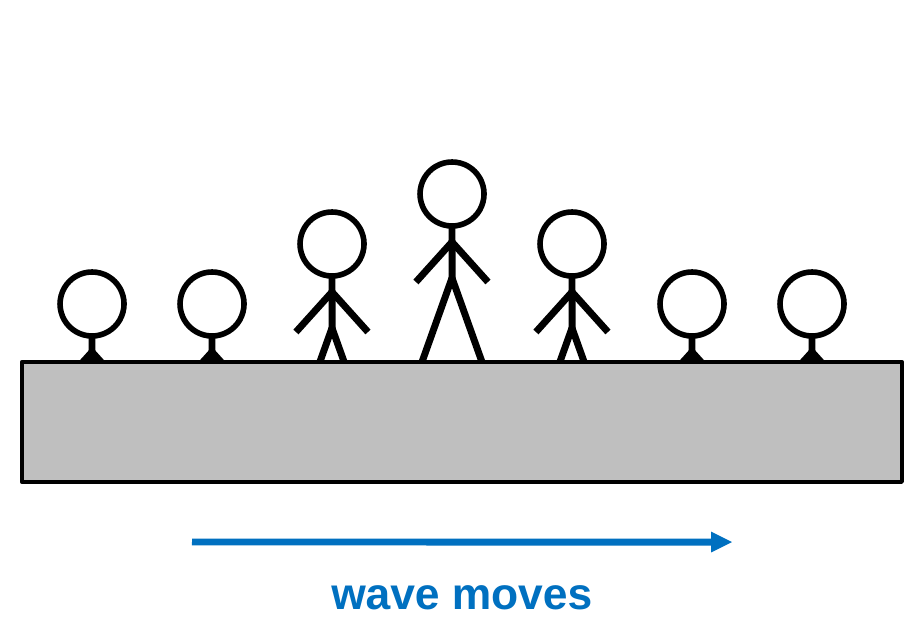
- Fan motion: each fan moves up and down
- Wave motion: the wave travels sideways around the stadium
- Compare: up and down is perpendicular to sideways
- Answer: transverse. No fan travels around the stadium. Each fan stays in their seat. Only the energy (the disturbance) travels.
Big Ideas
- Waves carry energy, not matter
- Mechanical waves need a medium; EM waves don’t
- Transverse: perpendicular. Longitudinal: parallel
- λ: crest to crest. Bigger A, more energy
Back to the essential question: a wave is a disturbance that carries energy from one place to another without carrying matter along with it. Waves can be transverse or longitudinal, and bigger amplitude means more energy. Next up, we’ll measure how often waves repeat and how fast they travel in Frequency, Period, and Wave Speed.

