
The video lesson for this topic is coming soon.
Essential Question
How far and how high does a launched object go?
Punts, jump shots, and golf drives all leave the ground at an angle, rise, and come back down. By the end of this lesson, you should be able to split a launch velocity into components and find a projectile’s hang time, maximum height, and range.
Launching at an Angle
- Split vi into components
- vx = vi cos θ
- viy = vi sin θ
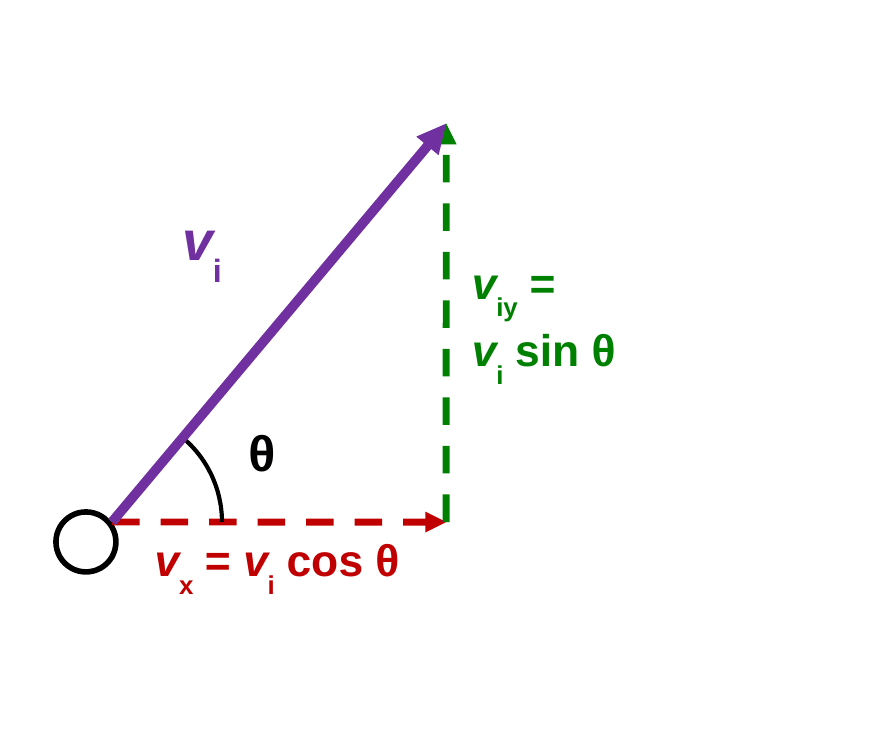
When an object is launched at an angle θ above the horizontal with speed vi, the first step is always to split the launch velocity into components, just like in the Vector Components lesson. The horizontal component is vx = vi cos θ, and the initial vertical component is viy = vi sin θ. From then on, we treat the horizontal and vertical motions separately.
Velocity Along the Path
- vx never changes
- vy shrinks going up
- vy grows coming down
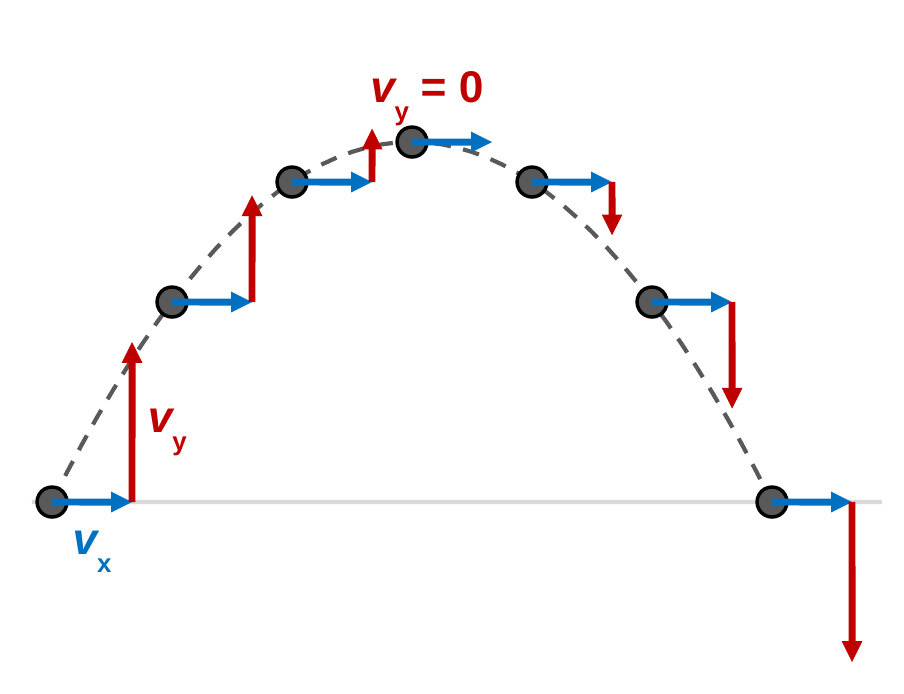
Here is the velocity of an angled projectile at equal time steps. The blue horizontal arrows never change, because no horizontal force acts. The red vertical arrows point up and shrink on the way up, because gravity takes away 9.8 m/s of upward velocity every second. At the top the vertical velocity is zero, and on the way down the red arrows point down and grow. The vertical motion is exactly the tossed-ball motion from the Free Fall lesson.
At the Top
- vy = 0
- vx is NOT zero
- a is still 9.8 m/s2 down
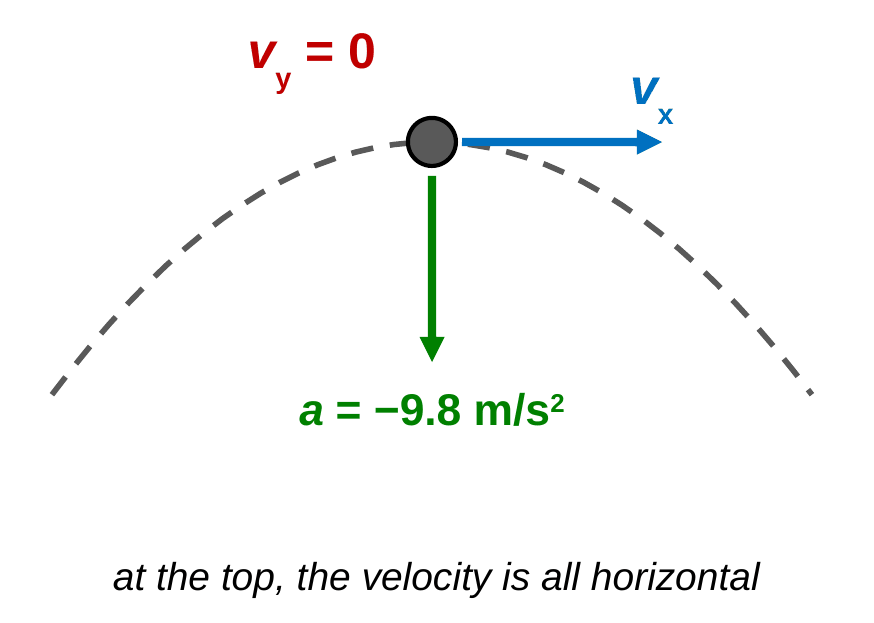
At the highest point, the projectile stops rising for an instant, so vy = 0. But unlike a ball tossed straight up, it is still moving: its horizontal velocity vx has not changed. So at the top, the speed is not zero, it is just vx. And the acceleration is still 9.8 m/s2 downward, because gravity never switches off. The fact that vy = 0 at the top is the key to finding both hang time and maximum height.
The Path Is Symmetric
- Time up = time down
- Same height, same speed
- Level ground: lands at launch speed
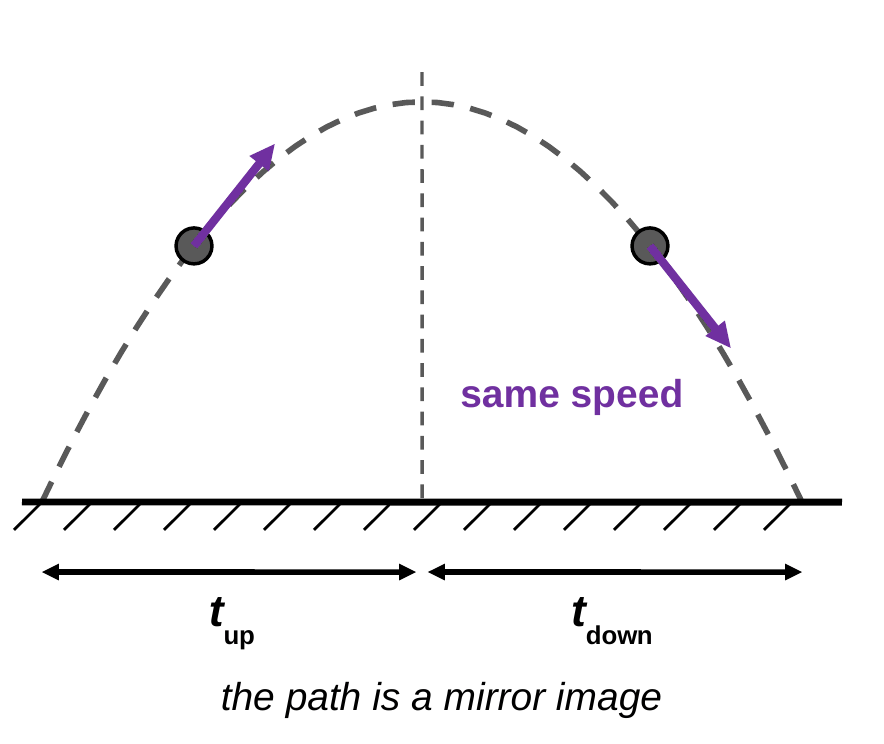
On level ground, a projectile’s path is perfectly symmetric about its highest point. It takes the same time to go up as to come down. At any height, the projectile has the same speed on the way down as it had on the way up, just angled downward instead of upward. So it lands with the same speed it was launched with. This symmetry is a huge shortcut: find the time to reach the top, then double it to get the total time.
Hang Time
- Use the vertical motion only
- Time to top: vy goes to 0
- Total time = 2 × time to top
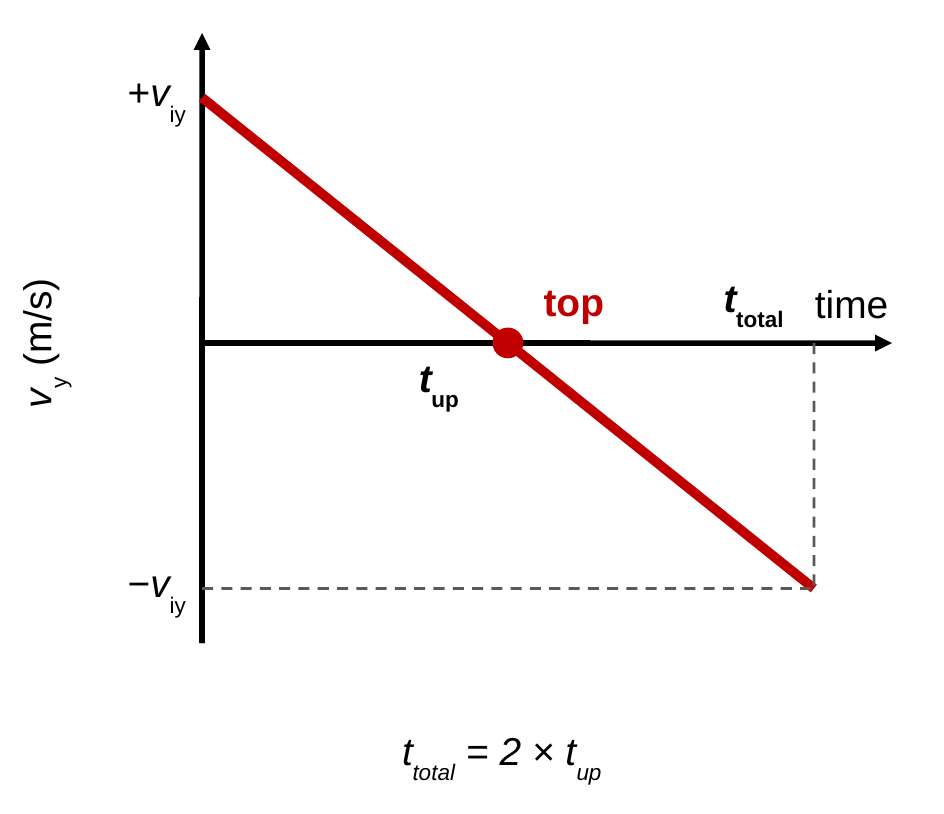
Hang time comes from the vertical motion alone. The vertical velocity starts at +viy and drops by 9.8 m/s every second until it reaches 0 at the top. Using vfy = viy + at with vfy = 0 gives the time to the top: tup = viy / 9.8 m/s2. On level ground the trip down takes the same time, so the total time in the air is 2 × tup.
Maximum Height
- Use the vertical motion only
- At the top, vfy = 0
- vfy2 = viy2 + 2aΔy
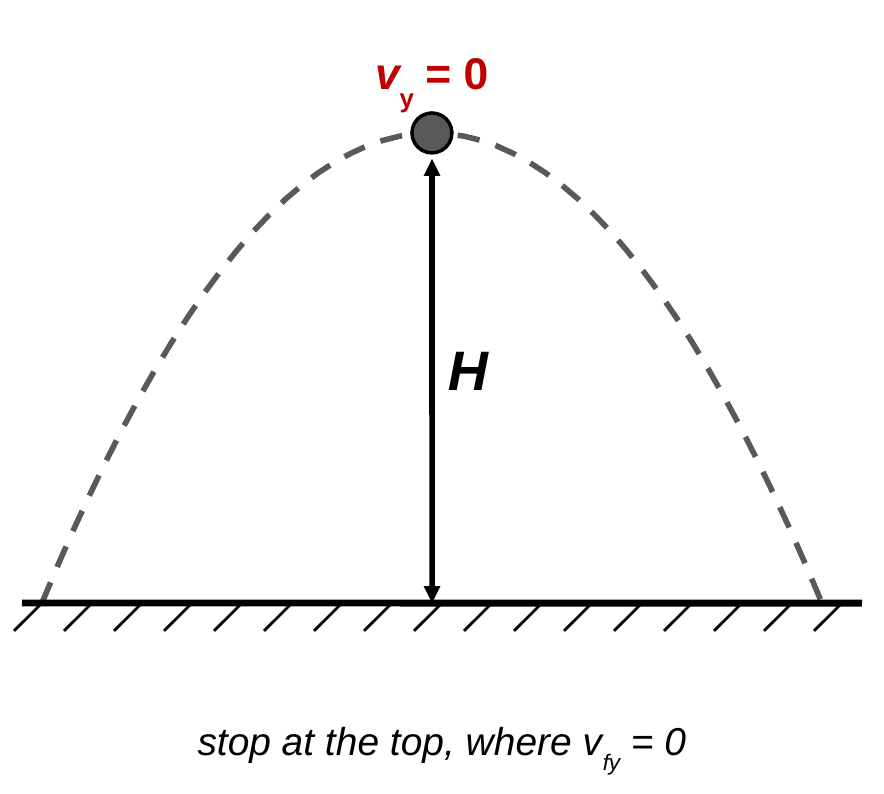
The maximum height also comes from the vertical motion. Stop the problem at the top, where the final vertical velocity is zero. Then use vfy2 = viy2 + 2aΔy with vfy = 0 and a = −9.8 m/s2, and solve for Δy. You can also find the time to the top first and use Δy = viyt + ½at2. Either way, only the vertical component viy matters, not the full launch speed.
Range
- Range = horizontal distance
- Δx = vx × ttotal
- 45° gives the most range
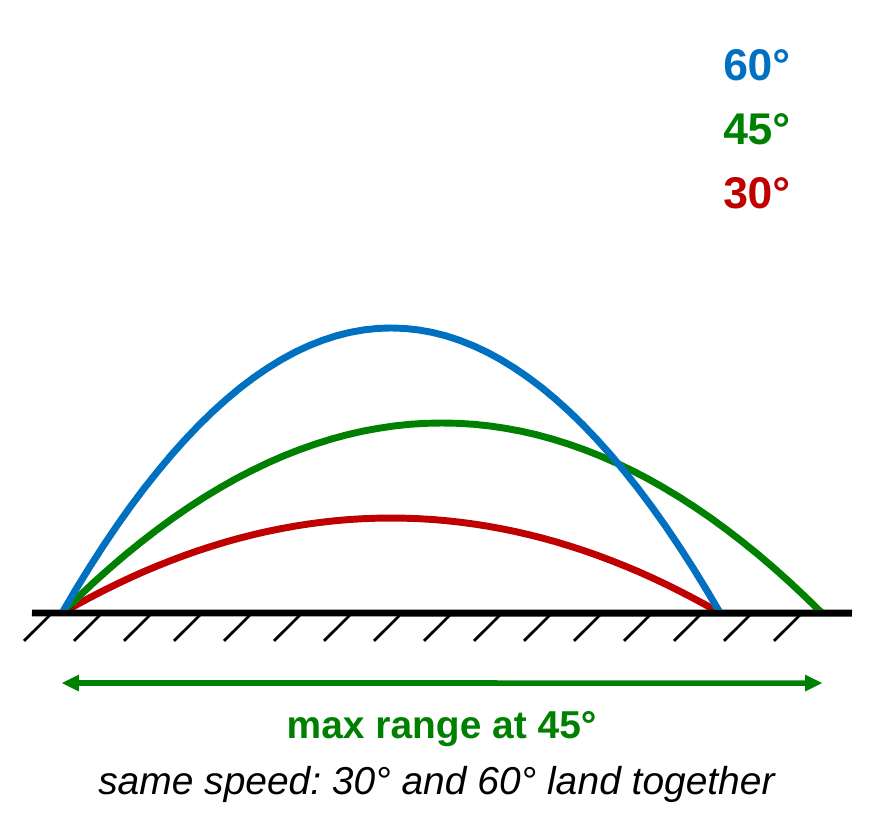
The range is the horizontal distance a projectile travels before it lands. Because the horizontal velocity is constant, range = vx × ttotal. A steep launch spends a long time in the air but moves forward slowly, and a shallow launch moves forward fast but lands quickly. On level ground with no air resistance, 45° is the best compromise and gives the maximum range. Angles that add up to 90°, like 30° and 60°, give the same range.
Worked Examples
Try each problem on your own first, then check your work against the solution.
Example 1: Launch Components
A soccer ball is kicked at 19.6 m/s at 30.0° above the ground. Find its horizontal velocity and its initial vertical velocity.
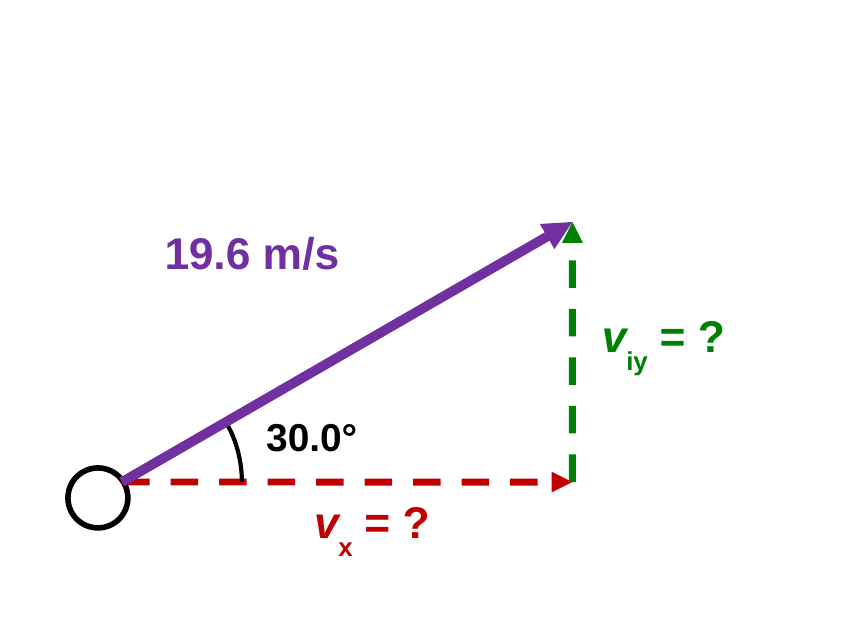
- Knowns: vi = 19.6 m/s, θ = 30.0°
- Horizontal: vx = vi cos θ = (19.6 m/s)(cos 30.0°) = (19.6 m/s)(0.866)
- Vertical: viy = vi sin θ = (19.6 m/s)(sin 30.0°) = (19.6 m/s)(0.500)
- Answer: vx = 17.0 m/s and viy = 9.80 m/s (upward)
These two numbers are all you need for every other question about this kick: vx stays 17.0 m/s the whole flight, and viy = 9.80 m/s starts the free-fall motion.
Example 2: Hang Time
A football is kicked from the ground at 25.0 m/s at 36.9° above the horizontal. How long is it in the air before it lands on the field?
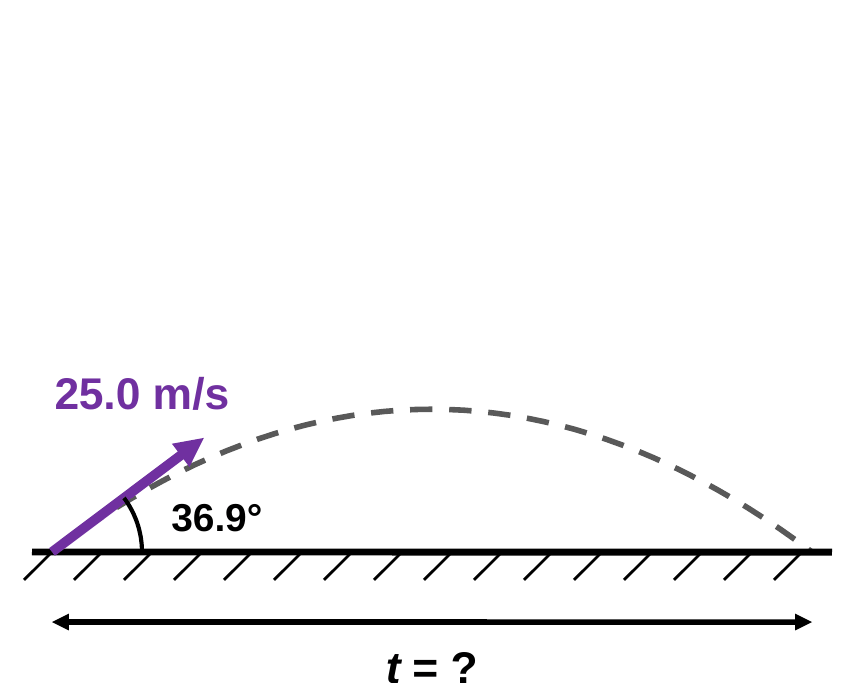
- Vertical component: viy = vi sin θ = (25.0 m/s)(sin 36.9°) = 15.0 m/s
- Time to the top: At the top vfy = 0. From vfy = viy + at: tup = (0 − 15.0 m/s) / (−9.8 m/s2) = 1.53 s
- Total time: The path is symmetric, so ttotal = 2 × 1.53 s
- Answer: t = 3.06 s
Example 3: Maximum Height
A water balloon is launched at 14.0 m/s at 60.0° above the horizontal. What is its maximum height above the launch point?
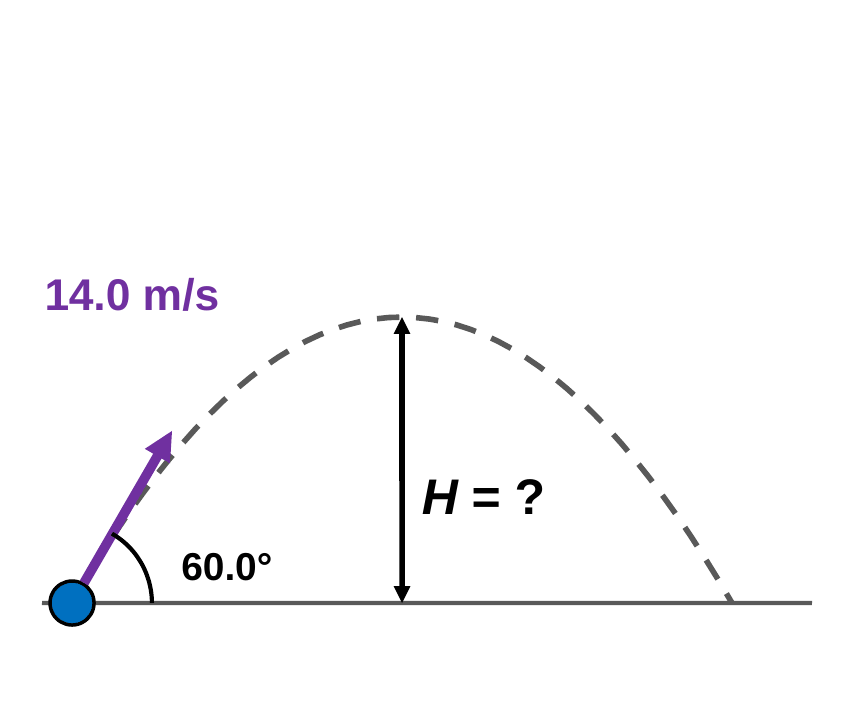
- Vertical component: viy = (14.0 m/s)(sin 60.0°) = 12.1 m/s
- Knowns (up to the top): viy = 12.1 m/s, vfy = 0, a = −9.8 m/s2, Δy = ?
- Equation: vfy2 = viy2 + 2aΔy, so Δy = (vfy2 − viy2) / 2a
- Substitute: Δy = (0 − (12.1 m/s)2) / 2(−9.8 m/s2) = (−147 m2/s2) / (−19.6 m/s2)
- Answer: H = 7.50 m above the launch point
Keep the unrounded value of viy (12.124…) in your calculator. Squaring it gives exactly 147.
Example 4: Range
A golf ball is hit at 30.0 m/s at 45.0° above level ground. How far away does it land?
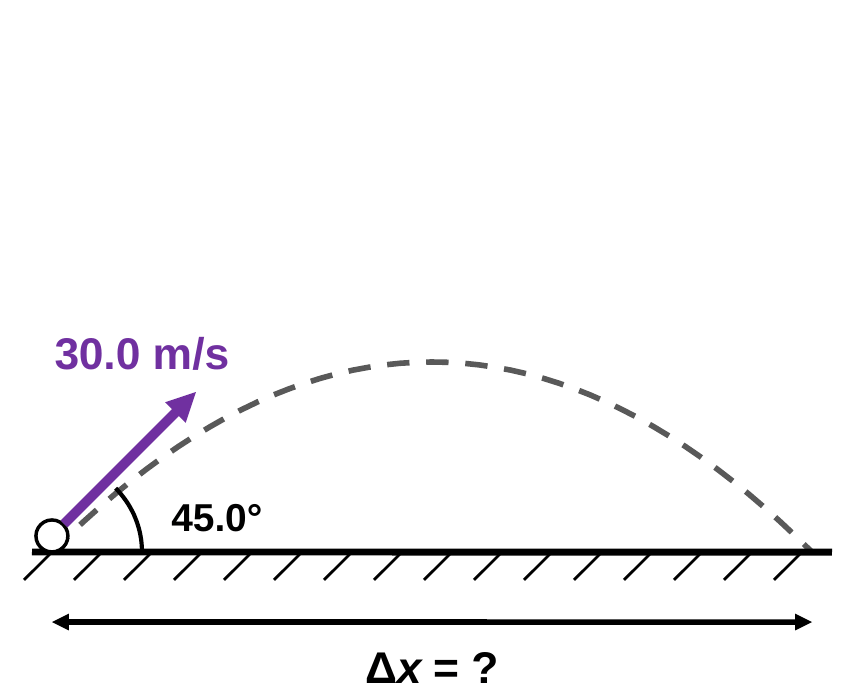
- Components: vx = (30.0 m/s)(cos 45.0°) = 21.2 m/s and viy = (30.0 m/s)(sin 45.0°) = 21.2 m/s
- Time to the top: tup = (0 − 21.2 m/s) / (−9.8 m/s2) = 2.16 s
- Total time: ttotal = 2 × 2.16 s = 4.33 s
- Range: Δx = vx × ttotal = (21.2 m/s)(4.33 s)
- Answer: Δx = 91.8 m
Keep unrounded values in your calculator between steps; rounding early can change the last digit.
Big Ideas
- Split vi: vx = vi cos θ, viy = vi sin θ
- At the top: vy = 0, but vx remains
- Hang time and height: vertical motion only
- Range = vx × total time
Back to the essential question: we split the launch velocity into components. The vertical part, vi sin θ, is free fall: it sets the hang time and the maximum height, where vy = 0. The horizontal part, vi cos θ, stays constant, so range = vx × hang time. Next up, we’ll study objects moving in circles with uniform circular motion.

