
The video lesson for this topic is coming soon.
Essential Question
What force keeps an object moving in a circle?
Anything moving in a circle is accelerating toward the center, and Newton’s second law says that takes a net force. By the end of this lesson, you should be able to identify the real force that keeps an object turning, draw free-body diagrams for circular motion, and use Fc = mv2/r.
Force Toward the Center
- Circular motion: a points to the center
- Newton’s 2nd law: needs Fnet
- Fnet toward center = centripetal force
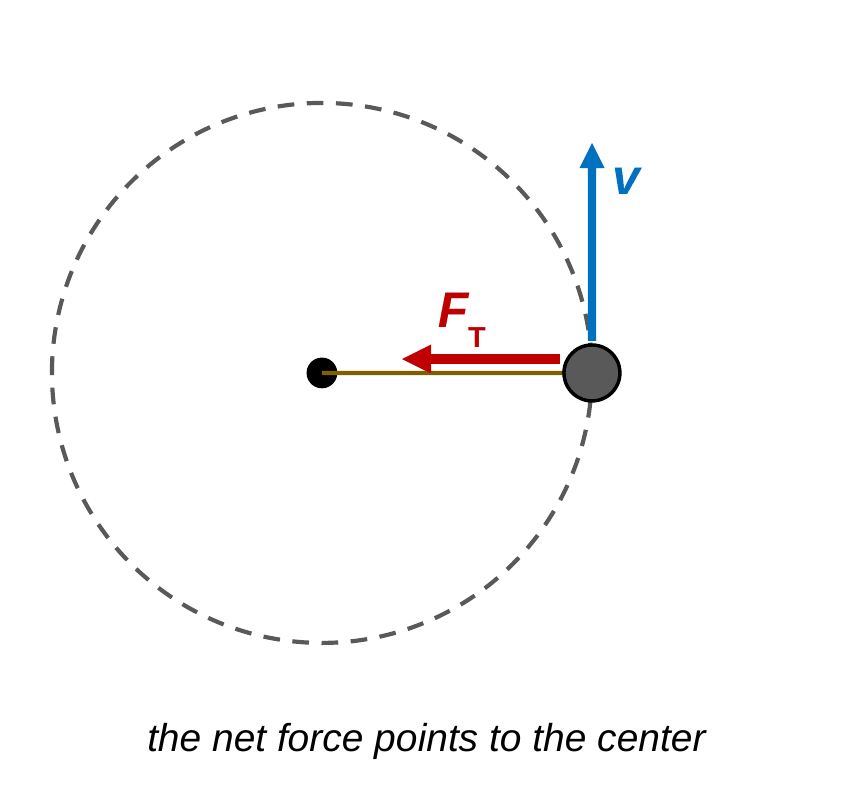
In the last lesson we saw that an object in uniform circular motion accelerates toward the center. Newton’s second law says every acceleration is caused by a net force in the same direction. So an object moving in a circle must have a net force pointing toward the center. That inward net force is called the centripetal force. For a puck swung on a string, the string’s tension pulls the puck inward and keeps it on the circle.
The Centripetal Force Equation
Start from Newton’s second law and use ac = v2/r:
- Fnet = mac
- Fc = mv2 / r
- Fc in newtons (N), m in kg, v in m/s, r in m
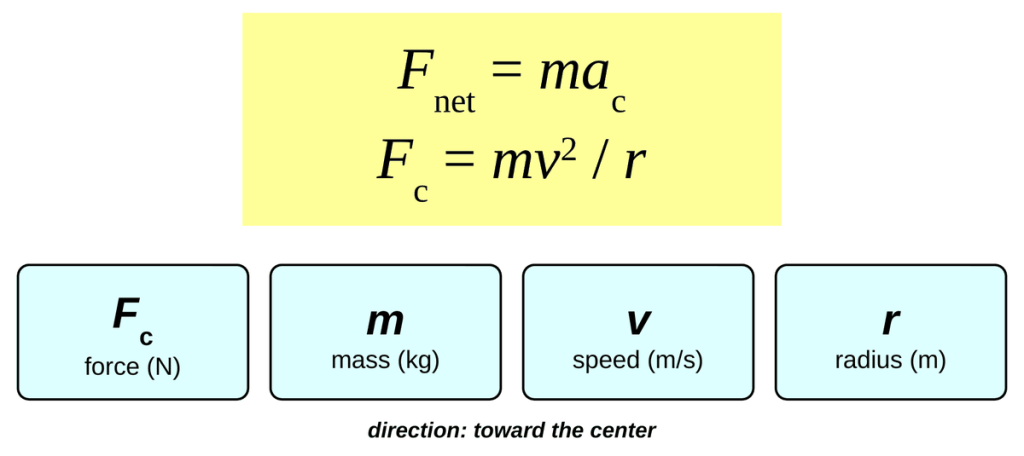
The centripetal force grows with mass and with the square of the speed, and it gets bigger for tighter circles. Doubling your speed on a curve takes four times as much inward force. Check the units: kg × (m/s)2 ÷ m = kg·m/s2, which is a newton.
Sources of Centripetal Force
- Not a new kind of force
- A real force pulls or pushes inward
- Always name the real force
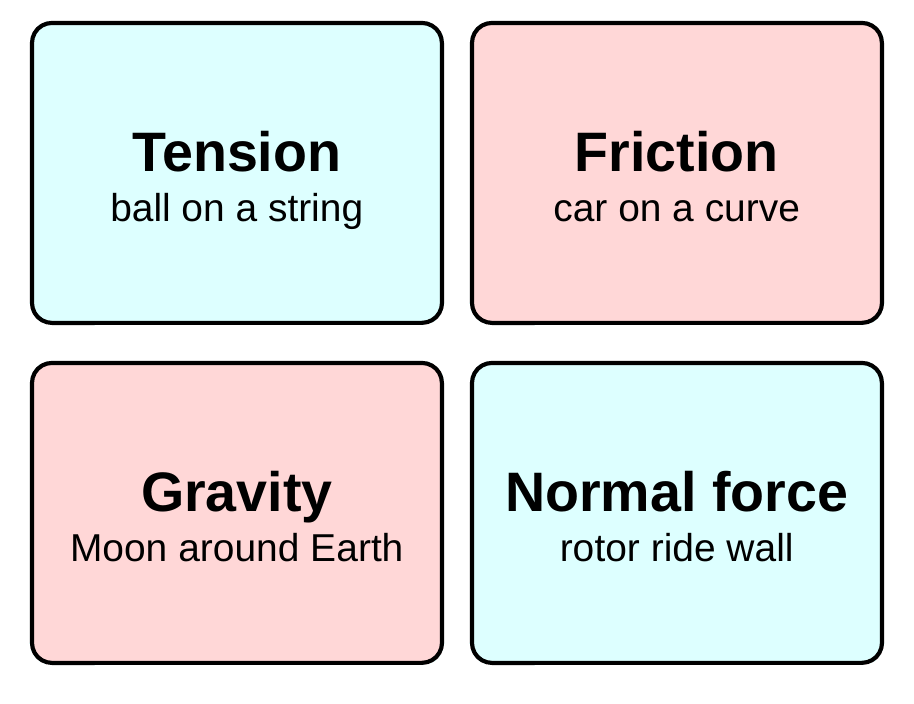
Centripetal force is not a new type of force like gravity or friction. It is a job that some real force has to do: pull or push the object toward the center. Tension does the job for a ball on a string. Static friction from the road does it for a car turning on a flat curve. Gravity does it for the Moon orbiting Earth. The normal force from the wall does it for a rider in a spinning rotor ride. When you solve a problem, always identify which real force is providing the centripetal force.
Free-Body Diagram: Car on a Curve
- Draw only real forces
- Friction points to the center
- No extra “Fc” arrow
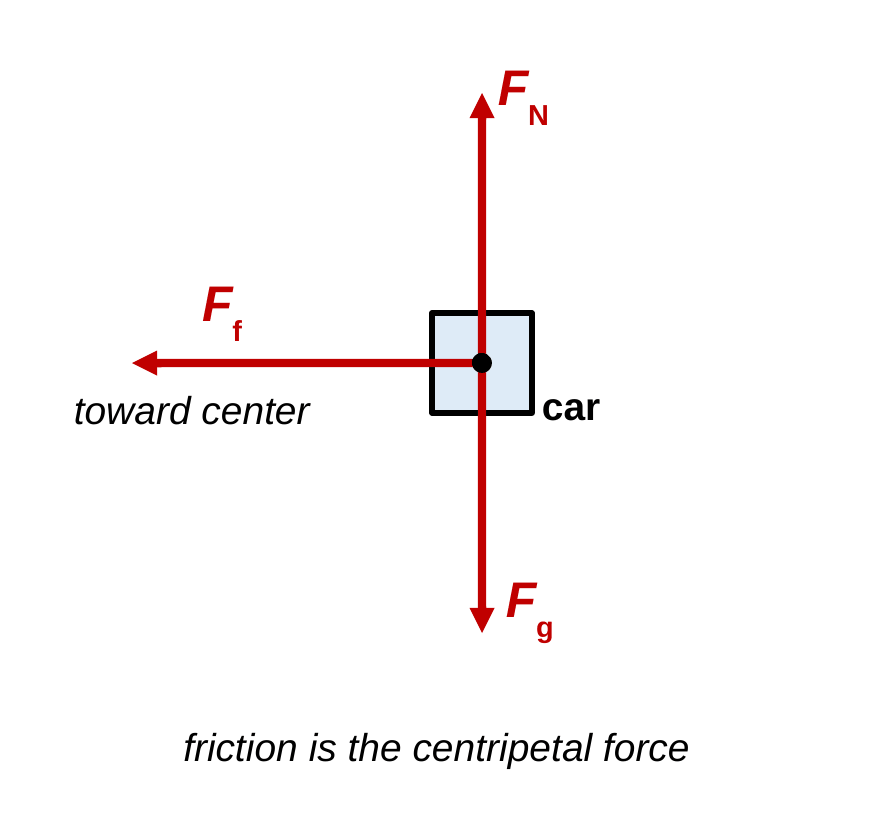
Here is a free-body diagram for a car turning left on a flat road, seen from behind. Vertically, the normal force and gravity are balanced, because the car is not moving up or down. Horizontally, the only force is static friction from the road on the tires, pointing toward the center of the curve. That friction is the centripetal force, so Ff = mv2/r. Do not add a separate arrow labeled Fc; the centripetal force is the friction arrow you already drew. If the road is icy, or the car goes too fast, friction cannot supply enough force and the car slides off along the tangent.
Gravity in Orbit
- Gravity pulls the Moon toward Earth
- Gravity is the centripetal force
- The Moon keeps falling around Earth
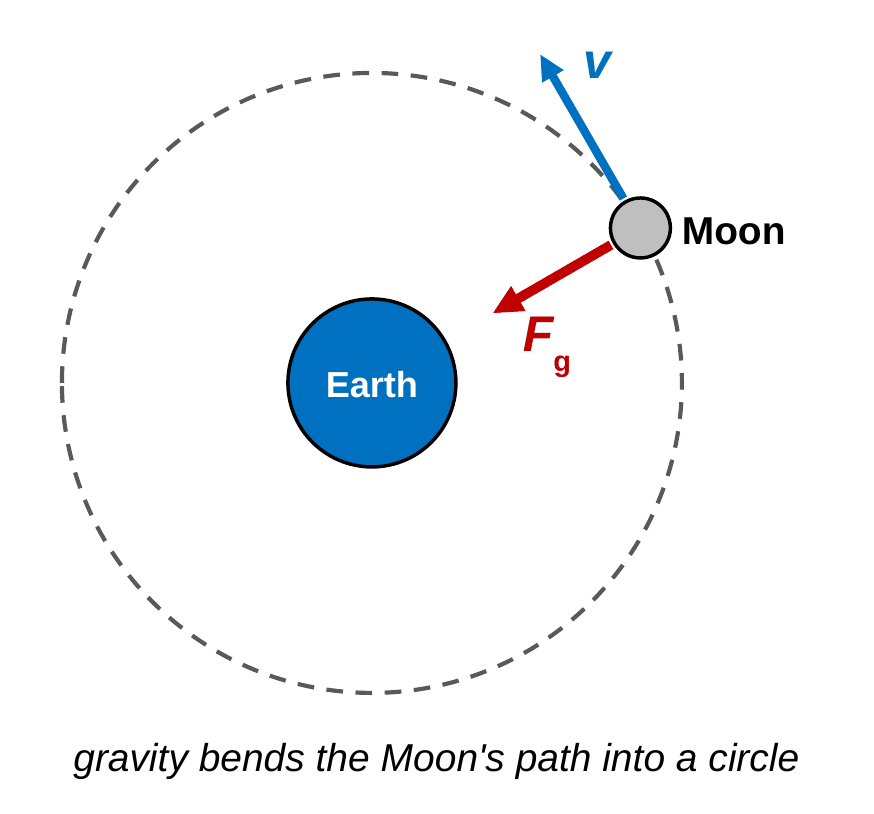
The Moon moves in a nearly circular orbit around Earth. Nothing touches it, so the only force on it is Earth’s gravity, which always points toward Earth’s center. Gravity is the centripetal force for the Moon: Fg = mv2/r. You can think of the Moon as constantly falling toward Earth while also moving sideways so fast that it keeps missing. Satellites and the International Space Station orbit the same way.
Free-Body Diagram: Rotor Ride
- Wall pushes rider toward the center
- Normal force is the centripetal force
- Friction holds the rider up
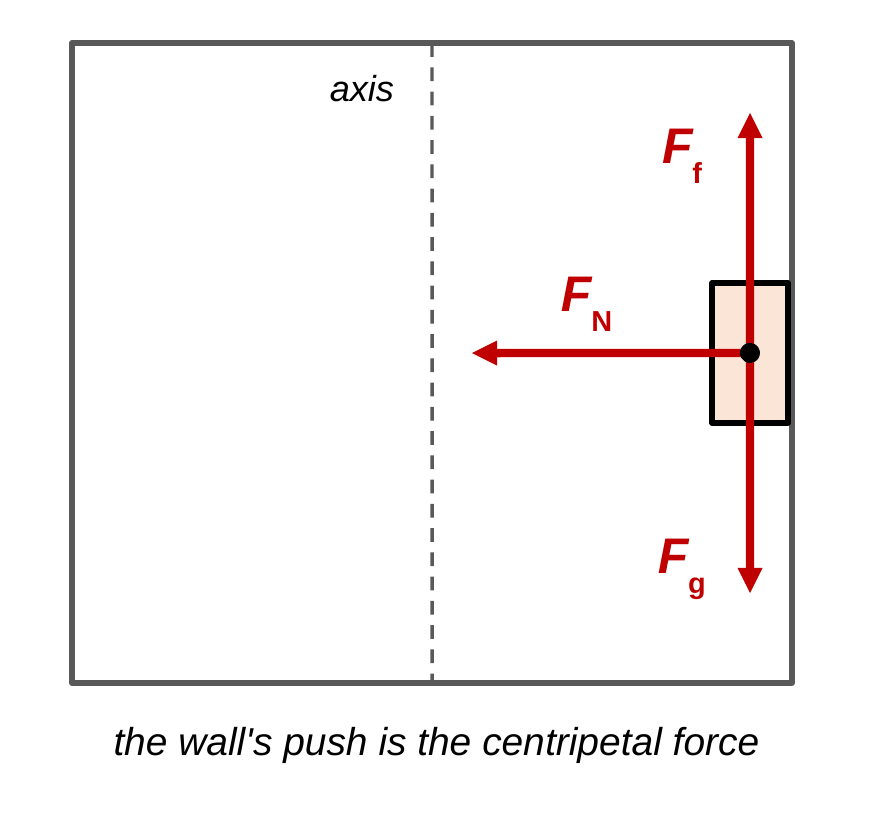
In a rotor ride, riders stand against the wall of a spinning cylinder, and then the floor drops away. The free-body diagram shows why they do not fall. The wall pushes each rider toward the center (the axis), so the normal force is the centripetal force: FN = mv2/r. That strong normal force also makes a large friction force possible, and friction pointing up balances gravity. Riders feel pressed into the wall, but the real force on them points inward.
Worked Examples
Try each problem on your own first, then check your work against the solution.
Example 1: Puck on a String
A 0.50 kg puck on an air hockey table is tied to a string and slides in a circle of radius 1.2 m at 6.0 m/s. What is the tension in the string?
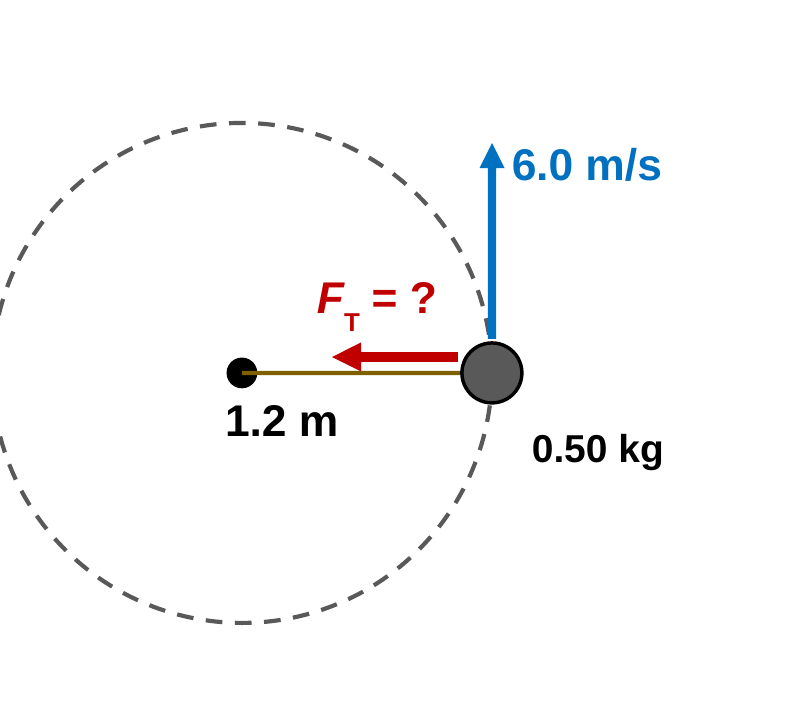
- Source of Fc: The string’s tension pulls the puck toward the center, so FT = mv2/r.
- Knowns: m = 0.50 kg, v = 6.0 m/s, r = 1.2 m
- Substitute: FT = (0.50 kg)(6.0 m/s)2 / 1.2 m = (0.50 kg)(36 m2/s2) / 1.2 m
- Answer: FT = 15 N toward the center
Example 2: Friction on a Curve
A 1,350 kg car rounds a flat curve of radius 45.0 m at 15.0 m/s. How much friction force must the road provide?
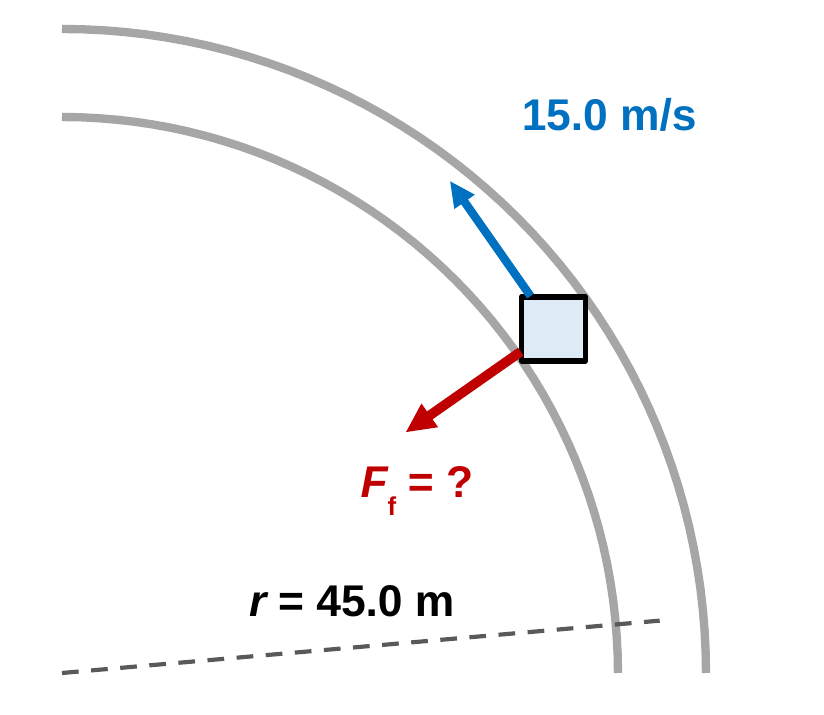
- Source of Fc: On a flat road, static friction points toward the center, so Ff = mv2/r.
- Knowns: m = 1,350 kg, v = 15.0 m/s, r = 45.0 m
- Substitute: Ff = (1,350 kg)(15.0 m/s)2 / 45.0 m = (1,350 kg)(225 m2/s2) / 45.0 m
- Answer: Ff = 6,750 N toward the center of the curve
Example 3: Rotor Ride Speed
A 60.0 kg rider stands against the wall of a rotor ride with a radius of 2.50 m. The wall pushes on her with a normal force of 1,350 N. How fast is she moving?
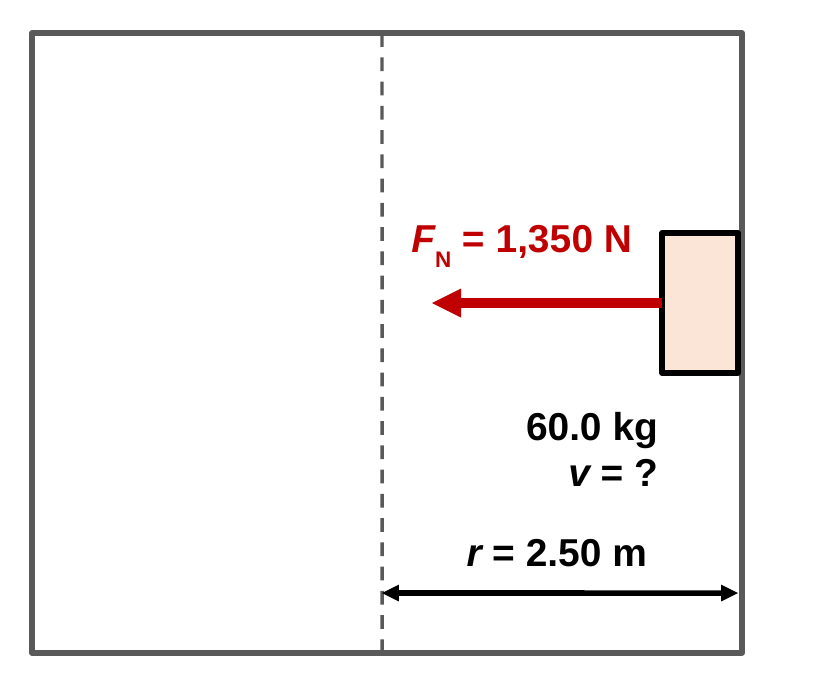
- Source of Fc: The wall’s normal force points toward the center, so FN = mv2/r.
- Rearrange: v2 = FNr / m, so v = √(FNr / m)
- Substitute: v = √((1,350 N)(2.50 m) / 60.0 kg) = √(56.25 m2/s2)
- Answer: v = 7.50 m/s
Example 4: Toy Car Track
A 0.200 kg toy car moves at a constant 3.00 m/s around a flat circular track. Friction provides a 1.20 N force toward the center. What is the radius of the track?
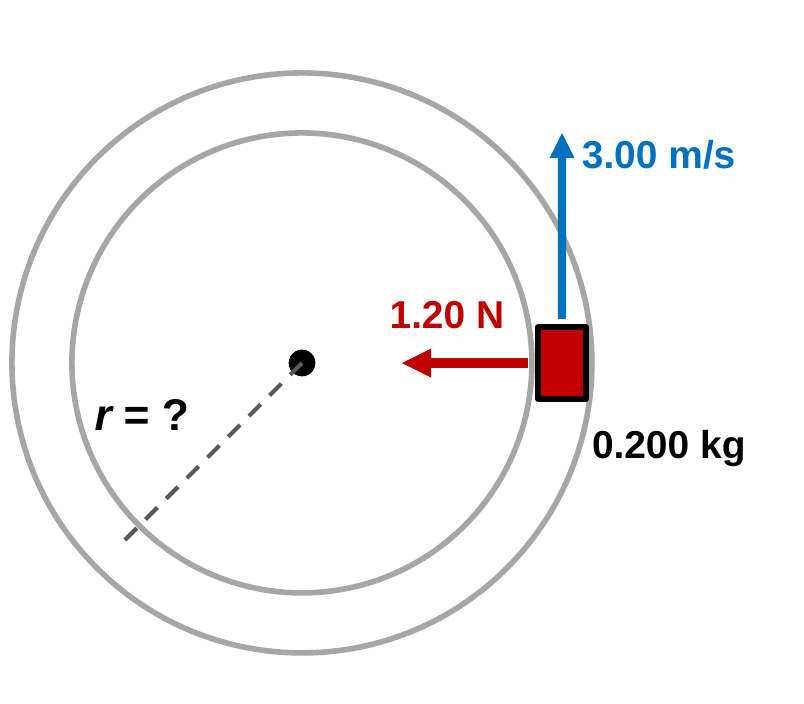
- Source of Fc: Friction points toward the center, so Ff = mv2/r.
- Rearrange: Multiply both sides by r and divide by Ff: r = mv2 / Ff
- Substitute: r = (0.200 kg)(3.00 m/s)2 / 1.20 N = (0.200 kg)(9.00 m2/s2) / 1.20 N
- Answer: r = 1.50 m
Big Ideas
- Circular motion needs Fnet toward the center
- Fc = mv2/r
- Tension, friction, gravity, or normal force does the job
- FBDs: real forces only, no extra Fc
Back to the essential question: a net force pointing toward the center, called the centripetal force, Fc = mv2/r. It is not a new kind of force. It is the job done by a real force such as tension, friction, gravity, or a normal force. This wraps up Unit 3 on 2D dynamics.

