
The video lesson for this topic is coming soon.
Essential Question
How can something move at a constant speed and still accelerate?
A car on a curve or a rider on a Ferris wheel can keep a steady speed and still be accelerating. By the end of this lesson, you should be able to explain centripetal acceleration and use v = 2πr/T and ac = v2/r.
Moving in a Circle
- Path: a circle of radius r
- Speed stays constant
- Ferris wheels, merry-go-rounds, curves
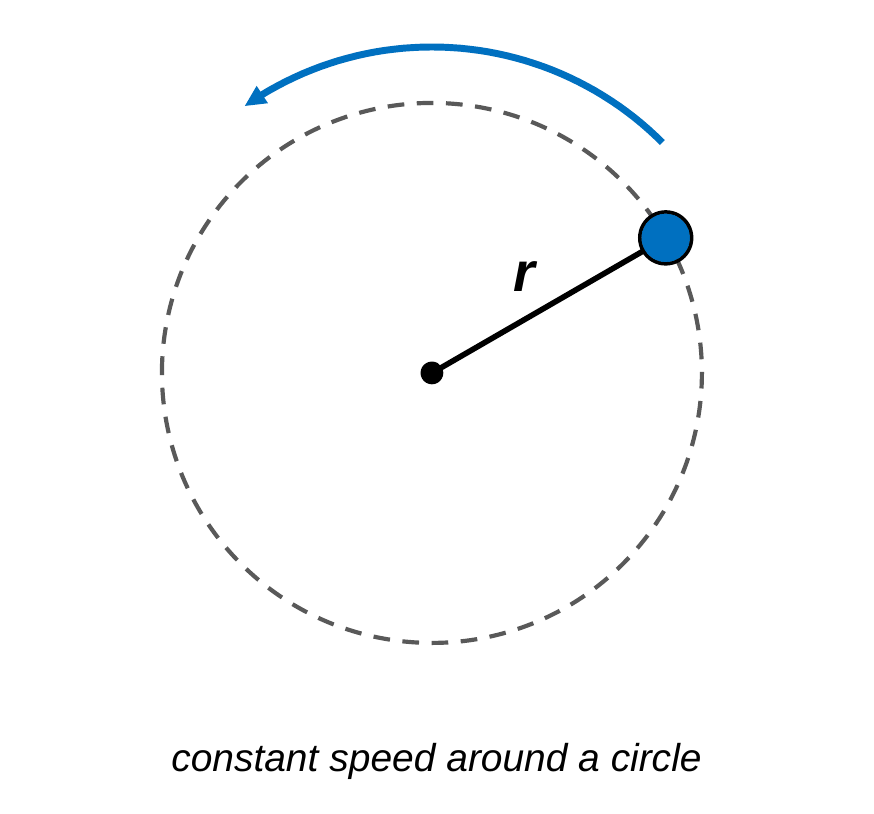
Uniform circular motion means moving in a circle at a constant speed. The circle has a radius r, the distance from the center to the moving object. Riders on a Ferris wheel, a kid on a merry-go-round, a car going around a curve at a steady speed, and the Moon orbiting Earth are all close to uniform circular motion.
Velocity Keeps Changing
- Velocity is tangent to the circle
- Same speed, new direction
- New velocity means acceleration
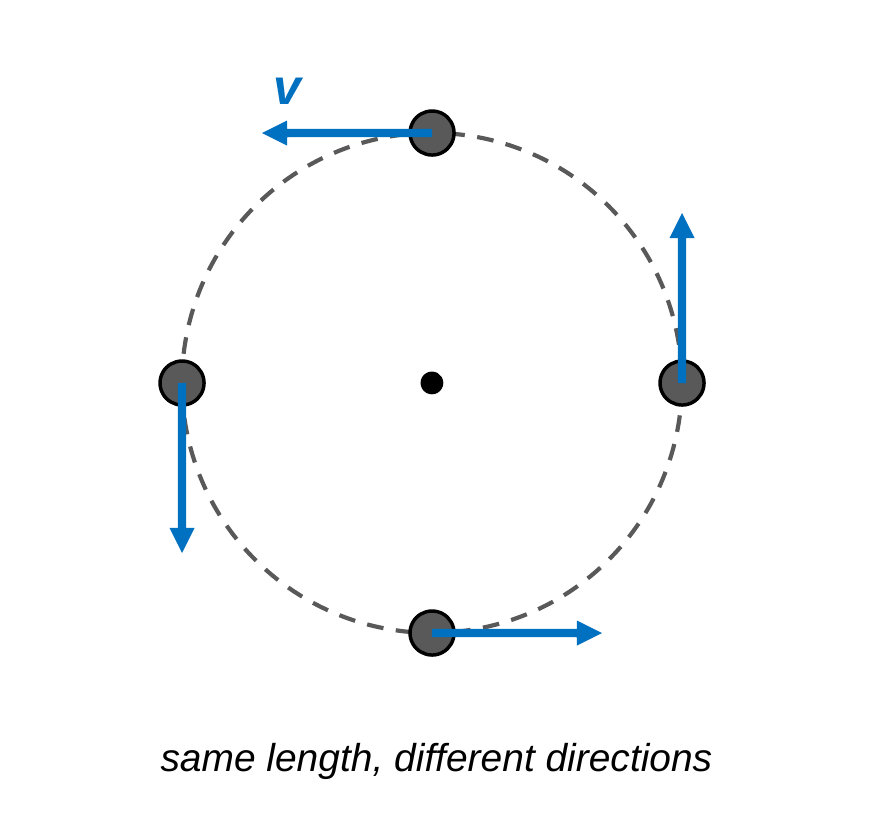
At every point, the velocity of an object moving in a circle points along the circle, tangent to it. In the picture, every arrow has the same length, because the speed is constant. But the arrows point in different directions. Velocity is a vector, so a change in direction is a change in velocity, and any change in velocity is an acceleration. That is how an object can have a constant speed and still accelerate.
Centripetal Acceleration
- Points toward the center
- “Centripetal” = center-seeking
- Always ⊥ to the velocity
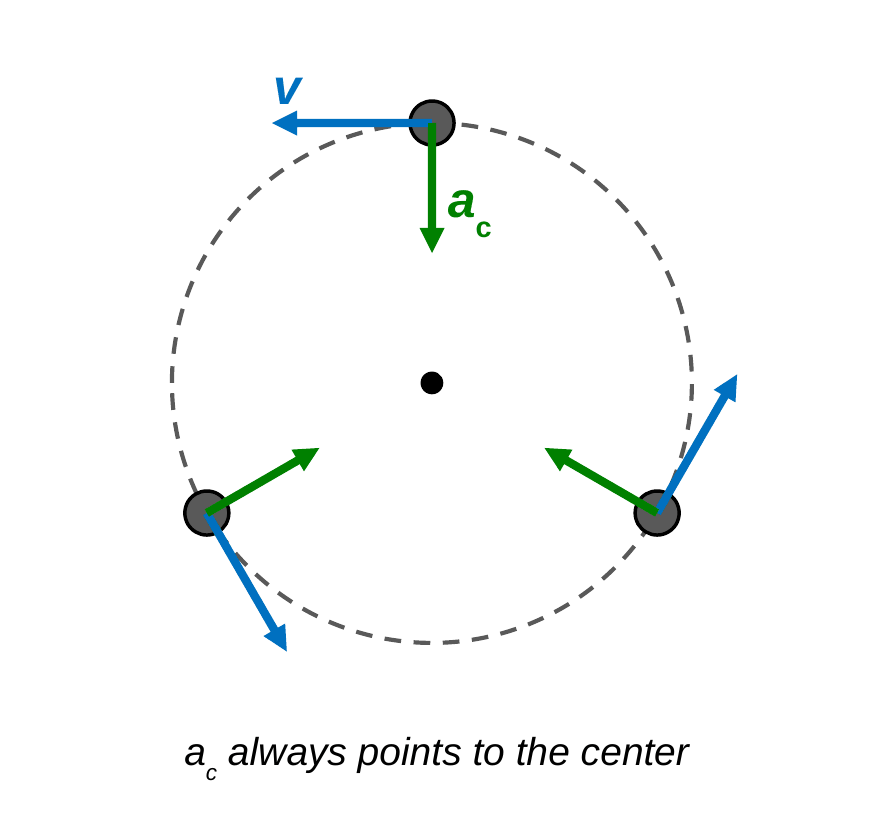
To keep turning onto a circle, the object’s velocity must keep bending toward the center. So its acceleration points toward the center of the circle. This is called centripetal acceleration, ac, from Latin words meaning “center-seeking.” It is always perpendicular to the velocity. Because it is sideways to the motion, it changes only the direction of the velocity, not the speed.
Period and Speed
v = 2πr / T
- v = speed, in meters per second (m/s)
- r = radius of the circle, in meters (m)
- T = period, the time for one full lap, in seconds (s)
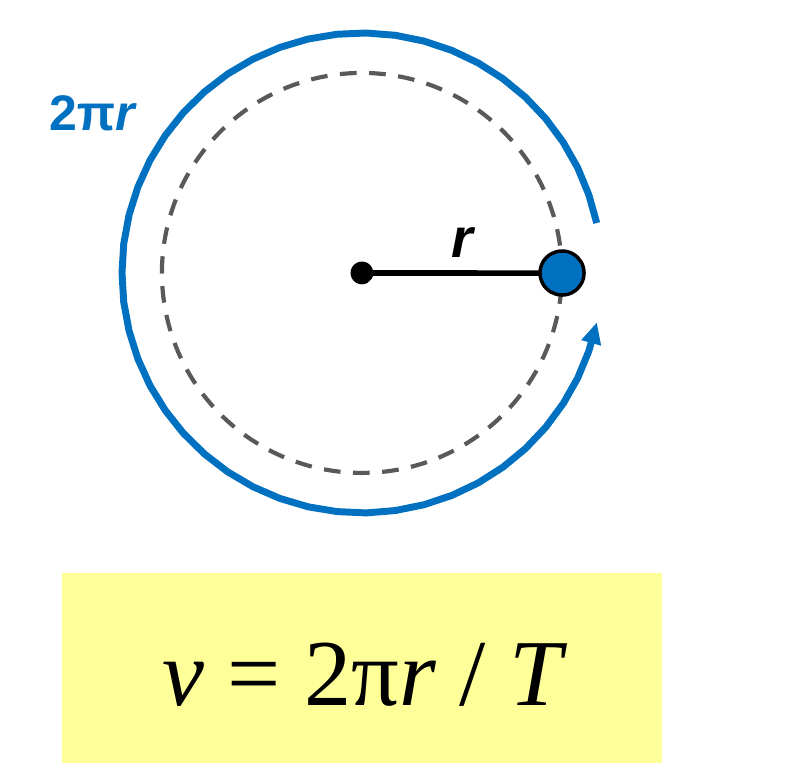
The period T is the time it takes to go around the circle once. In one lap, the object travels the circumference of the circle, 2πr. Speed is distance divided by time, so the speed is 2πr divided by T.
The Centripetal Acceleration Equation
a_c = v^2 / r
- ac = centripetal acceleration, in m/s2, pointing toward the center
- v = speed, in m/s
- r = radius, in m
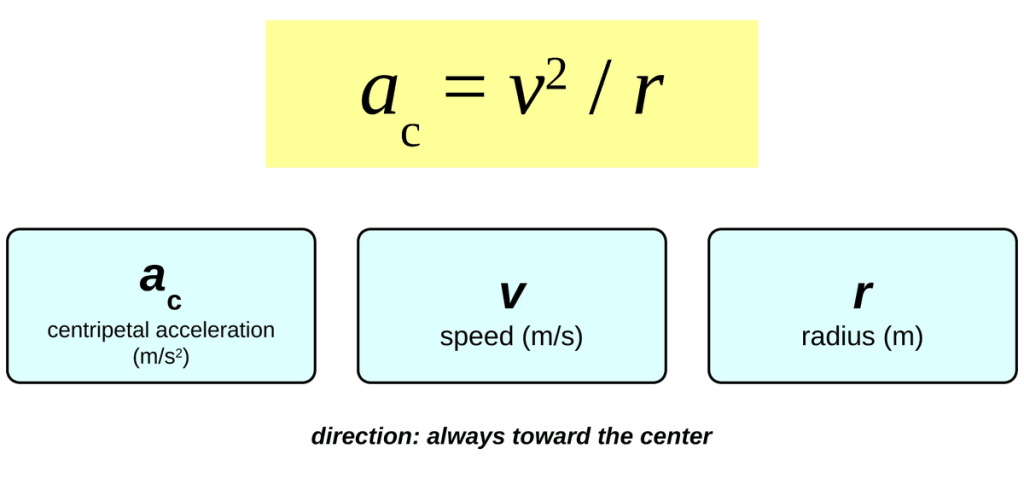
The faster you go around a curve, the more sharply your velocity has to turn, and the acceleration grows with the square of the speed. Double the speed and the acceleration becomes four times as large. A tighter circle (smaller r) also means a larger acceleration. The units work out: (m/s)2 ÷ m = m/s2.
When the Pull Stops
- It keeps going straight
- It leaves along the tangent
- It does NOT fly straight outward
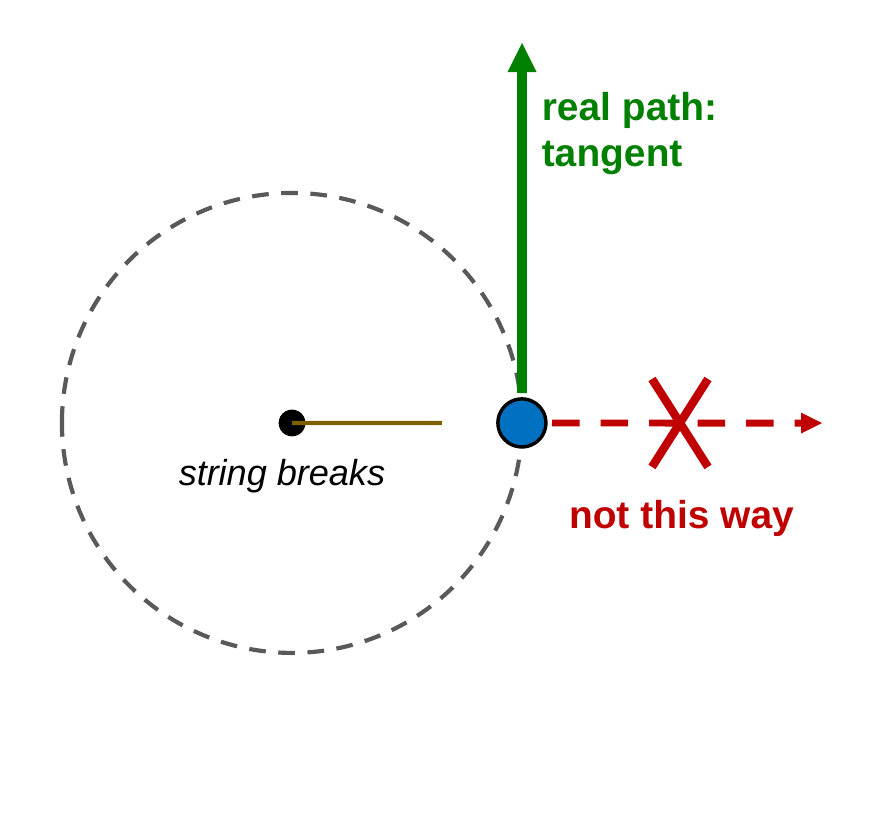
If the force pulling an object toward the center suddenly disappears, nothing bends its path anymore. By Newton’s first law, it keeps moving in a straight line in whatever direction it was going at that instant, which is along the tangent. It does not fly straight outward away from the center. The feeling of being “thrown outward” on a turn is really your body’s inertia trying to keep going straight.
Worked Examples
Try each problem on your own first, then check your work against the solution.
Example 1: Merry-Go-Round
A child sits 2.0 m from the center of a merry-go-round. It makes one full turn every 4.0 s. What is the child’s speed?
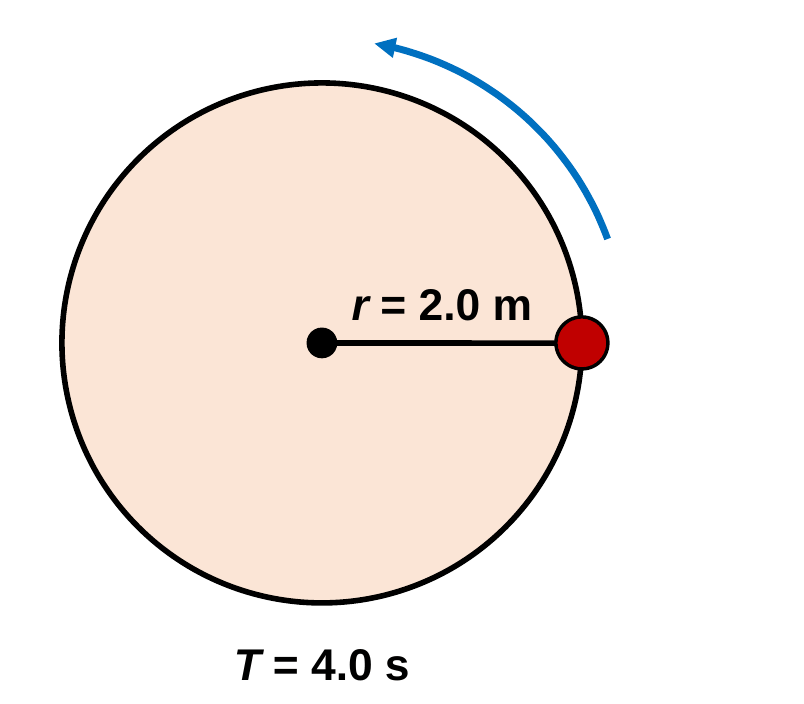
- Knowns: r = 2.0 m, T = 4.0 s, v = ?
- Equation: v = 2πr / T
- Substitute: v = 2π(2.0 m) / 4.0 s = 12.6 m / 4.0 s
- Answer: v = 3.1 m/s
Example 2: Car on a Curve
A car drives around a curve of radius 50.0 m at a constant 15.0 m/s. What is the car’s centripetal acceleration?
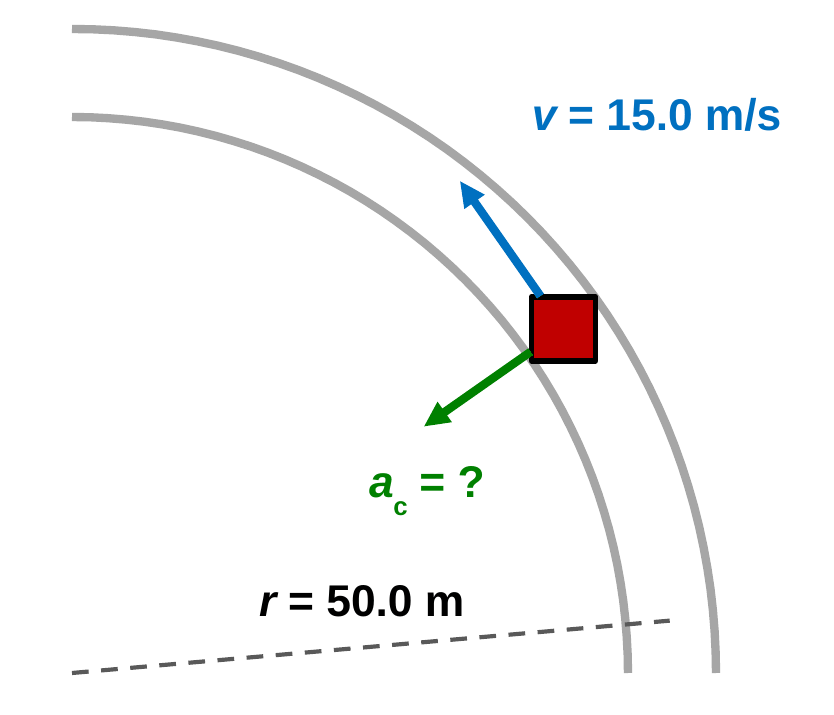
- Knowns: v = 15.0 m/s, r = 50.0 m, ac = ?
- Equation: ac = v2 / r
- Substitute: ac = (15.0 m/s)2 / 50.0 m = (225 m2/s2) / 50.0 m
- Answer: ac = 4.50 m/s2 toward the center of the curve
Example 3: Ferris Wheel
A Ferris wheel has a radius of 20.0 m and turns once every 40.0 s. Find a rider’s speed and centripetal acceleration.
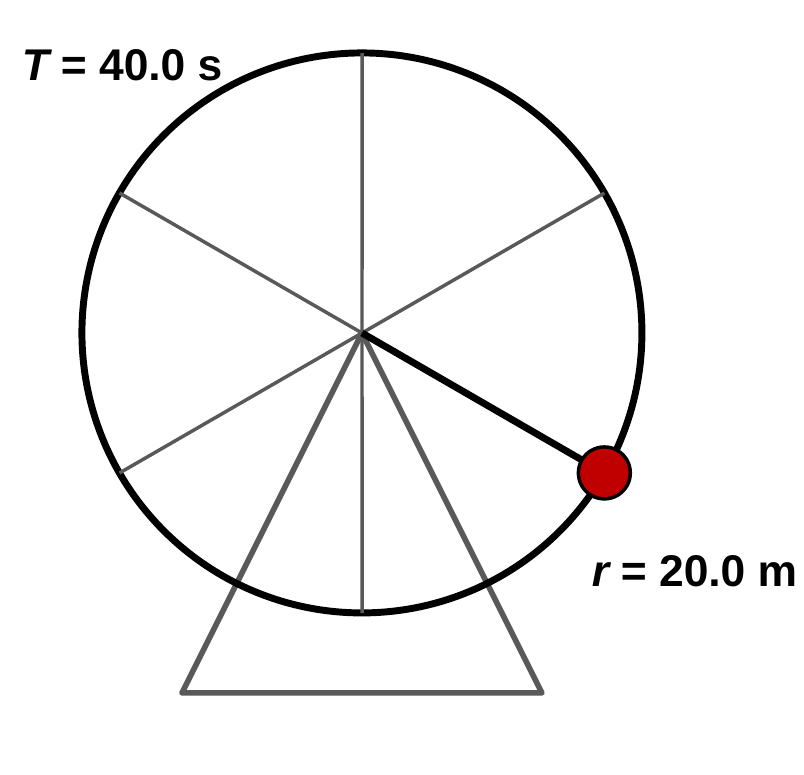
- Knowns: r = 20.0 m, T = 40.0 s
- Speed: v = 2πr / T = 2π(20.0 m) / 40.0 s = 125.7 m / 40.0 s = 3.14 m/s
- Acceleration: ac = v2 / r = (3.14 m/s)2 / 20.0 m = (9.87 m2/s2) / 20.0 m
- Answer: v = 3.14 m/s and ac = 0.493 m/s2 toward the center
Example 4: Ball on a String
A ball on a string moves in a horizontal circle of radius 0.50 m. Its centripetal acceleration is 32 m/s2. How fast is the ball moving?
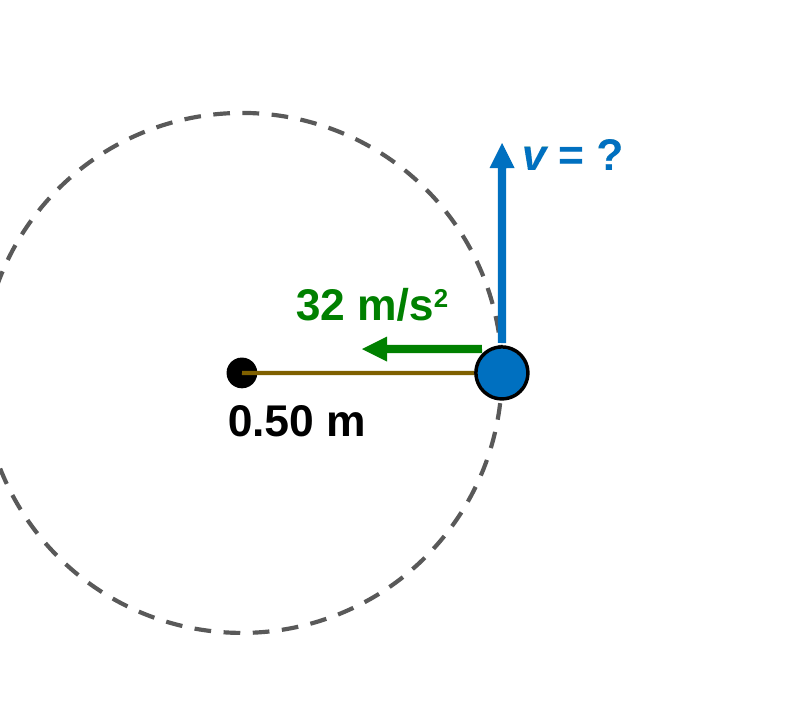
- Knowns: r = 0.50 m, ac = 32 m/s2, v = ?
- Equation: ac = v2 / r, rearranged to v = √(ac r)
- Substitute: v = √((32 m/s2)(0.50 m)) = √(16 m2/s2)
- Answer: v = 4.0 m/s
Big Ideas
- Constant speed, but changing velocity
- ac points toward the center
- v = 2πr/T and ac = v2/r
- No pull: object moves off along the tangent
Back to the essential question: velocity is a vector, so changing direction changes the velocity even when the speed stays the same. An object in uniform circular motion is always turning toward the center, so it has a centripetal acceleration ac = v2/r that points to the center. Next up, we’ll find the force that causes that acceleration: centripetal force.

