
The video lesson for this topic is coming soon.
Essential Question
What path does an object take when it’s launched sideways?
A ball rolling off a table moves forward and falls at the same time. By the end of this lesson, you should be able to treat the horizontal and vertical motions separately and solve for time in the air, horizontal distance, and vertical drop.
What Is a Projectile?
- Any object flying through the air
- Only gravity acts on it
- Its path is a curve: a parabola
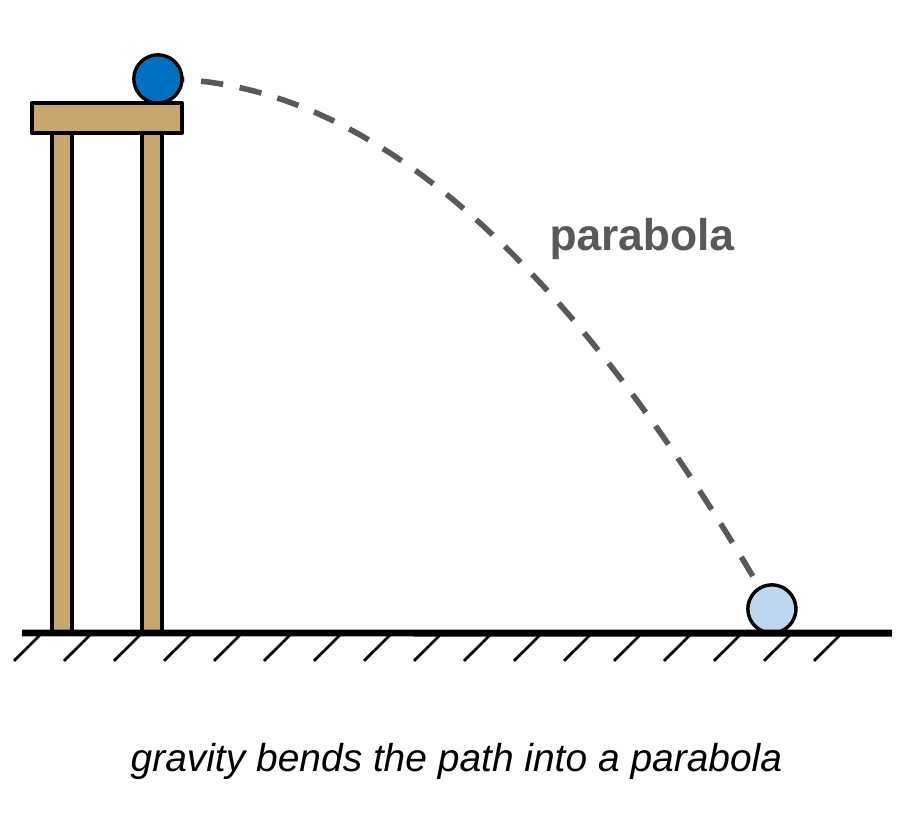
A projectile is any object moving through the air with only gravity acting on it, like a thrown ball, a kicked football, or a ball rolling off a table. As long as we ignore air resistance, the path of every projectile is the same kind of curve, called a parabola. In this lesson the projectile starts out moving horizontally.
Dropped vs. Launched
- Both start with vy = 0
- Both fall at the same rate
- They hit the ground together
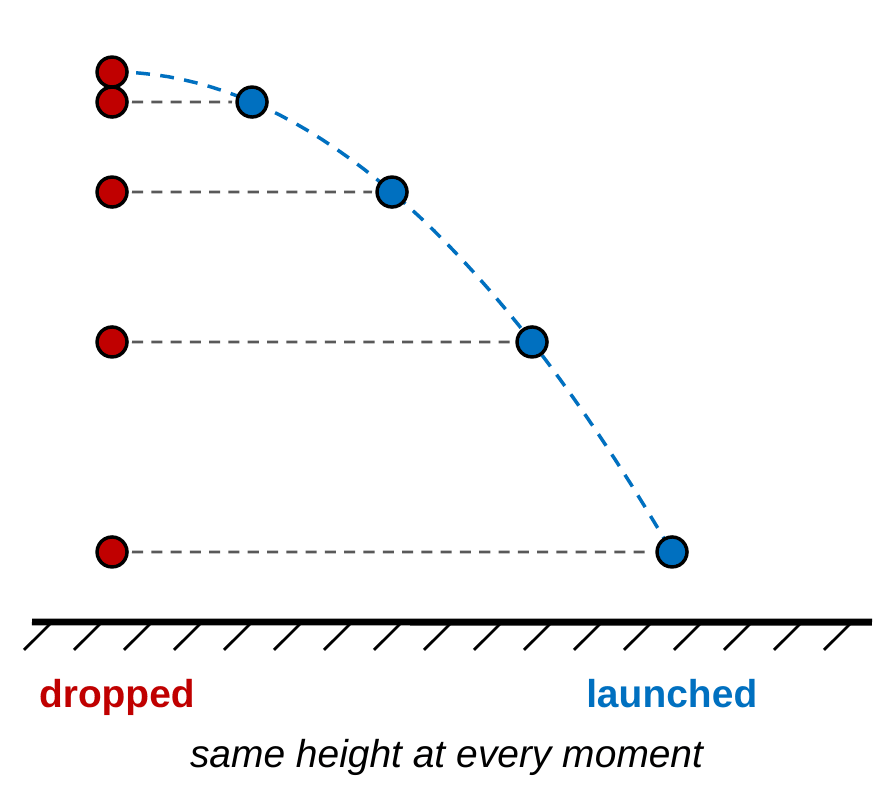
Drop one ball and launch another sideways from the same height at the same moment. The launched ball moves forward, but at every instant both balls are at exactly the same height, and they hit the ground at the same time. Neither ball starts with any vertical velocity, and gravity pulls on both the same way. Moving sideways does not change how fast an object falls.
Horizontal Motion
- No horizontal force
- vx stays constant
- Equal sideways steps
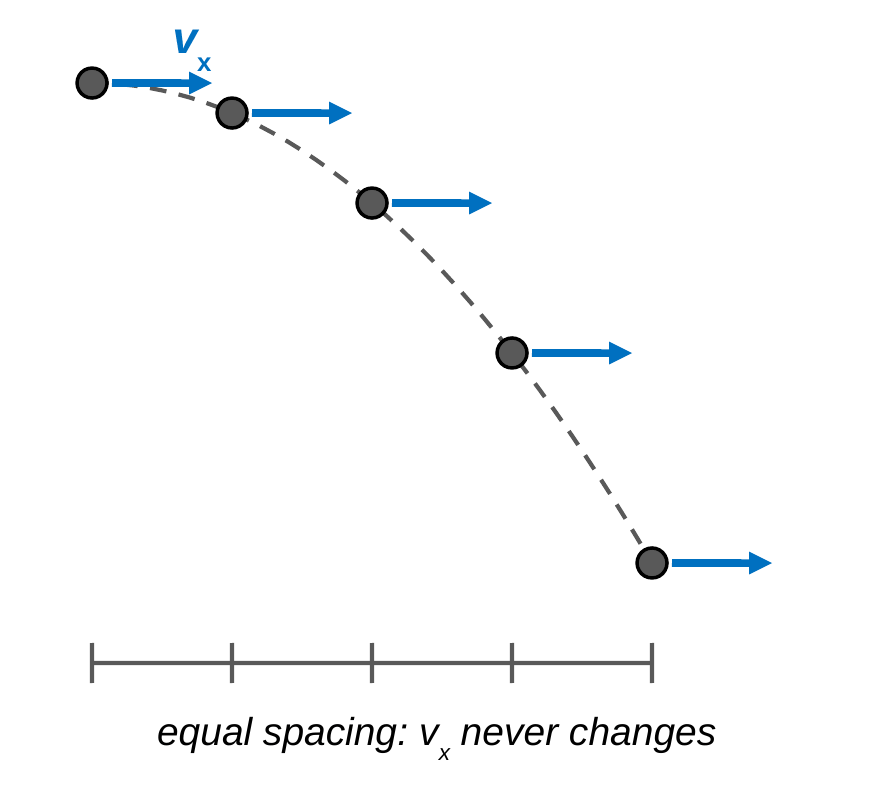
Once the projectile is launched, nothing pushes or pulls it sideways (we are ignoring air resistance). With no horizontal force, there is no horizontal acceleration, so the horizontal velocity vx stays exactly the same the whole flight. That is why the ball moves the same distance sideways in each equal time interval. Horizontally, a projectile is just constant velocity: Δx = vxt.
Vertical Motion
- Gravity pulls straight down
- vy grows 9.8 m/s each second
- Just like a dropped object
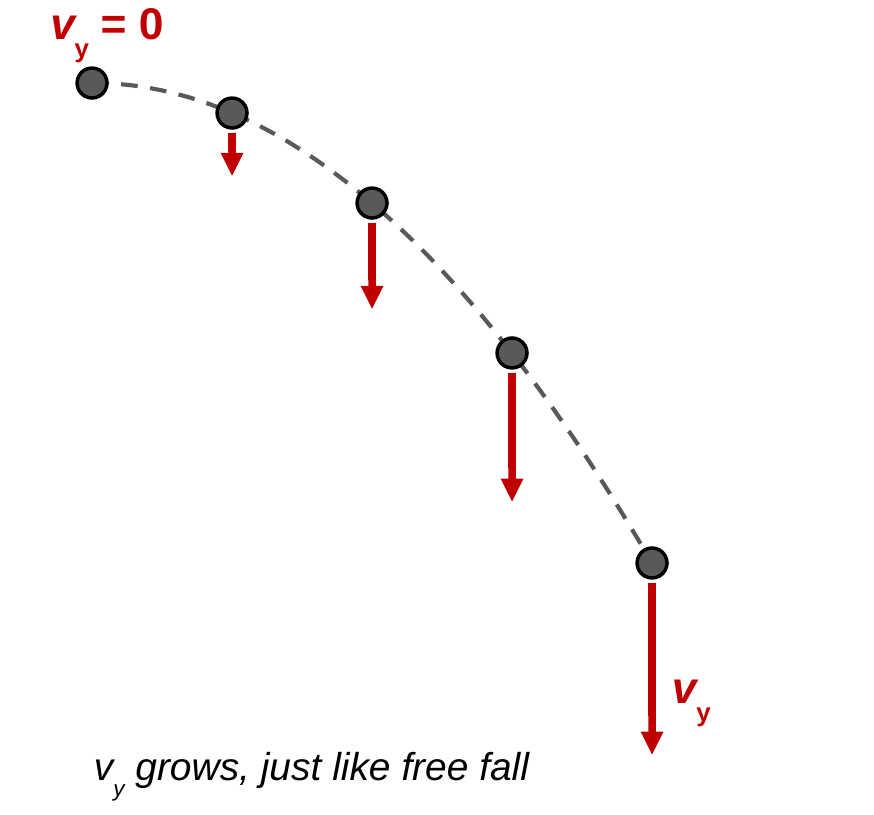
Vertically, the projectile is in free fall. It starts with vy = 0, because it was launched horizontally, and gravity makes its downward velocity grow by 9.8 m/s every second. The red arrows get longer and longer, and the ball drops farther in each time step. Vertically, a horizontal projectile behaves exactly like an object dropped from rest: a = −9.8 m/s2 and Δy = ½at2.
Putting It Together
- The two motions are independent
- vx: same; vy: grows
- Total velocity is tangent to the path
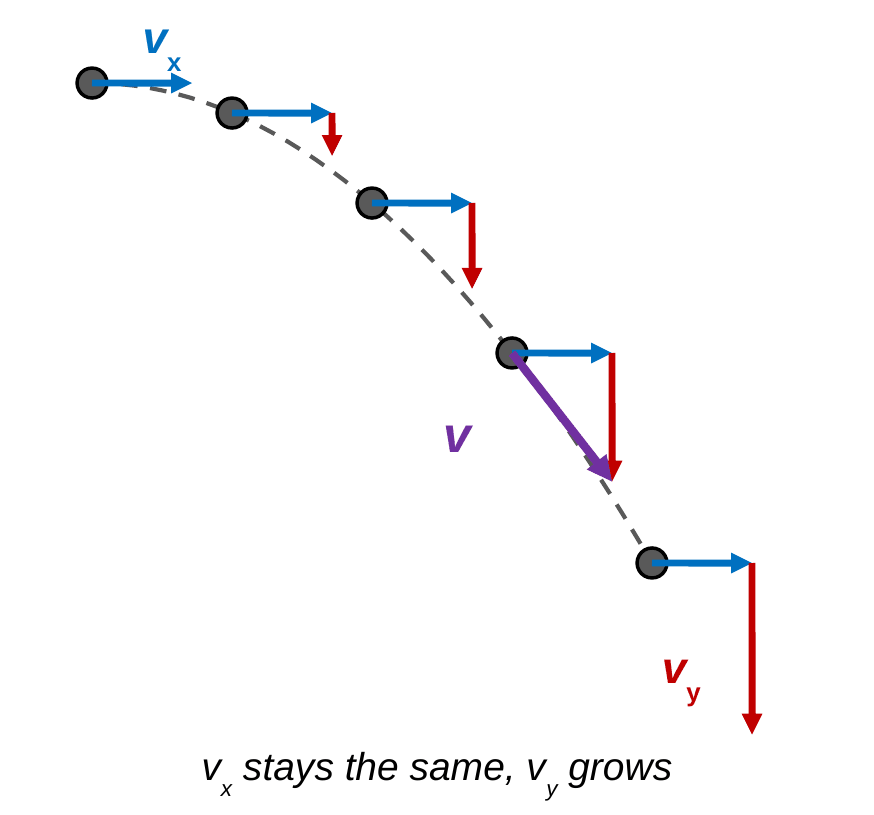
The horizontal and vertical motions are independent: neither one affects the other. At every point, the velocity has a constant blue horizontal component and a growing red vertical component. Adding them tip to tail gives the total velocity (purple), which always points along the path, tangent to the curve. Because the vertical part keeps growing while the horizontal part stays the same, the path bends more and more steeply downward.
Solving Horizontal Projectiles
Solve the horizontal and vertical parts separately, then connect them with time.
- Horizontal: vx is constant, ax = 0, so Δx = vxt
- Vertical: viy = 0, ay = −9.8 m/s2, so Δy = ½ayt2
- Time: t is the same in both equations
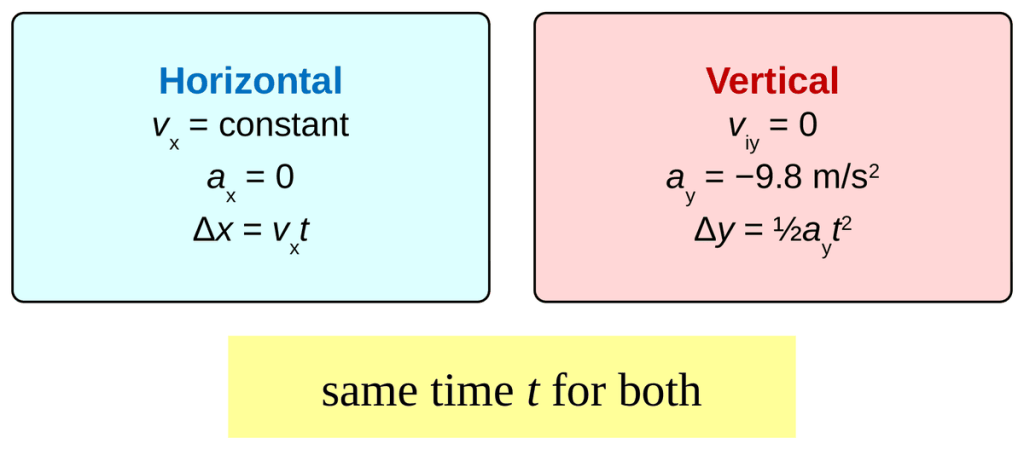
Usually the height tells you the time (from the vertical equation), and then the time tells you how far the projectile goes sideways (from the horizontal equation). Remember that Δy is negative because the projectile ends up below its launch point.
Worked Examples
Try each problem on your own first, then check your work against the solution.
Example 1: Marble off a Table
A marble rolls off a lab table 0.784 m high at 1.50 m/s. How long is the marble in the air?
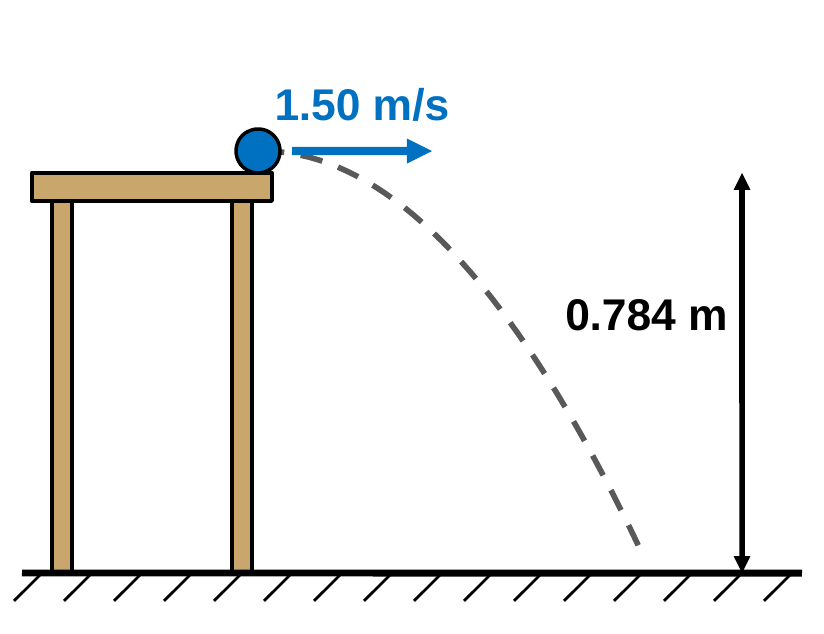
- Knowns (vertical): viy = 0 m/s, Δy = −0.784 m, ay = −9.8 m/s2, t = ?
- Equation: Δy = ½ayt2, rearranged to t = √(2Δy / ay)
- Substitute: t = √(2(−0.784 m) / (−9.8 m/s2)) = √(0.160 s2)
- Answer: t = 0.400 s. The 1.50 m/s does not affect the time in the air.
Example 2: Supply Drop
A plane flying horizontally at 60.0 m/s releases a supply package from a height of 490 m. How far does the package travel horizontally before it lands?
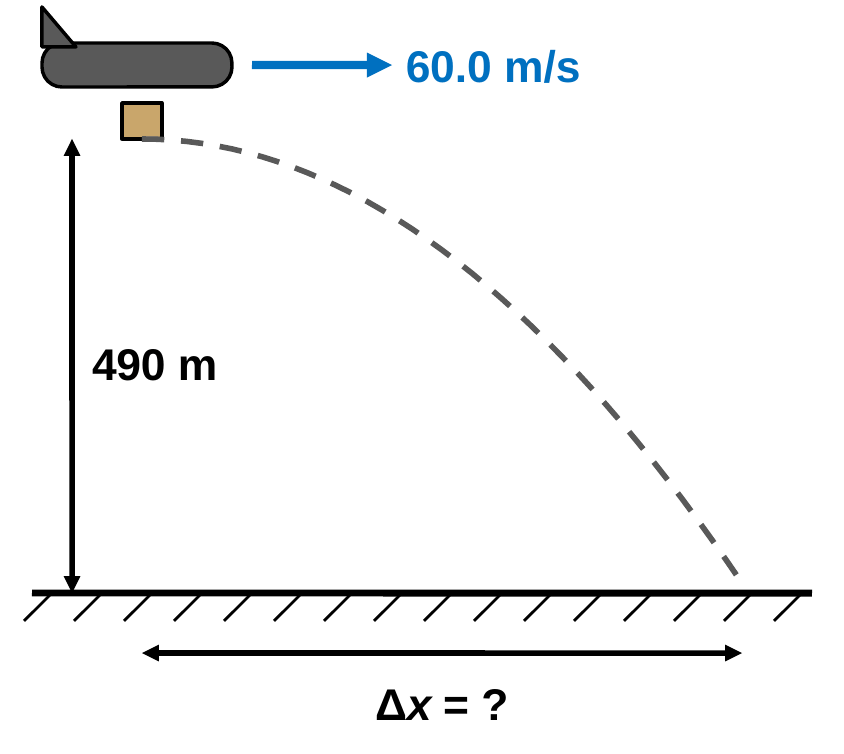
- Vertical knowns: viy = 0 m/s, Δy = −490 m, ay = −9.8 m/s2
- Find time: t = √(2Δy / ay) = √(2(−490 m) / (−9.8 m/s2)) = √(100 s2) = 10.0 s
- Horizontal knowns: vx = 60.0 m/s (the package keeps the plane’s speed), t = 10.0 s
- Find Δx: Δx = vxt = (60.0 m/s)(10.0 s)
- Answer: Δx = 600. m
From the plane, the package looks like it falls straight down, because it keeps moving forward at the plane’s speed the whole time.
Example 3: Dart Drop
A dart is thrown horizontally at 15.0 m/s toward a dartboard 3.00 m away. How far does the dart drop by the time it reaches the board?
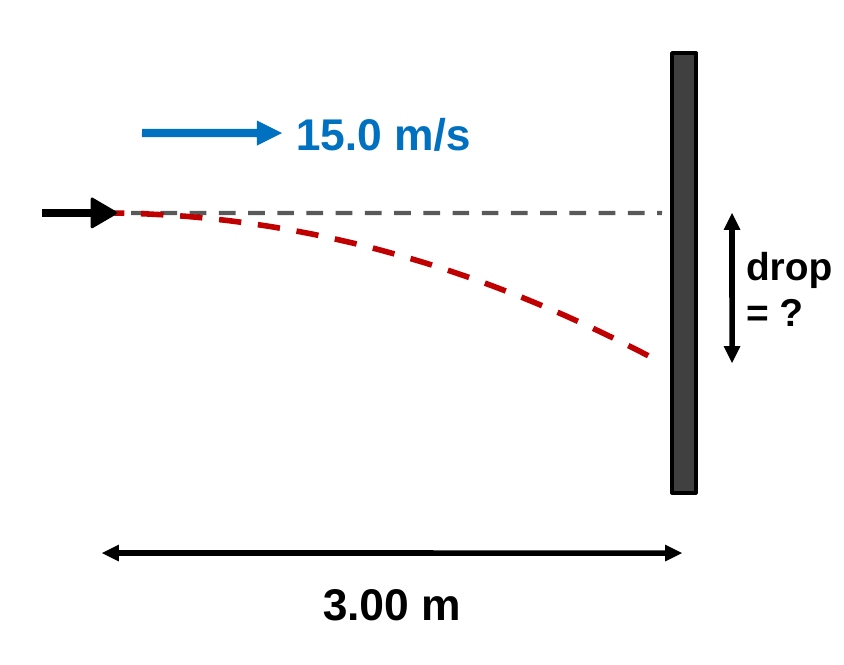
- Horizontal knowns: vx = 15.0 m/s, Δx = 3.00 m
- Find time: t = Δx / vx = 3.00 m / 15.0 m/s = 0.200 s
- Vertical knowns: viy = 0 m/s, ay = −9.8 m/s2, t = 0.200 s
- Find Δy: Δy = ½ayt2 = ½(−9.8 m/s2)(0.200 s)2 = (−4.9 m/s2)(0.0400 s2) = −0.196 m
- Answer: The dart drops 0.196 m (about 20 cm) below where it was aimed.
Example 4: Launch Speed
A ball is kicked horizontally off a ledge 4.9 m high. It lands 8.0 m from the base of the ledge. How fast was it kicked?
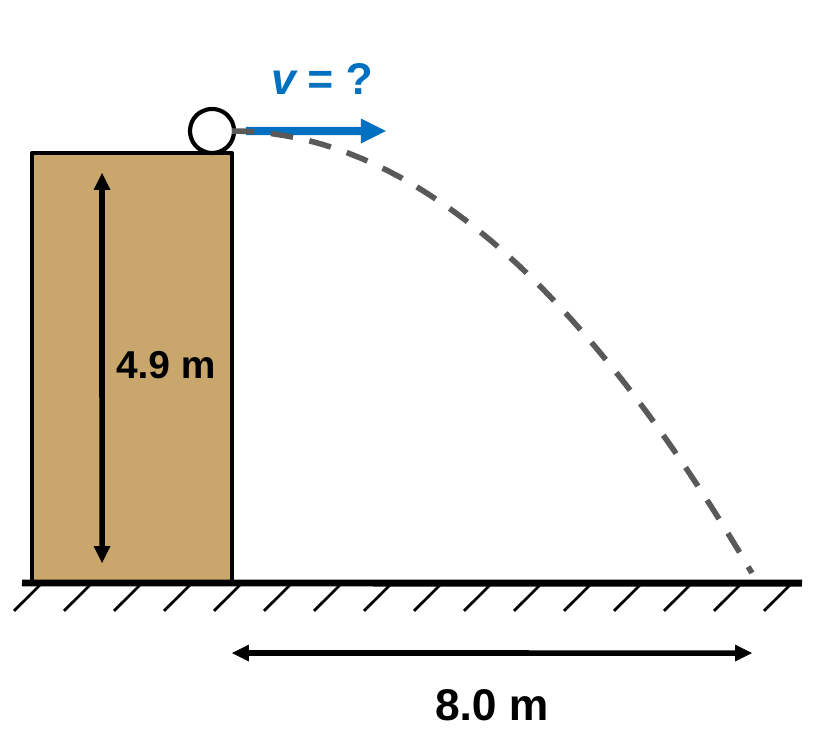
- Vertical knowns: viy = 0 m/s, Δy = −4.9 m, ay = −9.8 m/s2
- Find time: t = √(2Δy / ay) = √(2(−4.9 m) / (−9.8 m/s2)) = √(1.0 s2) = 1.0 s
- Horizontal knowns: Δx = 8.0 m, t = 1.0 s, vx = ?
- Find vx: vx = Δx / t = 8.0 m / 1.0 s
- Answer: The ball was kicked at 8.0 m/s.
Big Ideas
- Horizontal and vertical motions are independent
- Horizontal: vx constant, Δx = vxt
- Vertical: free fall, Δy = ½ayt2
- Time links the two motions
Back to the essential question: an object launched sideways follows a curved path called a parabola. Its horizontal velocity stays constant because no horizontal force acts on it, while its vertical motion is ordinary free fall with a = −9.8 m/s2. The time in the air links the two motions. Next up, we’ll launch projectiles at an angle.

