
The video lesson for this topic is coming soon.
Essential Question
How can we split one vector into two simpler parts?
A soccer ball kicked at an angle moves forward and upward at the same time. By the end of this lesson, you should be able to split a vector into horizontal and vertical components with sine and cosine, and add perpendicular vectors with the Pythagorean theorem.
Vectors
- Magnitude: how big
- Direction: which way
- Drawn as an arrow
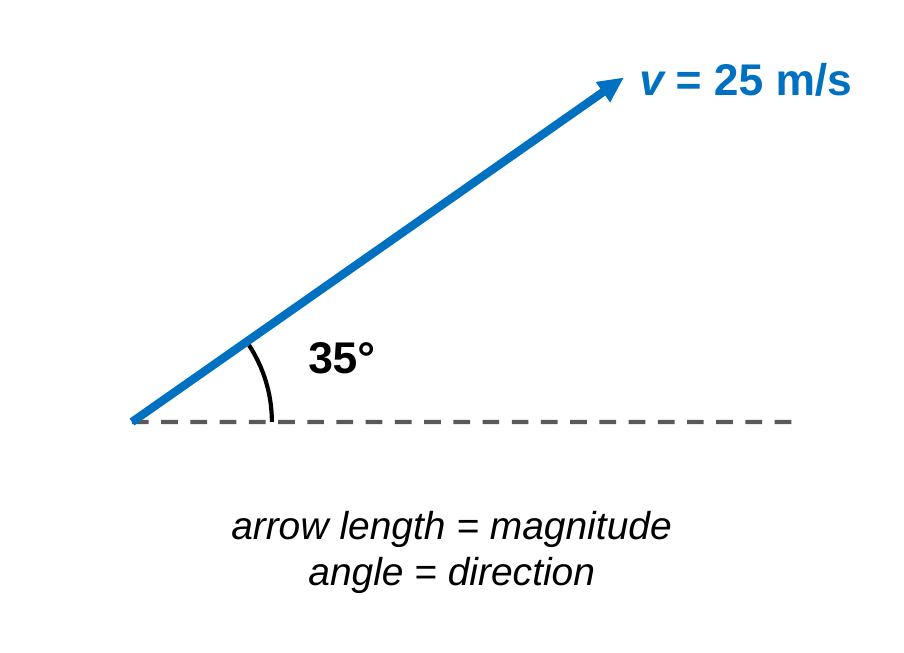
A vector has two parts: a magnitude (how big) and a direction (which way). We draw a vector as an arrow. The length of the arrow shows the magnitude, and the way it points shows the direction, usually given as an angle measured from the horizontal. Velocity, displacement, acceleration, and force are all vectors.
Components
- Every vector = horizontal part + vertical part
- Like walking east, then north
- The parts form a right triangle
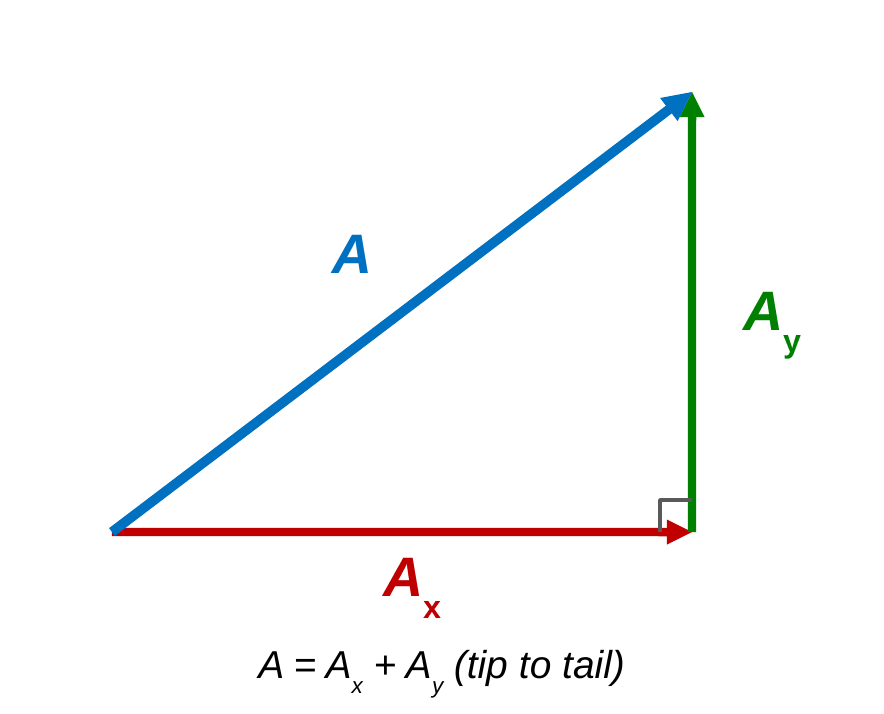
Any vector can be replaced by two perpendicular vectors called its components: a horizontal component Ax and a vertical component Ay. Placed tip to tail, the components take you to exactly the same spot as the original vector. Together with the original vector, they make a right triangle, which is why trigonometry works so well here.
Using Sine and Cosine
- SOH CAH TOA
- cos θ = adjacent ÷ hypotenuse
- sin θ = opposite ÷ hypotenuse
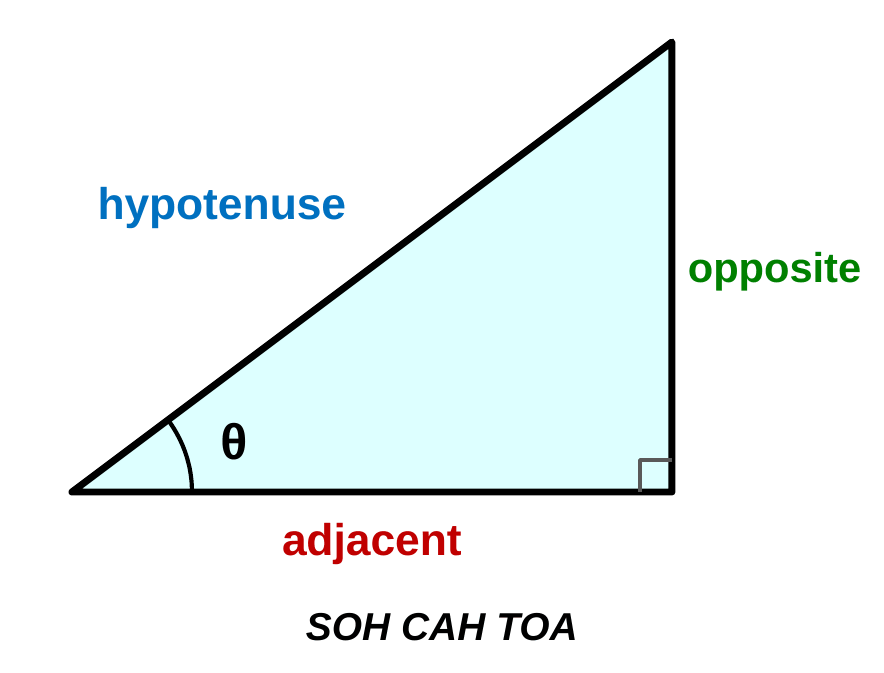
In a right triangle, the side adjacent to the angle θ is the one touching it, the side opposite θ is across from it, and the hypotenuse is the longest side. SOH CAH TOA reminds us that sin θ = opposite ÷ hypotenuse, cos θ = adjacent ÷ hypotenuse, and tan θ = opposite ÷ adjacent.
Component Equations
Multiply both sides of cos θ = Ax/A and sin θ = Ay/A by A to get:
- Horizontal component: Ax = A cos θ
- Vertical component: Ay = A sin θ
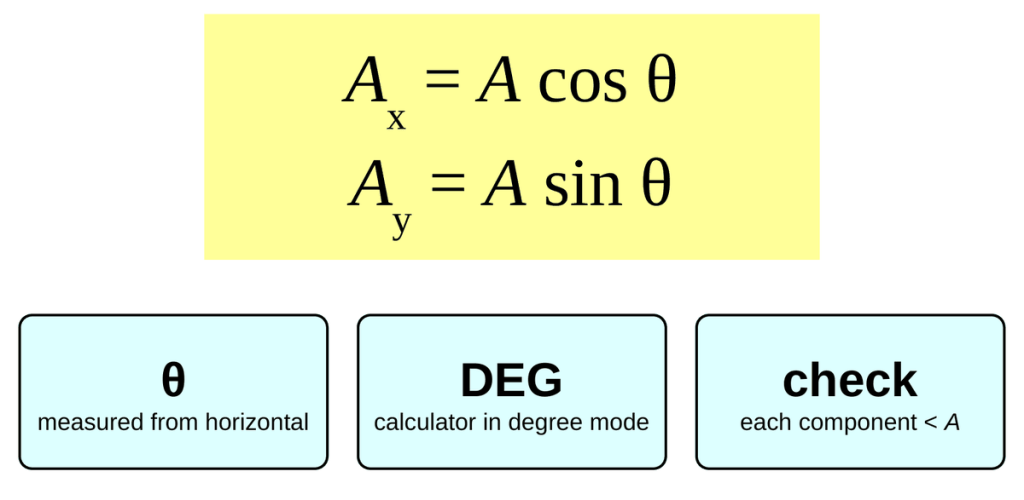
These work when θ is measured from the horizontal. Make sure your calculator is in degree mode. A quick check: each component must be smaller than the original vector, because the legs of a right triangle are always shorter than the hypotenuse.
Signs of Components
- Right or up: positive
- Left or down: negative
- Read the signs from your picture
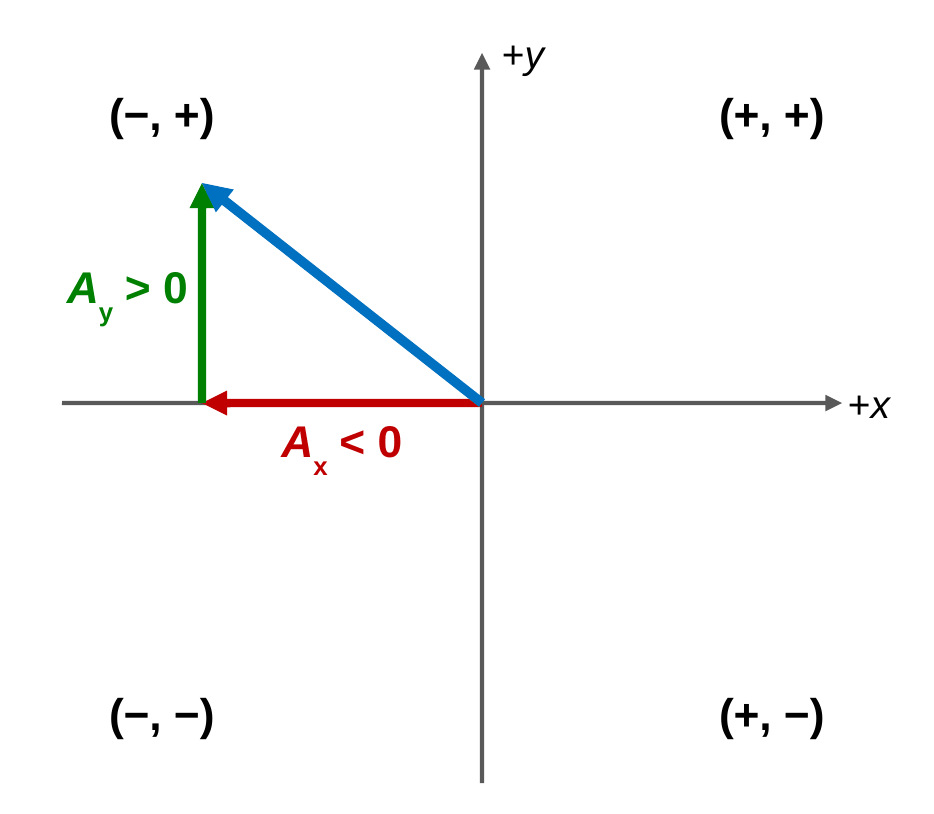
Components have signs. Like a number line, a component pointing right or up is positive, and a component pointing left or down is negative. The vector in the picture points up and to the left, so its horizontal component is negative and its vertical component is positive. Sine and cosine of an angle between 0° and 90° are always positive, so it is easiest to find the size of each component with trig and then add the sign by looking at your drawing.
Adding Perpendicular Vectors
- Draw them tip to tail
- Resultant: start to finish
- The resultant is the hypotenuse
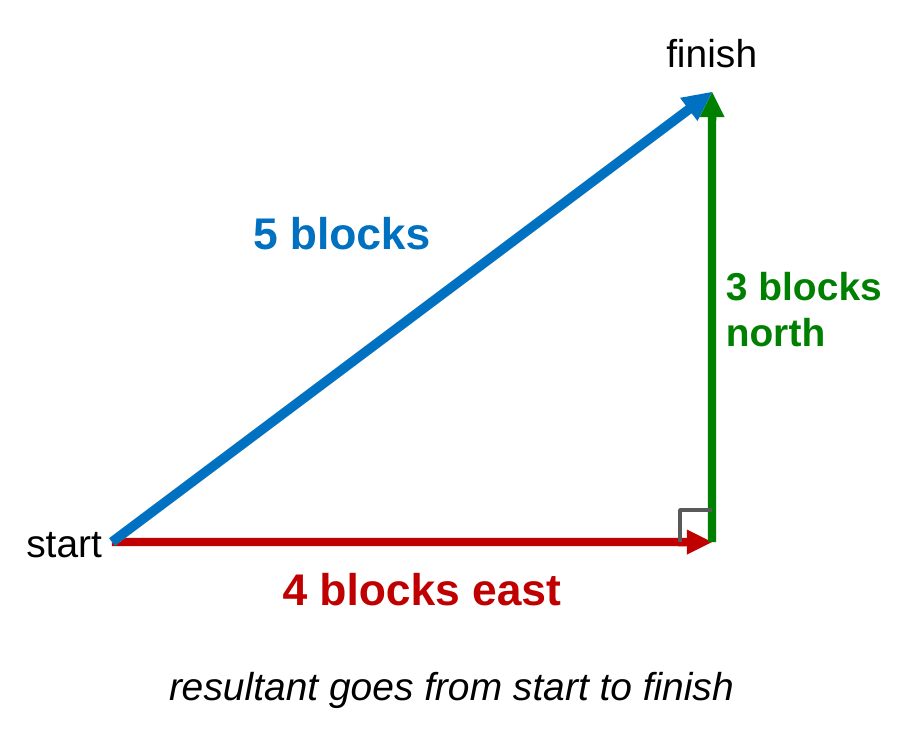
To add vectors, draw them tip to tail: start the second vector where the first one ends. The resultant is the single vector from the start of the first to the end of the last. Walk 4 blocks east and then 3 blocks north, and you end up 5 blocks from where you started. When the two vectors are perpendicular, they form a right triangle, and the resultant is the hypotenuse.
Magnitude and Direction
For two perpendicular vectors with sizes x (horizontal) and y (vertical):
- Magnitude: R = √(x2 + y2) (the Pythagorean theorem)
- Direction: θ = tan−1(y / x), measured from the horizontal
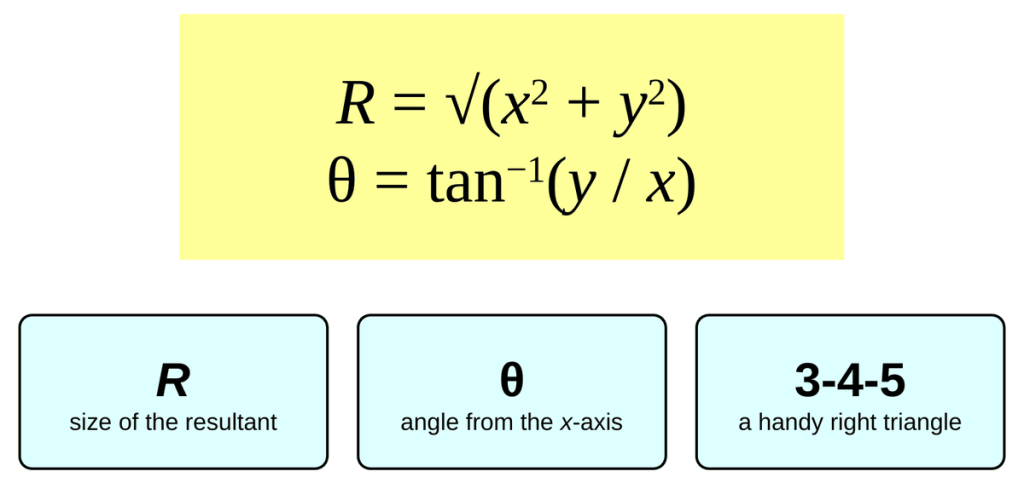
Always report both parts of the answer: the magnitude and the direction. For the walk on the last slide, R = √(42 + 32) = 5 blocks and θ = tan−1(3/4) = 37° north of east.
Worked Examples
Try each problem on your own first, then check your work against the solution.
Example 1: Kicked Soccer Ball
A soccer ball is kicked at 20.0 m/s at an angle of 30.0° above the horizontal. Find the horizontal and vertical components of its velocity.
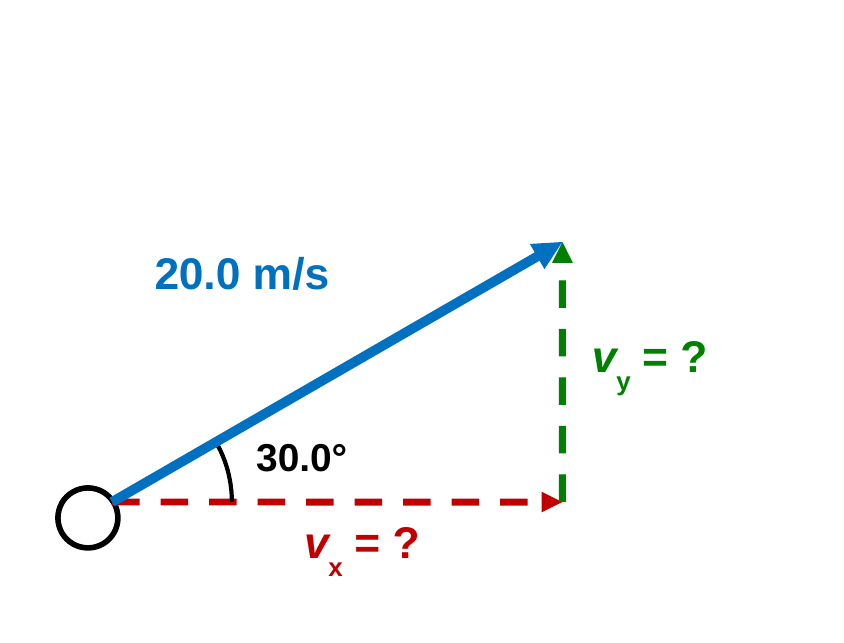
- Knowns: v = 20.0 m/s, θ = 30.0° above the horizontal
- Horizontal component: vx = v cos θ = (20.0 m/s)(cos 30.0°) = (20.0 m/s)(0.866)
- Vertical component: vy = v sin θ = (20.0 m/s)(sin 30.0°) = (20.0 m/s)(0.500)
- Answer: vx = 17.3 m/s (forward) and vy = 10.0 m/s (up). Both are smaller than 20.0 m/s, as they should be.
Example 2: Hiker’s Path
A hiker walks 150. m in a straight line at 40.0° north of east. How far east and how far north of her starting point does she end up?
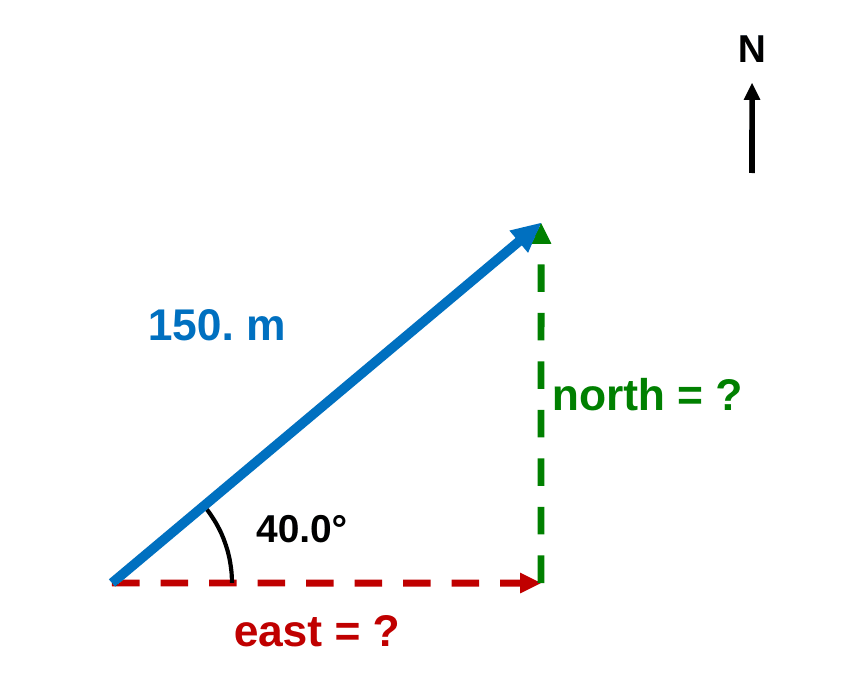
- Knowns: d = 150. m, θ = 40.0° north of east (measured from the east axis)
- East component: dx = d cos θ = (150. m)(cos 40.0°) = (150. m)(0.766) = 115 m
- North component: dy = d sin θ = (150. m)(sin 40.0°) = (150. m)(0.643) = 96.4 m
- Answer: She ends up 115 m east and 96.4 m north of where she started.
Example 3: Boat Crossing a River
A boat points straight east across a river at 4.0 m/s. The current pushes it north at 3.0 m/s. Find the boat’s resultant velocity.
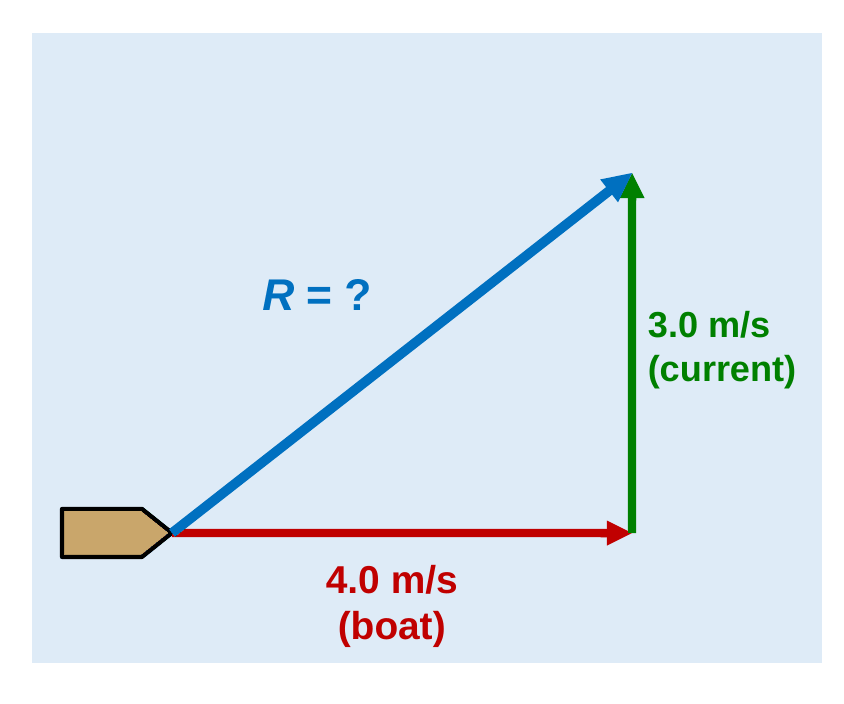
- Knowns: x = 4.0 m/s east (boat), y = 3.0 m/s north (current), R = ?, θ = ?
- Magnitude: R = √(x2 + y2) = √((4.0 m/s)2 + (3.0 m/s)2) = √(16 + 9.0) m/s = √25 m/s = 5.0 m/s
- Direction: θ = tan−1(y/x) = tan−1(3.0/4.0) = tan−1(0.75) = 37°
- Answer: R = 5.0 m/s at 37° north of east
Example 4: Drone Flight
A drone flies 60.0 m west, then 80.0 m north. Find the magnitude and direction of its displacement.
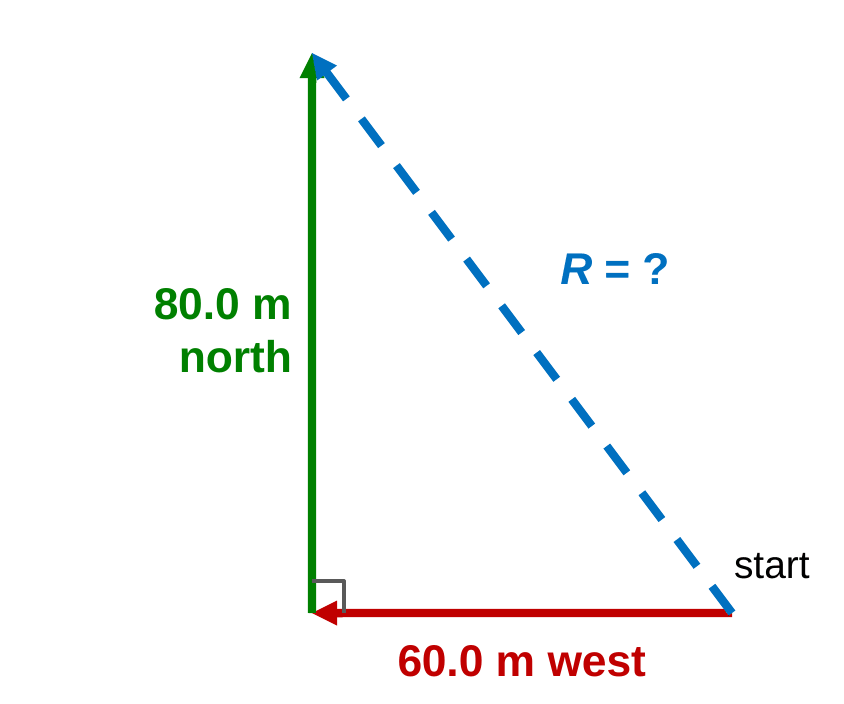
- Knowns: x = 60.0 m west, y = 80.0 m north
- Magnitude: R = √((60.0 m)2 + (80.0 m)2) = √(3,600 + 6,400) m = √10,000 m = 100. m
- Direction: θ = tan−1(80.0/60.0) = tan−1(1.33) = 53.1°, measured from west toward north
- Answer: R = 100. m at 53.1° north of west
Big Ideas
- A vector = horizontal + vertical components
- Ax = A cos θ, Ay = A sin θ
- R = √(x2 + y2), θ = tan−1(y/x)
- Give magnitude and direction
Back to the essential question: any vector can be split into a horizontal component, A cos θ, and a vertical component, A sin θ, as long as θ is measured from the horizontal. Going the other way, two perpendicular vectors add up to a resultant with R = √(x2 + y2) and θ = tan−1(y/x). Next up, we’ll use components to understand horizontal projectiles.

