
The video lesson for this topic is coming soon.
Essential Question
What happens to energy as things move?
So far we’ve met kinetic, gravitational potential, and elastic potential energy. In this lesson, we’ll see how energy changes from one kind to another while the total stays the same. By the end, you should be able to draw energy bar charts and use conservation of energy to find speeds and heights.
Energy Is Conserved
- Never created or destroyed
- Only transformed or transferred
- The total stays the same
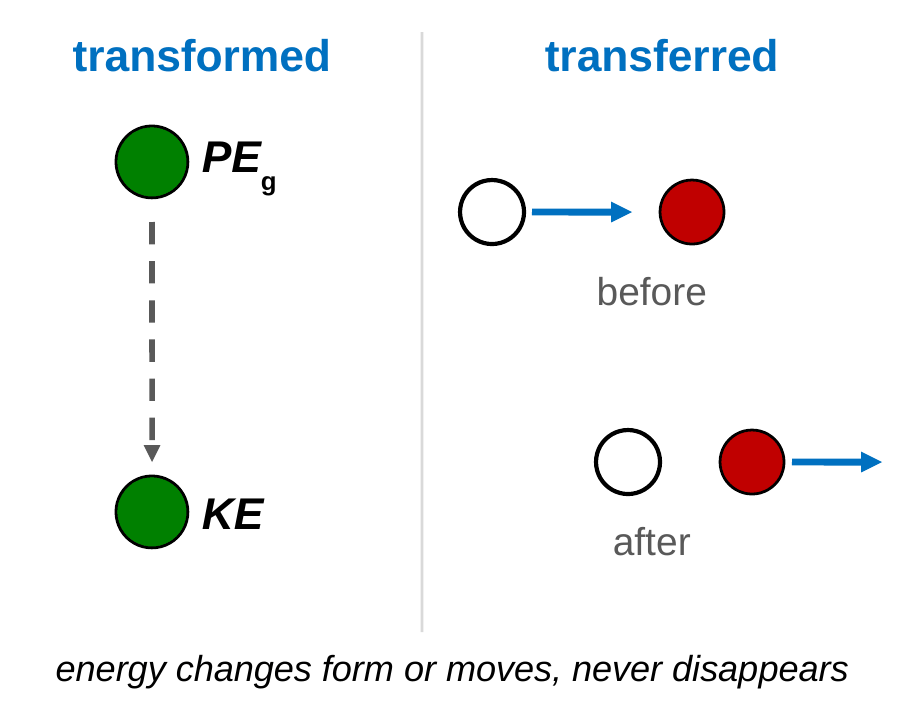
The law of conservation of energy says energy cannot be created or destroyed. It can be transformed from one type to another, like a falling ball turning gravitational potential energy into kinetic energy. It can also be transferred from one object to another, like a moving ball giving its kinetic energy to the ball it hits. Either way, the total amount of energy stays the same.
Total Mechanical Energy
TME = KE + PEg + PEe
- KE = ½mv2, energy of motion
- PEg = mgh, energy of height
- PEe = ½kx2, energy stored in a spring
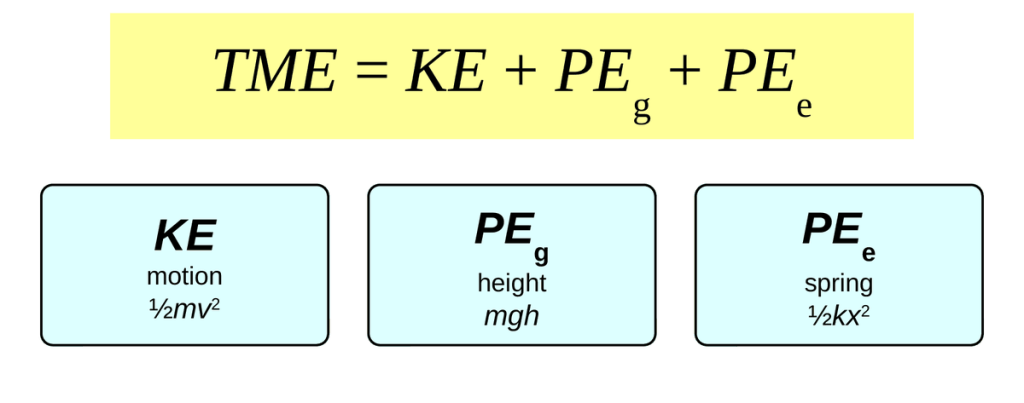
The total mechanical energy (TME) of a system is the sum of its kinetic, gravitational potential, and elastic potential energy. All three are measured in joules, so you can add them directly.
Mechanical Energy Is Conserved
- No friction, closed system
- TMEi = TMEf
- Energy changes form, total stays
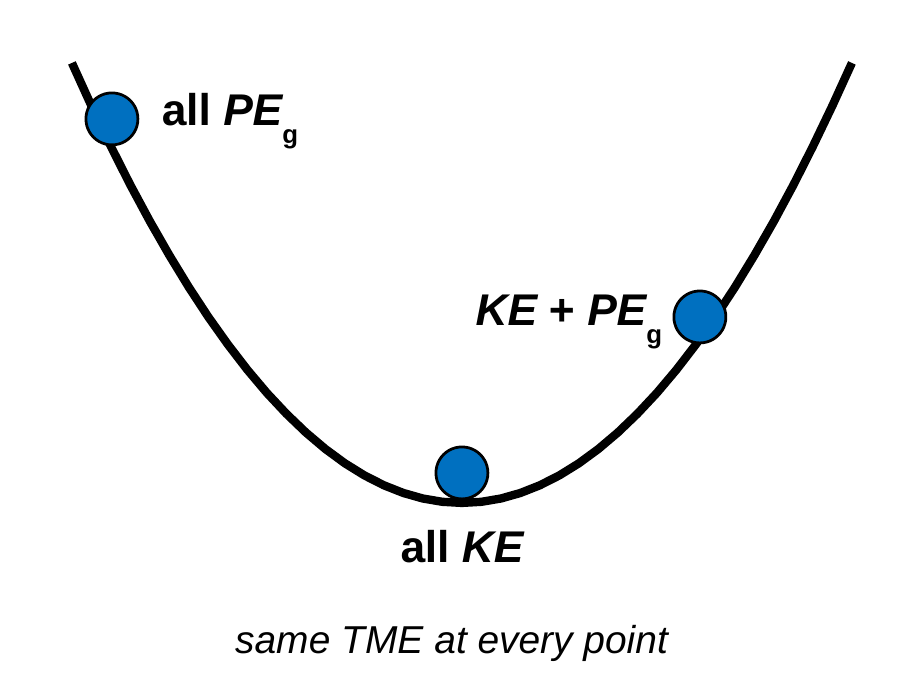
In a closed system with no friction, the total mechanical energy is conserved: TMEi = TMEf. A skater at the top of a half-pipe has all gravitational potential energy. At the bottom, all of it has become kinetic energy. Partway up the other side, she has some of each. The amounts of each type change, but the total never does. A closed system is one where no energy enters or leaves.
Energy Bar Charts
- Bar height = amount of energy
- One chart before, one after
- No friction: totals match
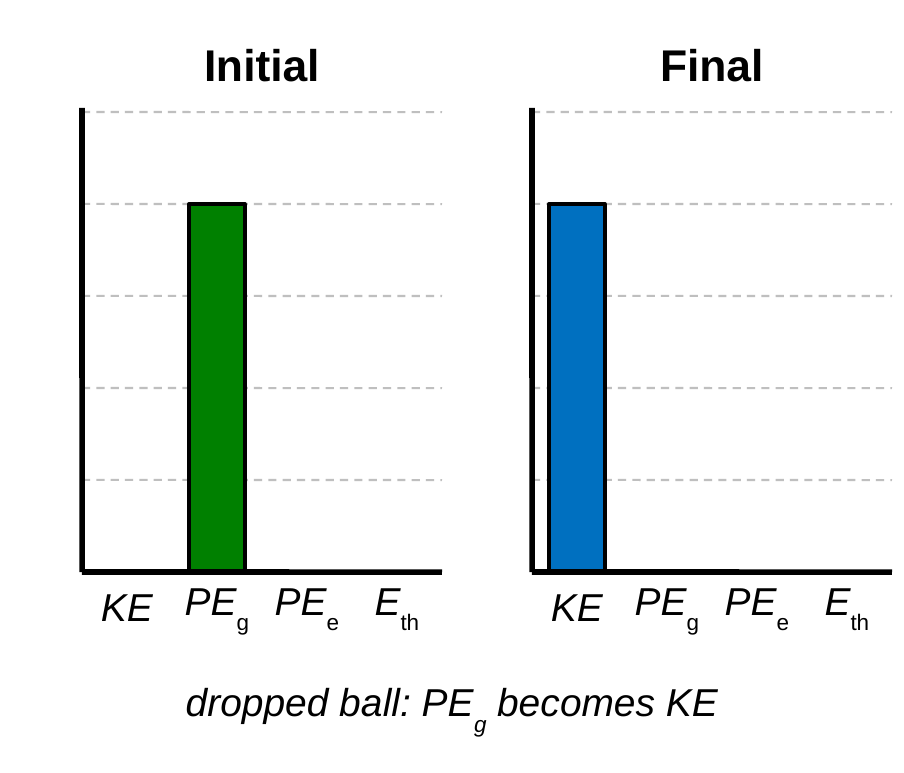
An energy bar chart shows how much of each type of energy a system has at a moment in time. We draw one chart for the initial moment and one for the final moment, with a bar for kinetic energy (KE), gravitational potential energy (PEg), elastic potential energy (PEe), and thermal energy (Eth). For a ball dropped from rest, the initial chart is all PEg. Just before it lands, the final chart is all KE. With no friction, the total height of the bars is the same on both sides.
Reading a Bar Chart
- A spring launches a ball up
- Start: all elastic energy
- Later: KE + PEg, same total
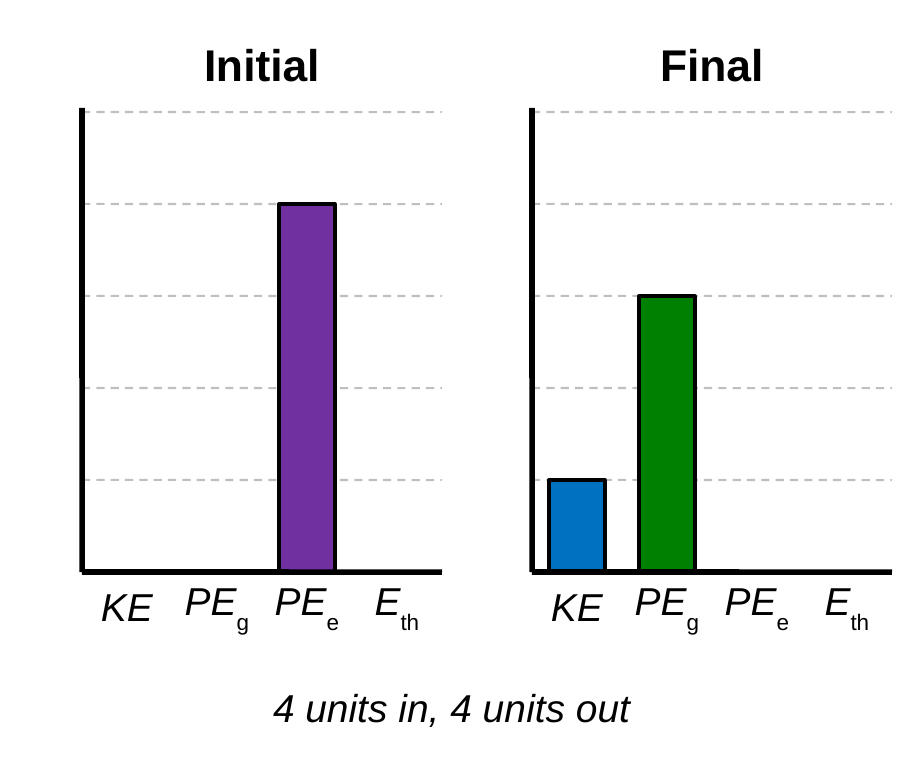
Here a compressed spring launches a ball straight up. At the start, the ball is at rest at h = 0, so all of the energy is elastic potential energy in the spring: 4 units. Later, the ball is partway up and still rising. It has some kinetic energy (1 unit) and some gravitational potential energy (3 units). The spring is relaxed, so PEe = 0. The total is still 4 units.
Solving Energy Problems
- Pick initial and final points
- Write TMEi = TMEf
- Cross out terms that are zero
- Solve for the unknown
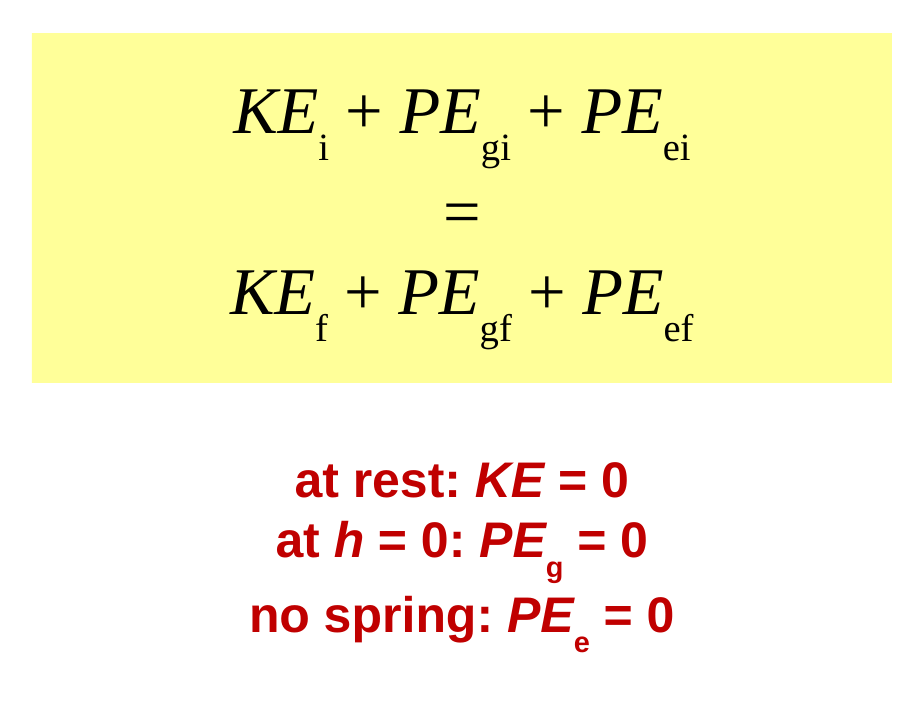
Start every conservation problem the same way. Choose an initial point and a final point. Write out TMEi = TMEf with all three types of energy on each side. Then cross out any term that is zero: an object at rest has no KE, an object at your reference level has no PEg, and if there’s no stretched or squeezed spring there’s no PEe. What’s left is usually a short equation you can solve.
Worked Examples
Try each problem on your own first, then check your work against the solution.
Example 1: Dropped Ball
A 0.50 kg ball is dropped from rest 5.0 m above the ground. Ignoring air resistance, how fast is it moving just before it hits the ground?
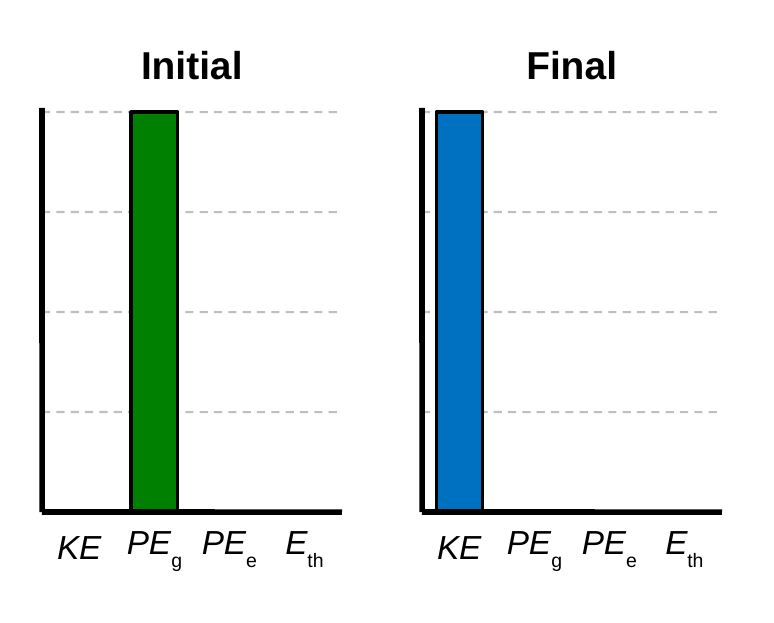
- Set up: initial: at rest at 5.0 m. Final: at the ground, h = 0
- Conservation: TMEi = TMEf, so PEgi = KEf: mgh = ½mv2
- Solve for v: mass cancels: v = √(2gh) = √(2 × 9.8 m/s2 × 5.0 m) = √(98 m2/s2) = 9.899 m/s
- Answer: v = 9.9 m/s (downward)
Example 2: Roller Coaster
A 400. kg roller coaster car starts from rest at the top of a 28 m hill. Ignoring friction, how fast is it moving at the top of the next hill, 18 m high?
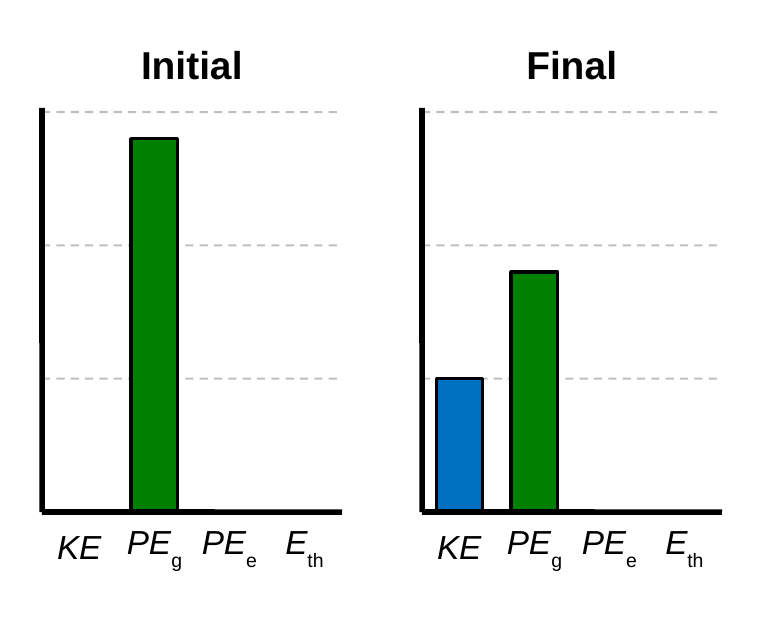
- Set up: initial: at rest at hi = 28 m. Final: hf = 18 m, moving. Ground is h = 0.
- Conservation: PEgi = KEf + PEgf: mghi = ½mv2 + mghf
- Cancel mass and rearrange: ½v2 = g(hi − hf) = (9.8 m/s2)(10. m) = 98 m2/s2, so v2 = 196 m2/s2
- Answer: v = √(196 m2/s2) = 14 m/s
Only the 10. m drop matters. The coaster’s speed doesn’t depend on its mass or on the shape of the track between the hills.
Example 3: Spring Launcher
A spring with k = 800. N/m is squeezed 0.10 m and launches a 0.20 kg ball straight up. Ignoring air resistance, how high does the ball rise above its starting point?
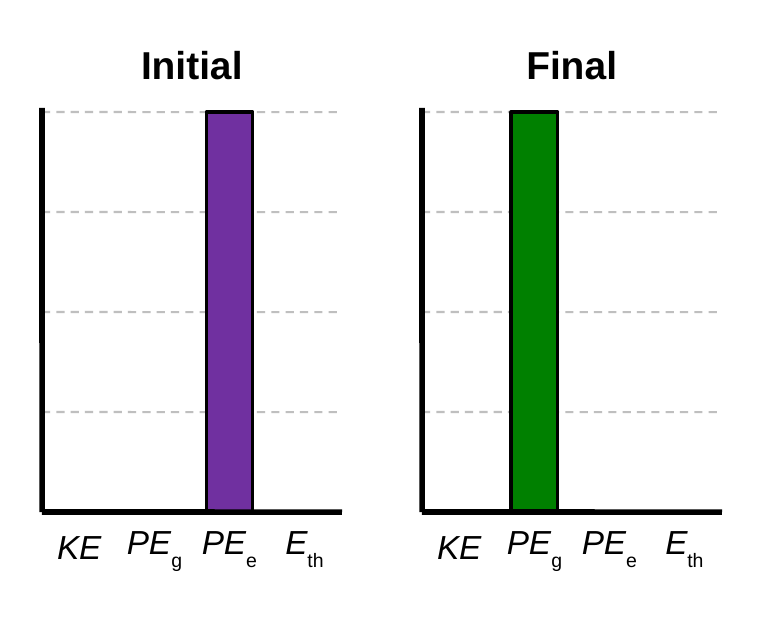
- Set up: initial: at rest on the squeezed spring, h = 0. Final: at the highest point, where v = 0
- Spring energy: PEe = ½kx2 = ½(800. N/m)(0.10 m)2 = 4.0 J
- Conservation: PEei = PEgf, so 4.0 J = mgh
- Answer: h = 4.0 J / [(0.20 kg)(9.8 m/s2)] = 4.0 J / 1.96 N = 2.04 m ≈ 2.0 m
Example 4: Coasting Uphill
A 55 kg skateboarder rolls at 6.0 m/s at the bottom of a ramp. Ignoring friction, how high up the ramp can she coast before she stops?
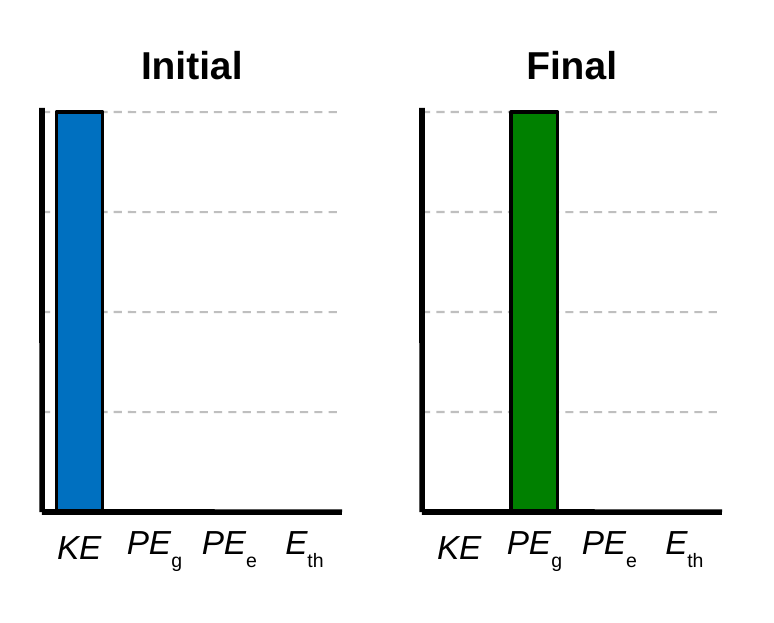
- Set up: initial: bottom of the ramp, h = 0, v = 6.0 m/s. Final: highest point, v = 0
- Conservation: KEi = PEgf: ½mv2 = mgh
- Cancel mass and rearrange: h = v2 / (2g) = (6.0 m/s)2 / (2 × 9.8 m/s2) = 36 m2/s2 / 19.6 m/s2 = 1.84 m
- Answer: h = 1.8 m
Big Ideas
- Energy is never created or destroyed
- TME = KE + PEg + PEe
- No friction: TMEi = TMEf
- Bar charts: both sides have the same total
Back to the essential question: energy is never created or destroyed. As things move, energy transforms between kinetic, gravitational potential, and elastic potential energy, and with no friction, the total mechanical energy stays the same: TMEi = TMEf. Next up, we’ll see what happens when friction turns some of that energy into thermal energy.

