
The video lesson for this topic is coming soon.
Essential Question
Where does energy go when friction slows things down?
Slide a book across a table and it stops, so its kinetic energy seems to vanish. But energy is never destroyed. By the end of this lesson, you should be able to explain where that energy goes and include friction in energy bar charts and in the conservation of energy equation.
Friction Changes Energy
- Friction is non-conservative
- It turns KE into thermal energy
- Plus a little sound
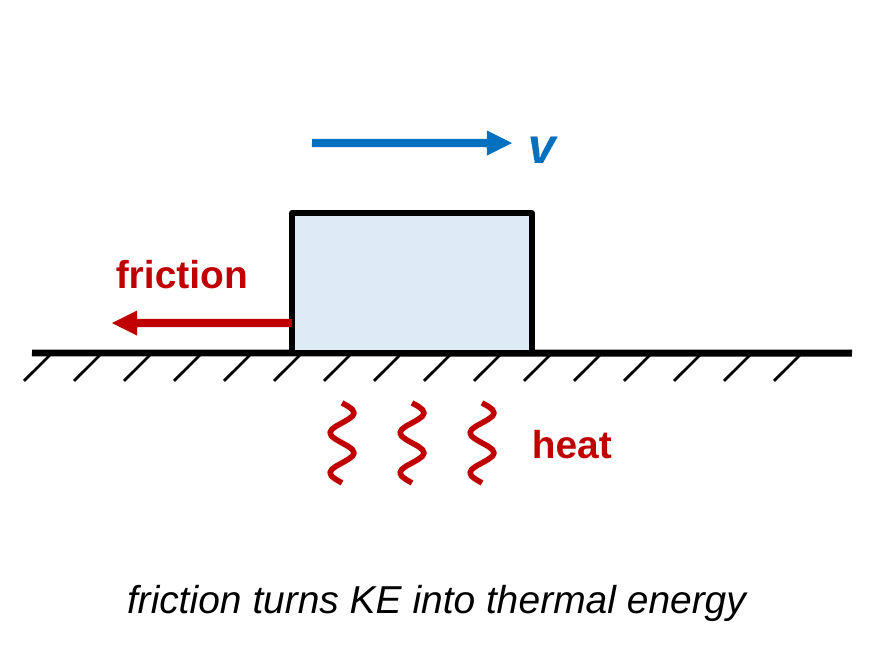
Friction is a non-conservative force. When friction acts, the total mechanical energy of a system does not stay the same. Instead, friction converts mechanical energy into thermal energy (the energy of jiggling atoms and molecules, which we feel as warmth) and a little bit of sound. A sliding block slows down and stops because friction turns its kinetic energy into thermal energy in the block and the floor.
Evidence: Warming and Sound
- Rub your hands: they warm up
- Brakes get hot
- Squeaks, scrapes, and screeches
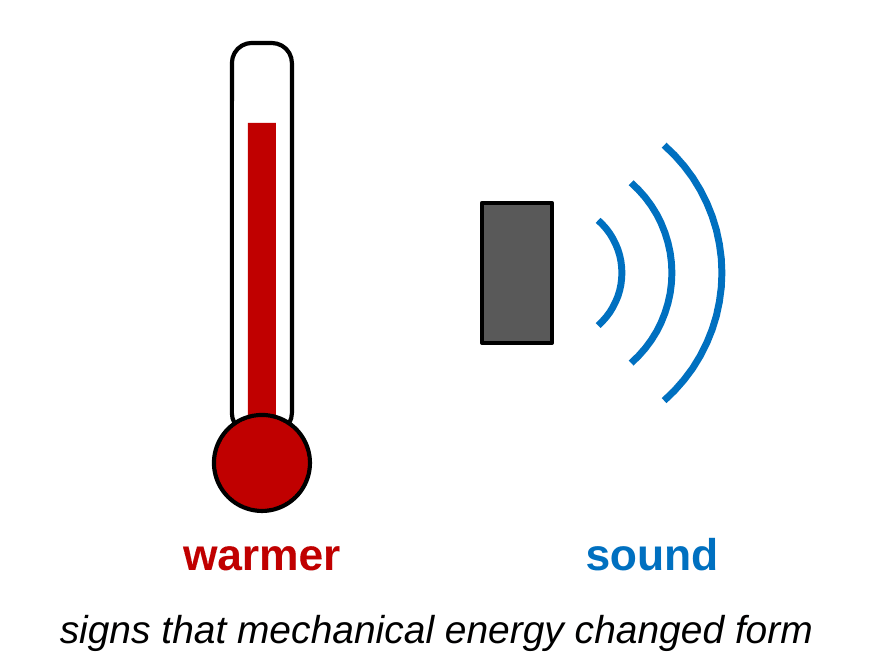
How do we know friction turns mechanical energy into thermal energy and sound? We can feel it and hear it. Rubbing your hands together makes them warm. Car brakes get hot after stopping a fast car. A sliding chair scrapes, and skidding tires screech. Each of these is evidence that mechanical energy changed into other forms.
Energy Equation with Friction
TMEi = TMEf + Wfriction
- TMEi = total mechanical energy at the start (J)
- TMEf = total mechanical energy at the end (J)
- Wfriction = work done by friction, which equals the thermal energy produced (J)
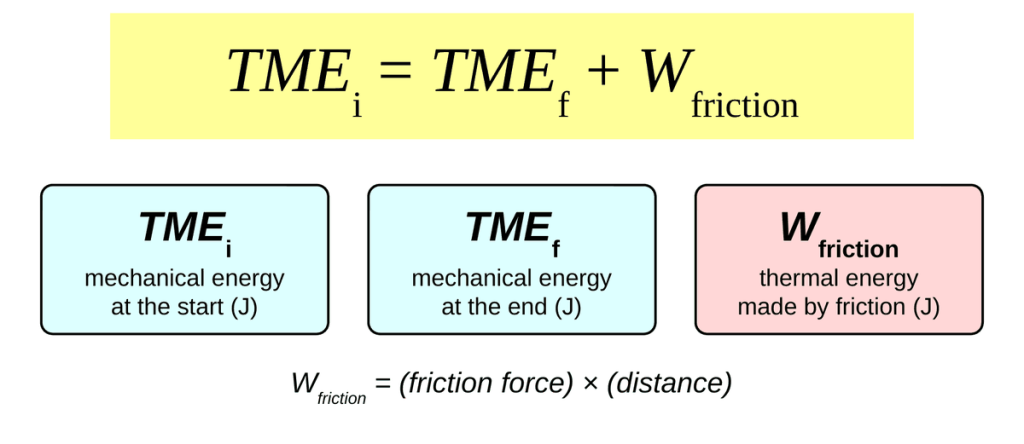
With friction, the mechanical energy at the end is less than at the start. The difference is the work done by friction, which became thermal energy. The work done by friction equals the friction force times the distance the object slides. Nothing is lost: every joule is still accounted for.
Bar Charts with Friction
- Add a thermal energy bar, Eth
- Friction fills the Eth bar
- The totals still match
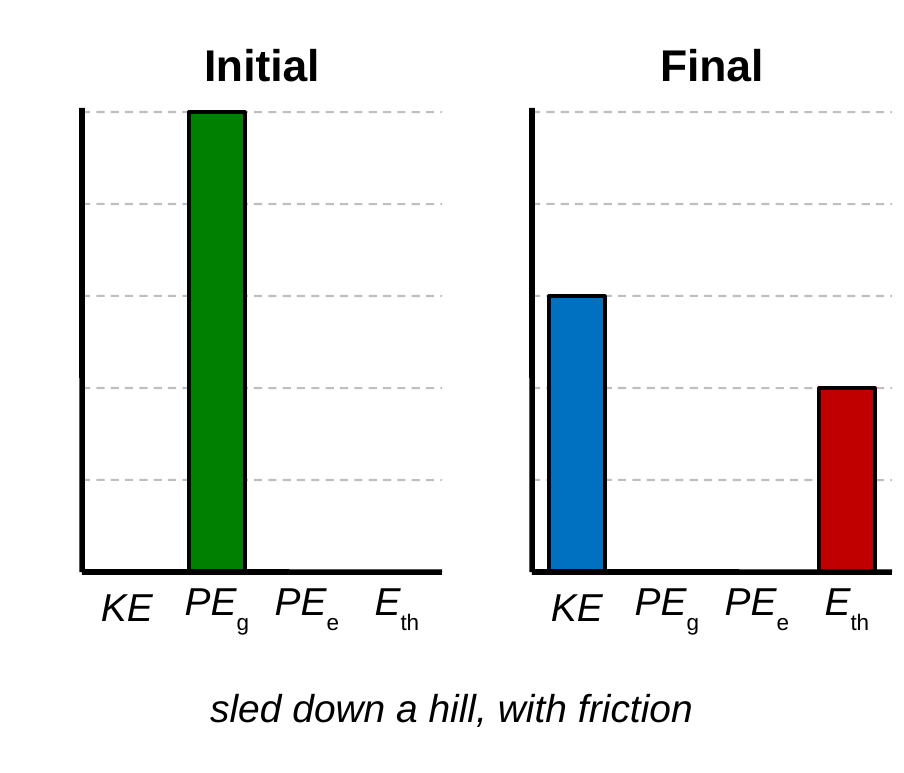
With friction, energy bar charts get a fourth bar that matters: thermal energy, Eth. A sled starts from rest at the top of a hill with 5 units of gravitational potential energy. At the bottom, it has only 3 units of kinetic energy. The other 2 units became thermal energy because of friction between the sled and the snow. The final total is still 5 units.
Is Energy “Used Up”?
- Energy is never destroyed
- It spreads out as thermal energy
- Hard to reuse, so we say “used”
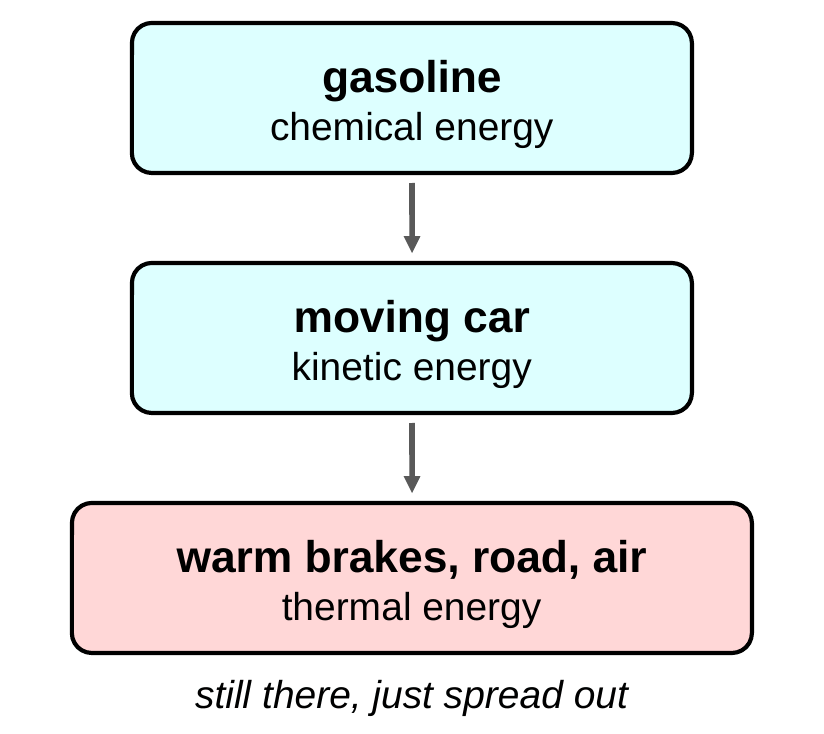
People often say we “use up” energy. Physics says energy is never destroyed, so what do they mean? Think about a car. Chemical energy in gasoline becomes kinetic energy, and when the car stops, friction turns that kinetic energy into thermal energy in the brakes, the road, and the air. That thermal energy is still there, but it’s spread out so thinly that we can’t gather it up to drive the car again. Energy that has spread out as heat is what people mean by “used up.”
Worked Examples
Try each problem on your own first, then check your work against the solution.
Example 1: Sliding Box
A 5.0 kg box slides across the floor at 4.0 m/s and friction brings it to a stop. How much thermal energy does friction produce?
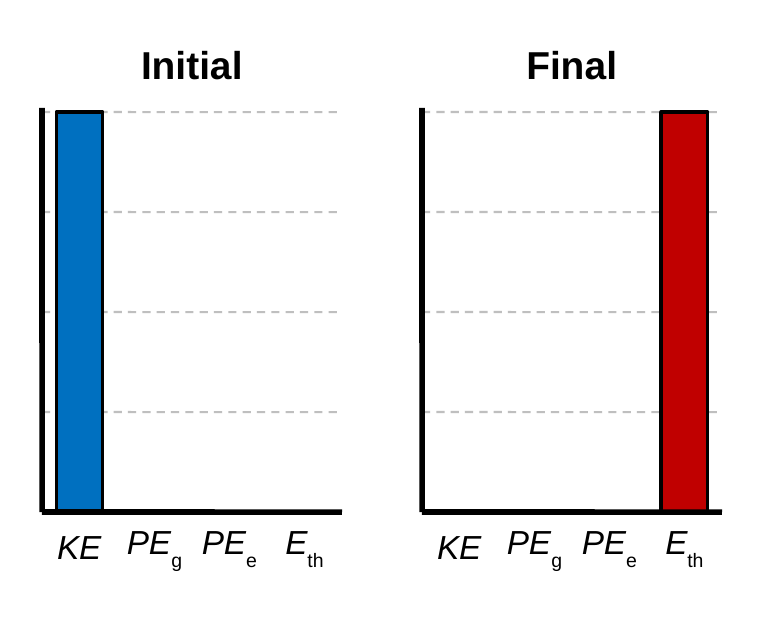
- Set up: initial: moving at 4.0 m/s. Final: stopped. The floor is level, so PEg doesn’t change.
- Equation: TMEi = TMEf + Wfriction, so KEi = 0 + Wfriction
- Initial KE: KEi = ½(5.0 kg)(4.0 m/s)2 = ½(5.0 kg)(16 m2/s2) = 40. J
- Answer: Wfriction = 40. J of thermal energy
Example 2: Friction Force
A 2.0 kg hockey puck slides at 6.0 m/s across a rough floor and stops after 4.5 m. What is the average friction force on it?
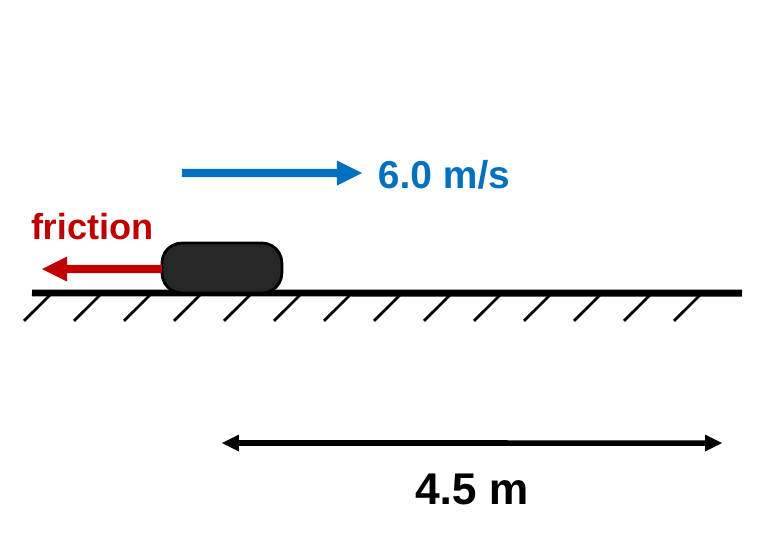
- Thermal energy: the puck stops on a level floor, so Wfriction = KEi = ½(2.0 kg)(6.0 m/s)2 = 36 J
- Work by friction: Wfriction = (friction force)(distance), so friction force = Wfriction / d
- Substitute: friction force = 36 J / 4.5 m
- Answer: 8.0 N, pointing opposite the motion
Example 3: Sledding Hill
A 25 kg sledder starts from rest at the top of a hill 10. m high and reaches the bottom at 12 m/s. How much energy did friction turn into thermal energy?
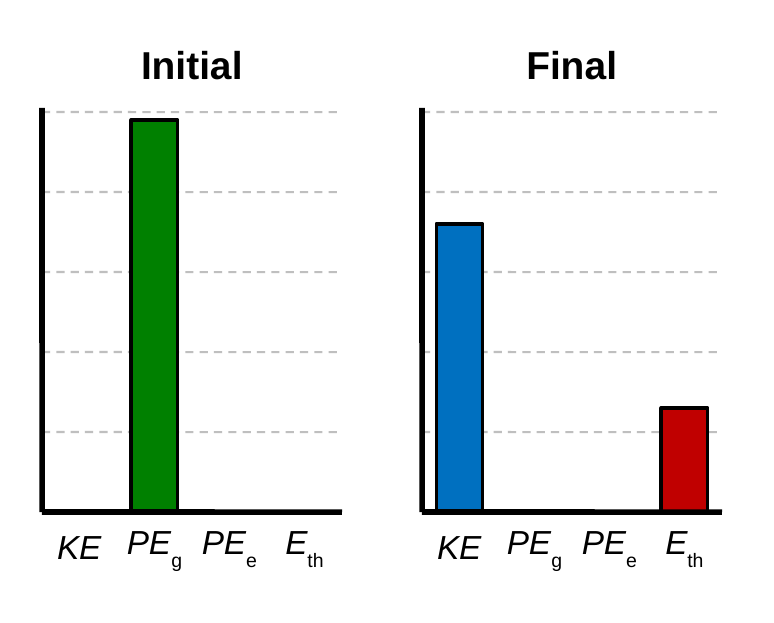
- Initial energy: at rest at the top: TMEi = mgh = (25 kg)(9.8 m/s2)(10. m) = 2,450 J
- Final energy: at the bottom, h = 0: TMEf = ½mv2 = ½(25 kg)(12 m/s)2 = 1,800 J
- Equation: TMEi = TMEf + Wfriction, so Wfriction = TMEi − TMEf
- Answer: Wfriction = 2,450 J − 1,800 J = 650 J of thermal energy
Example 4: Ramp with Friction
A 2.0 kg cart starts from rest at the top of a ramp 1.5 m high. Friction turns 4.4 J into thermal energy on the way down. How fast is the cart moving at the bottom?
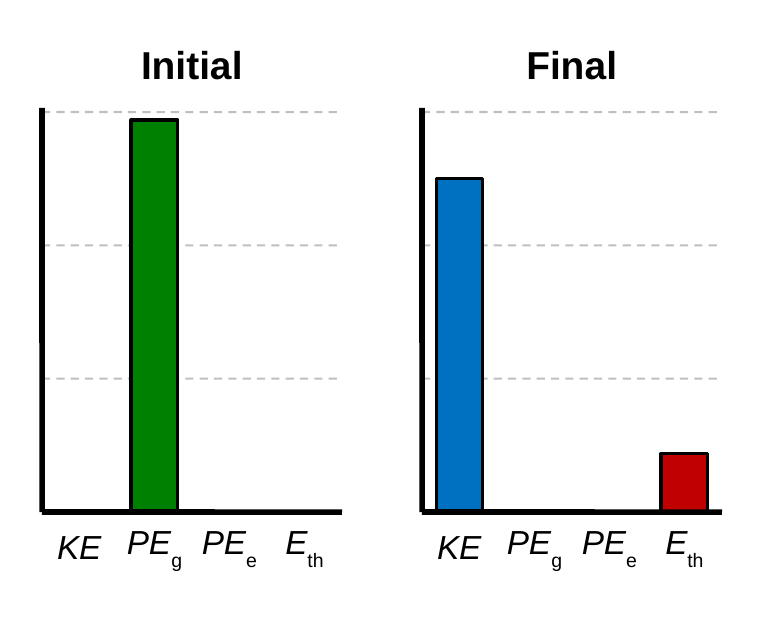
- Initial energy: TMEi = mgh = (2.0 kg)(9.8 m/s2)(1.5 m) = 29.4 J
- Final KE: TMEi = KEf + Wfriction, so KEf = 29.4 J − 4.4 J = 25.0 J
- Solve for speed: v = √(2KE/m) = √(2 × 25.0 J / 2.0 kg) = √(25 m2/s2)
- Answer: v = 5.0 m/s
Big Ideas
- Friction turns mechanical energy into thermal energy
- Evidence: things warm up and make sound
- TMEi = TMEf + Wfriction
- “Used up” energy is spread-out thermal energy
Back to the essential question: friction is a non-conservative force that turns mechanical energy into thermal energy and a little sound. The energy isn’t destroyed, so TMEi = TMEf + Wfriction, but once it spreads out as heat it’s hard to use again. That’s why people say energy gets “used up.” Next up, we’ll look at power, how fast energy is transferred.

