
The video lesson for this topic is coming soon.
Essential Question
How does a stretched spring store energy?
Pull back a slingshot and let go, and the stretched band launches the rock. By the end of this lesson, you should be able to use Hooke’s law, F = kx, find a spring constant from a graph, and calculate elastic potential energy with PEe = ½kx2.
Elastic Potential Energy
- Stored by stretching or squeezing
- Springs, rubber bands, trampolines
- More stretch: more energy
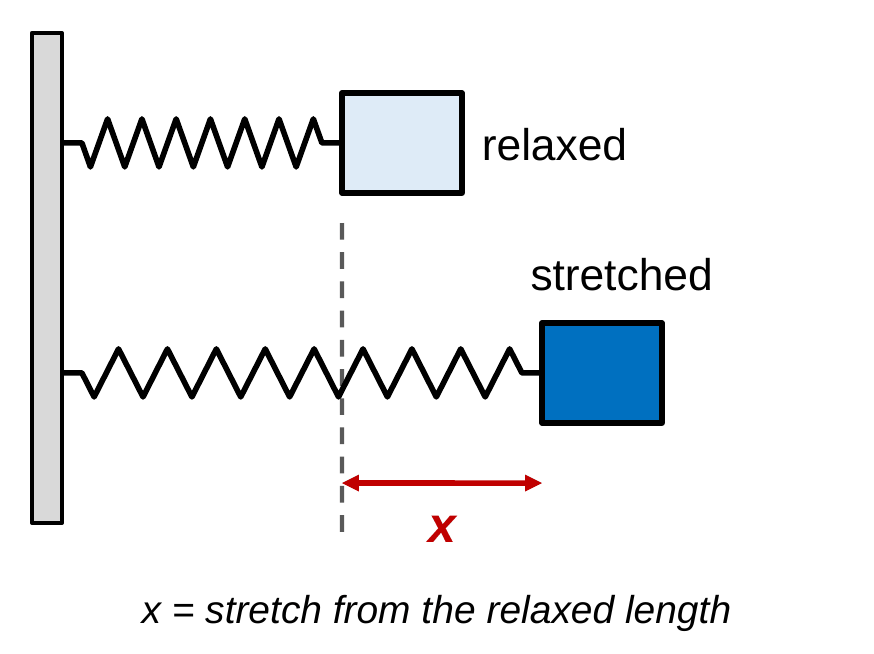
Elastic potential energy (PEe) is energy stored in an object that has been stretched or squeezed and can spring back, like a spring, a rubber band, a bow, or a trampoline. The amount of stretch or squeeze, measured from the relaxed length, is called x. The more you stretch it, the more energy it stores.
Hooke’s Law
- Spring force: F = kx
- x: stretch from relaxed length (m)
- k: spring constant (N/m)
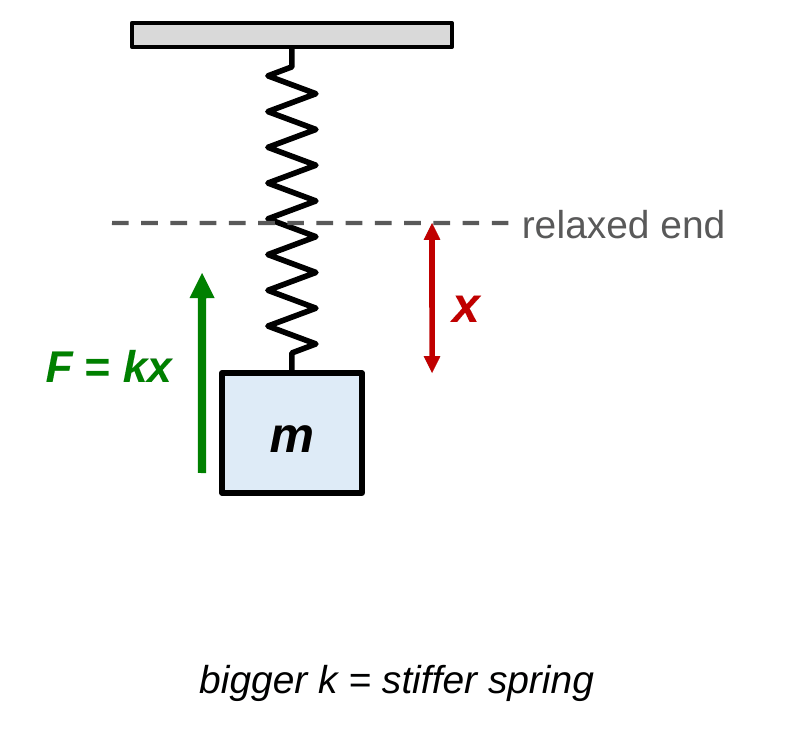
Hooke’s law says the force needed to stretch or squeeze a spring is proportional to how far you stretch it: F = kx. Here x is the stretch in meters and k is the spring constant in newtons per meter (N/m). The spring constant tells you how stiff the spring is. A stiff car spring might have k in the tens of thousands of N/m, while a soft toy spring might be just a few N/m.
Finding k from a Graph
- Hang masses, measure stretch
- Graph force vs. stretch
- Slope = k
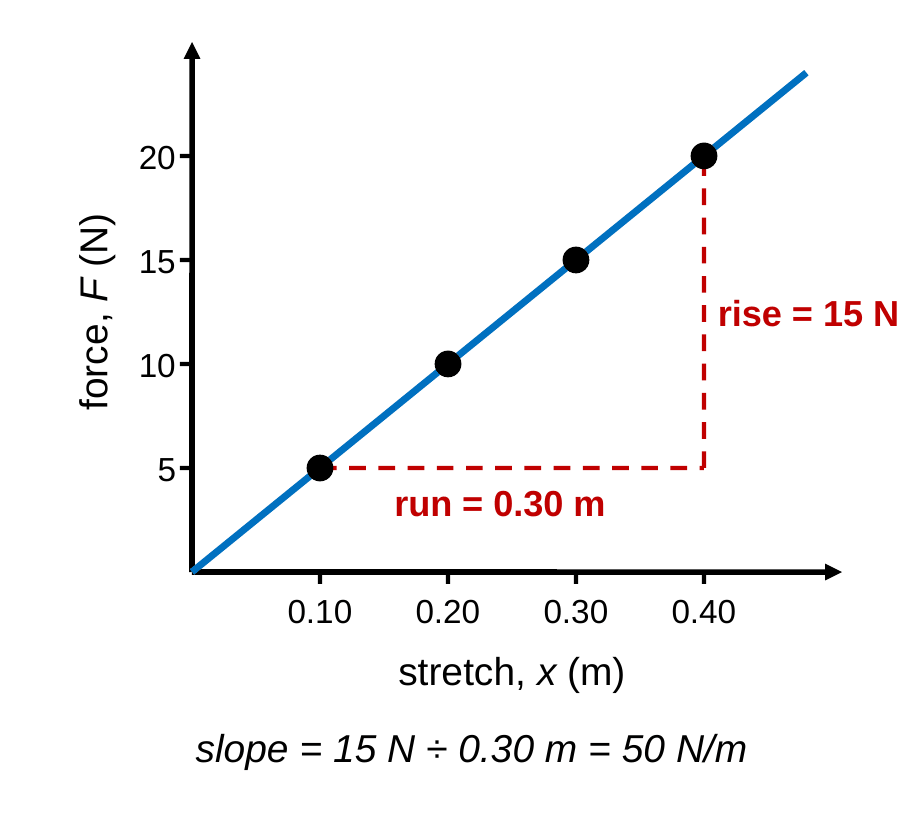
You can measure a spring constant in the lab. Hang different weights on the spring, measure the stretch each time, and graph force against stretch. For a spring that obeys Hooke’s law, the points fall on a straight line through the origin. Since F = kx, the slope of that line, rise over run, is the spring constant. Here the slope is 15 N ÷ 0.30 m = 50 N/m.
The Elastic Energy Equation
PEe = ½kx2
- PEe = elastic potential energy, in joules (J)
- k = spring constant, in newtons per meter (N/m)
- x = stretch or squeeze from the relaxed length, in meters (m)
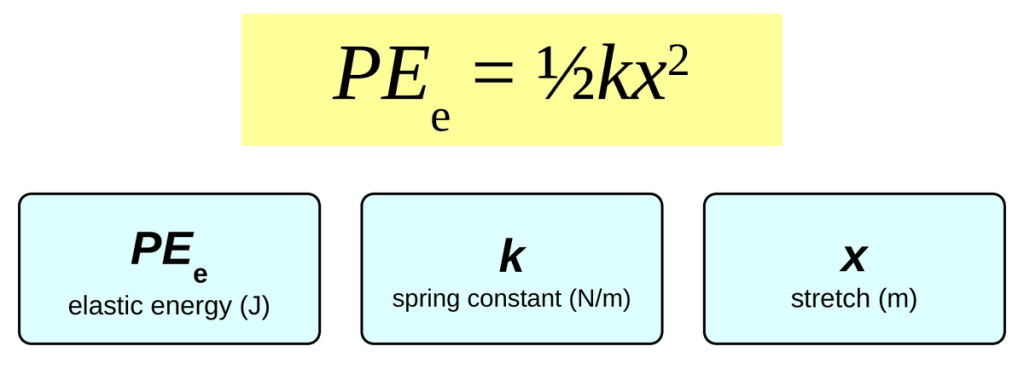
Only x is squared. Because of that, doubling the stretch stores four times as much energy. Squeezing a spring by 0.10 m stores the same energy as stretching it by 0.10 m.
Where the ½ Comes From
- Work to stretch = area under graph
- Triangle area = ½ × base × height
- ½ × x × kx = ½kx2
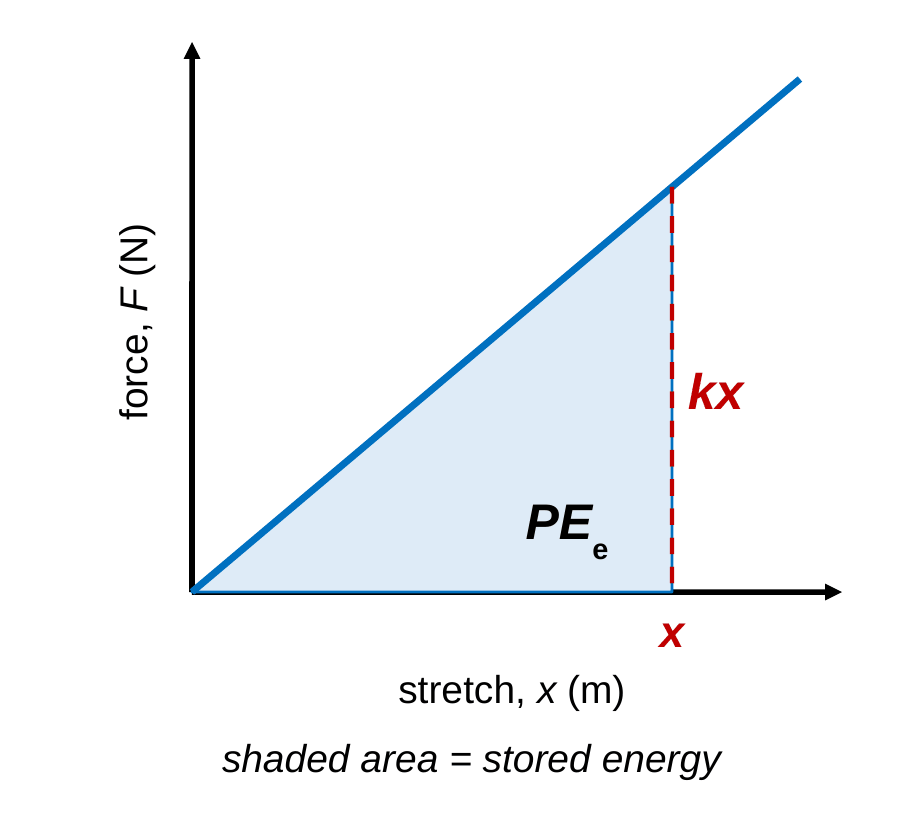
Why the ½? Stretching a spring isn’t like pushing a box with a steady force. The force starts at zero and grows to kx as you stretch. On a force vs. stretch graph, the work done is the area under the line. That area is a triangle with base x and height kx, so the work is ½ × x × kx = ½kx2. All of that work is stored as elastic potential energy.
Solving for Any Variable
- Write the equation first
- Find k: k = 2PEe / x2
- Find x: square root last
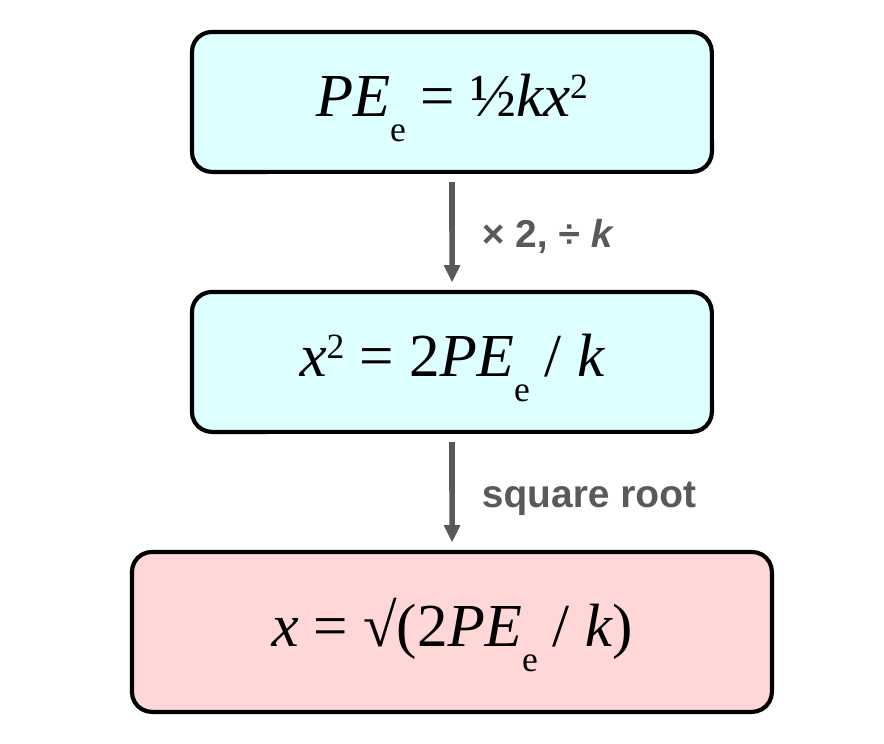
To find the spring constant, multiply both sides by 2 and divide by x2: k = 2PEe/x2. To find the stretch, multiply by 2, divide by k, then take the square root: x = √(2PEe/k). These are the same steps we used to solve the kinetic energy equation for v.
Worked Examples
Try each problem on your own first, then check your work against the solution.
Example 1: Spring Constant
A 6.0 N force stretches a spring 0.15 m from its relaxed length. What is the spring constant?
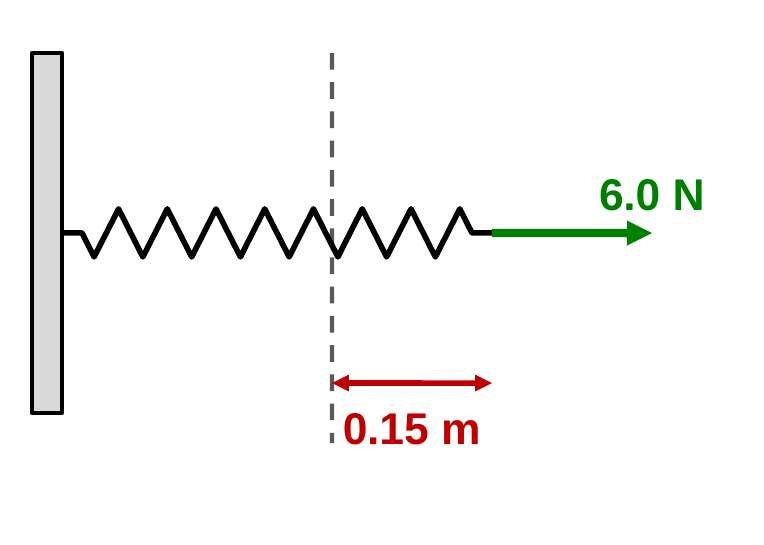
- Knowns: F = 6.0 N, x = 0.15 m, k = ?
- Rearrange: F = kx, so k = F/x
- Substitute: k = 6.0 N / 0.15 m
- Answer: k = 40. N/m
Example 2: Reading the Graph
A student hangs masses on a spring and graphs force vs. stretch. The points (0.10 m, 12 N), (0.20 m, 24 N), and (0.30 m, 36 N) lie on a straight line through the origin. Find the spring constant.
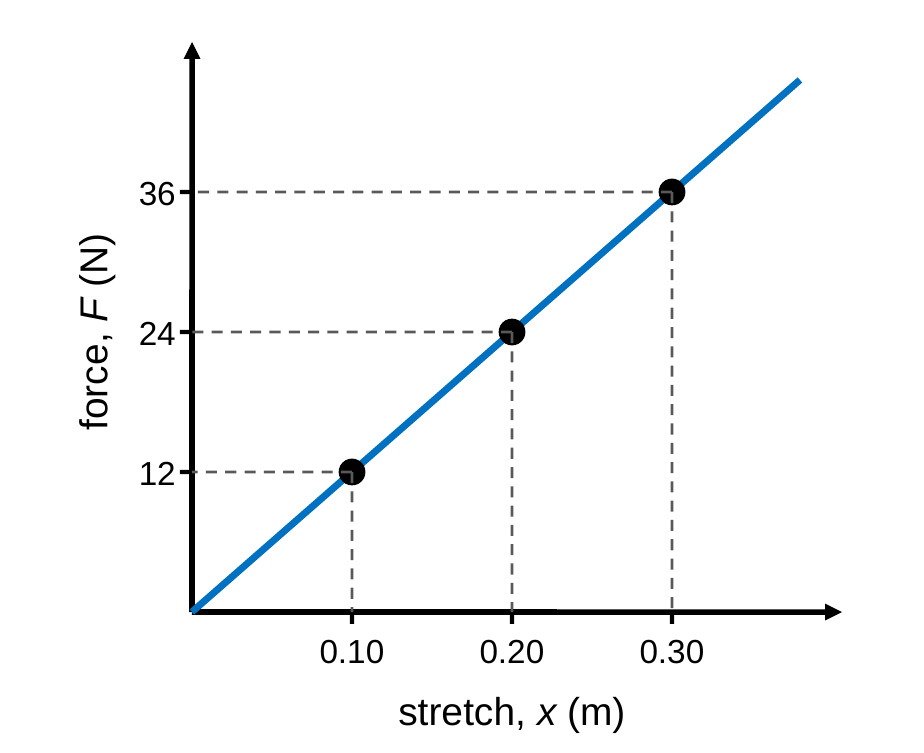
- Pick two points on the line: (0 m, 0 N) and (0.30 m, 36 N)
- Rise and run: rise = 36 N − 0 N = 36 N, run = 0.30 m − 0 m = 0.30 m
- Slope: k = rise/run = 36 N / 0.30 m
- Answer: k = 120 N/m
Example 3: Compressed Spring
A toy launcher has a spring with k = 250 N/m. It is squeezed 0.20 m from its relaxed length. How much elastic potential energy does it store?
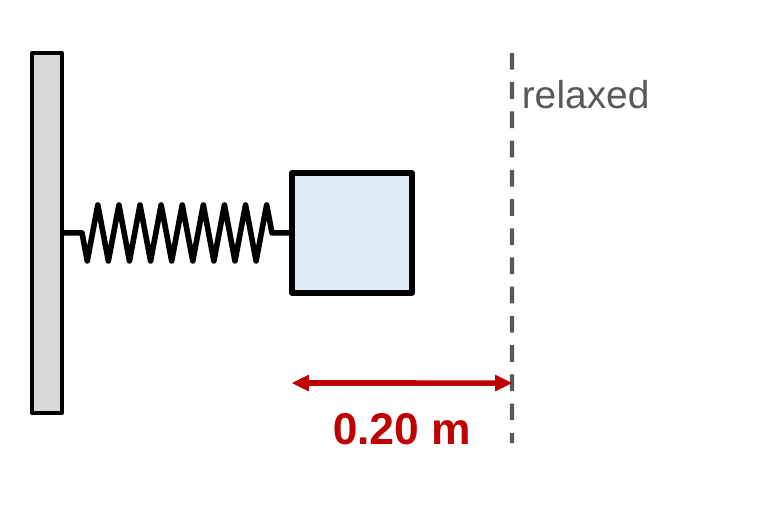
- Knowns: k = 250 N/m, x = 0.20 m
- Equation: PEe = ½kx2
- Substitute: PEe = ½(250 N/m)(0.20 m)2 = ½(250 N/m)(0.040 m2)
- Answer: PEe = 5.0 J
Example 4: Slingshot Stretch
A slingshot band acts like a spring with k = 400. N/m. How far must it be stretched to store 18 J of energy?
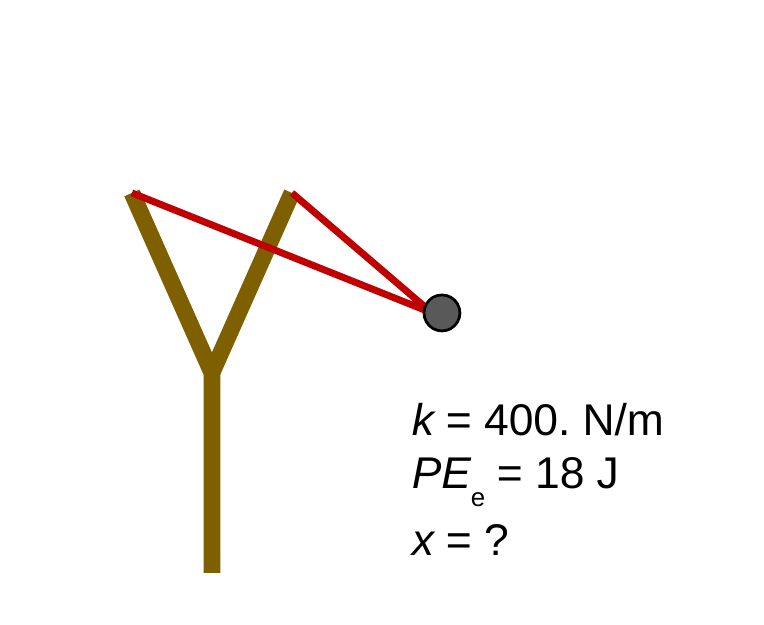
- Knowns: k = 400. N/m, PEe = 18 J, x = ?
- Rearrange: PEe = ½kx2, so x = √(2PEe/k)
- Substitute: x = √(2 × 18 J / 400. N/m) = √(0.090 m2)
- Answer: x = 0.30 m
Big Ideas
- Hooke’s law: F = kx
- k = slope of force vs. stretch graph
- PEe = ½kx2: energy stored in a spring
- Double the stretch: 4× the energy
Back to the essential question: stretching or squeezing a spring takes work, and that work is stored as elastic potential energy, PEe = ½kx2. The spring constant k comes from Hooke’s law, F = kx, and equals the slope of a force vs. stretch graph. Next up, we’ll put kinetic, gravitational, and elastic energy together in the law of conservation of energy.

