
The video lesson for this topic is coming soon.
Essential Question
How does lifting something store energy?
When you lift a backpack onto a shelf, you do work on it, but once it sits there it isn’t moving. The energy is stored because of its height. By the end of this lesson, you should be able to calculate that stored energy with PEg = mgh and choose a reference level.
Gravitational Potential Energy
- Energy stored by height
- Higher up: more PEg
- Heavier: more PEg
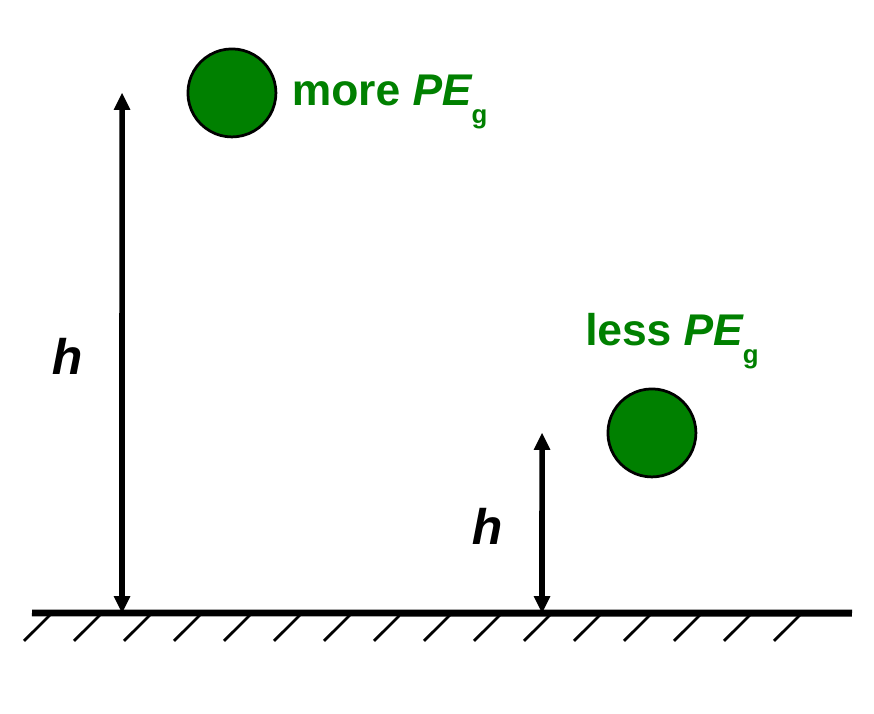
Gravitational potential energy (PEg) is energy stored because of an object’s height. It’s called potential energy because it isn’t doing anything yet, but it could. Let the ball go and the stored energy turns into motion. The higher the object, and the heavier it is, the more PEg it has.
The Potential Energy Equation
PEg = mgh
- PEg = gravitational potential energy, in joules (J)
- m = mass, in kilograms (kg)
- g = 9.8 m/s2 near Earth’s surface
- h = height above the reference level, in meters (m)
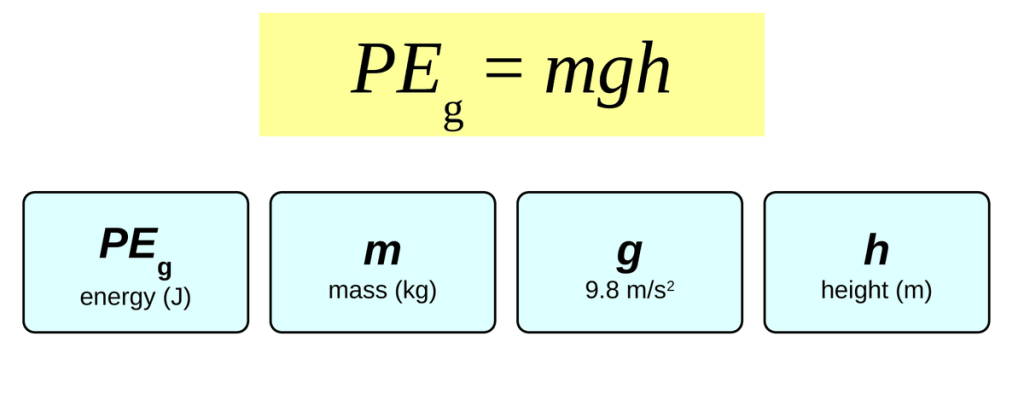
Notice that mg is the object’s weight, the force needed to lift it. So mgh is really weight times height, which is the same as force times distance. That’s why PEg is measured in joules, just like work.
Choosing Where h = 0
- You choose the zero level
- Often the lowest point
- Change in PEg stays the same
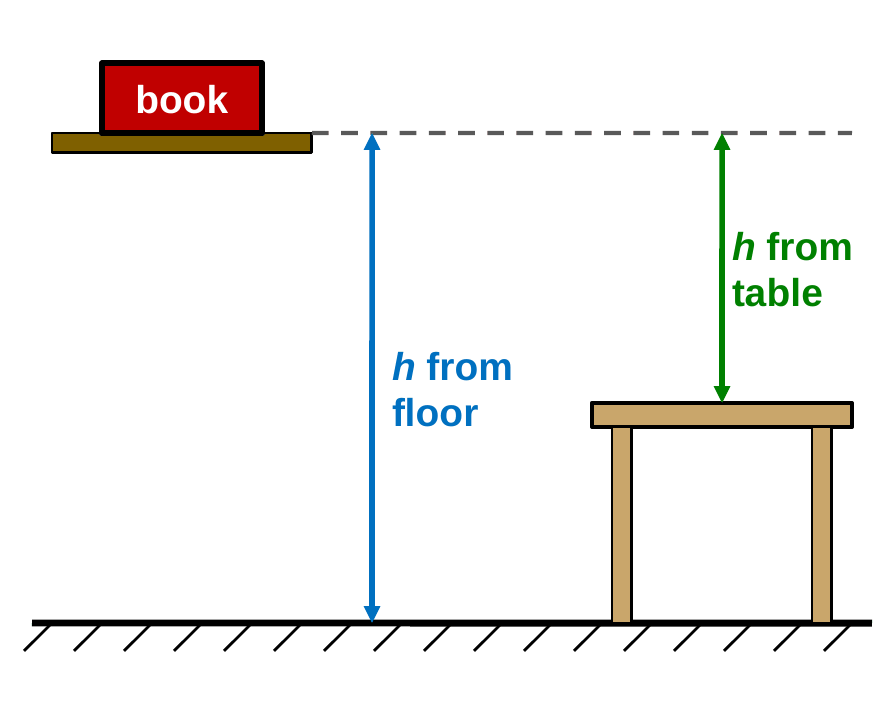
Height has to be measured from somewhere, and you get to choose where h = 0. This is called the reference level. The book has more PEg measured from the floor than measured from the table top. Both are correct, as long as you stick with one choice for the whole problem. Physics only cares about changes in PEg, and those come out the same no matter where you put zero.
Lifting Stores Energy
- Lift slowly: F = mg
- Work done: W = mgh
- Work lifting = gain in PEg
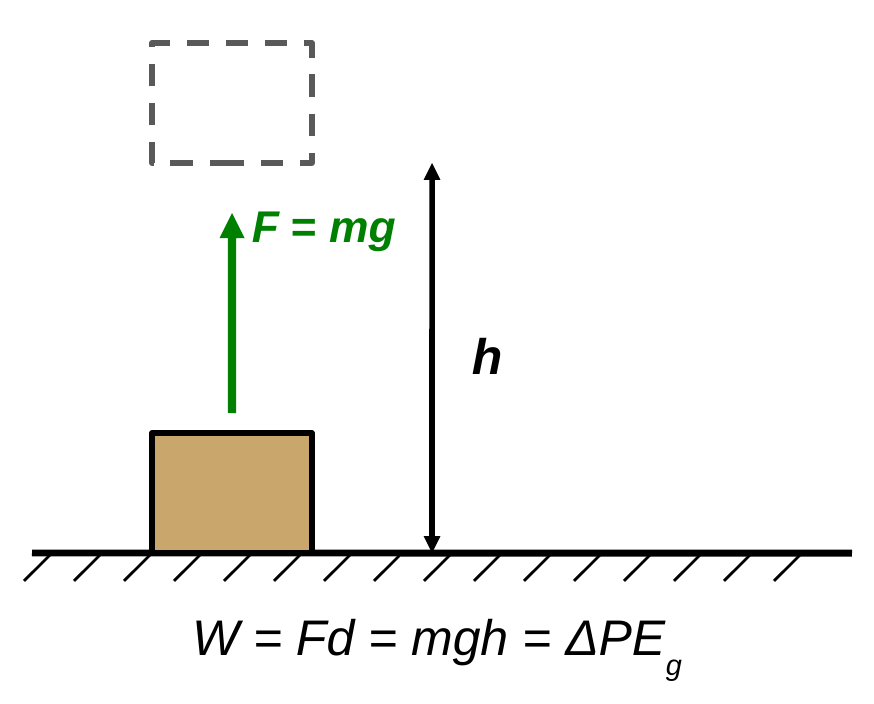
To lift a box at a constant speed, you push up with a force equal to its weight, F = mg. Over a height h, that force does work W = Fd = mgh. That work doesn’t disappear. It’s stored in the box as gravitational potential energy. So the work done lifting an object equals the gain in its PEg.
Solving for Any Variable
- Find height: h = PEg / (mg)
- Find mass: m = PEg / (gh)
- Cover the one you want
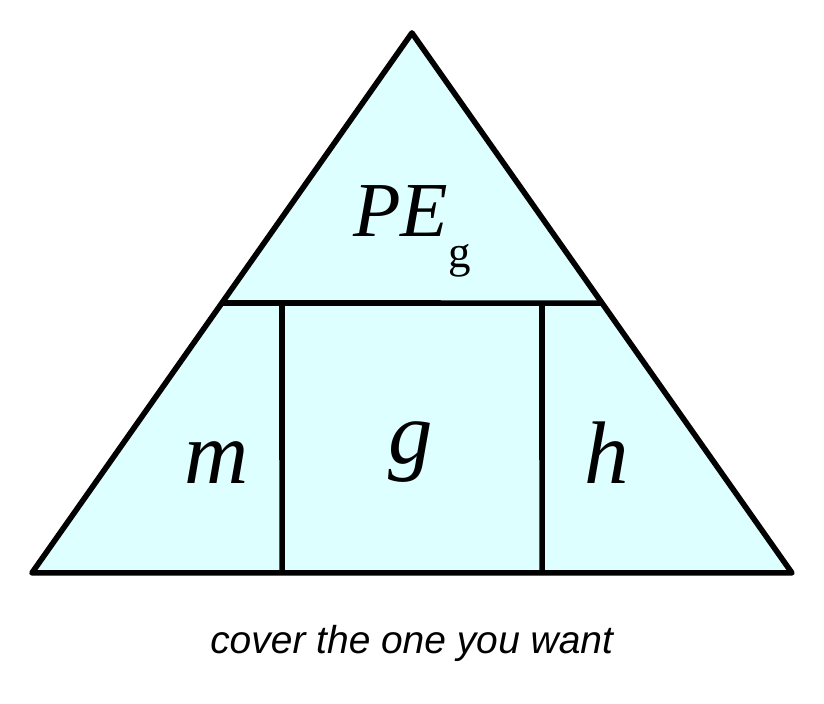
Rearrange PEg = mgh for whatever the problem asks. To find height, divide the energy by mg. To find mass, divide by gh. The triangle works the same way as before: cover the quantity you want, and what’s left tells you to divide the top by the bottom.
Worked Examples
Try each problem on your own first, then check your work against the solution.
Example 1: Flowerpot
A 0.50 kg flowerpot sits on a windowsill 6.0 m above the sidewalk. What is its gravitational potential energy relative to the sidewalk?
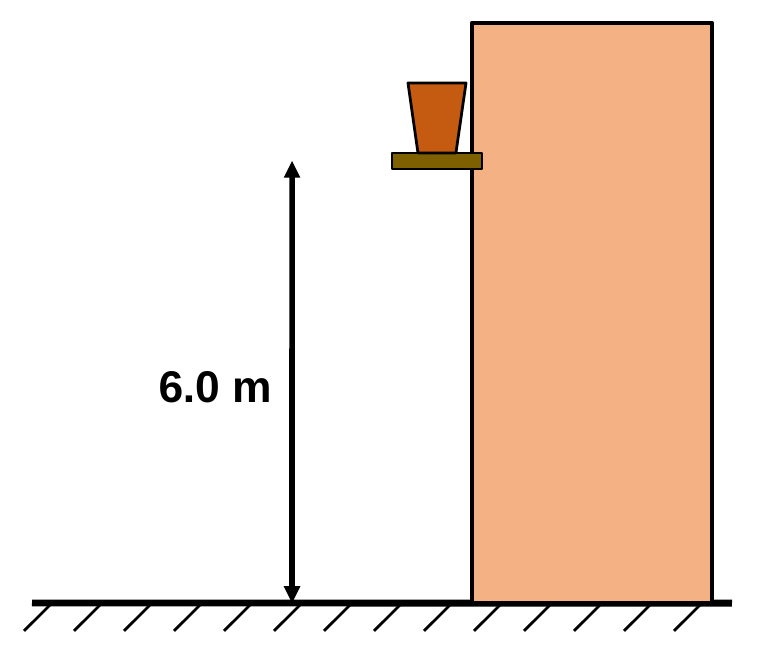
- Knowns: m = 0.50 kg, h = 6.0 m, g = 9.8 m/s2
- Equation: PEg = mgh
- Substitute: PEg = (0.50 kg)(9.8 m/s2)(6.0 m) = 29.4 J
- Answer: Round to two significant figures: PEg = 29 J
Example 2: Reference Level
A 1.5 kg textbook sits on a shelf 1.8 m above the floor. A desk top is 0.80 m above the floor. Find the book’s PEg relative to (a) the floor and (b) the desk top.
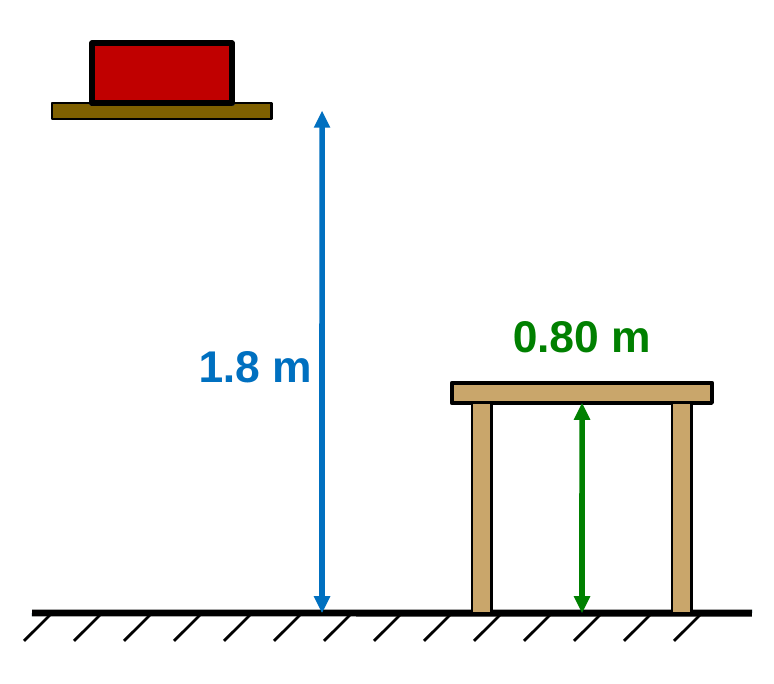
- Knowns: m = 1.5 kg, shelf at 1.8 m, desk top at 0.80 m, g = 9.8 m/s2
- (a) From the floor: h = 1.8 m, so PEg = (1.5 kg)(9.8 m/s2)(1.8 m) = 26.46 J ≈ 26 J
- (b) Height above the desk: h = 1.8 m − 0.80 m = 1.0 m
- (b) From the desk: PEg = (1.5 kg)(9.8 m/s2)(1.0 m) = 14.7 J ≈ 15 J
Same book, two different answers. Both are correct because they use different reference levels.
Example 3: Loading a Truck
A mover lifts a 25 kg box at a constant speed from the ground onto a truck bed 2.0 m high. How much work does he do? How much PEg does the box gain?
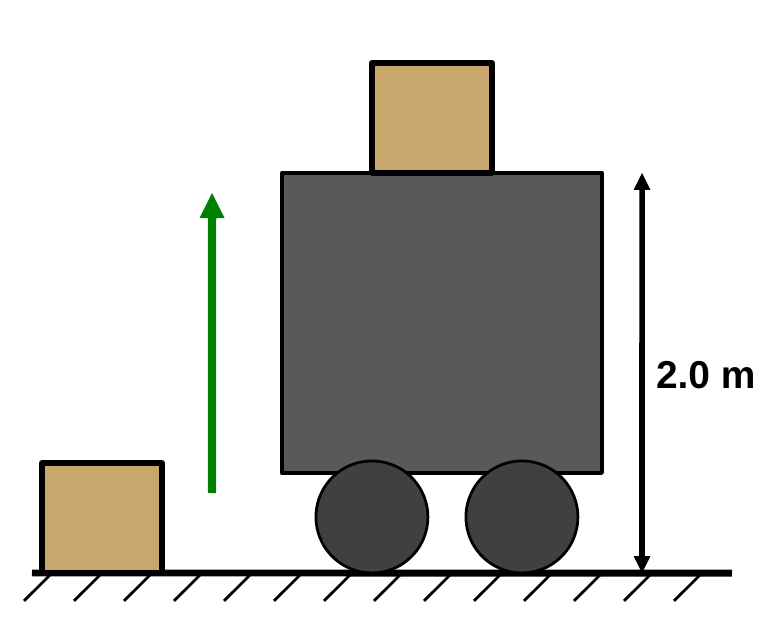
- Knowns: m = 25 kg, h = 2.0 m, g = 9.8 m/s2
- Force: constant speed, so F = mg = (25 kg)(9.8 m/s2) = 245 N up
- Work: W = Fd = (245 N)(2.0 m) = 490 J
- PEg gained: ΔPEg = mgh = (25 kg)(9.8 m/s2)(2.0 m) = 490 J, the same as the work done
Example 4: Finding Height
A 2.0 kg bag of flour sits on a high shelf. It has 98 J of gravitational potential energy relative to the floor. How high is the shelf?
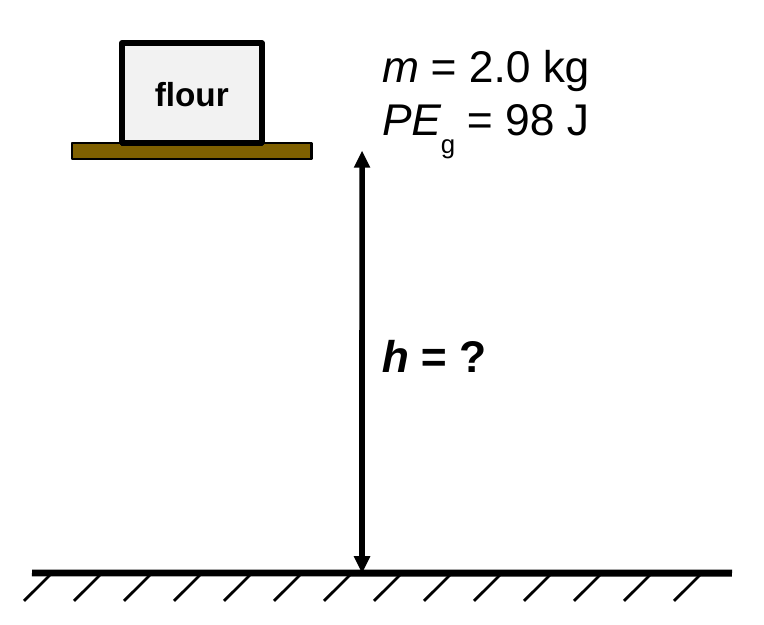
- Knowns: m = 2.0 kg, PEg = 98 J, g = 9.8 m/s2, h = ?
- Rearrange: PEg = mgh, so h = PEg / (mg)
- Substitute: h = 98 J / [(2.0 kg)(9.8 m/s2)] = 98 J / 19.6 N
- Answer: h = 5.0 m
Big Ideas
- PEg = mgh: energy stored by height
- You choose where h = 0
- Work lifting = gain in PEg
- Find height: h = PEg / (mg)
Back to the essential question: lifting an object stores energy as gravitational potential energy, PEg = mgh. The work done lifting it at constant speed equals the PEg it gains, and we choose where h = 0. Next up, we’ll look at elastic potential energy, the energy stored in stretched or squeezed springs.

