
The video lesson for this topic is coming soon.
Essential Question
How much energy does a moving object have?
When you push a cart and it speeds up, the work you did becomes energy of motion. By the end of this lesson, you should be able to calculate kinetic energy with KE = ½mv2 and connect it to work with the work-energy theorem.
Kinetic Energy
- Energy of motion
- Anything moving has KE
- Measured in joules (J)
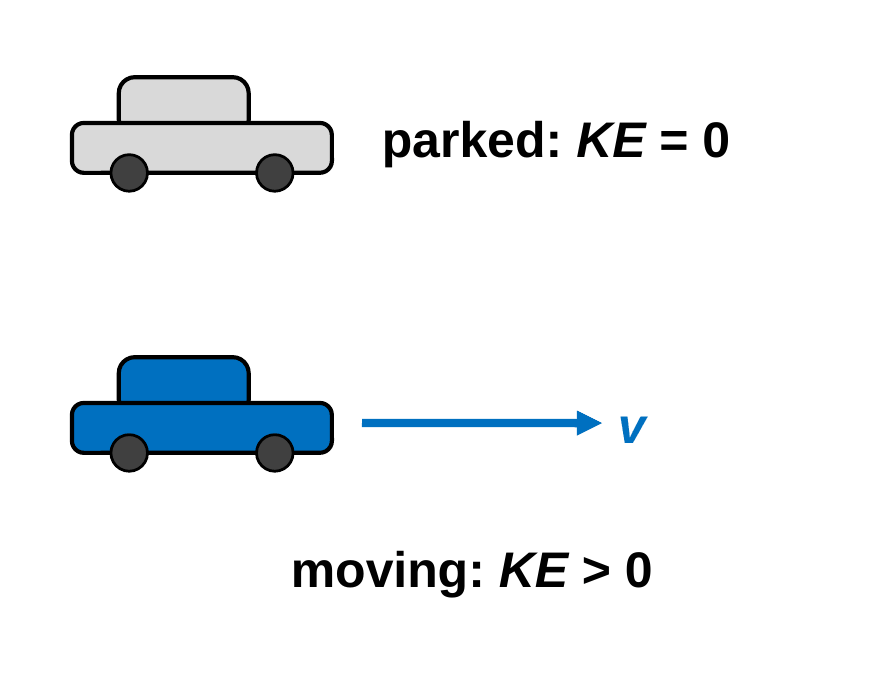
Kinetic energy (KE) is the energy an object has because it is moving. A parked car has no kinetic energy. The same car rolling down the street does. Like all energy, kinetic energy is measured in joules (J).
The Kinetic Energy Equation
KE = ½mv2
- KE = kinetic energy, in joules (J)
- m = mass, in kilograms (kg)
- v = speed, in meters per second (m/s)
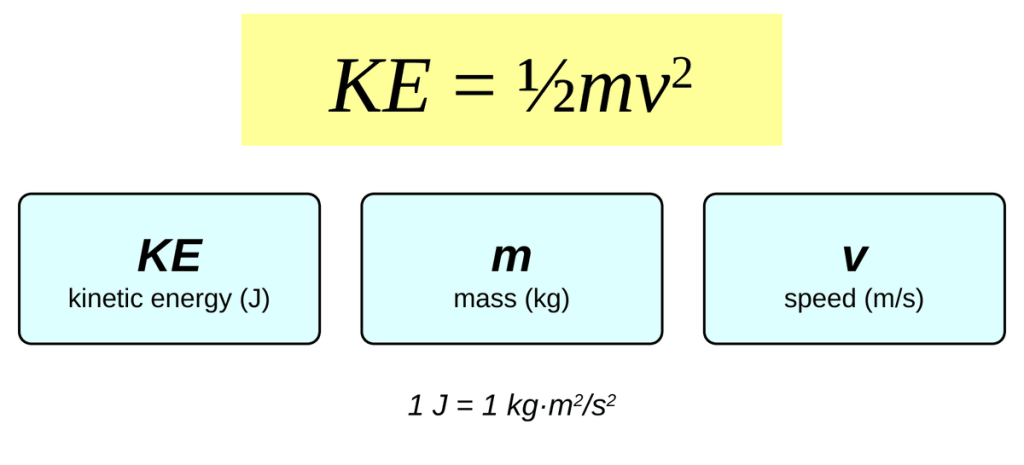
Only the speed is squared, not the mass. Kilograms times meters squared per second squared is a joule. Because v is squared, kinetic energy is never negative, and it does not depend on which direction the object moves. Kinetic energy is a scalar.
Speed Matters Most
- Double the mass: 2× the KE
- Double the speed: 4× the KE
- Triple the speed: 9× the KE
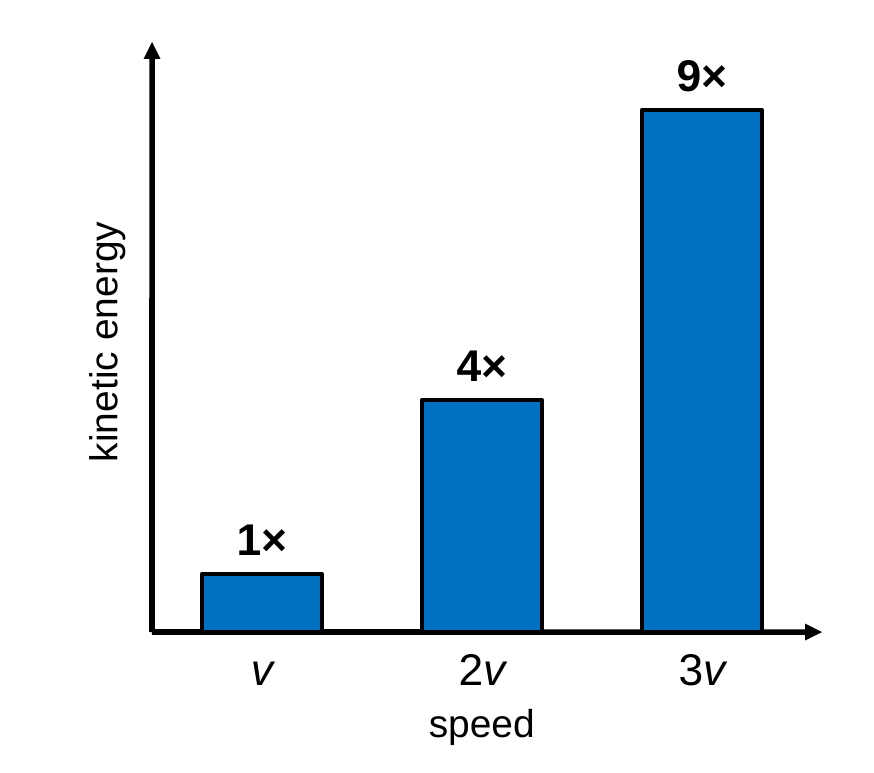
Mass and speed both increase kinetic energy, but not equally. Doubling the mass doubles the kinetic energy. Doubling the speed makes it four times as big, because 22 = 4. Tripling the speed makes it nine times as big, because 32 = 9. That’s why a small increase in driving speed makes a crash much more dangerous.
The Work-Energy Theorem
- Net work changes KE
- Wnet = KEf − KEi
- Positive work speeds it up
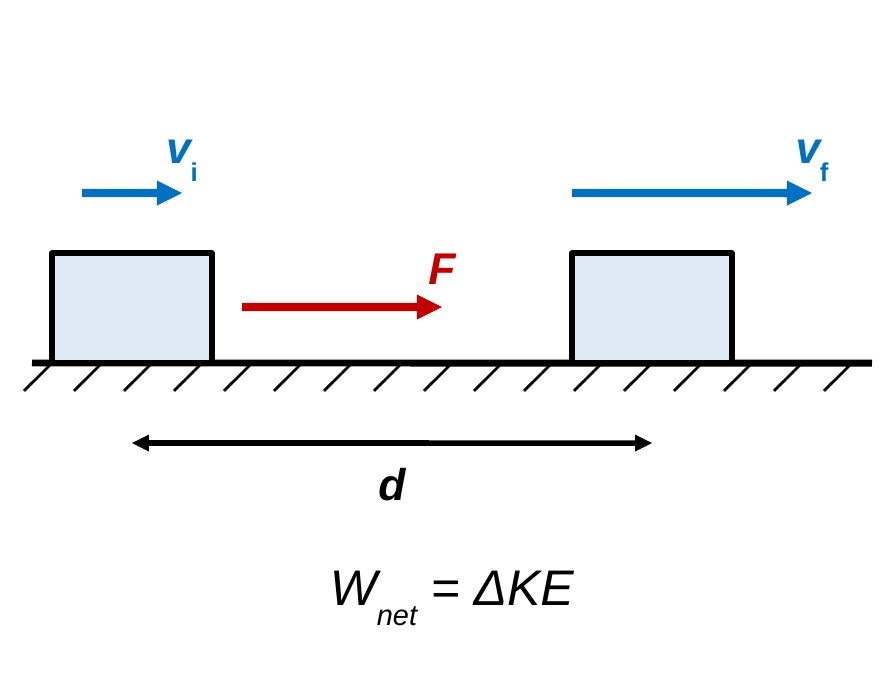
The work-energy theorem says the net work done on an object equals its change in kinetic energy: Wnet = KEf − KEi = ΔKE. If the net force pushes along the motion, the work is positive and the object speeds up. If the net force pushes against the motion, the work is negative and the object slows down.
Solving for Any Variable
- Write the equation first
- Undo steps in reverse order
- Square root last for v
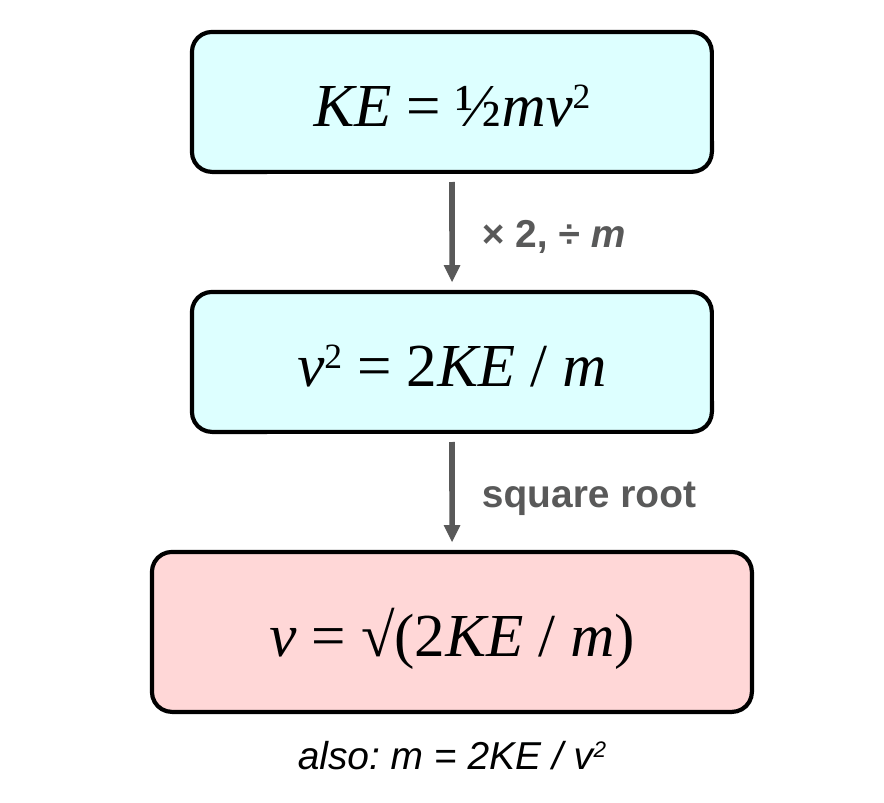
To find mass, multiply both sides by 2 and divide by v2: m = 2KE/v2. To find speed, multiply by 2, divide by m, then take the square root: v = √(2KE/m). Always rearrange before plugging in numbers, and take the square root as the very last step.
Worked Examples
Try each problem on your own first, then check your work against the solution.
Example 1: A Moving Car
A 1,500 kg car drives down the highway at 20.0 m/s. What is its kinetic energy?
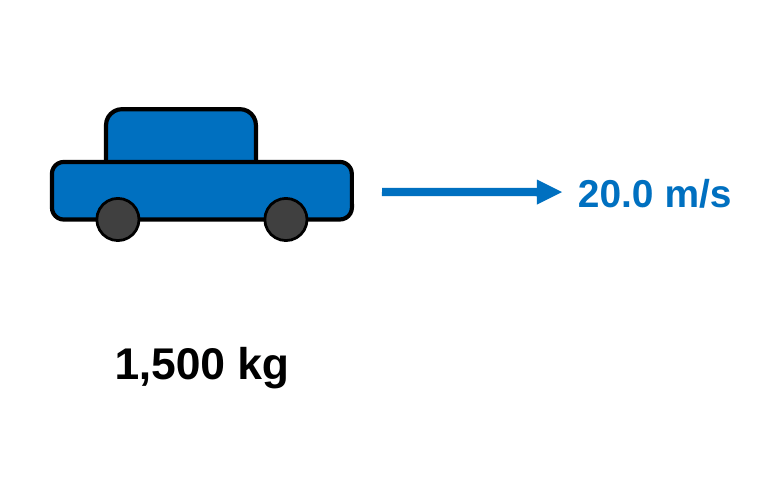
- Knowns: m = 1,500 kg, v = 20.0 m/s
- Equation: KE = ½mv2
- Substitute: KE = ½(1,500 kg)(20.0 m/s)2 = ½(1,500 kg)(400. m2/s2)
- Answer: KE = 3.0 × 10⁵ J (300,000 J)
Example 2: Doubling the Speed
A 0.145 kg baseball is thrown at 20.0 m/s, then at 40.0 m/s. Find its kinetic energy at each speed. How do they compare?
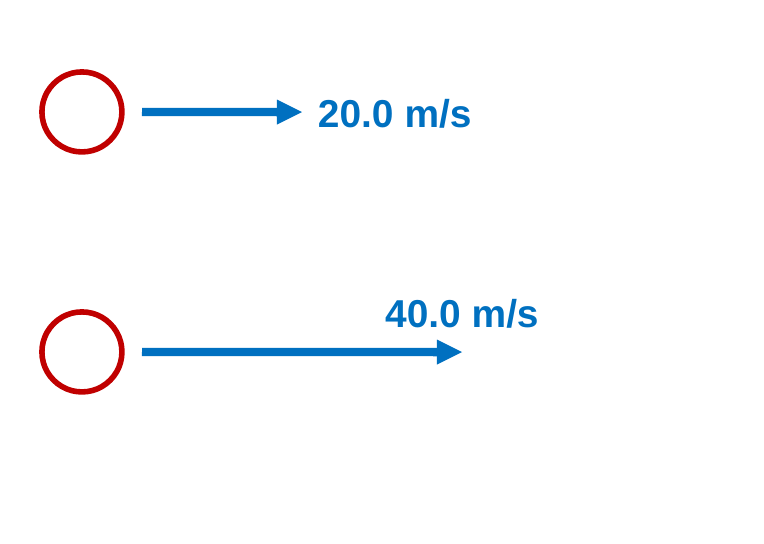
- Knowns: m = 0.145 kg, v1 = 20.0 m/s, v2 = 40.0 m/s
- At 20.0 m/s: KE = ½(0.145 kg)(20.0 m/s)2 = ½(0.145)(400.) = 29.0 J
- At 40.0 m/s: KE = ½(0.145 kg)(40.0 m/s)2 = ½(0.145)(1,600) = 116 J
- Compare: 116 J ÷ 29.0 J = 4.00. Doubling the speed made the kinetic energy four times as big.
Example 3: Finding Speed
A 60.0 kg skater glides across the ice with 1,920 J of kinetic energy. How fast is she moving?
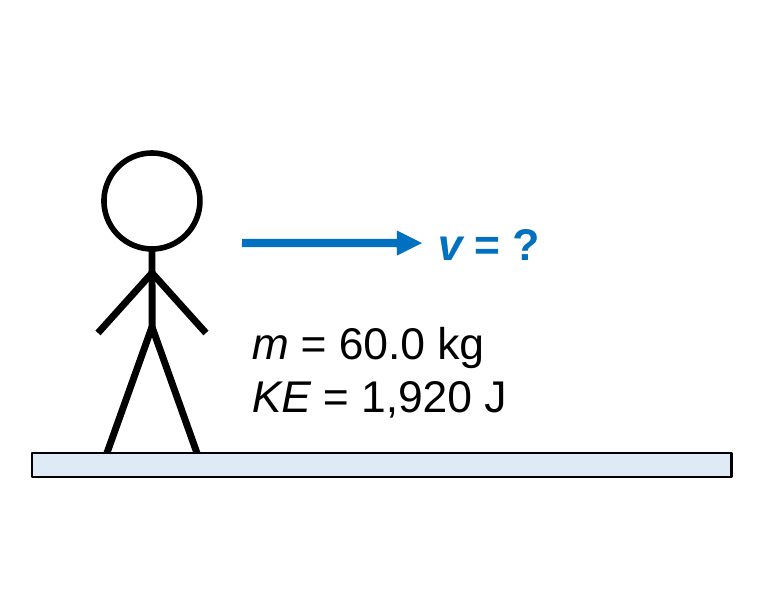
- Knowns: m = 60.0 kg, KE = 1,920 J, v = ?
- Rearrange: KE = ½mv2, so v = √(2KE/m)
- Substitute: v = √(2 × 1,920 J / 60.0 kg) = √(64.0 m2/s2)
- Answer: v = 8.00 m/s
Example 4: Work-Energy Theorem
A 2.0 kg cart rolls at 3.0 m/s. A push does 16 J of net work on it in the direction of motion. What is the cart’s new speed?
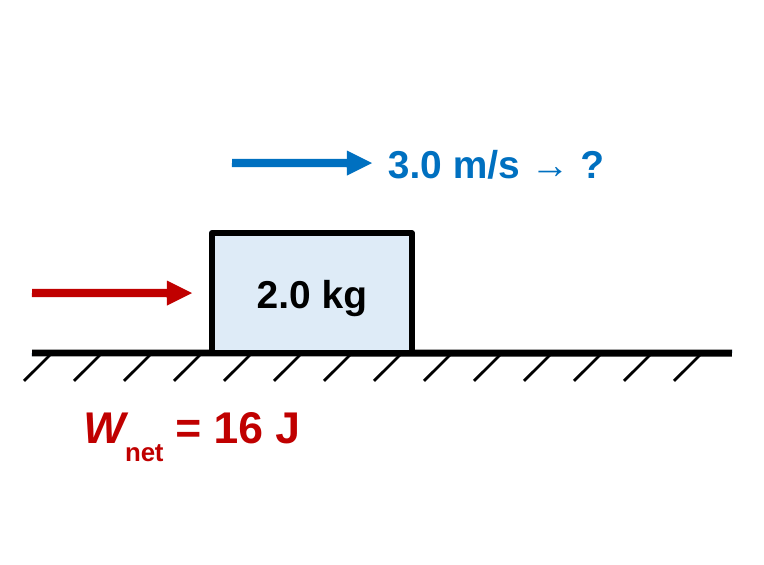
- Initial KE: KEi = ½(2.0 kg)(3.0 m/s)2 = 9.0 J
- Work-energy theorem: Wnet = KEf − KEi, so KEf = KEi + Wnet = 9.0 J + 16 J = 25 J
- Solve for speed: vf = √(2KEf/m) = √(2 × 25 J / 2.0 kg) = √(25 m2/s2)
- Answer: vf = 5.0 m/s
Big Ideas
- KE = ½mv2: the energy of motion
- Double the speed: 4× the kinetic energy
- Work-energy theorem: Wnet = ΔKE
- Find speed: v = √(2KE/m)
Back to the essential question: a moving object has kinetic energy, KE = ½mv2, which depends on its mass and, even more, on its speed. Doubling the speed makes the kinetic energy four times as big, and the net work done on an object equals its change in kinetic energy. Next up, we’ll look at gravitational potential energy, the energy stored by lifting something up.

