
The video lesson for this topic is coming soon.
Essential Question
How do we describe a change in velocity?
A car pulling away from a stop sign and a bike braking at the bottom of a hill both have a changing velocity. By the end of this lesson, you should be able to calculate acceleration, use it to find a final velocity, and tell whether an object is speeding up or slowing down.
Acceleration
- How fast velocity changes
- Speeding up or slowing down
- Changing direction counts too
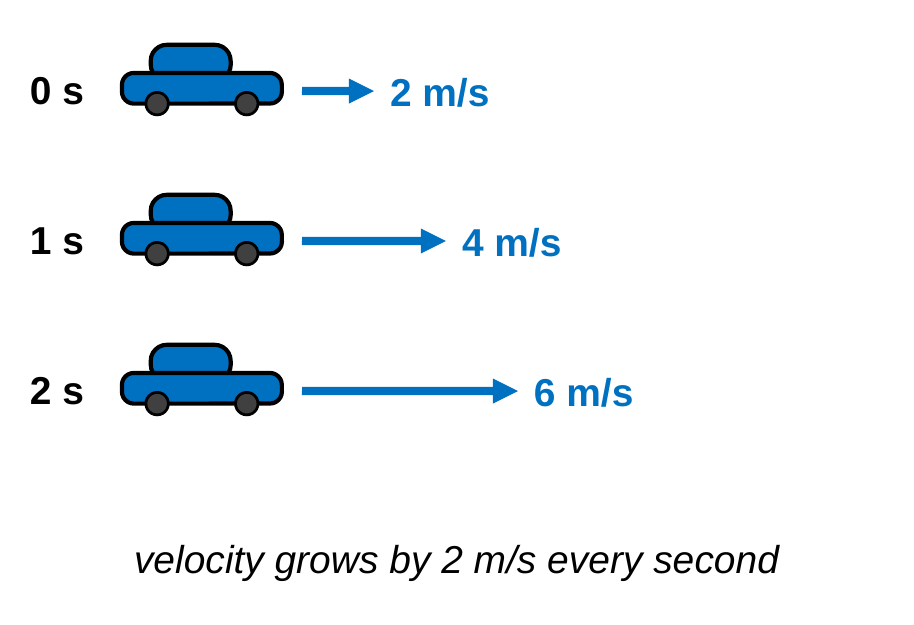
Acceleration describes how quickly an object’s velocity changes. This car’s velocity goes from 2 m/s to 4 m/s to 6 m/s, gaining 2 m/s every second, so it is accelerating. Slowing down is also acceleration, and so is changing direction, because velocity includes direction.
The Acceleration Equation
a = (vf − vi) / t
- a = acceleration, in meters per second squared (m/s2)
- vf = final velocity, in m/s
- vi = initial velocity, in m/s
- t = time, in seconds (s)
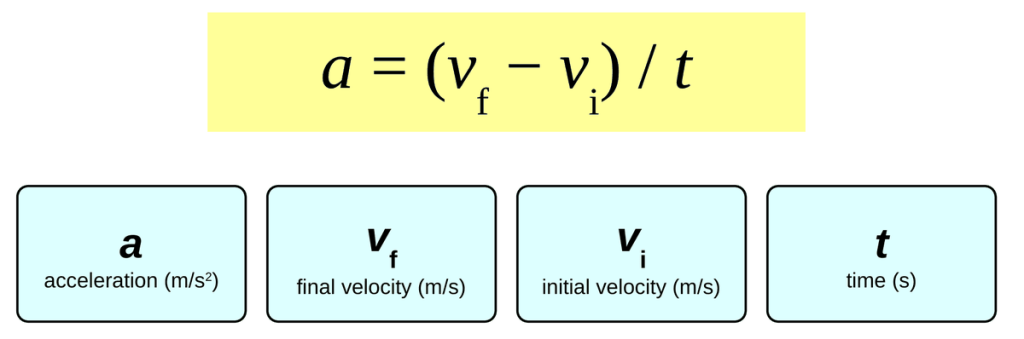
Acceleration is the change in velocity, final minus initial, divided by the time it took. Always subtract in the order final minus initial, so the sign of your answer comes out right.
Units of Acceleration
- (m/s) ÷ s = m/s2
- Meters per second, every second
- 2 m/s2: gain 2 m/s each second
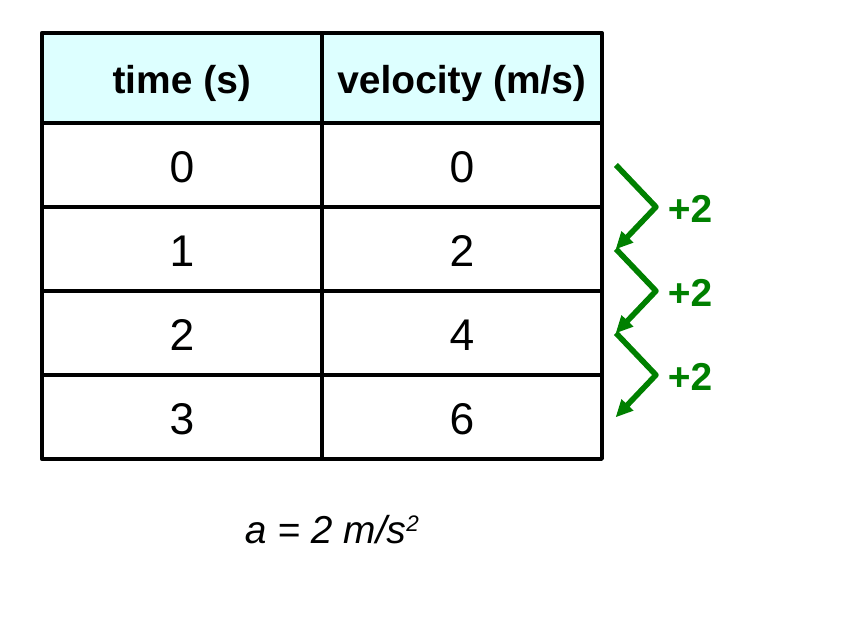
Dividing a velocity (m/s) by a time (s) gives meters per second per second, written m/s2. It’s easiest to read as “meters per second, every second.” An acceleration of 2 m/s2 means the velocity changes by 2 m/s each second, as the table shows.
Speeding Up vs. Slowing Down
- a same direction as v: speeding up
- a opposite to v: slowing down
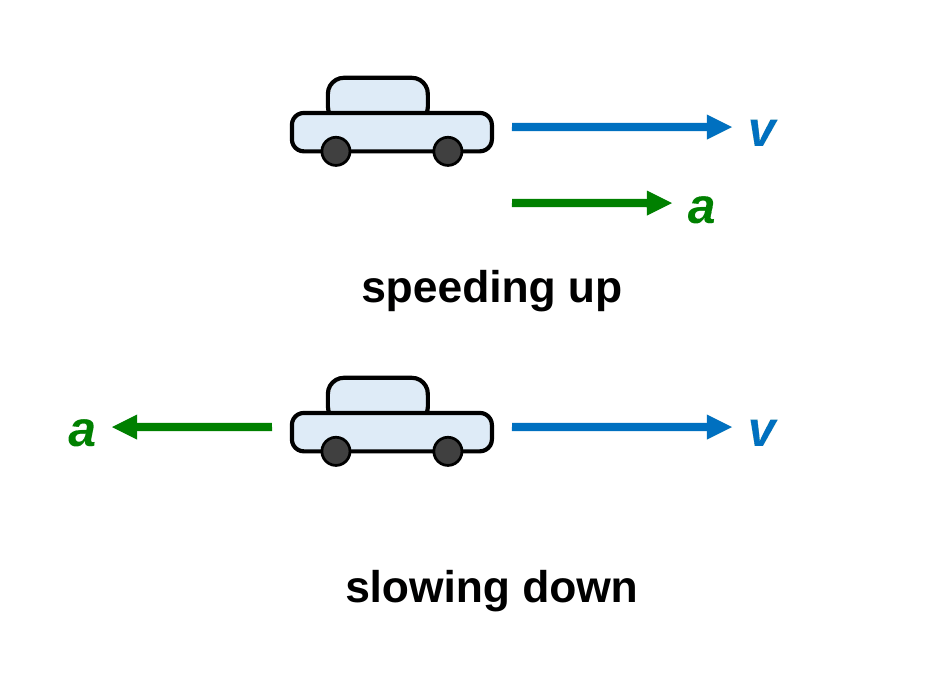
Whether an object speeds up or slows down depends on how its acceleration compares to its velocity. If the acceleration points the same way as the velocity, the object speeds up. If the acceleration points the opposite way, the object slows down, like a car braking while it still rolls forward.
The Sign of Acceleration
- Sign = direction of a
- Same signs: speeding up
- Opposite signs: slowing down
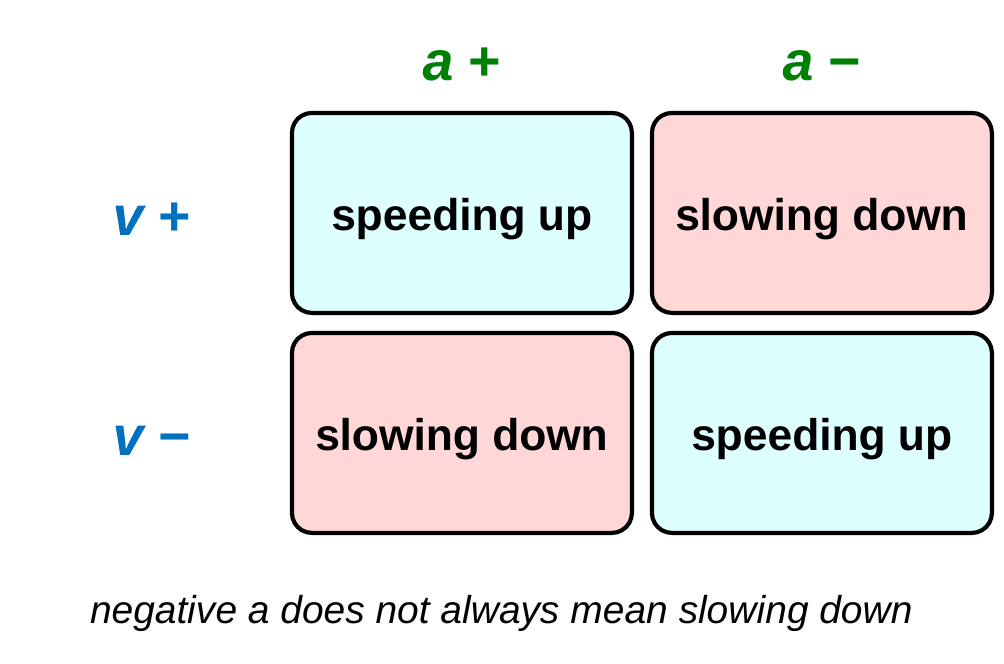
In one-dimensional problems, the sign of the acceleration tells you its direction, not whether the object is speeding up. Compare the signs of v and a. If they match, the object speeds up. If they are opposite, it slows down. So a negative acceleration can mean speeding up, for example when an object moving in the negative direction goes faster and faster.
Finding Final Velocity
vf = vi + at
- Start: a = (vf − vi)/t
- Multiply both sides by t
- Add vi to both sides
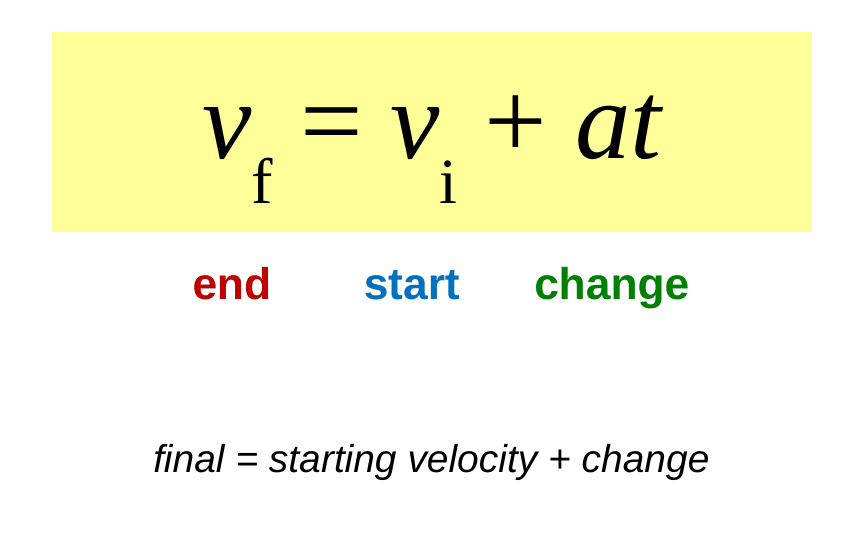
Rearranging the acceleration equation gives vf = vi + at. Multiply both sides by t to get at = vf − vi, then add vi to both sides. The product at is how much the velocity changes, so the final velocity is the starting velocity plus that change.
Worked Examples
Try each problem on your own first, then check your work against the solution.
Example 1: Speeding Up
A car speeds up from 5.0 m/s east to 25.0 m/s east in 4.0 s. What is its acceleration?
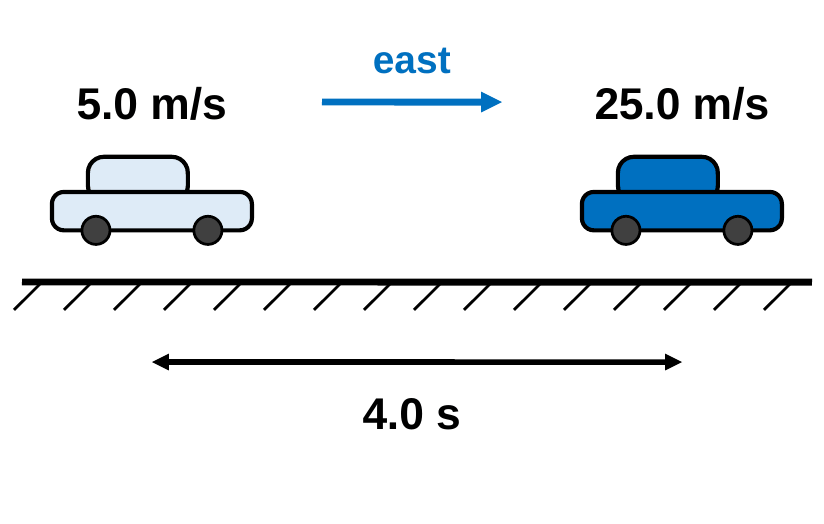
- Knowns: vi = 5.0 m/s east, vf = 25.0 m/s east, t = 4.0 s
- Equation: a = (vf − vi)/t
- Substitute: a = (25.0 m/s − 5.0 m/s) / 4.0 s = 20.0 m/s / 4.0 s
- Answer: a = 5.0 m/s2 east
Example 2: Slowing Down
A cyclist moving 12 m/s east brakes to a stop in 3.0 s. What is her acceleration?
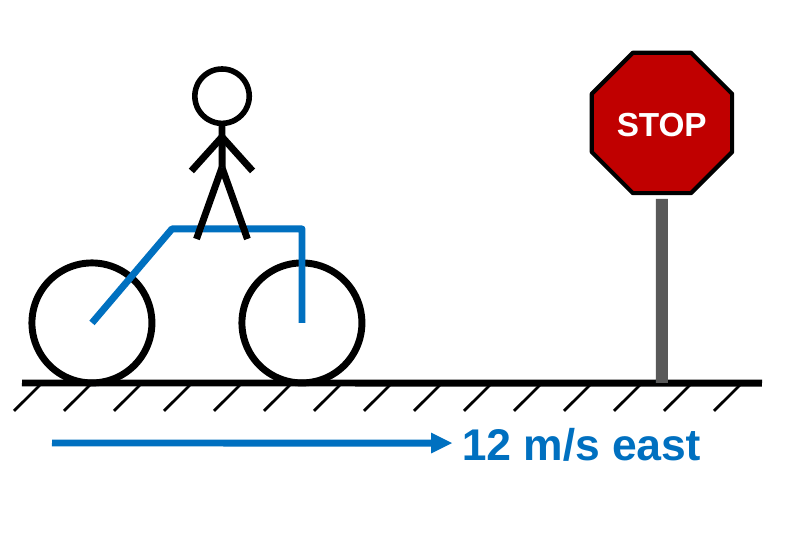
- Knowns: vi = 12 m/s east, vf = 0 m/s (a stop), t = 3.0 s
- Equation: a = (vf − vi)/t
- Substitute: a = (0 m/s − 12 m/s) / 3.0 s = −12 m/s / 3.0 s
- Answer: a = −4.0 m/s2, which is 4.0 m/s2 west
The acceleration is negative while the velocity is positive. Opposite signs mean she slows down, which is exactly what braking does.
Example 3: Finding Final Velocity
A skateboarder rolling at 2.0 m/s speeds up at 1.5 m/s2 down a ramp for 4.0 s. What is her final velocity?
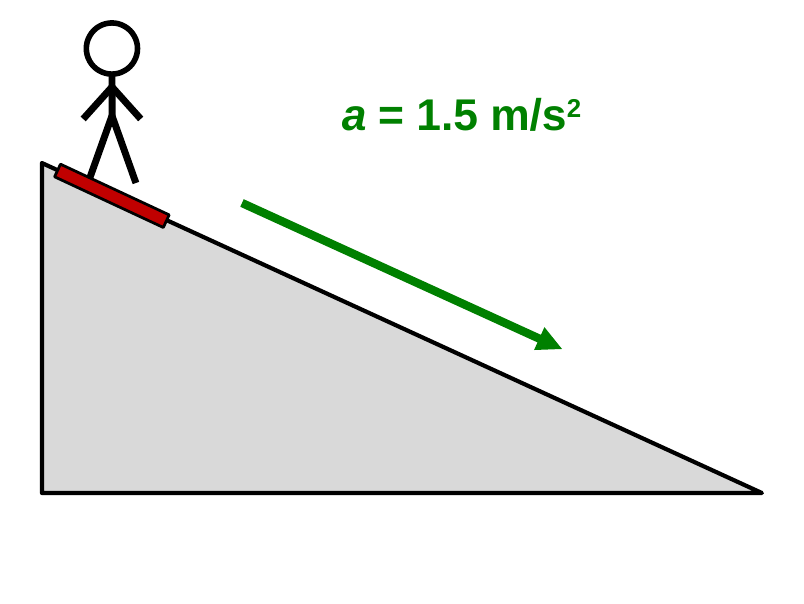
- Knowns: vi = 2.0 m/s, a = 1.5 m/s2, t = 4.0 s
- Equation: vf = vi + at
- Substitute: vf = 2.0 m/s + (1.5 m/s2)(4.0 s) = 2.0 m/s + 6.0 m/s
- Answer: vf = 8.0 m/s down the ramp
Example 4: Finding Time
A train speeds up from 10.0 m/s to 30.0 m/s with an acceleration of 0.50 m/s2. How long does this take?
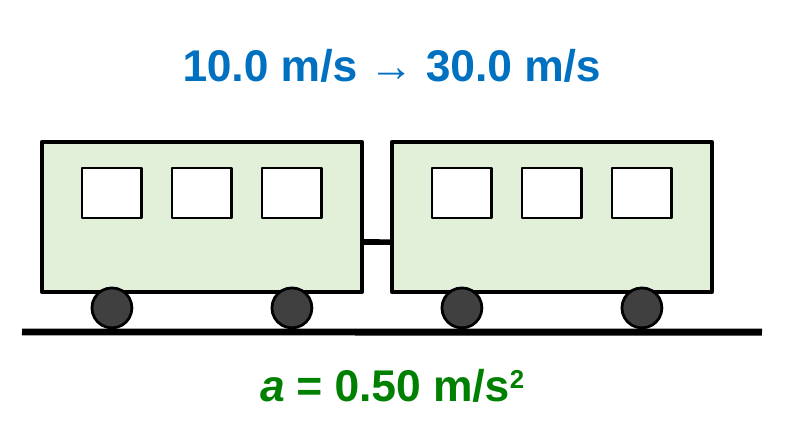
- Knowns: vi = 10.0 m/s, vf = 30.0 m/s, a = 0.50 m/s2
- Equation: a = (vf − vi)/t, so t = (vf − vi)/a
- Substitute: t = (30.0 m/s − 10.0 m/s) / 0.50 m/s2 = 20.0 m/s / 0.50 m/s2
- Answer: t = 40. s
The decimal point in “40.” shows that both digits are significant, matching the two significant figures in 0.50 m/s2.
Big Ideas
- a = (vf − vi)/t, measured in m/s2
- vf = vi + at
- a same direction as v: speeding up
- a opposite to v: slowing down
Back to the essential question: we describe a change in velocity with acceleration, the change in velocity divided by the time it takes, a = (vf − vi)/t, measured in m/s2. When acceleration points the same way as velocity, the object speeds up. When it points the opposite way, the object slows down. Next up, we’ll see what acceleration looks like on a velocity-time graph.

