
The video lesson for this topic is coming soon.
Essential Question
How do we describe how fast something moves?
A car on the highway moves faster than a person walking, but physics needs numbers, not just a feeling. By the end of this lesson, you should be able to tell the difference between speed and velocity and solve problems with v = d/t.
Speed
- How fast an object moves
- Speed = distance ÷ time
- Unit: meters per second (m/s)
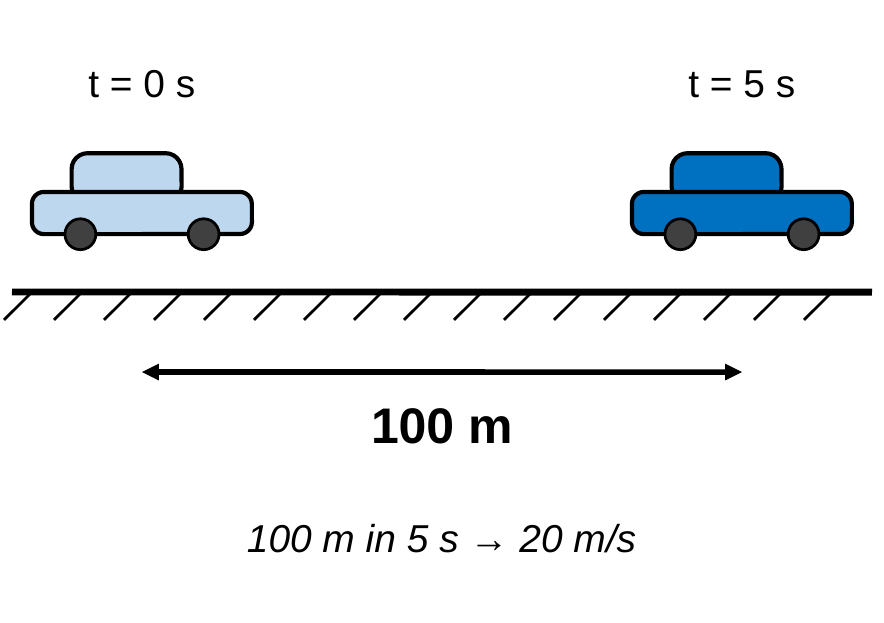
If a car travels 100 m in 5 s, it covers 20 m every second, so its speed is 20 m/s. Speed tells you how fast, but not which way. A quantity with size only and no direction is called a scalar.
Velocity
- Speed with a direction
- A vector: size + direction
- Uses displacement, not distance
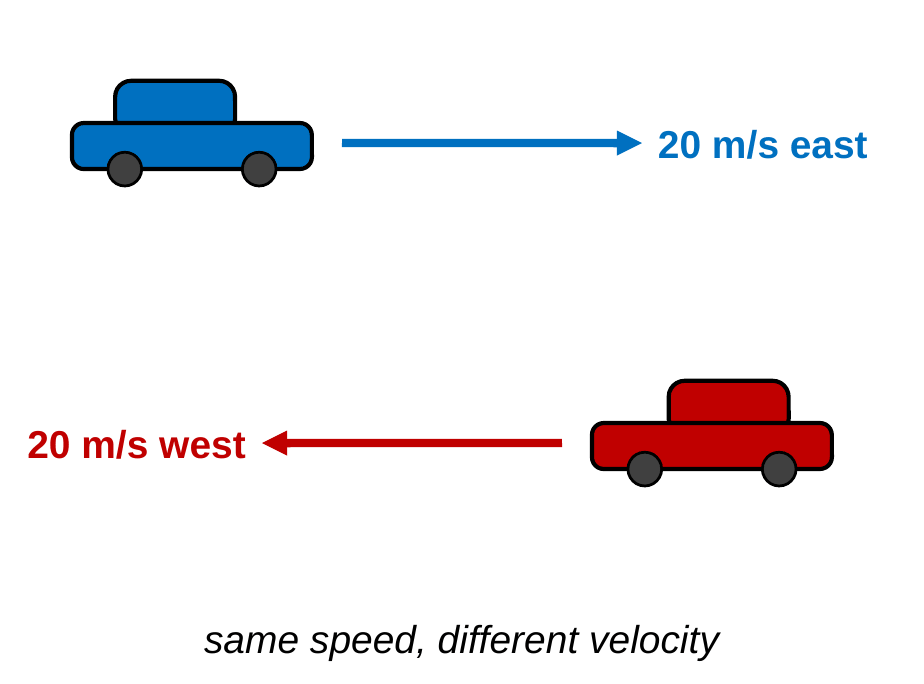
These two cars have the same speed, 20 m/s, but different velocities, because they move in opposite directions. A quantity with both a size and a direction is called a vector. Velocity is calculated from displacement, the straight-line change in position, instead of total distance.
The Velocity Equation
v = d / t
- v = velocity, in meters per second (m/s)
- d = displacement, in meters (m)
- t = time, in seconds (s)
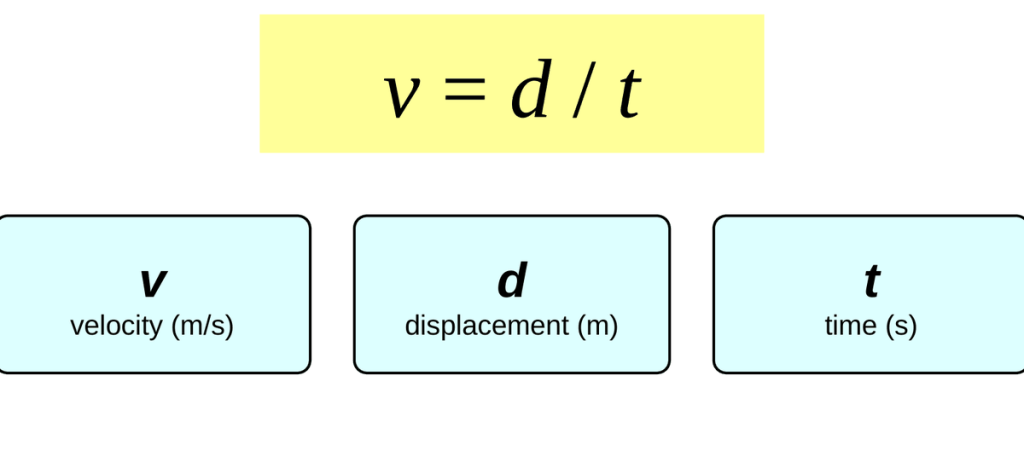
Dividing meters by seconds gives meters per second, which is why velocity is measured in m/s. When you only care about how fast and not which way, use distance for d and the answer is a speed.
Solving for Any Variable
- Find velocity: v = d/t
- Find displacement: d = vt
- Find time: t = d/v
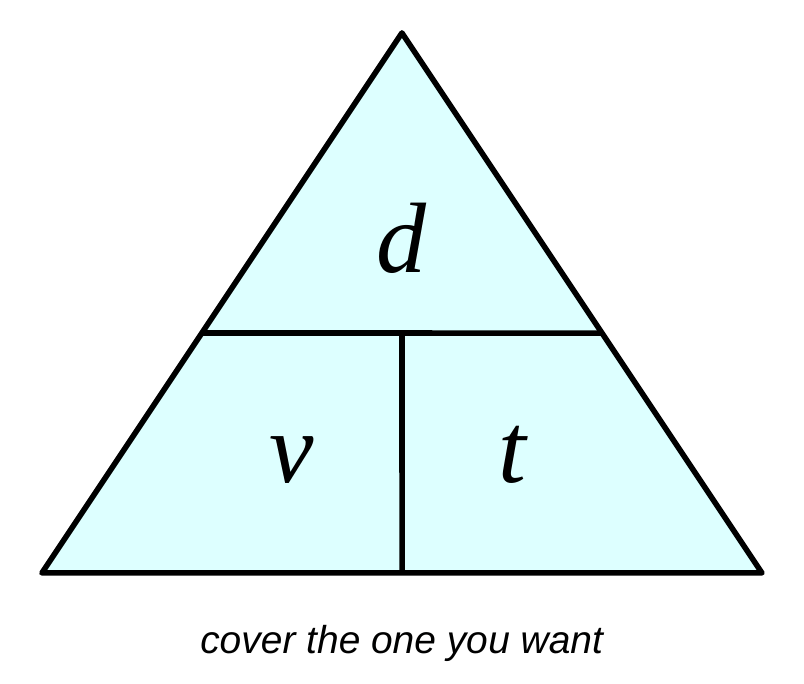
Rearrange the equation to solve for whatever the problem asks for. If algebra is tricky, use the triangle: cover the quantity you want, and what’s left shows the operation. Covering d leaves v next to t, so multiply. Covering v leaves d over t, so divide.
Constant Velocity
- Same displacement every second
- Same speed, same direction
- Equal spacing on a motion map
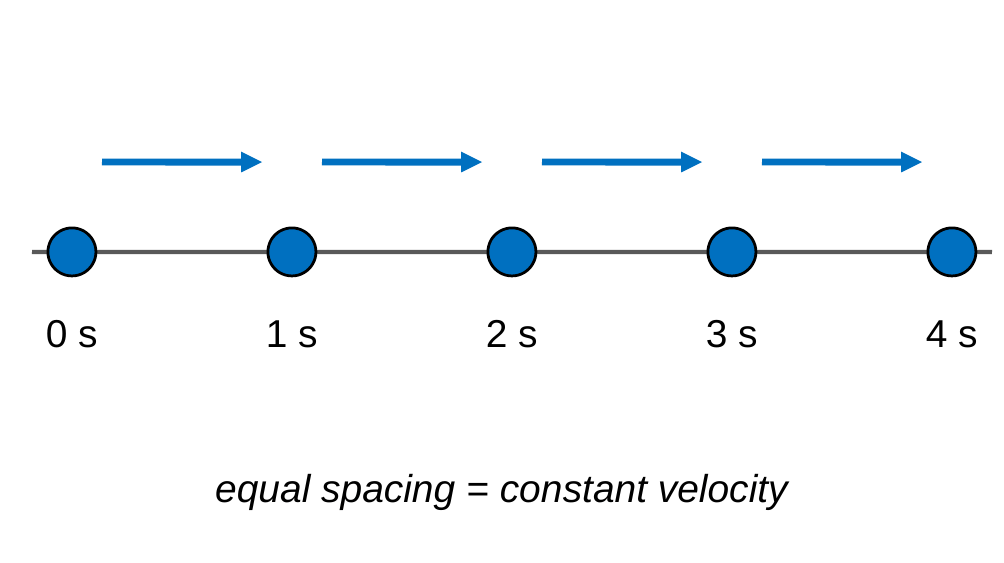
This motion map shows an object’s position once every second. The dots are evenly spaced, so the object moves the same distance in the same direction each second. That is constant velocity. If the dots spread apart or bunched together, the velocity would be changing.
Average Speed vs. Average Velocity
- Average speed = total distance ÷ time
- Average velocity = displacement ÷ time
- Round trip: displacement = 0
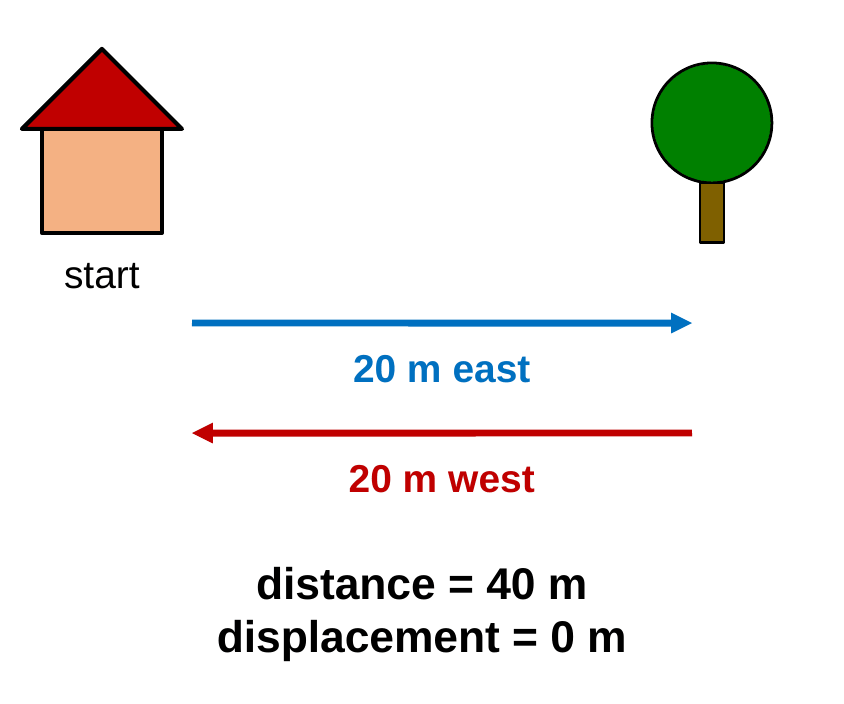
A dog walks 20 m east to a tree and 20 m back home. It traveled a distance of 40 m, so its average speed is not zero. But it ended where it started, so its displacement is 0 m and its average velocity is 0 m/s. Average speed and average velocity only match when an object moves in one direction without turning around.
Worked Examples
Try each problem on your own first, then check your work against the solution.
Example 1: Finding Velocity
A cyclist rides 450 m east in 30.0 s. What is her average velocity?
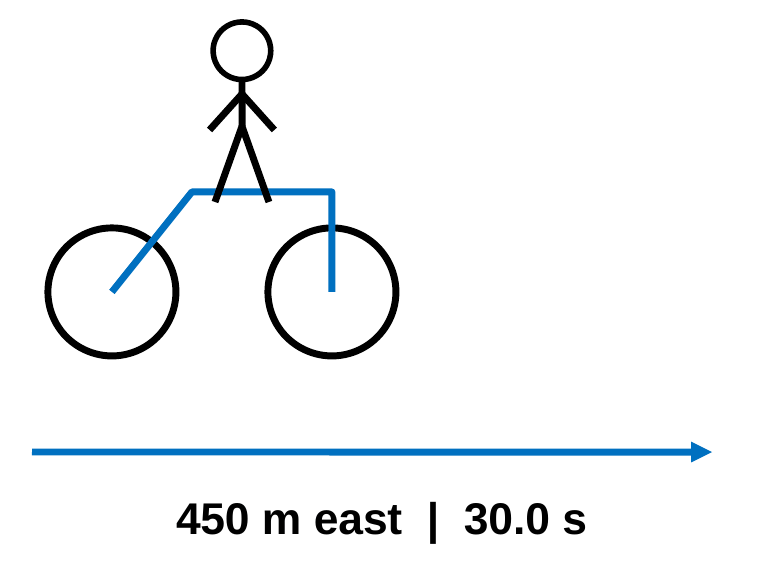
- Knowns: d = 450 m east, t = 30.0 s
- Equation: v = d/t
- Substitute: v = 450 m / 30.0 s
- Answer: v = 15.0 m/s east. Velocity needs a direction, so include “east.”
Example 2: Finding Displacement
A sprinter runs at a constant velocity of 9.5 m/s north for 4.0 s. What is his displacement?
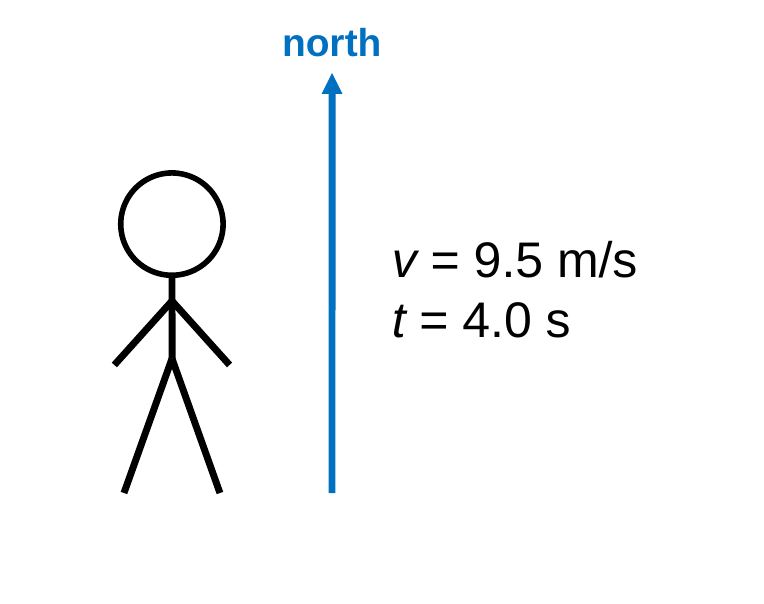
- Knowns: v = 9.5 m/s north, t = 4.0 s
- Equation: v = d/t, so d = vt
- Substitute: d = (9.5 m/s)(4.0 s). The seconds cancel, leaving meters.
- Answer: d = 38 m north
Example 3: Finding Time
Sound travels through air at 343 m/s. How long does it take thunder to reach you from a lightning strike 1,715 m away?
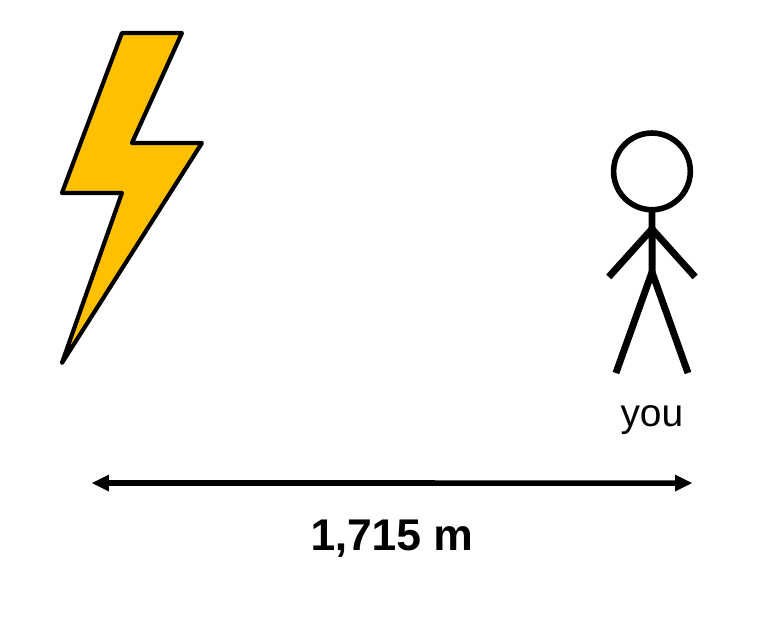
- Knowns: v = 343 m/s, d = 1,715 m
- Equation: v = d/t, so t = d/v
- Substitute: t = 1,715 m / 343 m/s. Meters cancel, leaving seconds.
- Answer: t = 5.00 s
That’s why counting the seconds between lightning and thunder tells you how far away a storm is.
Example 4: Speed vs. Velocity
A runner completes one 400. m lap of a track in 80.0 s and ends where she started. Find her average speed and her average velocity.
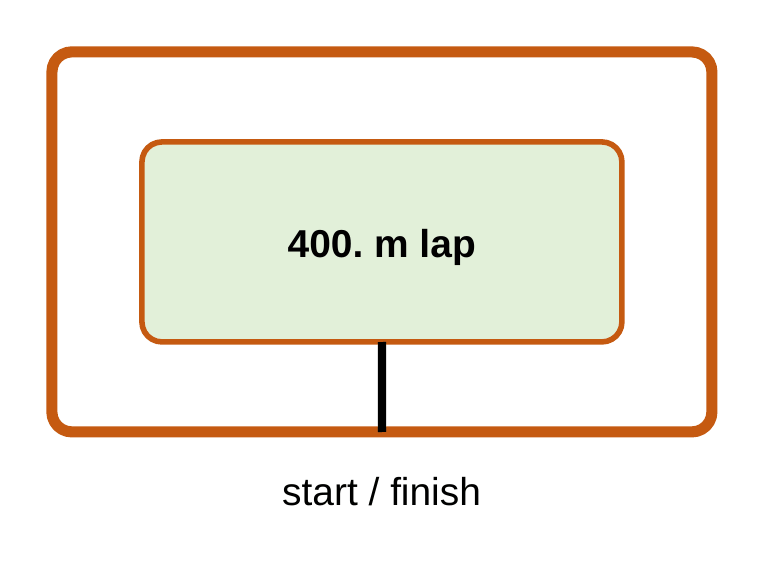
- Average speed: total distance ÷ time = 400. m / 80.0 s = 5.00 m/s
- Displacement: she ends where she started, so d = 0 m
- Average velocity: v = d/t = 0 m / 80.0 s = 0 m/s
Why they differ: speed uses total distance, but velocity uses displacement, and a full lap has zero displacement.
Big Ideas
- Speed = distance ÷ time (no direction)
- Velocity = displacement ÷ time (has direction)
- v = d/t, d = vt, t = d/v
- Round trip: average velocity = 0
Back to the essential question: we describe how fast something moves with speed, the distance it covers per unit of time. When direction matters, we use velocity, which is displacement divided by time, v = d/t. Next up, we’ll see what motion looks like on a position-time graph.

