
The video lesson for this topic is coming soon.
Essential Question
How can we predict motion when acceleration is constant?
This lesson brings together displacement, velocity, and acceleration into four equations that can answer almost any question about steady speeding up or slowing down. By the end of this lesson, you should be able to choose the right kinematic equation and solve for the unknown.
The Five Variables
- d = displacement, in meters (m)
- vi = initial velocity, in m/s
- vf = final velocity, in m/s
- a = acceleration, in m/s2
- t = time, in seconds (s)
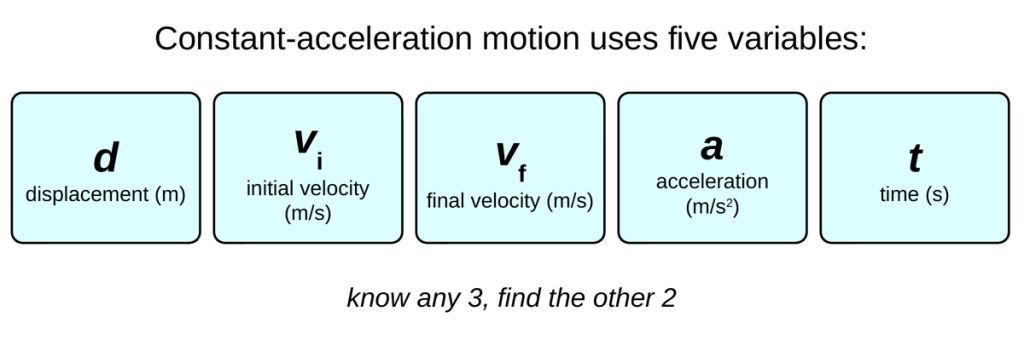
Every problem with constant acceleration involves the same five variables. If you know any three of them, the kinematic equations let you find the other two. Whenever a problem uses one of these quantities, write it down with its symbol and units before you do anything else.
The Four Equations
The four kinematic equations (constant acceleration only):
- vf = vi + at (no d)
- d = vit + ½at2 (no vf)
- vf2 = vi2 + 2ad (no t)
- d = ½(vf + vi)t (no a)
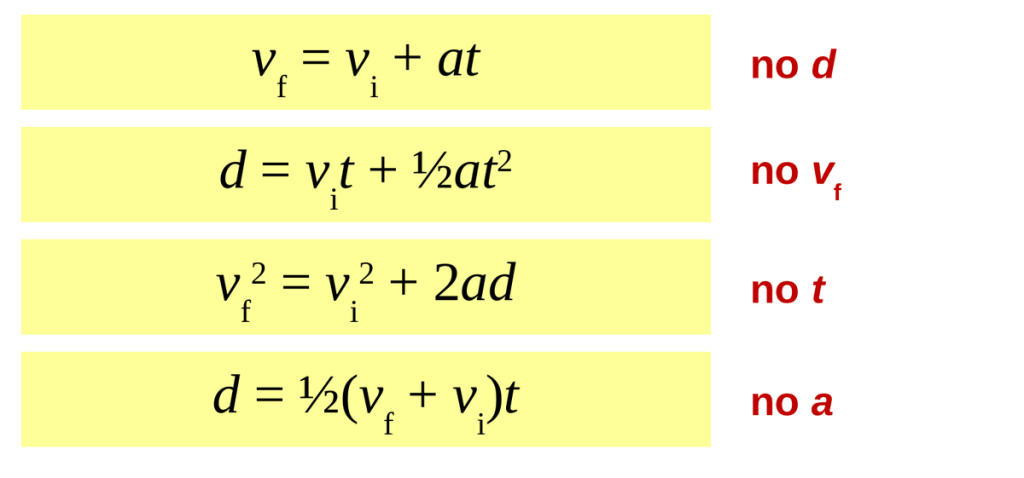
Each equation contains four of the five variables and leaves one out. That missing variable is the key to choosing which equation to use. The first one is the acceleration equation you already know, rearranged. The last one says displacement equals average velocity times time.
Choosing the Equation
- List the 3 knowns
- Name the unknown
- Find the variable you don’t need
- Use the equation without it
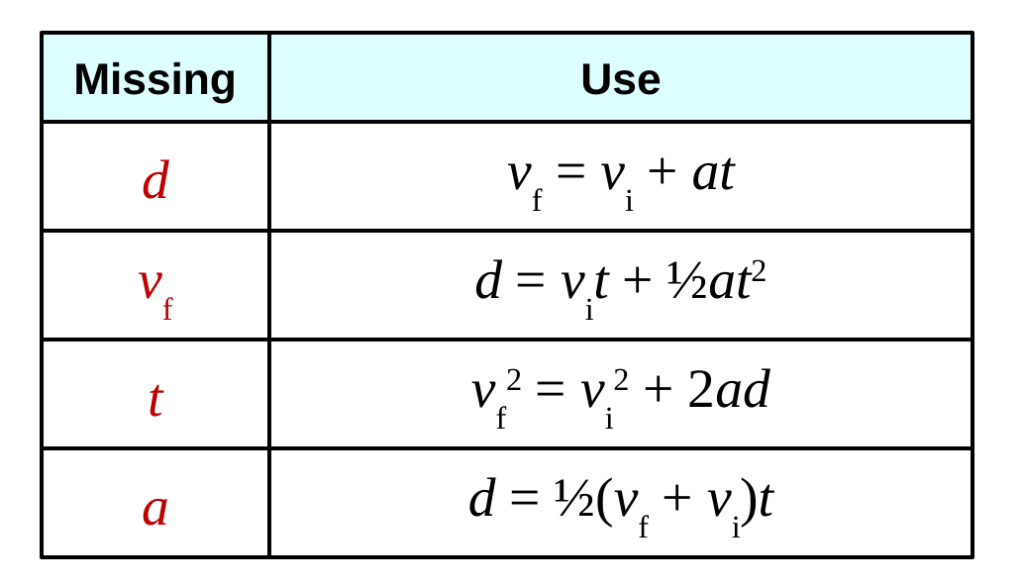
To pick an equation, list the three quantities you know and the one you want. The fifth variable is the one you don’t know and don’t need. Choose the equation that leaves that variable out. For example, if a problem never mentions time and doesn’t ask for it, use vf2 = vi2 + 2ad.
Hidden Knowns
- “From rest”: vi = 0
- “Comes to a stop”: vf = 0
- “Constant velocity”: a = 0
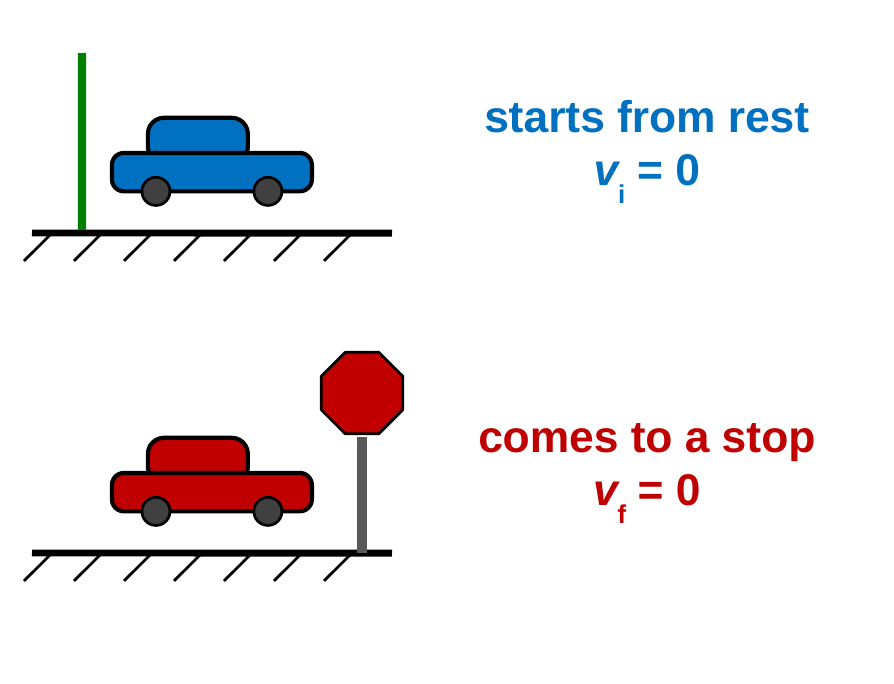
Problems often give you a known value in words instead of numbers. “Starts from rest” or “dropped” means the initial velocity is zero. “Comes to a stop” means the final velocity is zero. “Constant velocity” means the acceleration is zero. Read every problem carefully for these hidden knowns, because you usually need them to have three knowns.
Signs Matter
- Pick a positive direction first
- Slowing down: a has the opposite sign of v
- Keep units on every number
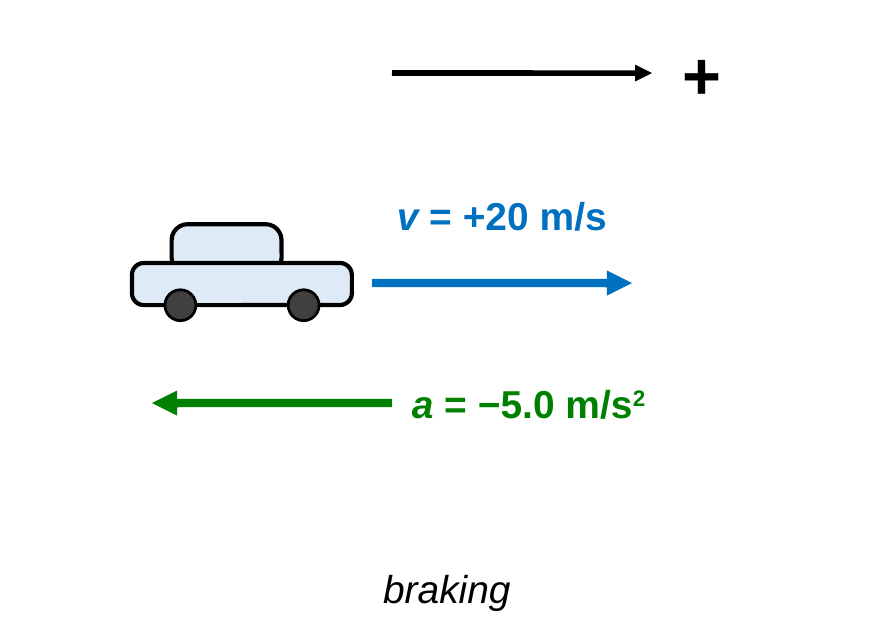
Velocity, displacement, and acceleration are vectors, so their signs matter. Before solving, choose which direction is positive. If an object is slowing down, its acceleration points opposite to its velocity, so it gets the opposite sign. A car moving at +20 m/s while braking has a negative acceleration, like −5.0 m/s2.
Worked Examples
Try each problem on your own first, then check your work against the solution.
Example 1: From Rest
A car starts from rest and speeds up at 3.0 m/s2 for 5.0 s. How far does it travel?
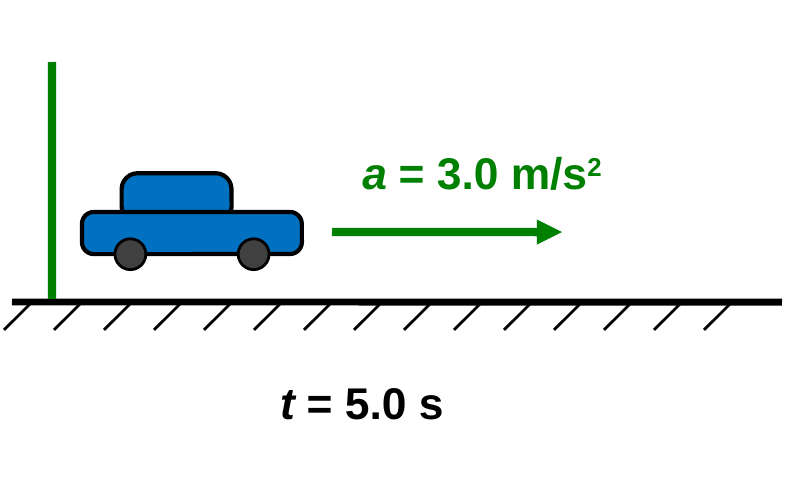
- Knowns: vi = 0 m/s (from rest), a = 3.0 m/s2, t = 5.0 s. Unknown: d. Not needed: vf
- Equation: no vf, so d = vit + ½at2
- Substitute: d = (0)(5.0 s) + ½(3.0 m/s2)(5.0 s)2 = ½(3.0 m/s2)(25 s2)
- Answer: d = 37.5 m, which rounds to 38 m (two significant figures)
Example 2: Stopping Distance
A car moving at 20.0 m/s brakes with an acceleration of −5.00 m/s2 until it stops. How far does it travel while braking?
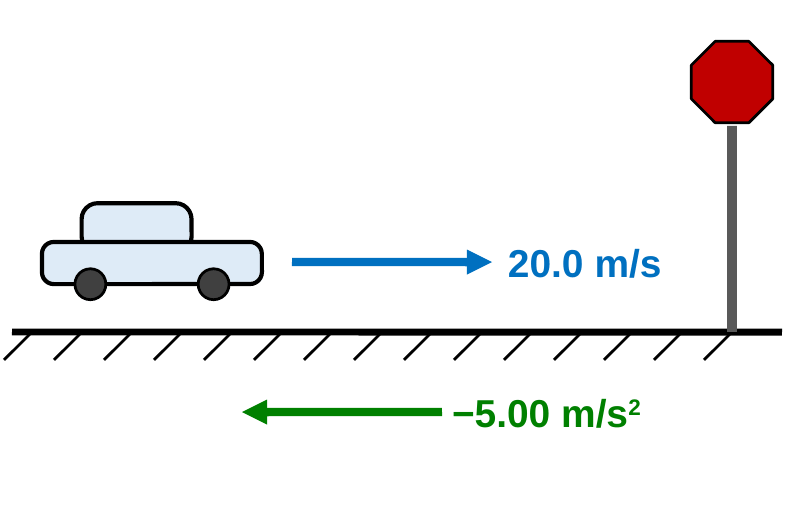
- Knowns: vi = 20.0 m/s, vf = 0 m/s (stops), a = −5.00 m/s2. Unknown: d. Not needed: t
- Equation: no t, so vf2 = vi2 + 2ad, rearranged to d = (vf2 − vi2) / 2a
- Substitute: d = (0 − (20.0 m/s)2) / (2 × −5.00 m/s2) = (−400. m2/s2) / (−10.0 m/s2)
- Answer: d = 40.0 m
The two negative signs cancel, so the displacement is positive: the car keeps moving forward while it brakes.
Example 3: Landing Plane
A plane touches down at 70.0 m/s and slows to 10.0 m/s in 20.0 s. How far does it travel during this time?
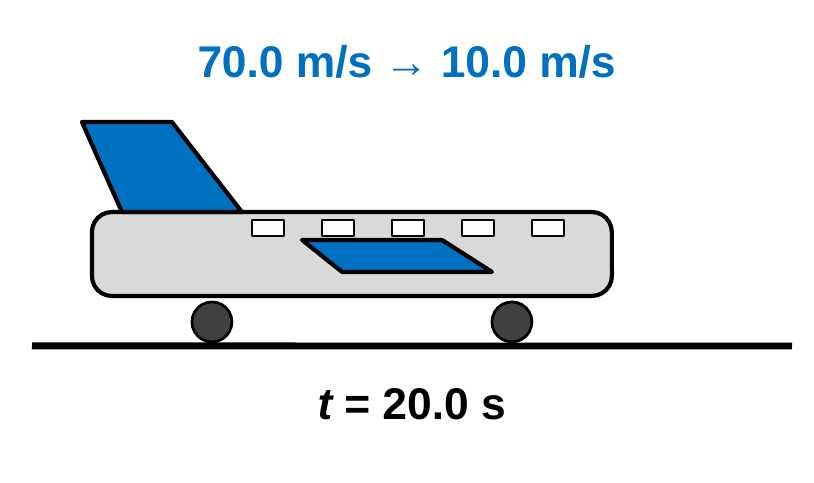
- Knowns: vi = 70.0 m/s, vf = 10.0 m/s, t = 20.0 s. Unknown: d. Not needed: a
- Equation: no a, so d = ½(vf + vi)t
- Substitute: d = ½(10.0 m/s + 70.0 m/s)(20.0 s) = (40.0 m/s)(20.0 s)
- Answer: d = 800. m
Example 4: Finding Time
A sled moving at 2.0 m/s speeds up at 0.80 m/s2 down a hill until it reaches 6.0 m/s. How long does this take?
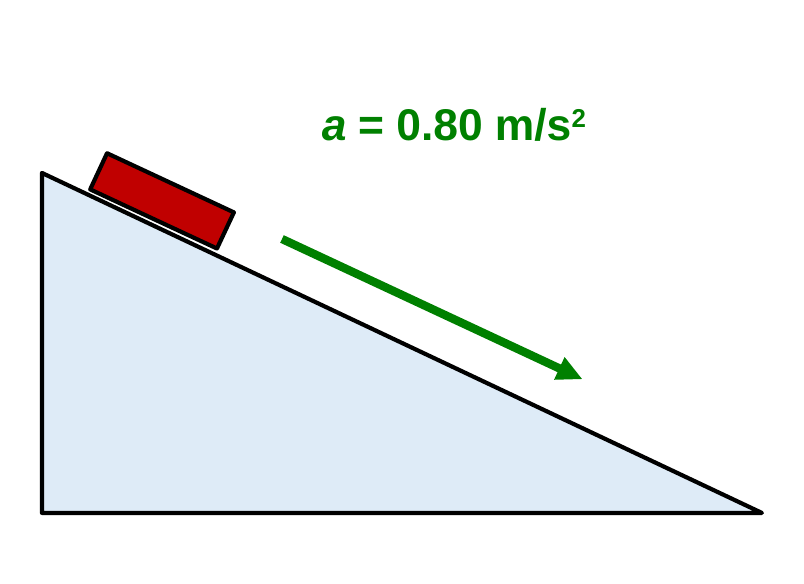
- Knowns: vi = 2.0 m/s, vf = 6.0 m/s, a = 0.80 m/s2. Unknown: t. Not needed: d
- Equation: no d, so vf = vi + at, rearranged to t = (vf − vi) / a
- Substitute: t = (6.0 m/s − 2.0 m/s) / 0.80 m/s2 = 4.0 m/s / 0.80 m/s2
- Answer: t = 5.0 s
Big Ideas
- Constant a: five variables, four equations
- Know 3 variables, find the rest
- Use the equation missing the one you don’t need
- Watch for hidden knowns and signs
Back to the essential question: when acceleration is constant, the four kinematic equations connect displacement, initial velocity, final velocity, acceleration, and time. If you know any three of these, you can choose the equation that leaves out the variable you don’t know and don’t need, and solve for the one you want. This wraps up our unit on linear motion.

