
The video lesson for this topic is coming soon.
Essential Question
How far did you go, and where did you end up?
Walk around the block and come home, and you’ve gone a long way but ended up right where you started. By the end of this lesson, you should be able to find the distance and the displacement for a trip, and tell the difference between a scalar and a vector.
Position
- Where an object is
- Measured from a reference point
- Unit: meters (m)
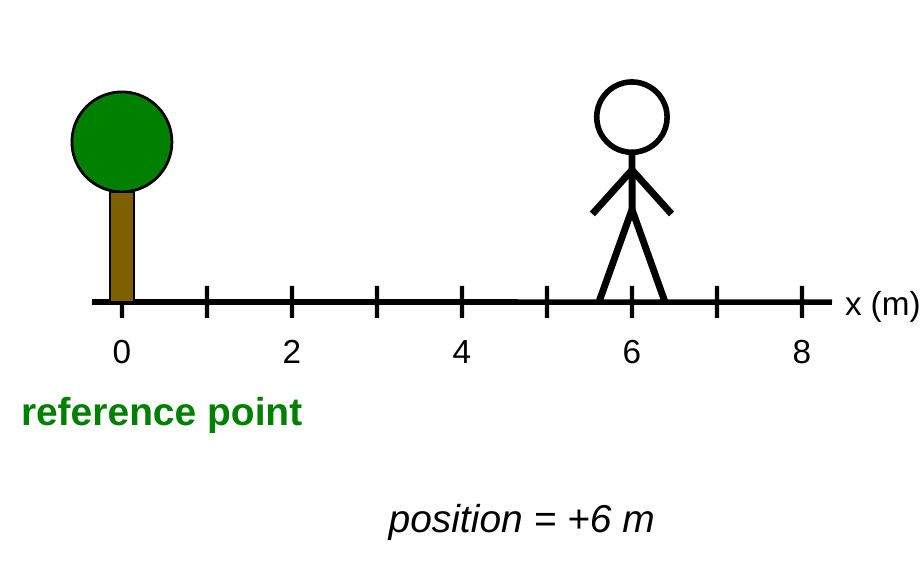
Position tells you where an object is. It is always measured from a reference point, a spot you choose to call zero. Here the tree is the reference point, and the person is standing 6 m to the right of it, so their position is +6 m. Position is measured in meters (m).
Choosing Directions
- Pick a reference point (zero)
- One direction is positive (+)
- The other is negative (−)
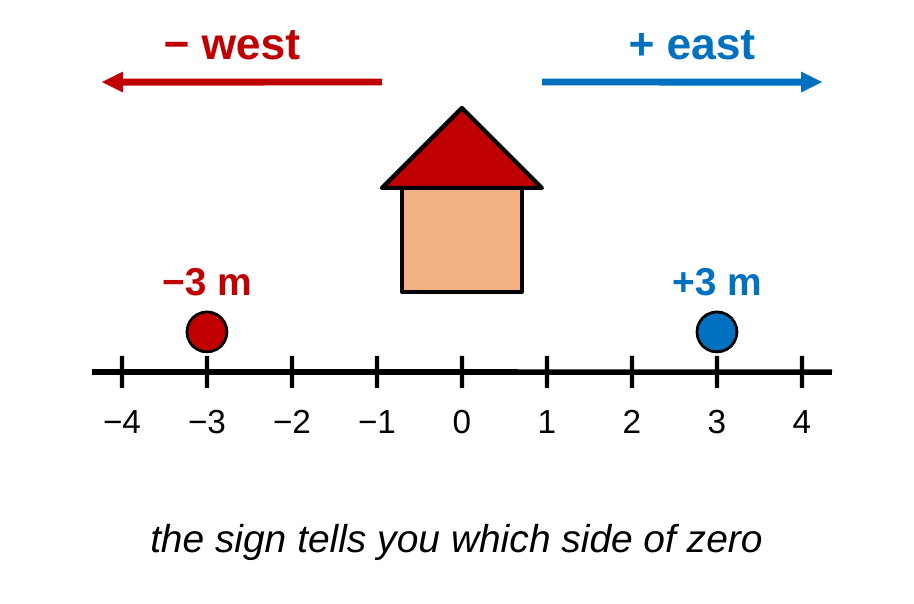
Once you choose a reference point, you also choose which direction counts as positive. Here east (right) is positive and west (left) is negative. A position of +3 m means 3 m east of the house, and −3 m means 3 m west of it. The sign is how a single number can show direction.
Distance
- Total length of the path
- Never negative
- A scalar: size only
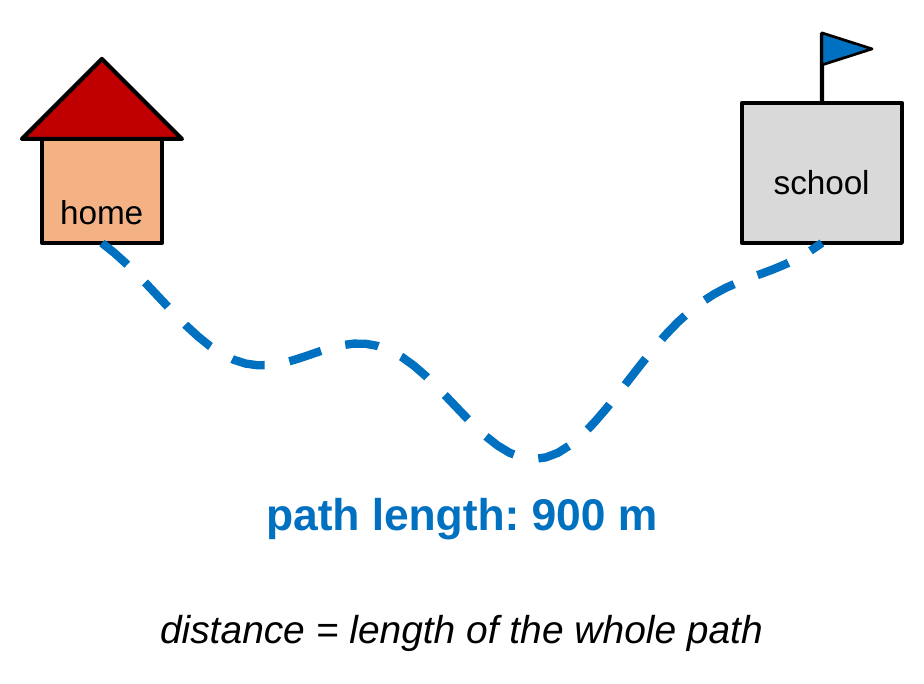
Distance is the total length of the path an object travels. If the winding route from home to school is 900 m long, you traveled a distance of 900 m, no matter which direction the path turned. Distance can never be negative, and it has no direction, so it is a scalar: a quantity with size only.
Displacement
- Change in position
- Straight line from start to end
- A vector: size + direction
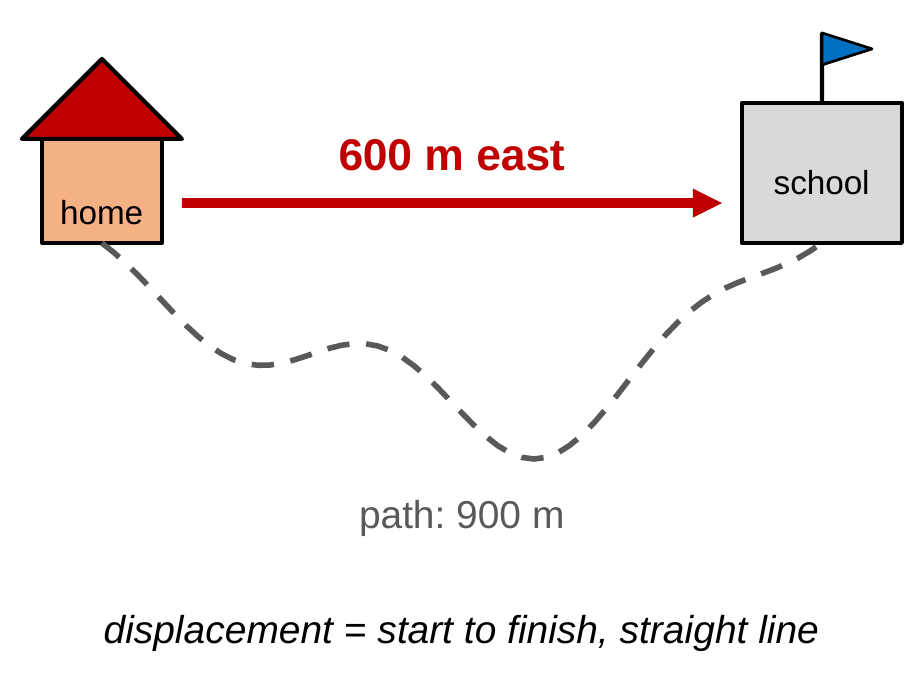
Displacement is the straight-line change in position from where you started to where you ended, including direction. The path to school is 900 m long, but school is only 600 m east of home, so the displacement is 600 m east. Because displacement has both a size and a direction, it is a vector.
Finding Displacement
Δx = xf − xi
- Δx = displacement, in meters (m)
- xf = final position, in meters (m)
- xi = initial position, in meters (m)
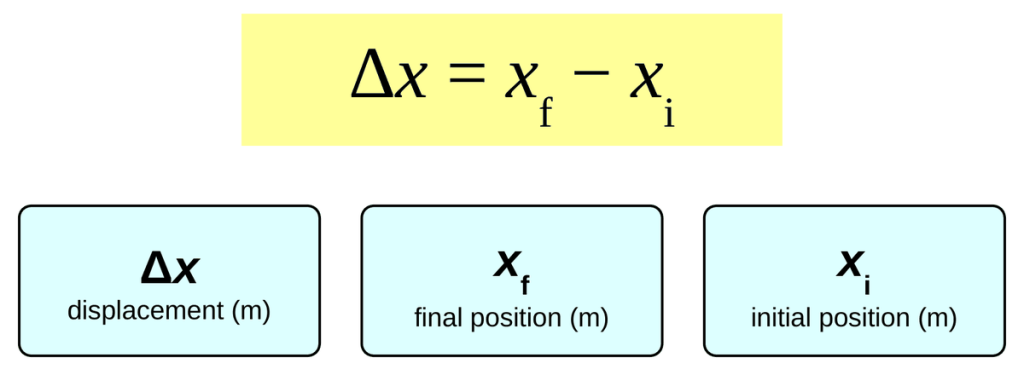
The Greek letter Δ (delta) means “change in,” so Δx means change in position. Always subtract final minus initial. A positive answer means the displacement is in the positive direction, and a negative answer means it is in the negative direction. You will often see displacement written simply as d.
Scalars vs. Vectors
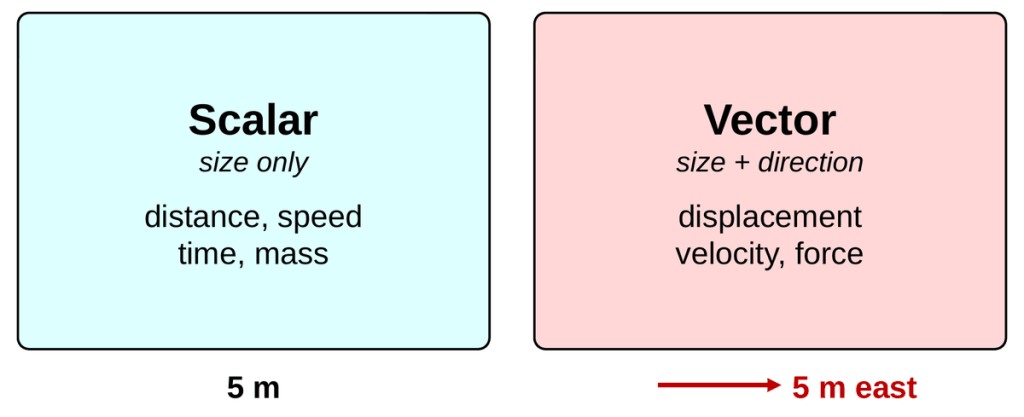
Every quantity in physics is either a scalar or a vector. A scalar has a size only, like a distance of 5 m, a time of 60 s, or a mass of 2 kg. A vector has a size and a direction, like a displacement of 5 m east. Vectors are drawn as arrows, where the length shows the size and the arrowhead shows the direction.
Worked Examples
Try each problem on your own first, then check your work against the solution.
Example 1: Hallway Walk
A student walks 12 m east down a hallway, then turns around and walks 5 m west to a drinking fountain. Find her distance and her displacement.
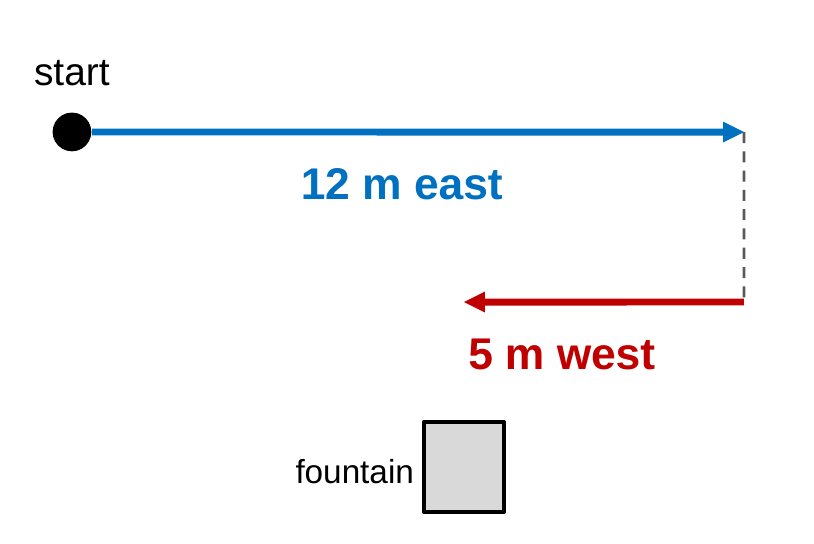
- Distance: add up every part of the path: 12 m + 5 m = 17 m
- Choose directions: call east positive (+) and west negative (−)
- Displacement: Δx = (+12 m) + (−5 m) = +7 m
- Answer: 7 m east. The positive sign means east.
Distance and displacement are different because she turned around. They are only equal when an object moves in one direction the whole time.
Example 2: Using Positions
A soccer ball starts at position +3.0 m and rolls to position −5.0 m. East is positive. What is the ball’s displacement?
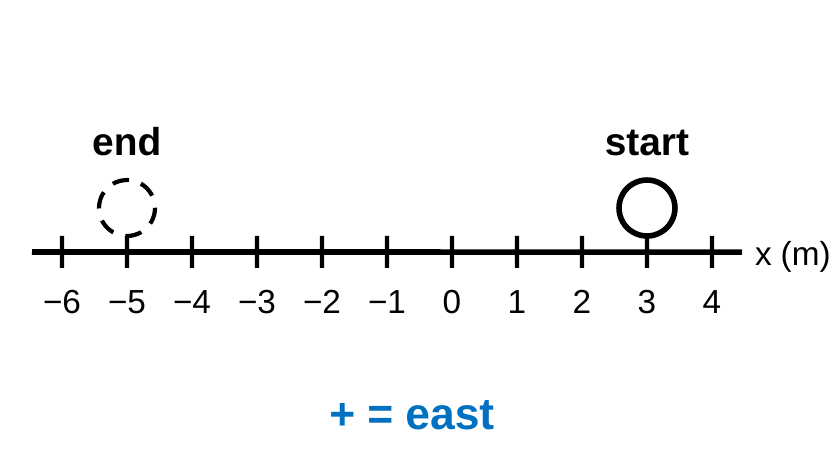
- Knowns: xi = +3.0 m, xf = −5.0 m
- Equation: Δx = xf − xi
- Substitute: Δx = (−5.0 m) − (+3.0 m) = −8.0 m
- Answer: Δx = 8.0 m west. The negative sign means west.
Example 3: Elevator Ride
An elevator starts 12 m above the ground. It rises to 33 m, then goes down to 6 m. Up is positive. Find the elevator’s distance and displacement.
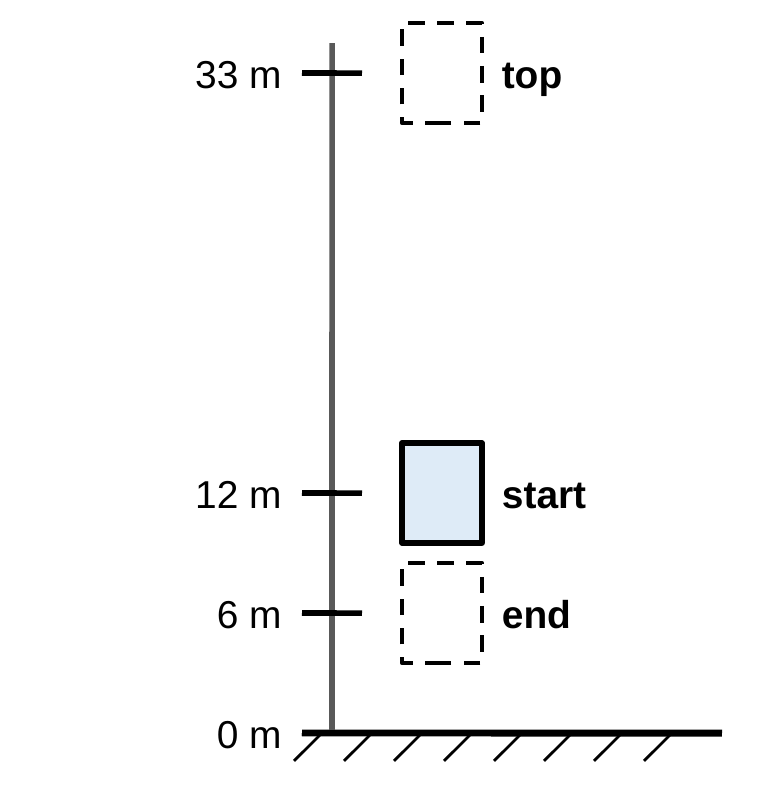
- Distance: up: 33 m − 12 m = 21 m. Down: 33 m − 6 m = 27 m. Total: 21 m + 27 m = 48 m
- Displacement equation: Δx = xf − xi
- Substitute: Δx = 6 m − 12 m = −6 m
- Answer: Δx = 6 m down. The negative sign means down.
The trip to the top doesn’t change the displacement at all. Only the starting and ending positions matter.
Example 4: Scalar or Vector?
Which of these are vectors? A) 25 m north B) 60 s C) 15 m/s west D) 9 m
- A) 25 m north: has a size and a direction, so it is a vector (a displacement)
- B) 60 s: time has no direction, so it is a scalar
- C) 15 m/s west: has a size and a direction, so it is a vector (a velocity)
- D) 9 m: a size with no direction, so it is a scalar (a distance)
- Answer: A and C are vectors
Big Ideas
- Position: where you are, measured from zero
- Distance: total path length (scalar)
- Displacement: Δx = xf − xi (vector)
- Vectors have size and direction
Back to the essential question: “how far you went” is your distance, the total length of your path. “Where you ended up” is your displacement, the straight-line change in position from start to finish, with a direction. Next up, we’ll use distance and displacement to describe how fast something moves with speed and velocity.

