
The video lesson for this topic is coming soon.
Essential Question
How can we draw all the forces on an object?
Real objects usually have several forces acting on them at once. By the end of this lesson, you should be able to draw and label a free-body diagram for an object at rest, moving at a constant velocity, or speeding up.
What Is a Free-Body Diagram?
- Shows every force on one object
- Object drawn as a box or dot
- Leave everything else out
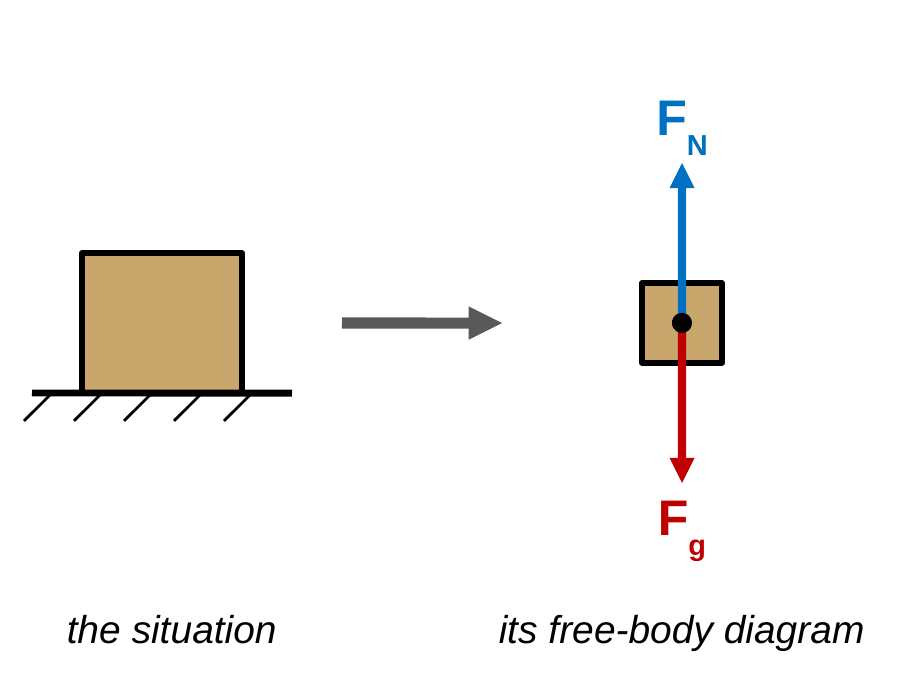
A free-body diagram (FBD) is a simple picture that shows every force acting on one object. We draw the object as a box or a dot and leave out everything else: no floor, no ropes, no people. Each force becomes an arrow. For a box resting on the ground, there are just two forces: the floor pushing up (FN) and gravity pulling down (Fg).
Drawing Force Arrows
- Start at the object’s center
- Point the way the force acts
- Longer arrow = bigger force
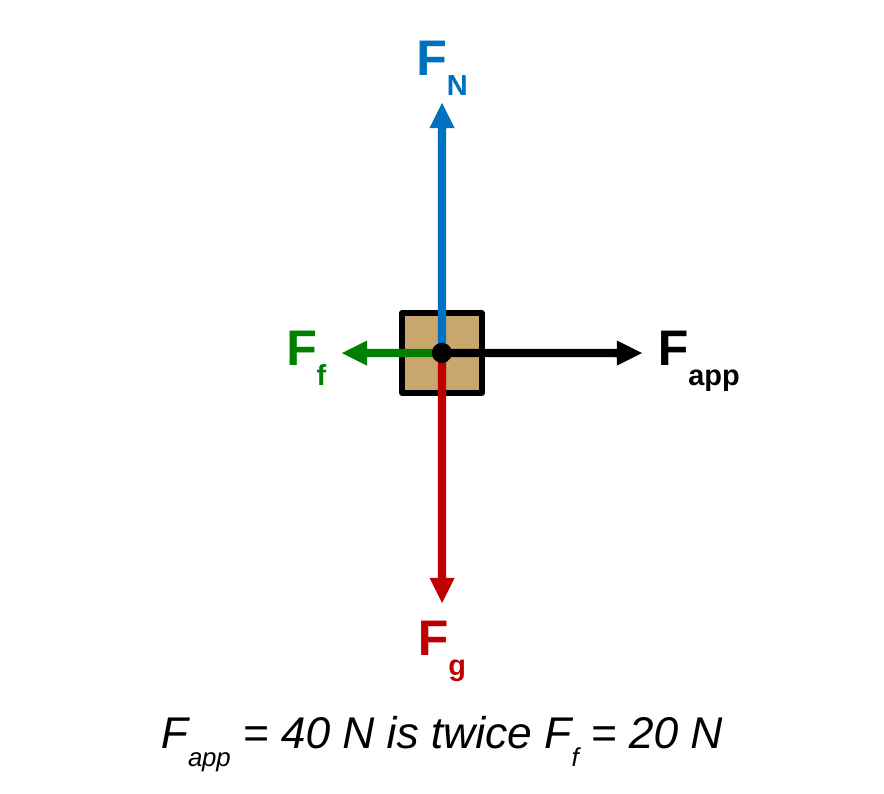
Every force arrow starts at the center of the object and points in the direction the force acts. The length of the arrow shows how strong the force is. Here, the 40 N push is drawn twice as long as the 20 N friction force. The normal force and gravity are equal, so their arrows are the same length.
Labeling Forces
Each arrow gets a label. Use a capital F for force and a subscript to say which force it is:
- FN: normal force, a surface pushing on the object
- Fg: gravitational force (weight), Earth pulling down
- Ff: friction, a surface rubbing against the object
- FT: tension, a rope, string, or cable pulling
- Fapp: applied force, a person or object pushing or pulling
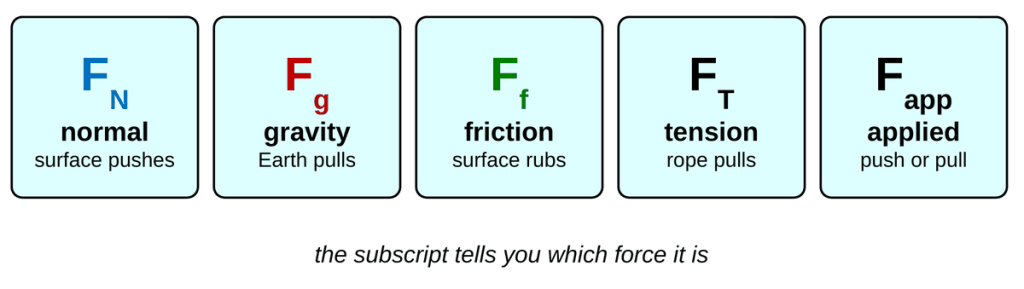
Always label every arrow. An unlabeled arrow could mean anything.
Finding Every Force
- What touches the object?
- Each touch gives a force or two
- Then add gravity
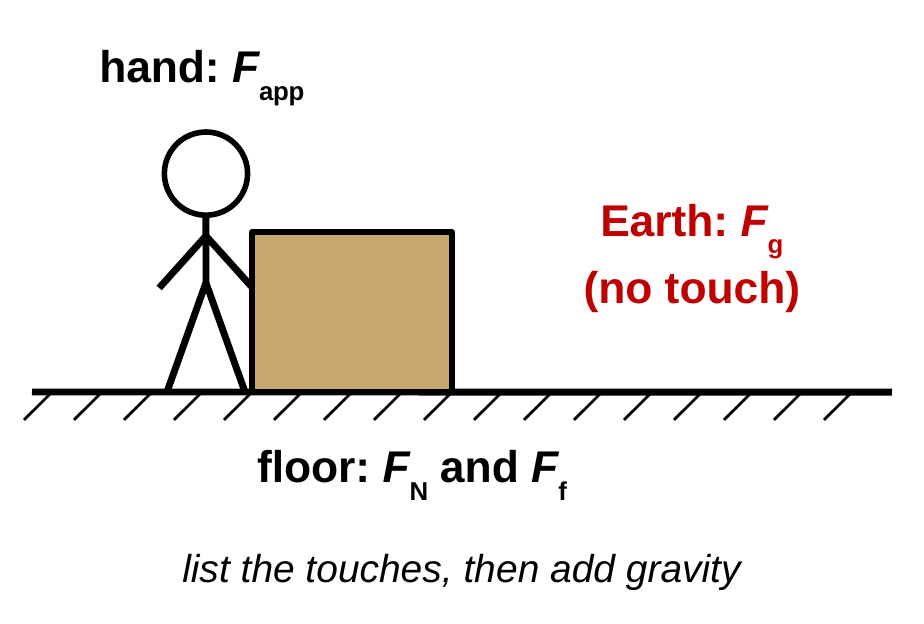
To find every force, look at what is touching the object. Each thing that touches it gives a contact force. A hand gives an applied force. A floor gives a normal force, and if the object slides, friction too. Once you’ve listed the touches, add gravity, since Earth pulls on everything without touching it.
At Rest
- Forces balance
- Opposite arrows are equal
- Example: book on a table
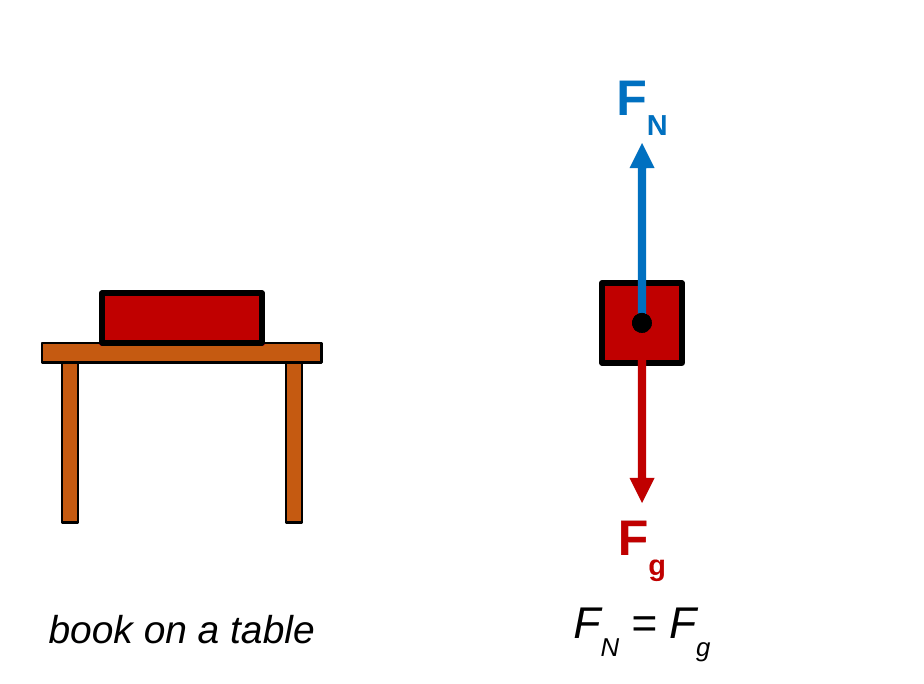
An object at rest is in equilibrium, so the forces on it balance. For a book resting on a table, the table pushes up exactly as hard as gravity pulls down. In the free-body diagram, the FN and Fg arrows point in opposite directions and have the same length.
Constant Velocity
- Forces still balance
- Moving doesn’t need extra force
- Example: steady push on a box
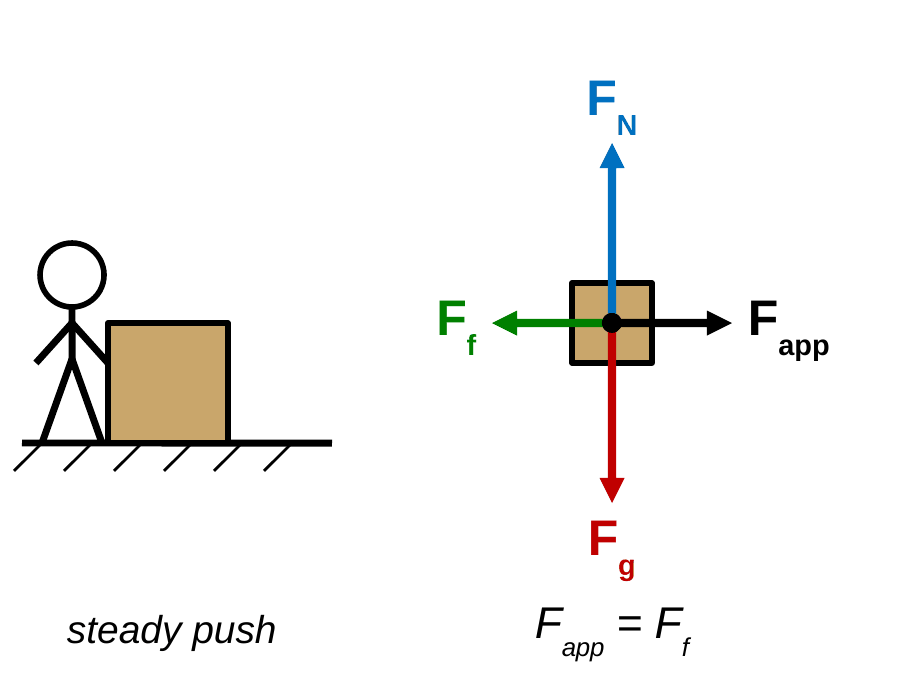
An object moving at a constant velocity is also in equilibrium. When you push a box across the floor at a steady speed, your push exactly balances friction, and the normal force balances gravity. Both pairs of arrows are equal. It can feel like you need to push harder than friction to keep the box moving, but a bigger push would make it speed up.
Accelerating
- Forces do not balance
- The longer arrow wins
- Speeds up in that direction
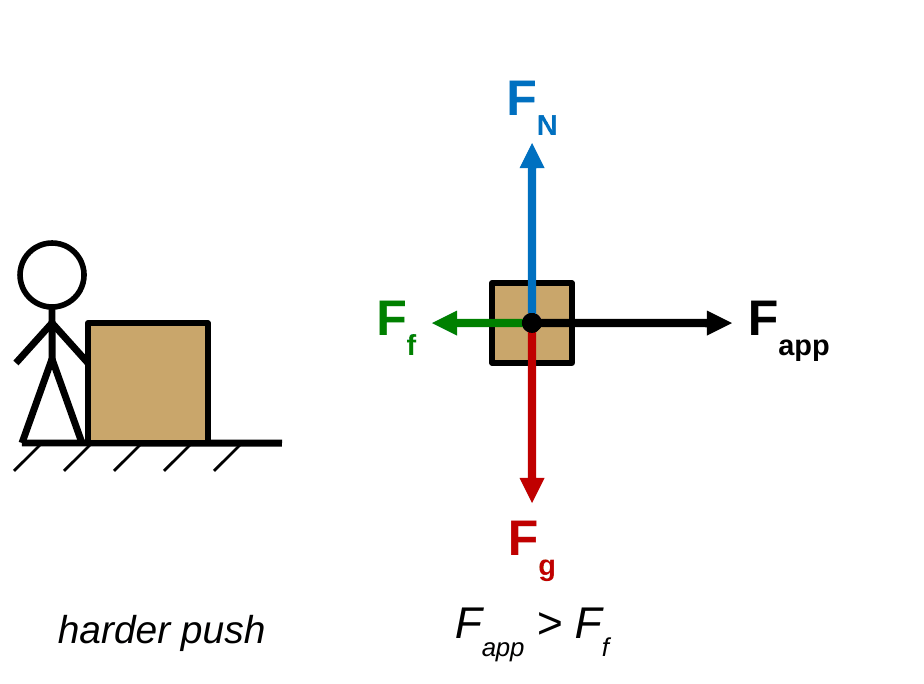
If the forces on an object don’t balance, the object accelerates. When the push is bigger than friction, the Fapp arrow is longer than the Ff arrow, and the box speeds up in the direction of the push. The vertical forces still balance, because the box isn’t moving up or down.
Worked Examples
Try each problem on your own first, then check your work against the solution.
Example 1: Hanging Sign
A 36 N sign hangs at rest from a single chain. Draw its free-body diagram and label the size of each force.
- Draw the object: Draw the sign as a box.
- Find the forces: Only the chain touches the sign, so there is tension, FT, pointing up. Gravity, Fg, points down.
- Compare sizes: The sign is at rest, so the forces balance: FT = Fg = 36 N.
- Answer: An arrow up labeled FT = 36 N and an equal-length arrow down labeled Fg = 36 N, both starting at the center of the box.
Example 2: Elevator Speeding Up
An elevator car is pulled up by its cable and speeds up as it rises. Draw the free-body diagram for the elevator car.
- Draw the object: Draw the elevator car as a box.
- Find the forces: The cable pulls up (FT). Gravity pulls down (Fg).
- Compare sizes: The car is speeding up while moving up, so the forces are unbalanced in the upward direction: FT > Fg.
- Answer: An arrow up labeled FT that is longer than the arrow down labeled Fg.
Example 3: Puck Sliding to a Stop
A hockey puck slides to the right across the ice and slows down. Nothing is touching it except the ice. Draw its free-body diagram.
- Draw the object: Draw the puck as a box.
- Find the forces: The ice pushes up (FN) and rubs against the sliding puck (Ff). Gravity pulls down (Fg).
- Directions: Friction points left, opposite the sliding. There is no forward force, because nothing touches the puck from behind.
- Answer: Equal arrows up (FN) and down (Fg), and one arrow to the left (Ff). No arrow to the right.
The most common mistake here is drawing a forward “force of motion.” Moving objects don’t carry a force with them. The puck keeps moving because of inertia.
Example 4: Skydiver at Constant Speed
A 750 N skydiver falls straight down at a constant speed. Draw her free-body diagram and label the size of each force.
- Draw the object: Draw the skydiver as a box.
- Find the forces: The air pushes up on her (air resistance, Fair). Gravity pulls down (Fg = 750 N).
- Compare sizes: Constant speed in a straight line means the forces balance: Fair = Fg = 750 N.
- Answer: An arrow up labeled Fair = 750 N and an equal-length arrow down labeled Fg = 750 N.
Big Ideas
- A free-body diagram shows every force on one object
- Arrows start at the center; length shows size
- Label each arrow: FN, Fg, Ff, FT, Fapp
- Equal opposite arrows: at rest or constant v
Back to the essential question: we draw all the forces on an object with a free-body diagram: the object as a box, with a labeled arrow for each force starting at its center, sized to match how strong the force is. Next up, we’ll use free-body diagrams to add forces together and find the net force.

