
The video lesson for this topic is coming soon.
Essential Question
Why is a full shopping cart harder to speed up than an empty one?
Give an empty cart a shove and it zooms off. Give a full cart the same shove and it barely moves. By the end of this lesson, you should be able to explain how force and mass affect acceleration and use Fnet = ma to solve for any of the three.
Force Causes Acceleration
- Net force causes acceleration
- a points the same way as Fnet
- No net force, no acceleration
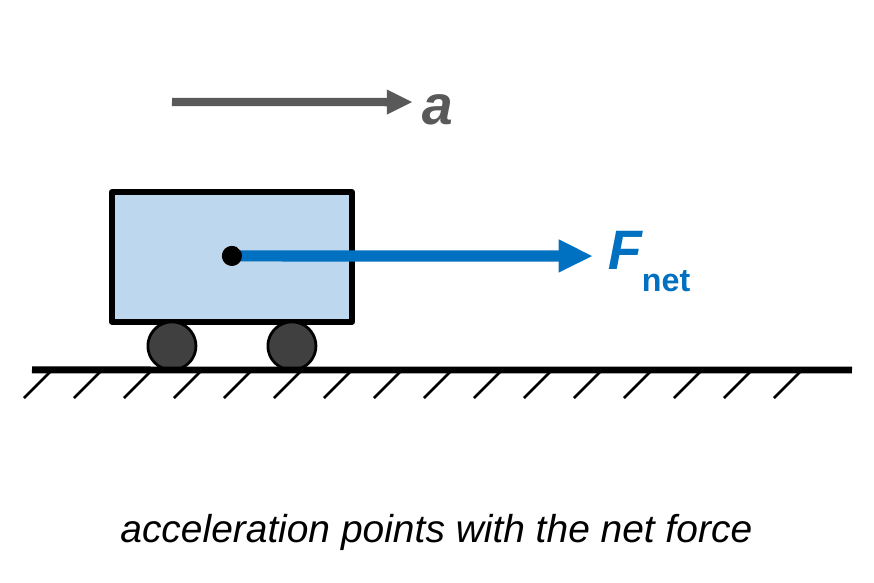
Newton’s first law says an unbalanced force changes an object’s motion. The second law tells us how. A net force makes an object accelerate, and the acceleration always points in the same direction as the net force. If the net force is zero, the acceleration is zero and the velocity stays the same.
Force and Acceleration
- More force, more acceleration
- Double Fnet, double a
- Mass stays the same
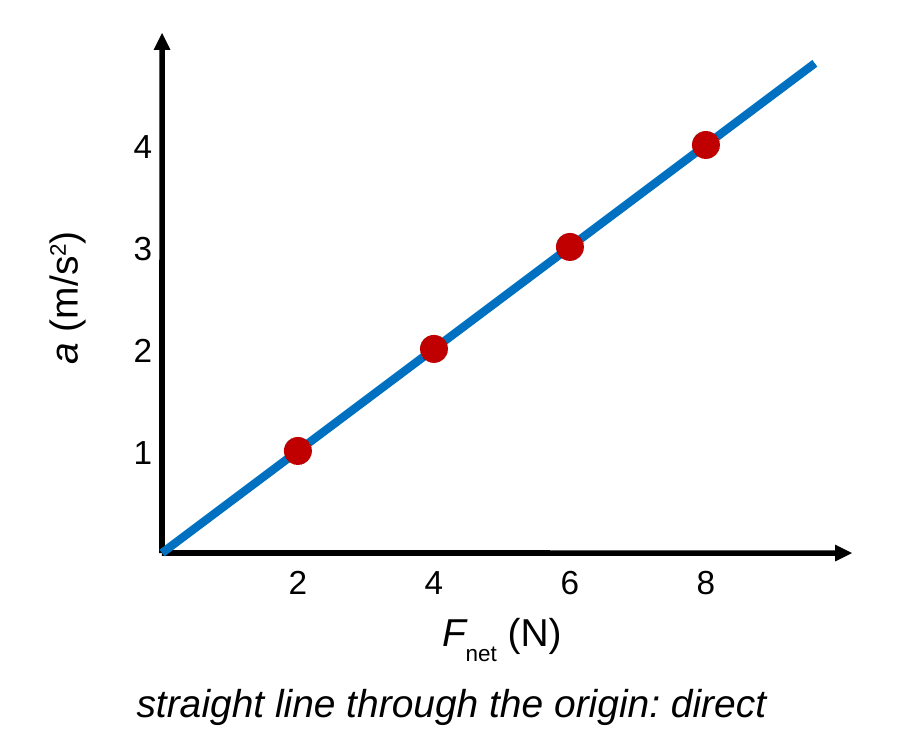
If you keep the mass the same and increase the net force, the acceleration increases by the same factor. Double the force and you double the acceleration. On a graph of a versus Fnet, this makes a straight line through the origin. We say acceleration is directly proportional to net force.
Mass and Acceleration
- More mass, less acceleration
- Double m, half the a
- Force stays the same
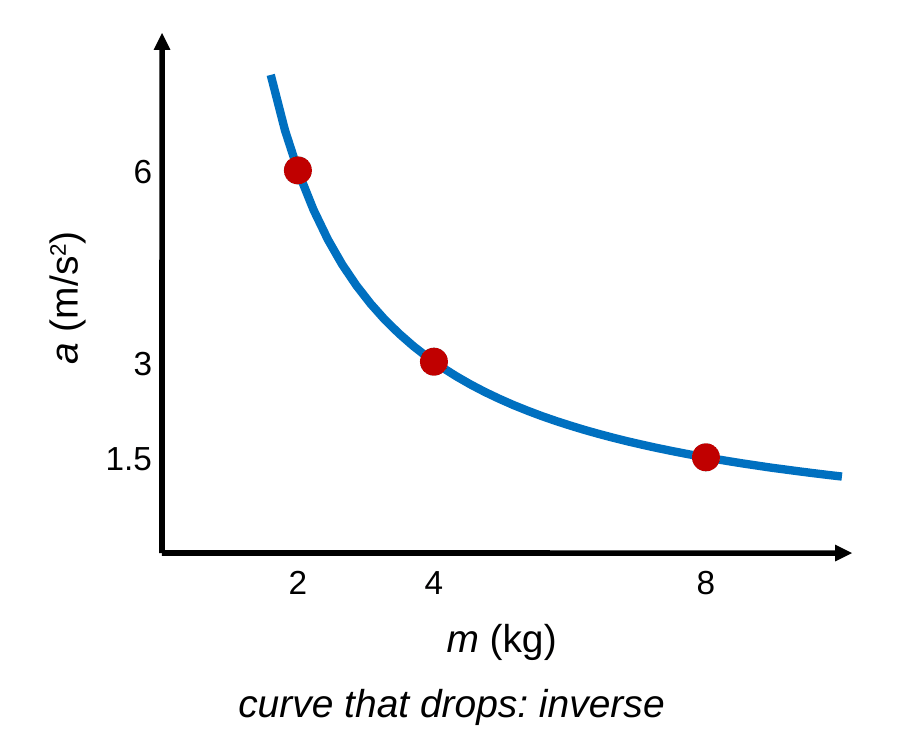
If you keep the net force the same and increase the mass, the acceleration goes down. Double the mass and the acceleration is cut in half. With a 12 N net force, a 2 kg cart accelerates at 6 m/s2, a 4 kg cart at 3 m/s2, and an 8 kg cart at 1.5 m/s2. We say acceleration is inversely proportional to mass.
Newton’s Second Law
a = Fnet / m
- a = acceleration, in meters per second squared (m/s2)
- Fnet = net force, in newtons (N)
- m = mass, in kilograms (kg)
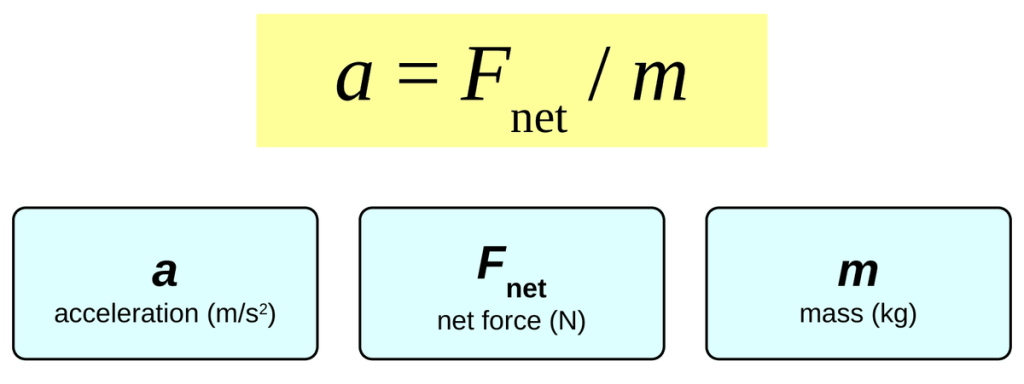
Newton’s second law puts both relationships into one equation. Net force is on top, so more force means more acceleration. Mass is on the bottom, so more mass means less acceleration. Always use the net force, not just one of the forces.
Solving for Any Variable
- Find a: a = Fnet/m
- Find force: Fnet = ma
- Find mass: m = Fnet/a
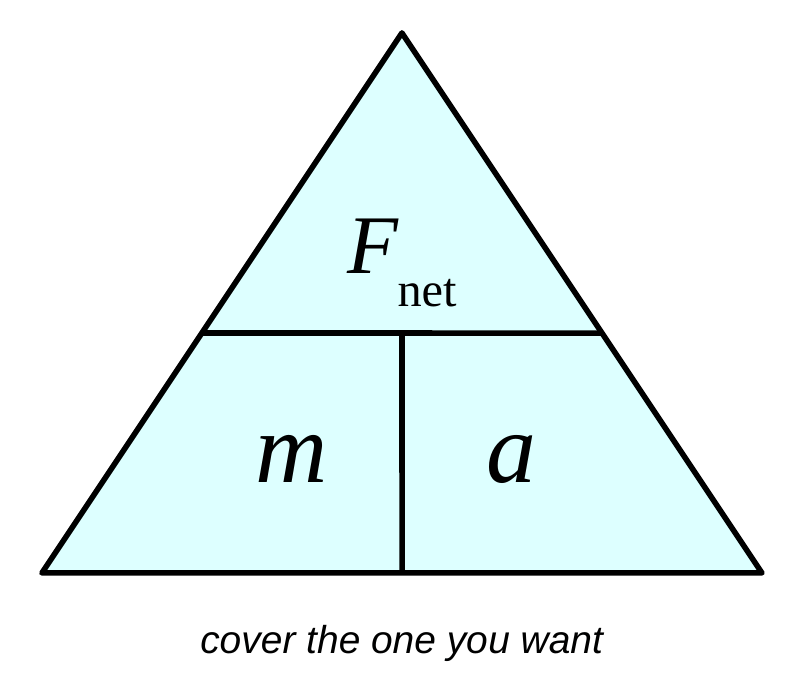
Newton’s second law is usually written as Fnet = ma. Rearrange it to solve for whichever quantity the problem asks for. With the triangle, cover the quantity you want: covering Fnet leaves m next to a, so multiply. Covering m leaves Fnet over a, so divide.
The Newton
- 1 N = 1 kg·m/s2
- Gives 1 kg an a of 1 m/s2
- Units check your work
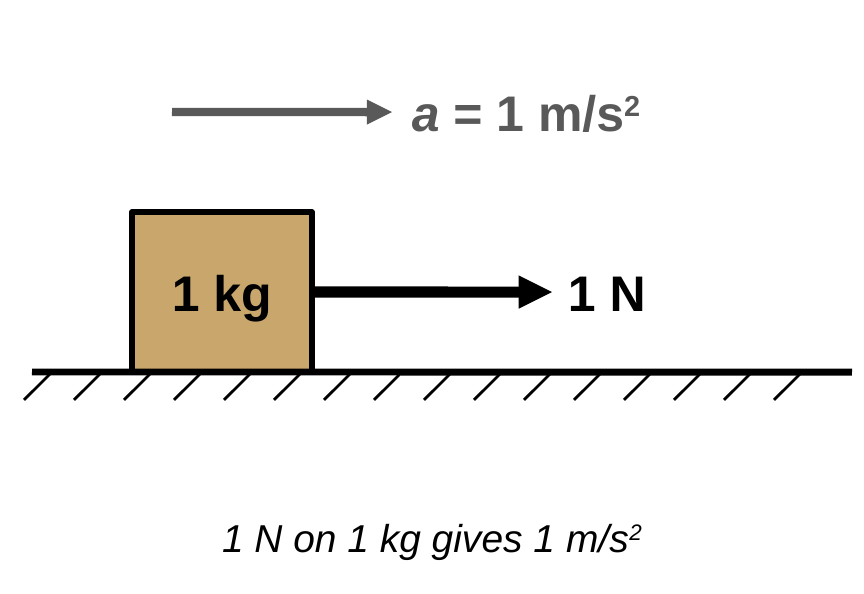
Newton’s second law defines the newton. One newton is the net force that gives a 1 kg mass an acceleration of 1 m/s2. Since F = ma, the units multiply too: 1 N = 1 kg·m/s2. Checking that your units work out is a great way to catch mistakes.
Worked Examples
Try each problem on your own first, then check your work against the solution.
Example 1: Finding Acceleration
A net force of 36 N east acts on a 12 kg wagon. What is the wagon’s acceleration?
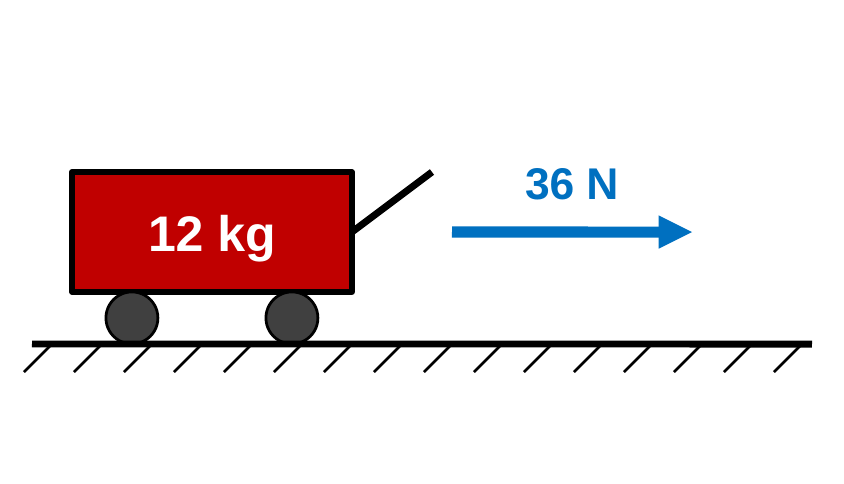
- Knowns: Fnet = 36 N east, m = 12 kg
- Equation: a = Fnet/m
- Substitute: a = 36 N / 12 kg = 36 kg·m/s2 / 12 kg
- Answer: a = 3.0 m/s2 east
Example 2: Finding Net Force
A 75.0 kg sprinter accelerates out of the starting blocks at 4.20 m/s2 forward. What net force acts on her?
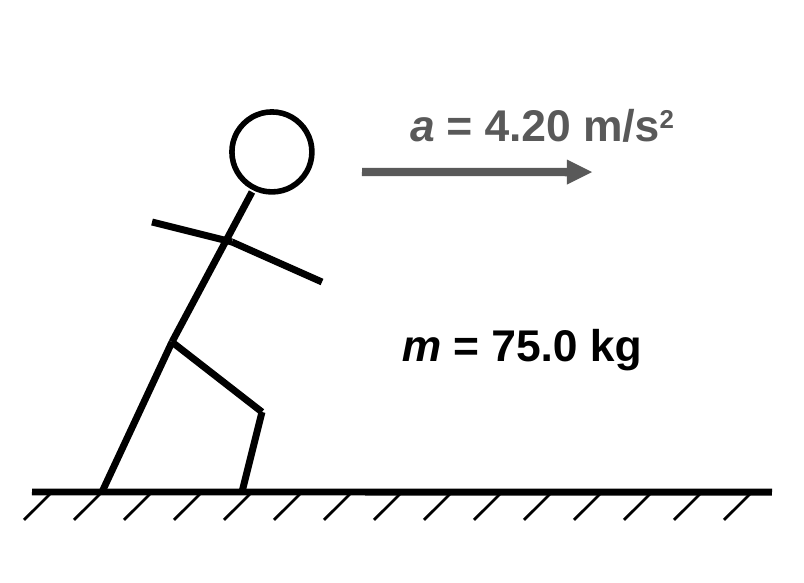
- Knowns: m = 75.0 kg, a = 4.20 m/s2 forward
- Equation: Fnet = ma
- Substitute: Fnet = (75.0 kg)(4.20 m/s2) = 315 kg·m/s2
- Answer: Fnet = 315 N forward
Example 3: Finding Mass
A net force of 24 N gives a bowling ball an acceleration of 4.0 m/s2. What is the ball’s mass?
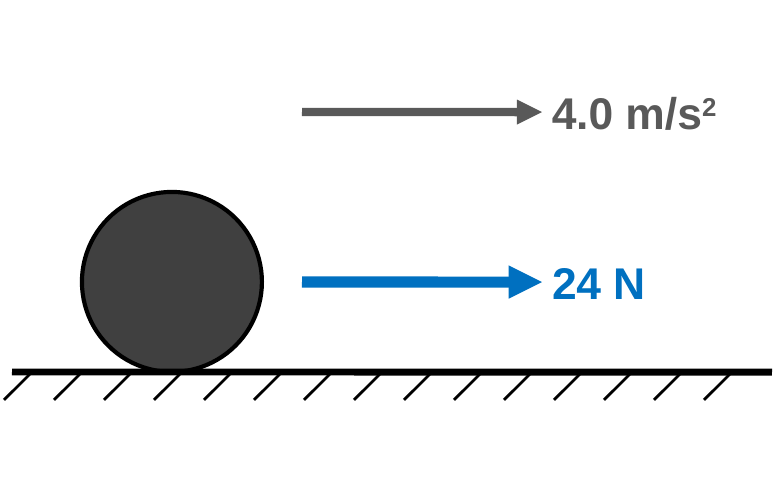
- Knowns: Fnet = 24 N, a = 4.0 m/s2
- Equation: Fnet = ma, so m = Fnet/a
- Substitute: m = 24 N / 4.0 m/s2 = 24 kg·m/s2 / 4.0 m/s2
- Answer: m = 6.0 kg
Example 4: Using a Free-Body Diagram
A 15 kg box is pushed east with a 92 N force. Friction acts on it with 47 N west. What is the box’s acceleration?
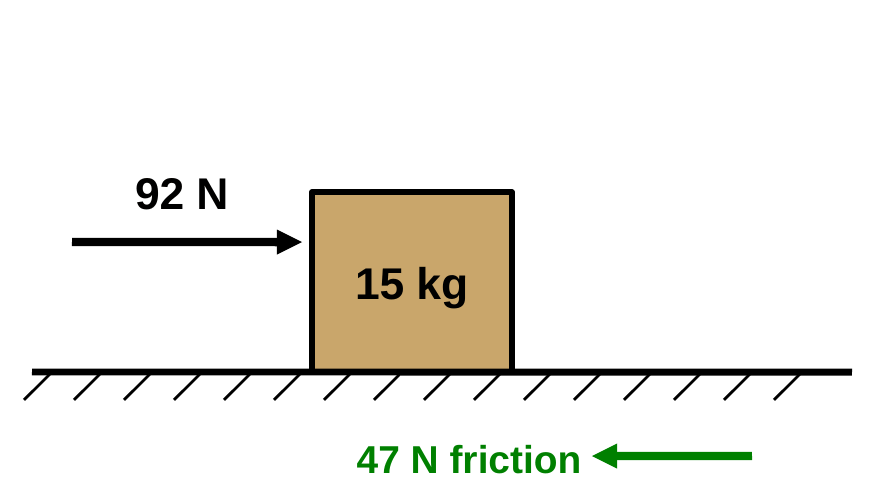
- Net force: east is +: Fnet = Fapp − Ff = 92 N − 47 N = 45 N east
- Equation: a = Fnet/m
- Substitute: a = 45 N / 15 kg
- Answer: a = 3.0 m/s2 east
Using only the 92 N push would give 6.1 m/s2, which is wrong. Newton’s second law uses the net force.
Big Ideas
- A net force causes acceleration in the same direction
- a = Fnet/m: more force, more a; more mass, less a
- Rearrange: Fnet = ma, m = Fnet/a
- 1 N = 1 kg·m/s2
Back to the essential question: a full cart has more mass, and acceleration equals net force divided by mass, so the same push gives a full cart a smaller acceleration. More force means more acceleration, and more mass means less. Next up, we’ll look at the difference between mass and weight.

