
The video lesson for this topic is coming soon.
Essential Question
If you push on a wall, does the wall push back?
Put your hand flat on a wall and push. You can feel the wall pushing back on your hand. By the end of this lesson, you should be able to identify action-reaction force pairs, explain why they don’t cancel, and use a = F/m to compare how the two objects move.
Newton’s Third Law
- Forces come in pairs
- Equal size, opposite directions
- Act on different objects
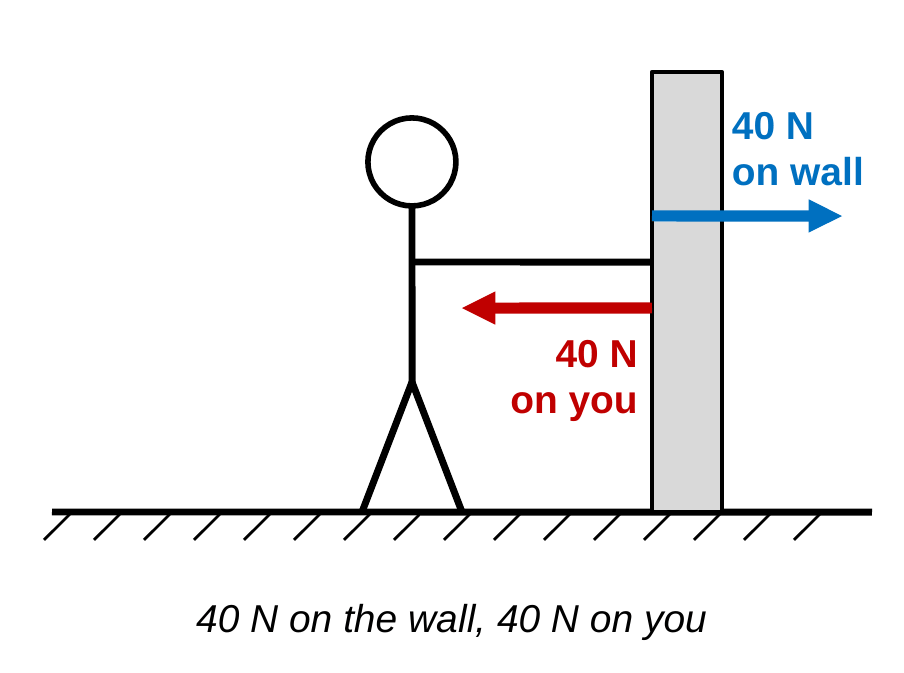
Newton’s third law says that forces always come in pairs. When object A pushes or pulls on object B, object B pushes or pulls back on object A with a force that is equal in size and opposite in direction. If you push on a wall with 40 N, the wall pushes back on you with 40 N. The two forces act on different objects: one on the wall, one on you.
Naming Force Pairs
- A on B, then B on A
- Swap the two objects
- Same type of force
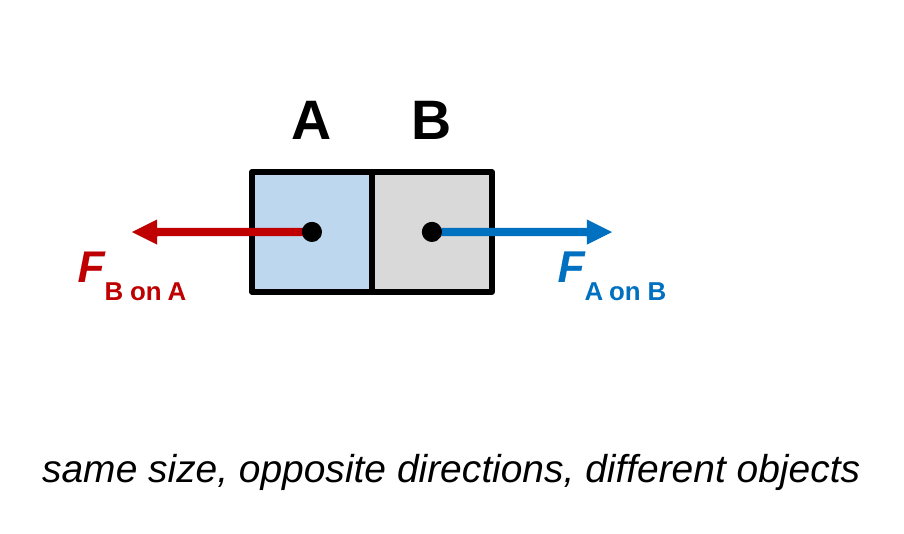
To find a force’s partner, swap the two objects. If the force is “A on B,” its partner is “B on A.” The partner is always the same type of force. If block A pushes block B with a normal force, block B pushes back on A with a normal force. If Earth pulls on you with gravity, you pull on Earth with gravity.
Action-Reaction Examples
- Walking: foot pushes ground back
- Swimming: hands push water back
- Rocket: pushes gas down
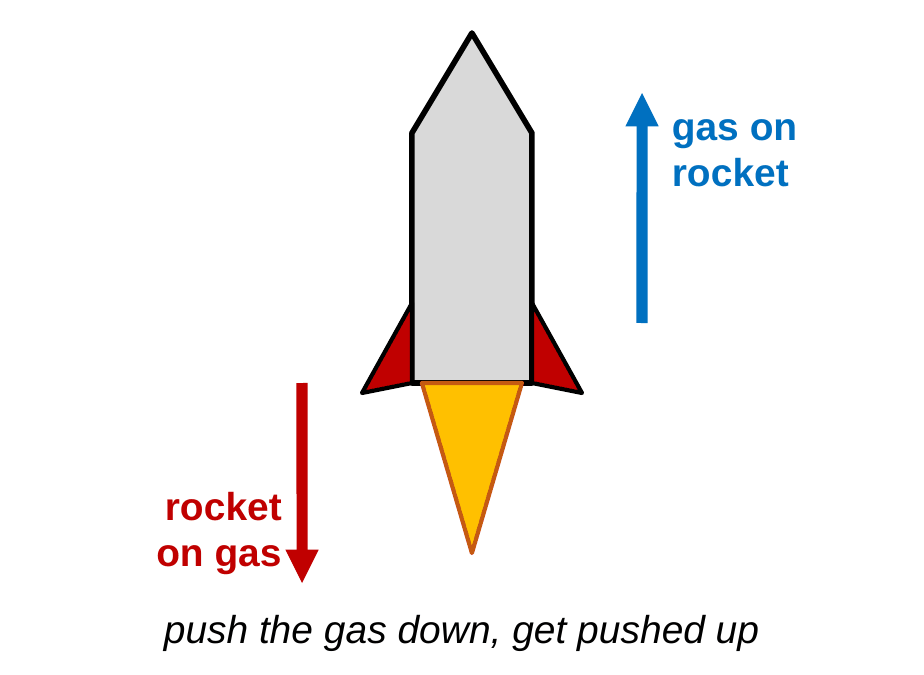
Force pairs explain how things move. When you walk, your foot pushes backward on the ground, and the ground pushes forward on your foot. When you swim, your hands push water backward, and the water pushes you forward. A rocket pushes hot gas down out of its engine, and the gas pushes the rocket up. A rocket doesn’t need air to push against. It pushes on its own exhaust.
Why Pairs Don’t Cancel
- They act on different objects
- Only forces on one object cancel
- Each object moves on its own
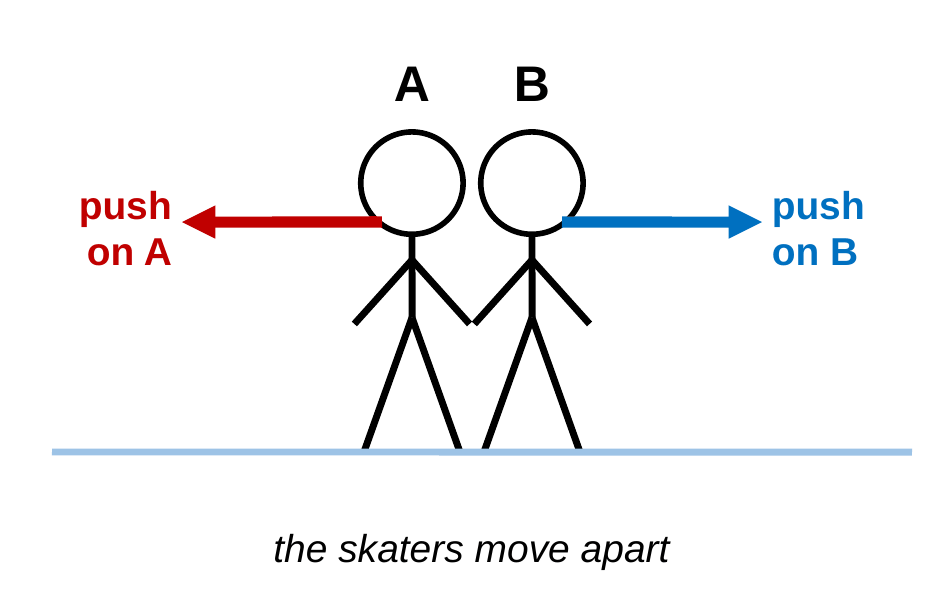
If the two forces in a pair are equal and opposite, why don’t they cancel? Because they act on different objects. Forces only cancel when they act on the same object. When two skaters push off each other, one push acts on skater A and the other acts on skater B. Each skater has an unbalanced force on them, so both accelerate, in opposite directions.
Same Force, Different Acceleration
- Both feel the same force
- Each one: a = F/m
- Less mass, more acceleration
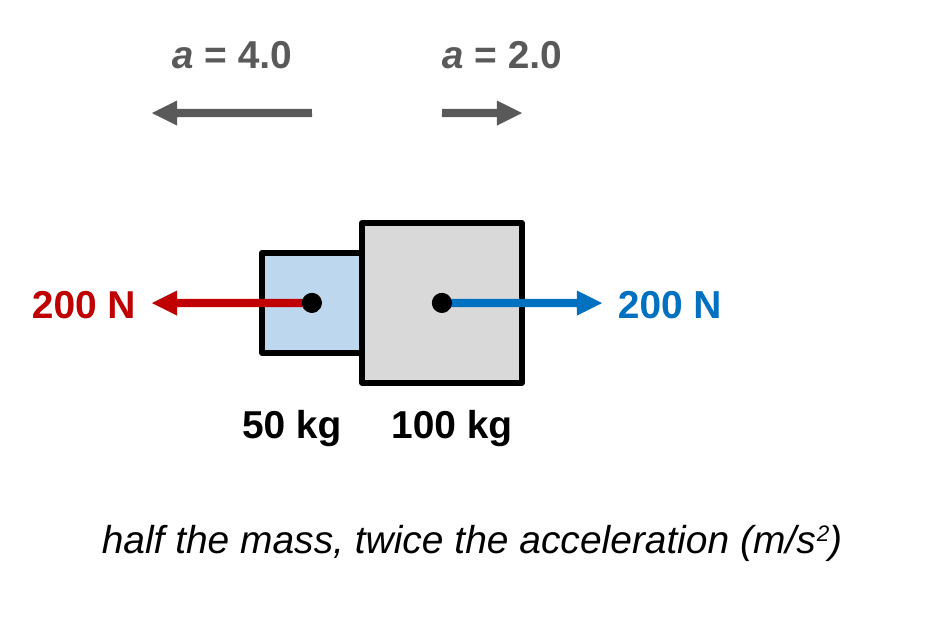
The two forces in a pair are always equal, but the objects can respond very differently. Each object follows Newton’s second law, a = F/m. If a 50 kg block and a 100 kg block push apart with 200 N each, the 50 kg block accelerates at 200 N / 50 kg = 4.0 m/s2, while the 100 kg block accelerates at 200 N / 100 kg = 2.0 m/s2. Same force, half the mass, twice the acceleration.
Pair or Not?
- Pairs: two objects, same type
- FN and Fg on a book: not a pair
- Both act on the same book
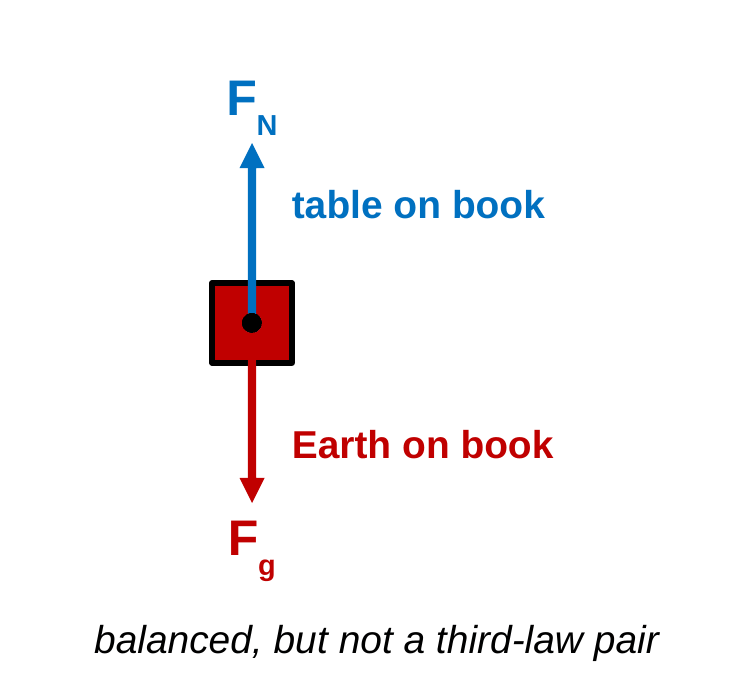
A book on a table has two forces on it, FN up and Fg down. They’re equal and opposite, so they look like a third-law pair, but they’re not. Both act on the same object, the book, and they’re different types of forces. The real partner of the table pushing up on the book is the book pushing down on the table. The real partner of Earth pulling down on the book is the book pulling up on Earth.
Worked Examples
Try each problem on your own first, then check your work against the solution.
Example 1: Bat and Ball
A bat exerts a 1,500 N force on a baseball, toward the pitcher. What force does the ball exert on the bat?
- Identify the force: Bat on ball: 1,500 N toward the pitcher.
- Swap the objects: The partner force is ball on bat.
- Apply the third law: Equal size, opposite direction.
- Answer: 1,500 N on the bat, away from the pitcher (toward the catcher).
Example 2: Walking
As you walk, your foot pushes backward on the floor. Name the reaction force. What does it do to you?
- Identify the force: Foot on floor, pointing backward.
- Swap the objects: The partner is floor on foot.
- Direction: Opposite direction, so the floor pushes forward. This is a friction force from the floor.
- Answer: The floor pushes forward on your foot, and that forward force is what moves you ahead.
That’s why walking on ice is so hard. With very little friction, the floor can’t push you forward.
Example 3: Skaters Push Off
A 45 kg skater and a 75 kg skater stand on ice and push off each other. Each skater feels a 135 N force. Find each skater’s acceleration.
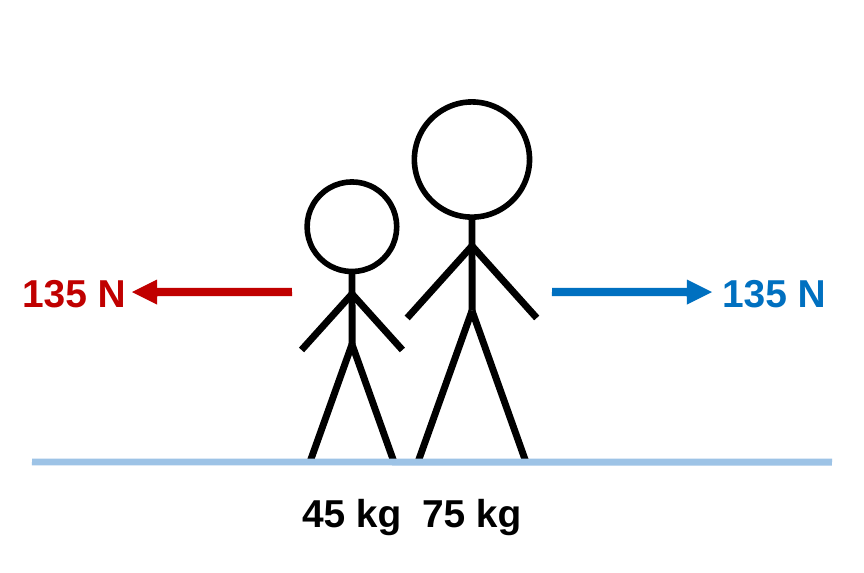
- Knowns: F = 135 N on each skater. m1 = 45 kg, m2 = 75 kg.
- Equation: a = F/m for each skater
- 45 kg skater: a = 135 N / 45 kg = 3.0 m/s2
- 75 kg skater: a = 135 N / 75 kg = 1.8 m/s2, in the opposite direction
Example 4: Bug vs. Truck
A 0.0020 kg bug hits the windshield of a 2,400 kg truck. The truck pushes on the bug with 1.2 N. Find the force on the truck and the acceleration of each.
- Force on the truck: By the third law, the bug pushes on the truck with 1.2 N, opposite the truck’s push on the bug.
- Bug’s acceleration: a = F/m = 1.2 N / 0.0020 kg = 6.0 × 10² m/s2
- Truck’s acceleration: a = F/m = 1.2 N / 2,400 kg = 5.0 × 10⁻⁴ m/s2
- Answer: Force on the truck: 1.2 N. Bug: a = 6.0 × 10² m/s2. Truck: a = 5.0 × 10⁻⁴ m/s2.
Same force, but the bug’s mass is over a million times smaller, so its acceleration is over a million times bigger.
Big Ideas
- Forces come in equal and opposite pairs
- Pair forces act on different objects
- Pairs never cancel each other out
- Same force, less mass: more acceleration
Back to the essential question: yes. Whenever you push on the wall, the wall pushes back on you with a force of the same size in the opposite direction. Forces always come in pairs that act on two different objects. That wraps up our unit on forces and Newton’s laws.

