
The video lesson for this topic is coming soon.
Essential Question
Would you weigh the same on the Moon?
Astronauts bounce around on the Moon as if they were super light, but they didn’t lose any of themselves on the trip. By the end of this lesson, you should be able to explain the difference between mass and weight and use Fg = mg to solve for weight, mass, or g.
Mass
- Amount of matter in an object
- Measured in kilograms (kg)
- Same everywhere
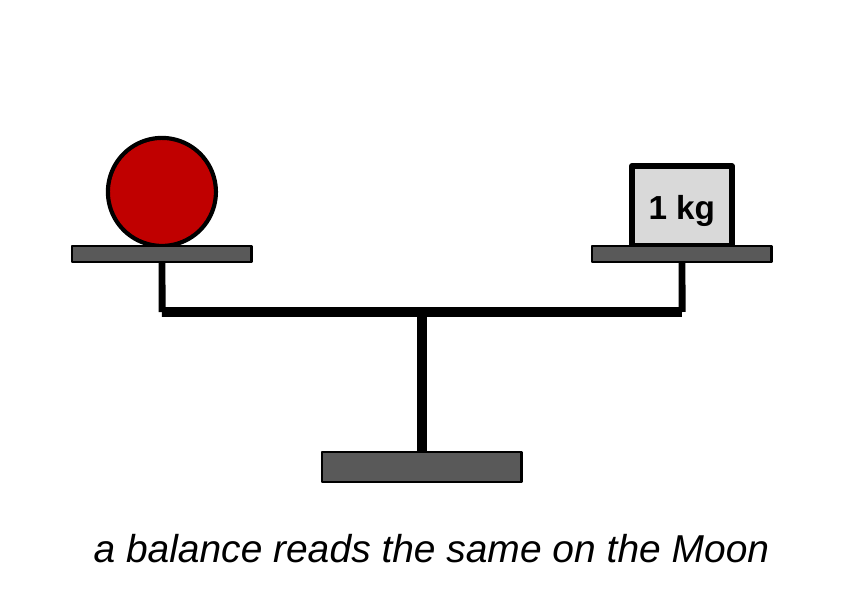
Mass is the amount of matter in an object. It’s measured in kilograms (kg). Mass doesn’t depend on where you are. A 1 kg object has a mass of 1 kg on Earth, on the Moon, or floating in space. A pan balance measures mass by comparing an object to known masses, so it gives the same reading anywhere.
Weight
- Gravity’s pull on an object
- Measured in newtons (N)
- Changes with location
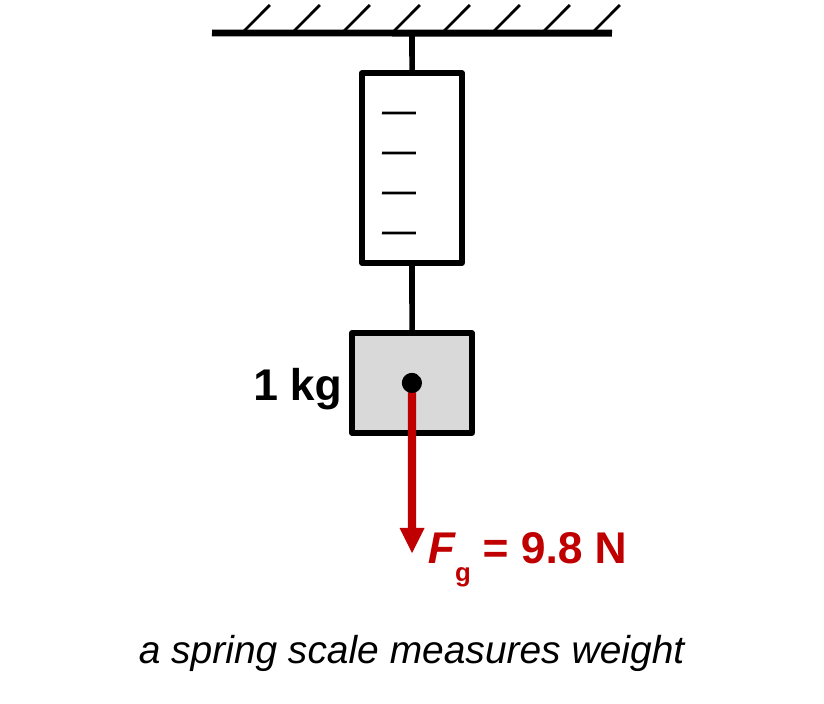
Weight is the gravitational force on an object, Fg. Since it’s a force, it’s measured in newtons (N) and it has a direction: down, toward the center of the planet. A spring scale measures weight by how much the spring stretches. On Earth, a 1 kg mass weighs 9.8 N. Weight depends on how strongly the planet or moon you’re on pulls, so it changes with location.
Calculating Weight
Fg = mg
- Fg = weight (gravitational force), in newtons (N)
- m = mass, in kilograms (kg)
- g = gravitational field strength, 9.8 m/s2 on Earth
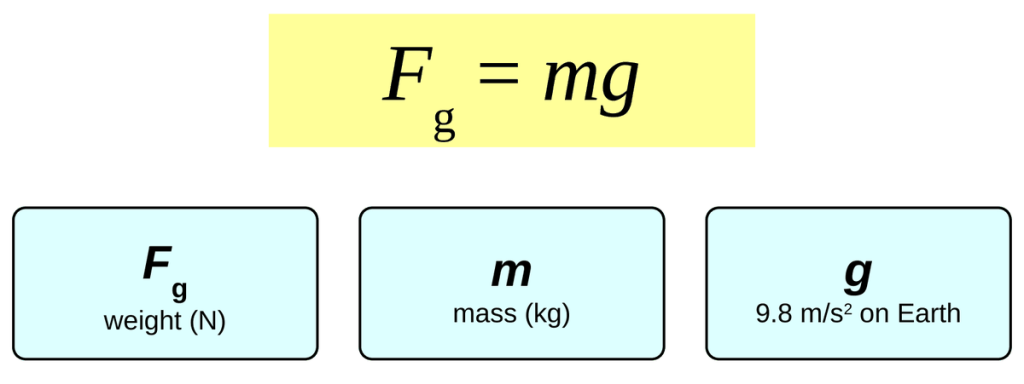
This is really Newton’s second law, F = ma, where the force is gravity and the acceleration is g. If gravity were the only force on an object, it would accelerate downward at g.
The Value of g
- Strength of gravity at a location
- Earth: g = 9.8 m/s2
- Each kg weighs 9.8 N on Earth
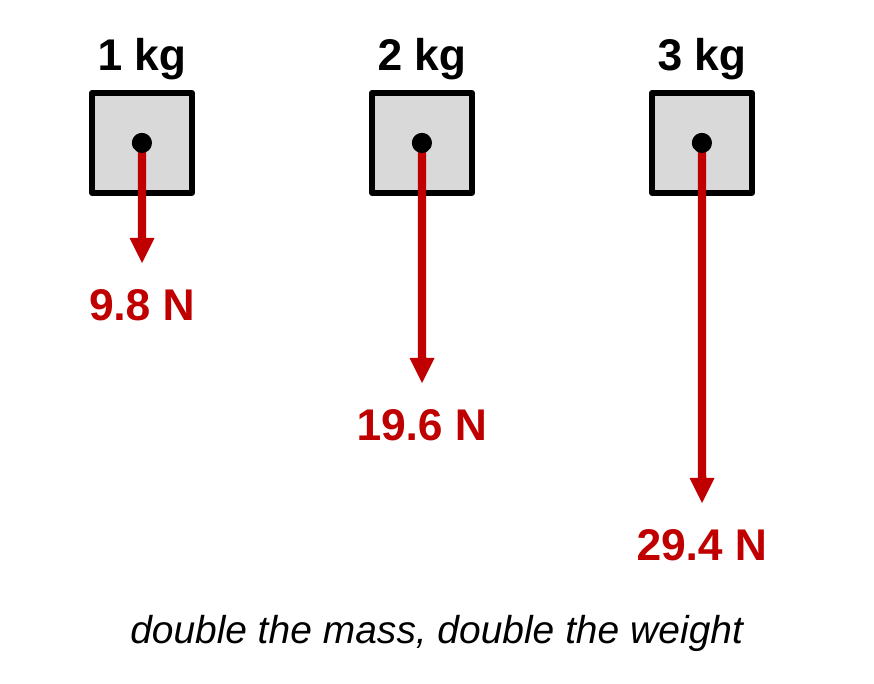
The value of g tells you how strongly gravity pulls on each kilogram of mass. On Earth, g = 9.8 m/s2, so every kilogram weighs 9.8 N. A 2 kg object weighs twice as much, 19.6 N, and a 3 kg object weighs three times as much, 29.4 N. Weight is directly proportional to mass.
Weight on Other Worlds
- Different worlds, different g
- Your mass stays the same
- Your weight changes
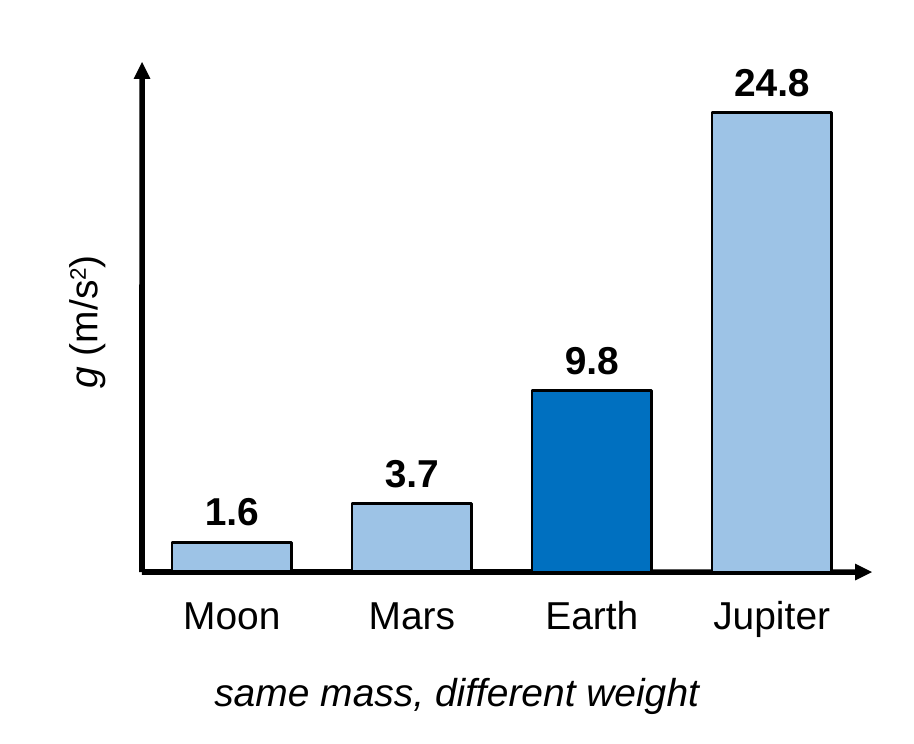
Each planet or moon has its own value of g, depending on its mass and size. On the Moon, g is about 1.6 m/s2, about one sixth of Earth’s 9.8 m/s2. On Jupiter, g is about 24.8 m/s2. If you traveled to each of these places, your mass would never change, but your weight would.
Mass vs. Weight
Mass and weight are related, but they are not the same thing.
- Mass: the amount of matter, in kilograms (kg), measured with a balance, the same everywhere
- Weight: the pull of gravity, a force in newtons (N), measured with a spring scale, depends on location
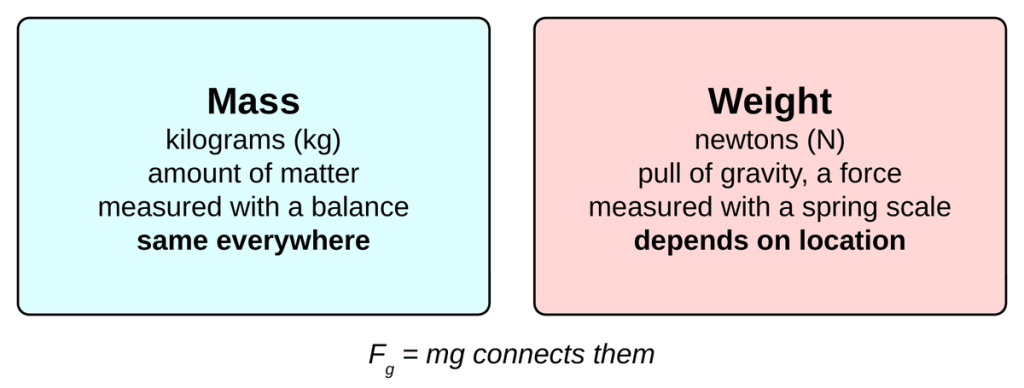
The equation Fg = mg connects the two. In everyday life, people say they “weigh” 60 kg, but in physics, 60 kg is a mass. That person’s weight on Earth is about 590 N.
Worked Examples
Try each problem on your own first, then check your work against the solution.
Example 1: Weight of a Backpack
What is the weight of a 5.0 kg backpack on Earth?
- Knowns: m = 5.0 kg, g = 9.8 m/s2
- Equation: Fg = mg
- Substitute: Fg = (5.0 kg)(9.8 m/s2) = 49 kg·m/s2
- Answer: Fg = 49 N down
Example 2: Finding Mass
A dog weighs 147 N on Earth. What is its mass?
- Knowns: Fg = 147 N, g = 9.8 m/s2
- Equation: Fg = mg, so m = Fg/g
- Substitute: m = 147 N / 9.8 m/s2 = 147 kg·m/s2 / 9.8 m/s2
- Answer: m = 15 kg
Example 3: Weight on the Moon
An astronaut has a mass of 70.0 kg. What are her mass and her weight on the Moon, where g = 1.62 m/s2?
- Mass: Mass doesn’t change with location, so m = 70.0 kg on the Moon.
- Equation: Fg = mg
- Substitute: Fg = (70.0 kg)(1.62 m/s2) = 113.4 kg·m/s2
- Answer: Fg = 113 N down, about one sixth of her 690 N weight on Earth.
Example 4: Finding g on Mars
A 900. kg rover weighs 3,330 N on Mars. What is the value of g on Mars?
- Knowns: m = 900. kg, Fg = 3,330 N
- Equation: Fg = mg, so g = Fg/m
- Substitute: g = 3,330 N / 900. kg = 3,330 kg·m/s2 / 900. kg
- Answer: g = 3.70 m/s2 on Mars
Big Ideas
- Mass: amount of matter, in kg, same everywhere
- Weight: gravity’s pull, in N, depends on location
- Fg = mg, with g = 9.8 m/s2 on Earth
- Rearrange: m = Fg/g and g = Fg/m
Back to the essential question: no. Your mass, the amount of matter in you, is the same everywhere, but your weight, Fg = mg, depends on the value of g. The Moon’s g is about one sixth of Earth’s, so you would weigh about one sixth as much there. Next up, Newton’s third law will show us that forces always come in pairs.

