
The video lesson for this topic is coming soon.
Essential Question
How do we combine all the forces on an object?
An object can have many forces acting on it, but it only responds to their total. By the end of this lesson, you should be able to add forces in one dimension using signs, write a net force equation from a free-body diagram, and use the net force to predict motion.
What Is Net Force?
- The total of all forces
- Symbol: Fnet
- Decides how motion changes
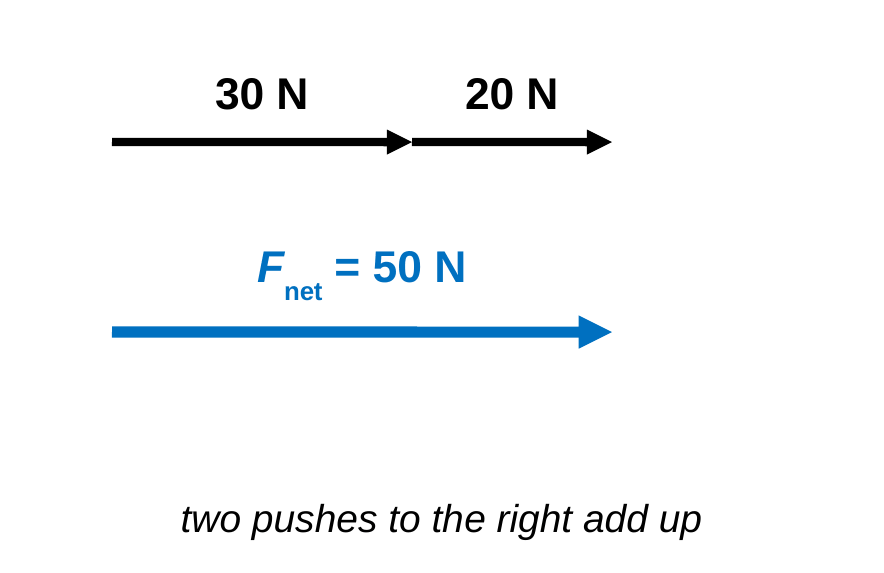
The net force, Fnet, is the total of all the forces acting on an object. Because forces are vectors, we add them head-to-tail. If you push a box to the right with 30 N and a friend also pushes right with 20 N, the net force is 50 N to the right. The net force is what actually decides how the object’s motion changes.
Signs Show Direction
- Right and up: positive (+)
- Left and down: negative (−)
- Add forces with their signs
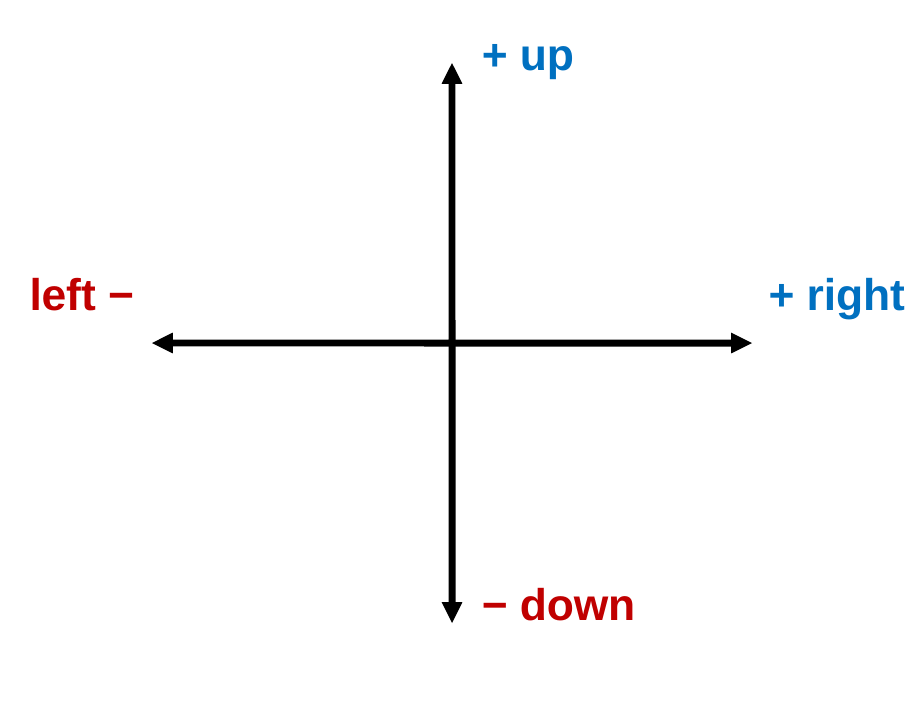
In one dimension, we use signs to show direction. Forces pointing right or up are positive. Forces pointing left or down are negative. To find the net force, write each force with its sign and add them all up. The sign of the answer tells you the direction of the net force.
Opposite Directions
- Opposite forces partly cancel
- Use + and − signs
- Net points toward the bigger force
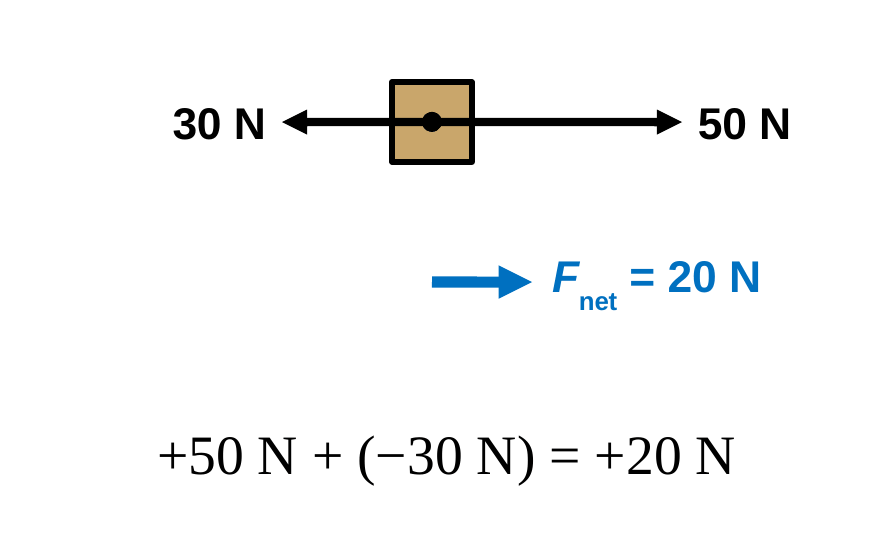
When forces point in opposite directions, they partly cancel. Give the leftward force a negative sign and add: +50 N + (−30 N) = +20 N. The net force is 20 N, and the positive sign tells us it points right, toward the bigger force.
Balanced vs. Unbalanced
- Balanced: Fnet = 0
- Unbalanced: Fnet ≠ 0
- Unbalanced forces change velocity
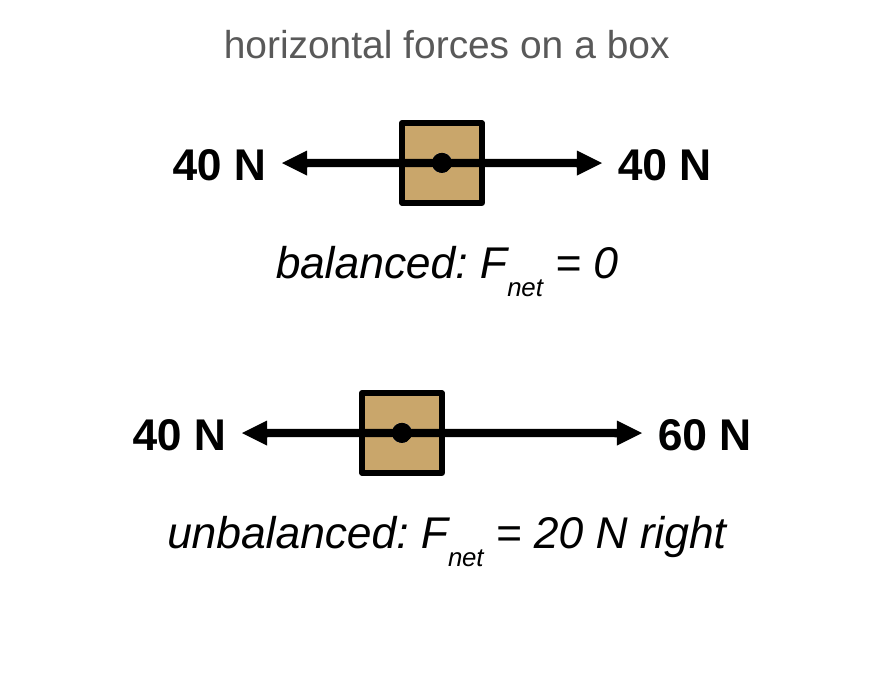
If the forces add up to zero, they are balanced and the net force is zero. If they don’t add to zero, they are unbalanced. Only an unbalanced force, meaning a nonzero net force, can change an object’s velocity. In the bottom box, 60 N right and 40 N left leave a net force of 20 N to the right.
Writing the Net Force Equation
- One equation per direction
- Horizontal: Fnet = Fapp − Ff
- Vertical: Fnet = FN − Fg
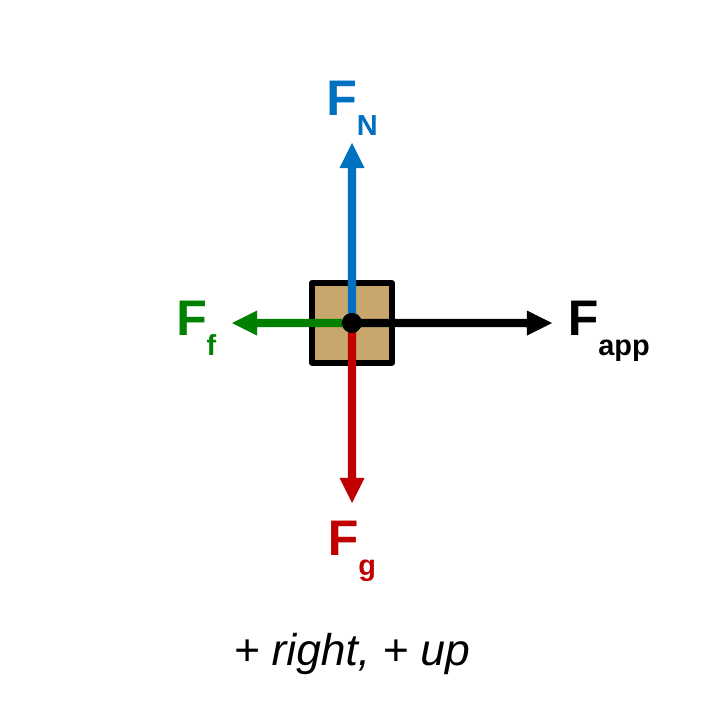
To write a net force equation, look at the free-body diagram one direction at a time. Forces pointing in the positive direction get a plus sign, and forces pointing the other way get a minus sign. For a box pushed across the floor, the horizontal equation is Fnet = Fapp − Ff, and the vertical equation is Fnet = FN − Fg. Here the vertical forces cancel, so all of the net force is horizontal.
Predicting Motion
- Fnet = 0: same velocity
- Fnet with v: speeds up
- Fnet against v: slows down
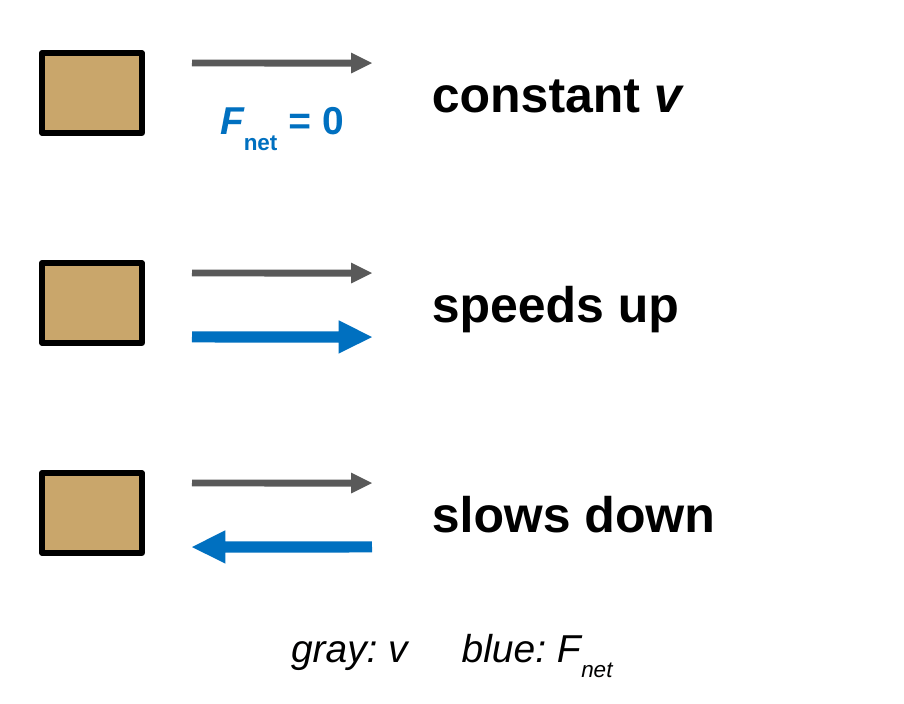
The net force tells you how an object’s velocity will change. If Fnet = 0, the velocity stays the same: the object stays at rest or keeps moving at a constant velocity. If the net force points the same way the object is moving, it speeds up. If the net force points opposite the motion, it slows down.
Worked Examples
Try each problem on your own first, then check your work against the solution.
Example 1: Pushing a Stalled Car
Two students push a stalled car east, one with 250 N and the other with 310 N. Friction on the car is 480 N west. What is the net force on the car?
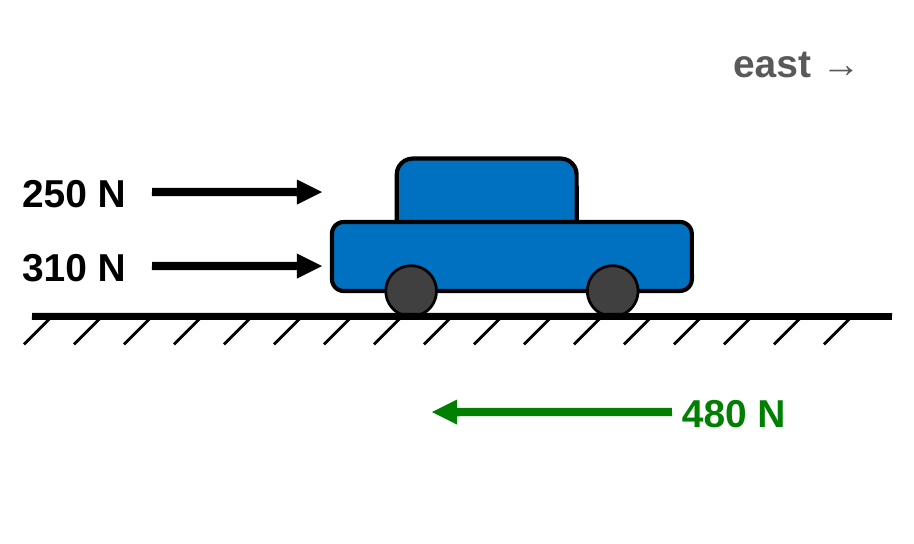
- Choose positive: east is +, so west is −
- Forces with signs: +250 N, +310 N, −480 N
- Add: Fnet = +250 N + 310 N + (−480 N) = +80 N
- Answer: Fnet = 80 N east. The car speeds up toward the east.
Example 2: Tug-of-War
In a tug-of-war, Team A pulls the rope west with 845 N. Team B pulls it east with 790 N. Find the net force on the rope. Which way does the rope start to move?
- Choose positive: east is +, so west is −
- Forces with signs: Team A: −845 N. Team B: +790 N.
- Add: Fnet = −845 N + 790 N = −55 N
- Answer: Fnet = 55 N west. The rope starts moving west, toward Team A.
Example 3: Lifting a Beam
A crane cable pulls up on a 4,520 N steel beam with a tension of 4,850 N. Find the net force on the beam. If the beam starts at rest, what happens?
- Choose positive: up is +, so down is −
- Forces with signs: FT = +4,850 N. Fg = −4,520 N.
- Write the equation: Fnet = FT − Fg = 4,850 N − 4,520 N
- Answer: Fnet = 330 N up. The beam starts at rest, so it speeds up as it rises.
Example 4: A Rolling Cart
A shopper pushes a cart east with 35 N while friction acts on it with 35 N west. The cart is already moving east. Find the net force and describe the cart’s motion.
- Choose positive: east is +, so west is −
- Add the forces: Fnet = +35 N + (−35 N) = 0 N
- Apply the first law: Zero net force means the velocity doesn’t change.
- Answer: Fnet = 0 N. The cart keeps rolling east at a constant velocity.
A zero net force does not mean the cart stops. It means nothing about its motion changes.
Big Ideas
- Net force: the sum of all forces, with signs
- Balanced: Fnet = 0. Unbalanced: Fnet ≠ 0
- Write Fnet from the free-body diagram
- Fnet = 0 means constant velocity
Back to the essential question: we combine forces by adding them as vectors, using + and − signs for direction, to get the net force. If the net force is zero, the velocity stays the same. If it isn’t, the object speeds up or slows down. Next up, Newton’s second law will tell us exactly how much an object accelerates for a given net force.

