
The video lesson for this topic is coming soon.
Essential Question
How can a magnet make electricity?
Electricity can make a magnet, so can a magnet make electricity? Yes, as long as the magnetic field is changing. By the end of this lesson, you should be able to predict when a current is induced and which way it flows, and use Faraday’s law to calculate the induced voltage.
Faraday’s Discovery
- Changing field in a coil: current
- This is called induction
- No battery needed
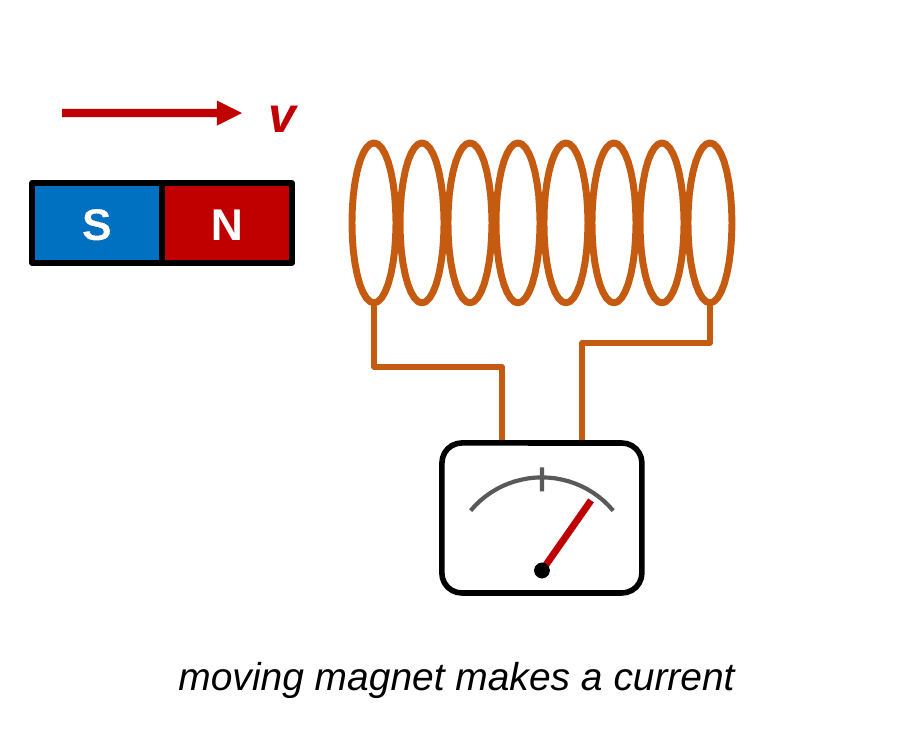
In 1831, Michael Faraday discovered that moving a magnet into a coil of wire makes a current flow in the coil, even though there is no battery anywhere in the circuit. Making a current this way is called electromagnetic induction, and the current is called an induced current. The key is change: the magnetic field passing through the coil has to be changing.
Direction Depends on Motion
- Magnet in: needle one way
- Magnet out: needle the other way
- Flip the magnet: current flips too
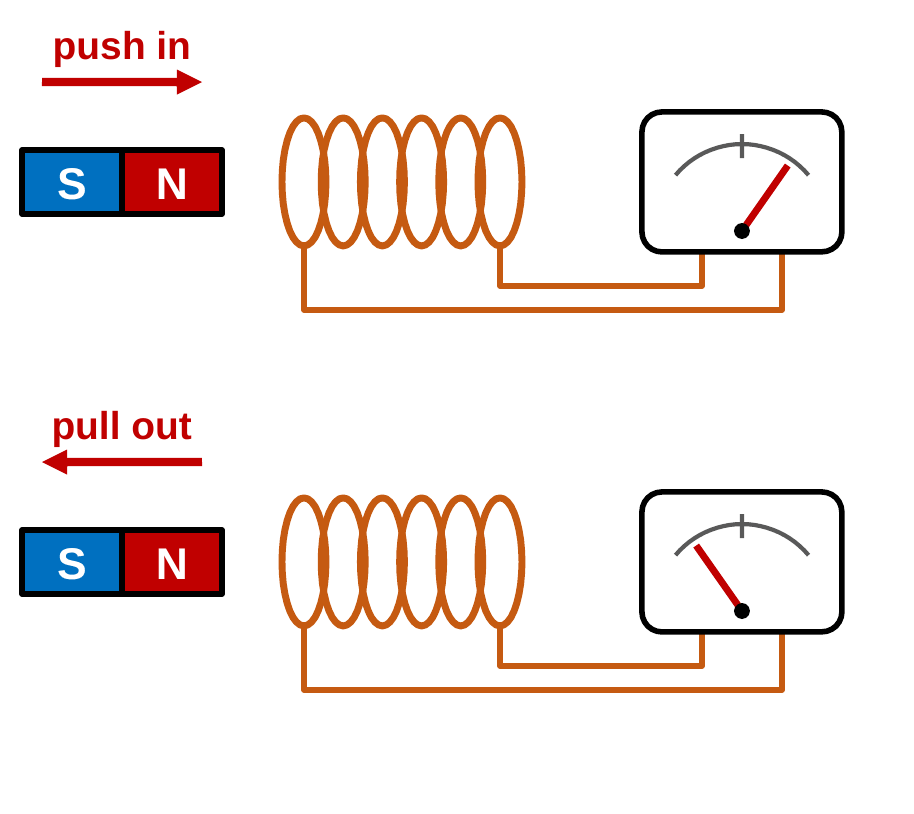
The direction of the induced current depends on how the field changes. Pushing the N pole into the coil makes the meter swing one way. Pulling it back out makes the meter swing the opposite way, because now the field through the coil is decreasing instead of increasing. Turning the magnet around so the S pole leads also reverses the current.
No Change, No Current
- Magnet held still: no current
- Even when it sits inside the coil
- Only a changing field counts
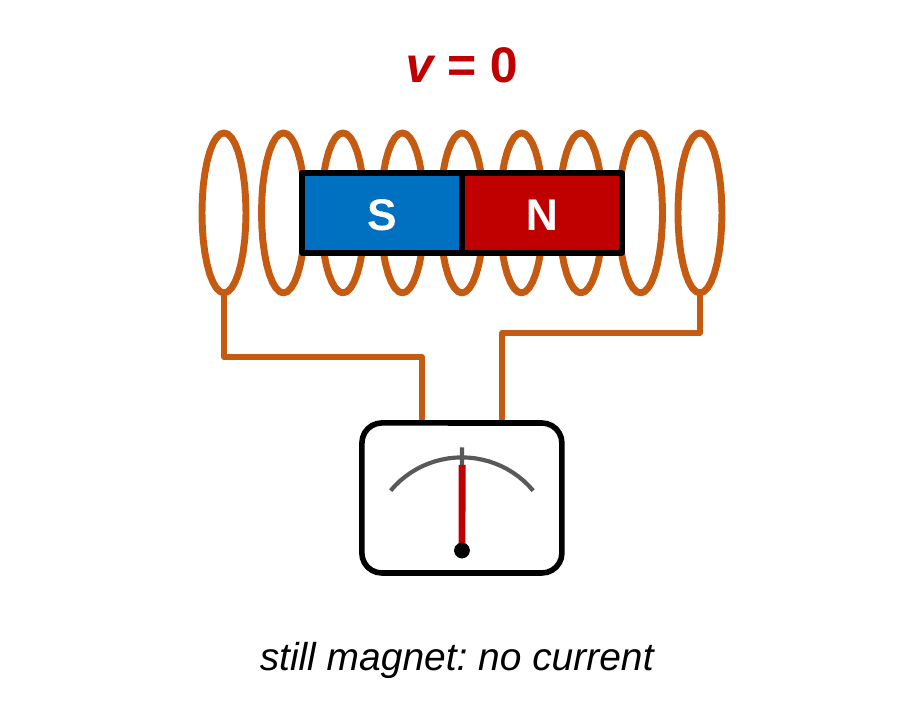
A magnet sitting still produces no induced current, even if it rests right inside the coil where the field is strongest. The field through the coil is strong, but it is not changing, so nothing is induced. Induction depends on the change in the field, not on how strong the field is.
Making More Current
- More turns in the coil
- A stronger magnet
- Faster motion
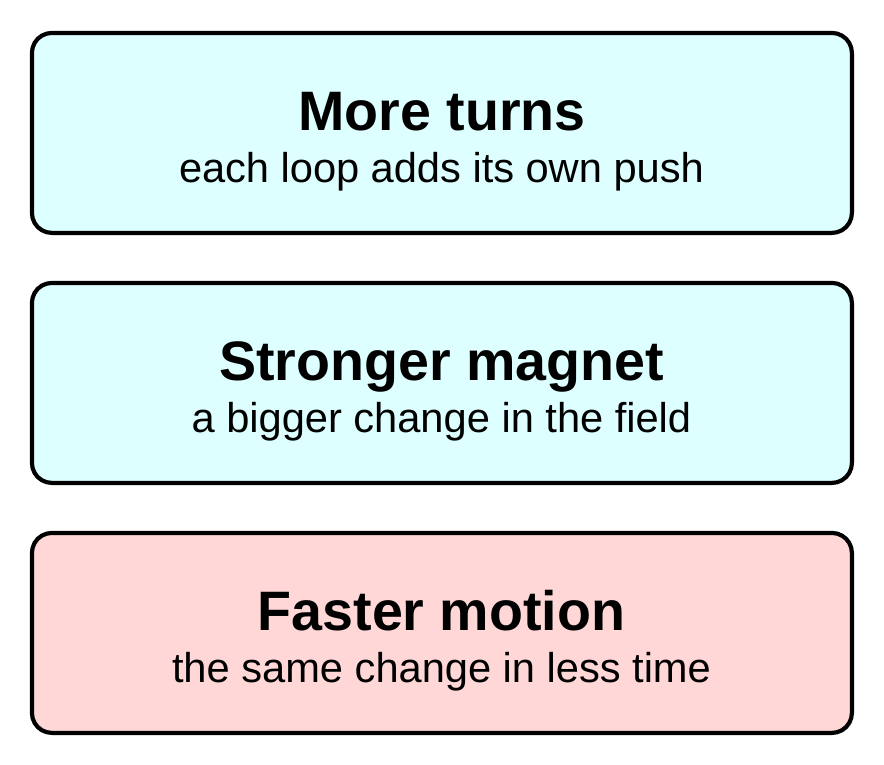
Three things increase the induced current. A coil with more turns gives a bigger current, because every loop has its own voltage induced in it, and the loops add up like batteries in series. A stronger magnet makes a bigger change in the field. And moving the magnet faster makes the same change happen in less time. Slowly sliding a weak magnet into one loop of wire barely moves the meter, but quickly plunging a strong magnet into a big coil makes a large current.
Magnetic Flux
Φ = BA
- Φ (Greek letter phi) = magnetic flux, in webers (Wb)
- B = magnetic field, in teslas (T)
- A = area of the loop, in square meters (m2)
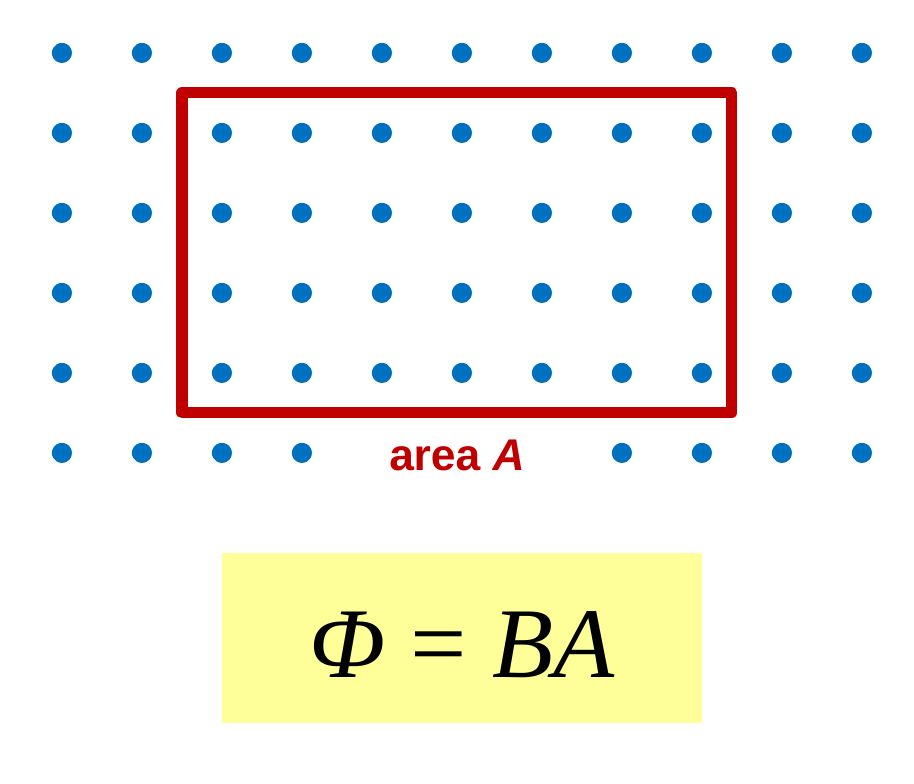
Magnetic flux measures how much magnetic field passes through a loop. Picture the field lines as arrows poking through the loop: more lines through the loop means more flux. When the field points straight through the loop, the flux is the field times the area. Flux changes if the field gets stronger or weaker, if the loop’s area changes, or if the loop turns so fewer field lines pass through it.
Faraday’s Law
ε = N ΔΦ / Δt
- ε (Greek letter epsilon) = induced voltage, called the induced emf, in volts (V)
- N = number of turns in the coil
- ΔΦ = change in magnetic flux, in webers (Wb)
- Δt = time for the change, in seconds (s)
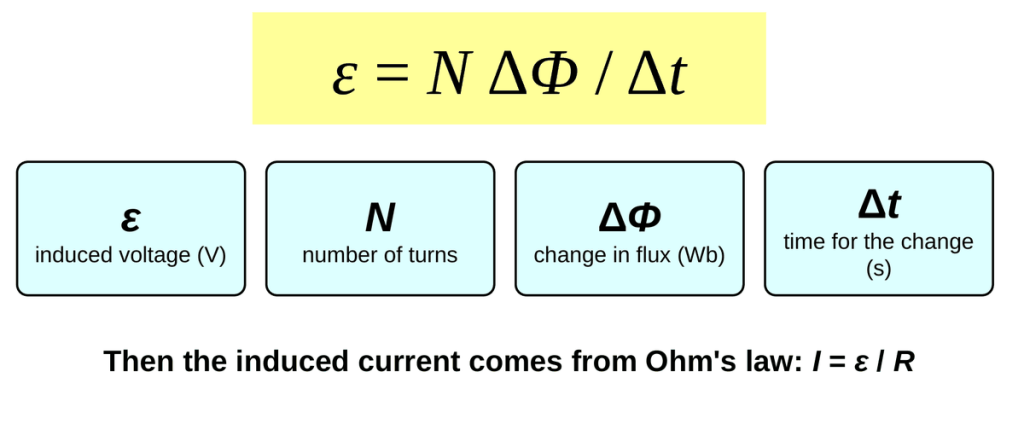
Faraday’s law says the induced voltage equals the number of turns times how fast the flux changes. A bigger change in flux, a shorter time, or more turns all make a bigger voltage. Once you know the voltage, Ohm’s law gives the induced current: I = ε/R. (The full law has a minus sign that tells the direction of the induced current. In this course we find the size with this equation and the direction from the motion.)
Motion Becomes Electricity
- The coil pushes back on the magnet
- You do work to move it
- Your work becomes electrical energy
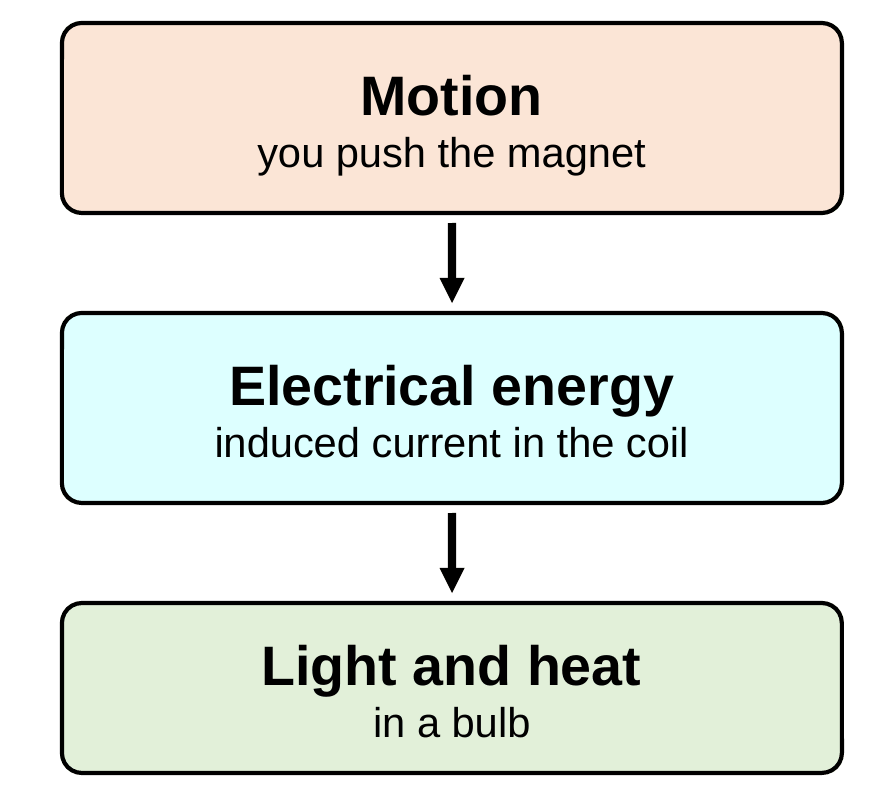
Induction does not make energy out of nothing. When a current is induced, the coil becomes an electromagnet that pushes back against the moving magnet, so you have to do work to keep the magnet moving. That work, which starts as the kinetic energy of the moving magnet, is transformed into electrical energy in the coil, and then into light and heat in a bulb. Energy is conserved the whole way.
Worked Examples
Try each problem on your own first, then check your work against the solution.
Example 1: Reading the Meter
When a magnet’s N pole is pushed into a coil, the meter swings right. The magnet is turned around, and its S pole is pulled out of the coil. Which way does the meter swing?
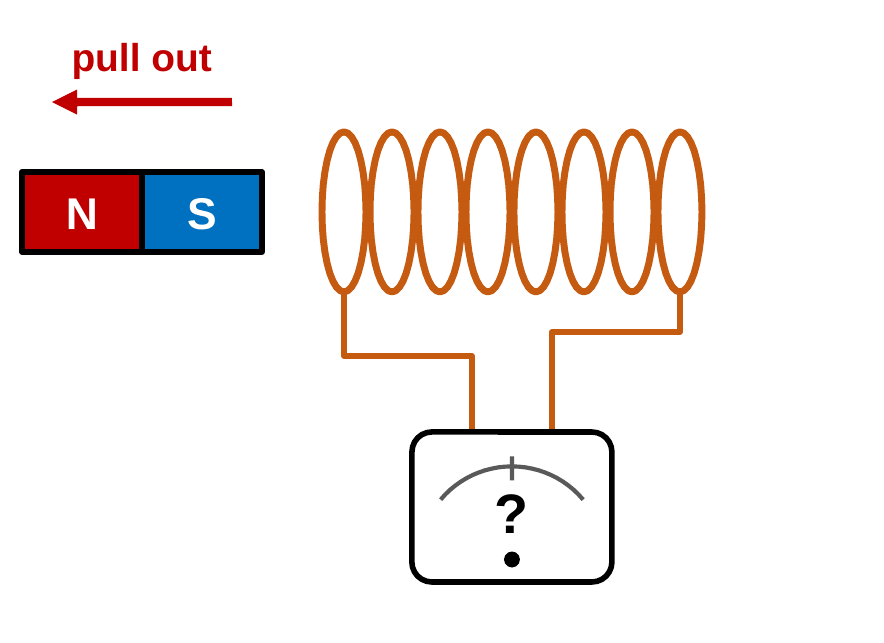
- Start: N pole pushed in: the meter swings right.
- Change 1: flip the pole: Using the S pole instead of the N pole reverses the current: the meter would swing left.
- Change 2: reverse the motion: Pulling out instead of pushing in reverses the current again.
- Answer: Two reversals cancel, so the meter swings right.
Example 2: Magnetic Flux
A rectangular loop of wire measures 0.20 m by 0.25 m. A 0.40 T magnetic field points straight through it. What is the magnetic flux through the loop?
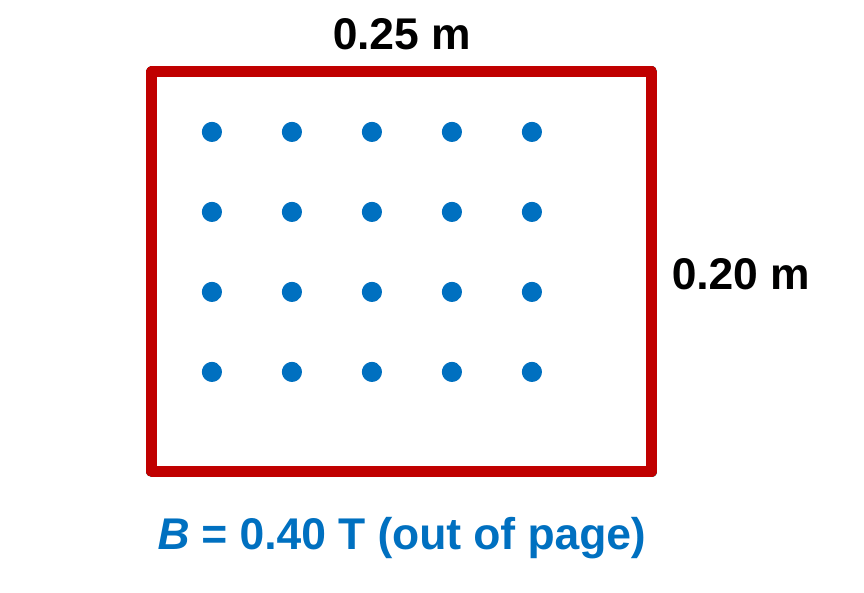
- Knowns: B = 0.40 T, loop is 0.20 m × 0.25 m, field points straight through the loop
- Area: A = (0.20 m)(0.25 m) = 0.050 m2
- Equation: Φ = BA
- Substitute: Φ = (0.40 T)(0.050 m2)
- Answer: Φ = 0.020 Wb
Example 3: Induced Voltage
A coil has 50 turns, each with an area of 0.020 m2. The field through it increases steadily from 0 T to 0.30 T in 0.10 s. What voltage is induced in the coil?
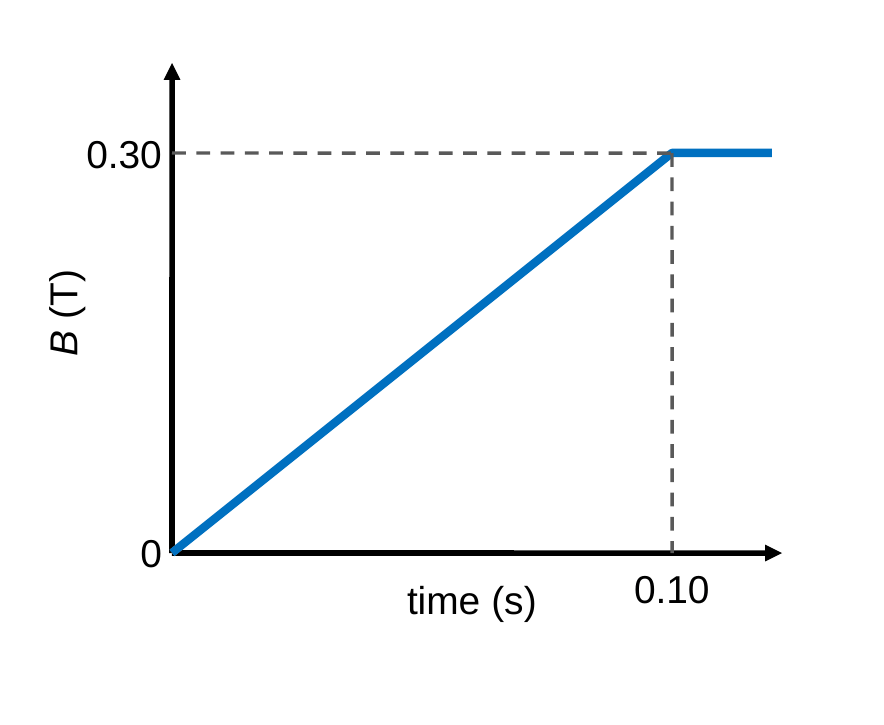
- Knowns: N = 50, A = 0.020 m2, B changes from 0 T to 0.30 T, Δt = 0.10 s
- Change in flux: ΔΦ = ΔB × A = (0.30 T)(0.020 m2) = 0.0060 Wb
- Equation: ε = N ΔΦ / Δt
- Substitute: ε = (50)(0.0060 Wb) / (0.10 s)
- Answer: ε = 3.0 V
Example 4: Induced Current
The flux through a 100-turn coil changes by 0.012 Wb in 0.20 s. The coil is connected to a circuit with a total resistance of 12 Ω. Find the induced current.
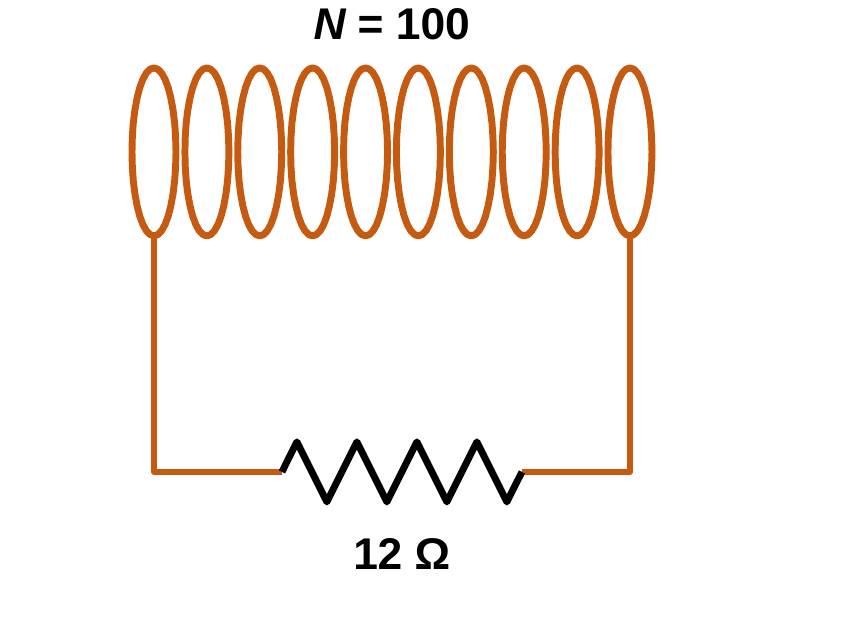
- Knowns: N = 100, ΔΦ = 0.012 Wb, Δt = 0.20 s, R = 12 Ω
- Induced voltage: ε = N ΔΦ / Δt = (100)(0.012 Wb) / (0.20 s) = 6.0 V
- Ohm’s law: I = ε / R
- Substitute: I = 6.0 V / 12 Ω
- Answer: I = 0.50 A
Big Ideas
- A changing field through a coil induces current
- Reverse the change: reverse the current
- No change: no current
- Φ = BA and ε = N ΔΦ / Δt
Back to the essential question: a magnet makes electricity when its magnetic field through a coil changes, for example when the magnet moves in or out. The changing field induces a voltage and a current, and the induced voltage is ε = NΔΦ/Δt, so more turns, a stronger magnet, or faster motion means more current. Next up, we’ll see how motors and generators put magnetic forces and induction to work.

