
The video lesson for this topic is coming soon.
Essential Question
How do we turn electricity into motion, and motion into electricity?
Every fan, blender, and electric car uses a motor, and almost all of our electricity comes from generators. By the end of this lesson, you should be able to explain how motors, generators, and transformers work, and solve transformer problems with Vs/Vp = Ns/Np.
Electric Motors
- A current loop sits in a magnetic field
- The field pushes its sides opposite ways
- So the loop spins
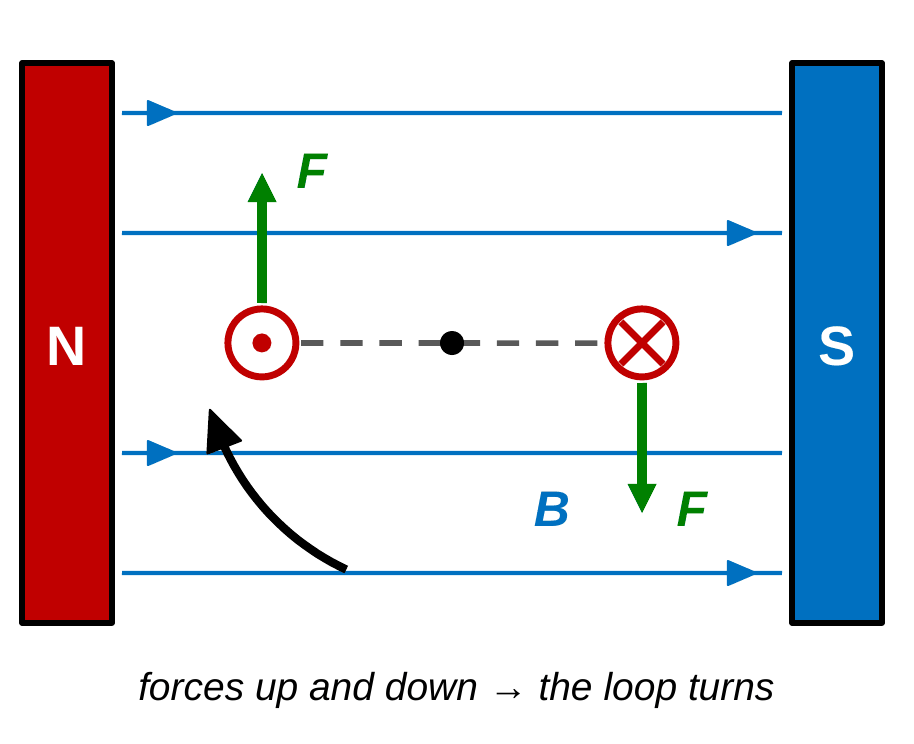
An electric motor is a loop (or coil) of wire carrying current in a magnetic field. This picture looks at the loop end-on. Using the right-hand rule, the field pushes the left side, where current comes out of the page, upward, and pushes the right side, where current goes into the page, downward. Equal and opposite pushes on opposite sides make the loop rotate clockwise, just like pushing up on the left side of a steering wheel and down on the right. That’s the magnetic force on a current from the last two lessons, put to work.
Keeping It Spinning
- Split ring flips current every half turn
- So the loop keeps turning one way
- More loops + iron core: more power
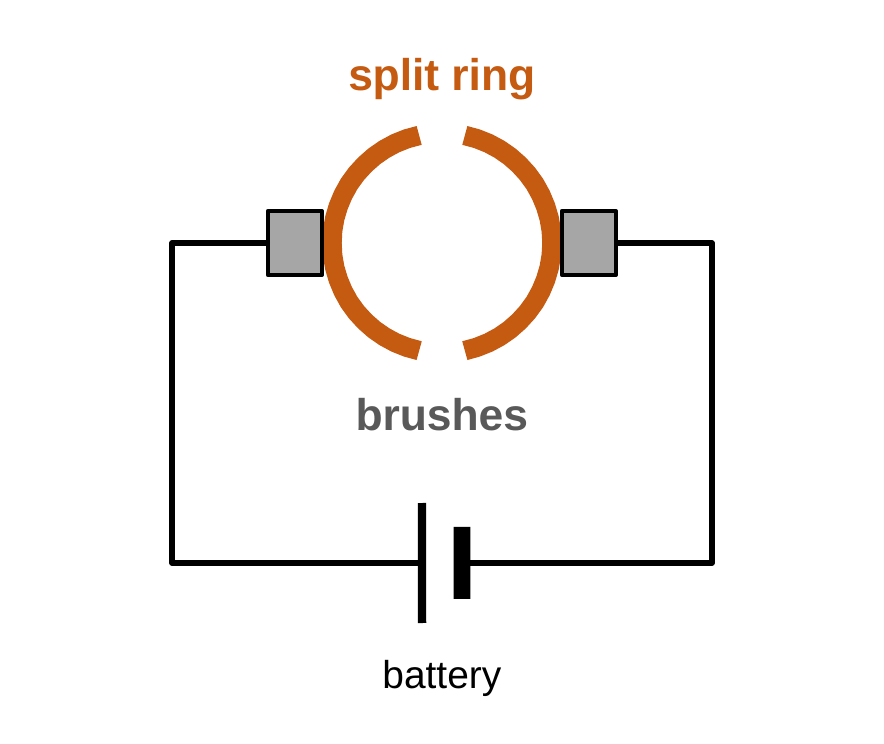
After half a turn, the sides of the loop have swapped places, and if nothing changed, the forces would push it back the other way. A split ring commutator fixes this. The ends of the loop connect to two halves of a ring, and brushes connect the ring to the battery. Every half turn, each brush slides onto the other half of the ring, which reverses the current in the loop, so the forces keep turning it the same direction. Real motors use many loops wound on an iron core to make the forces bigger.
Generators
- Spin a coil in a magnetic field
- The flux through it keeps changing
- Induction makes a current
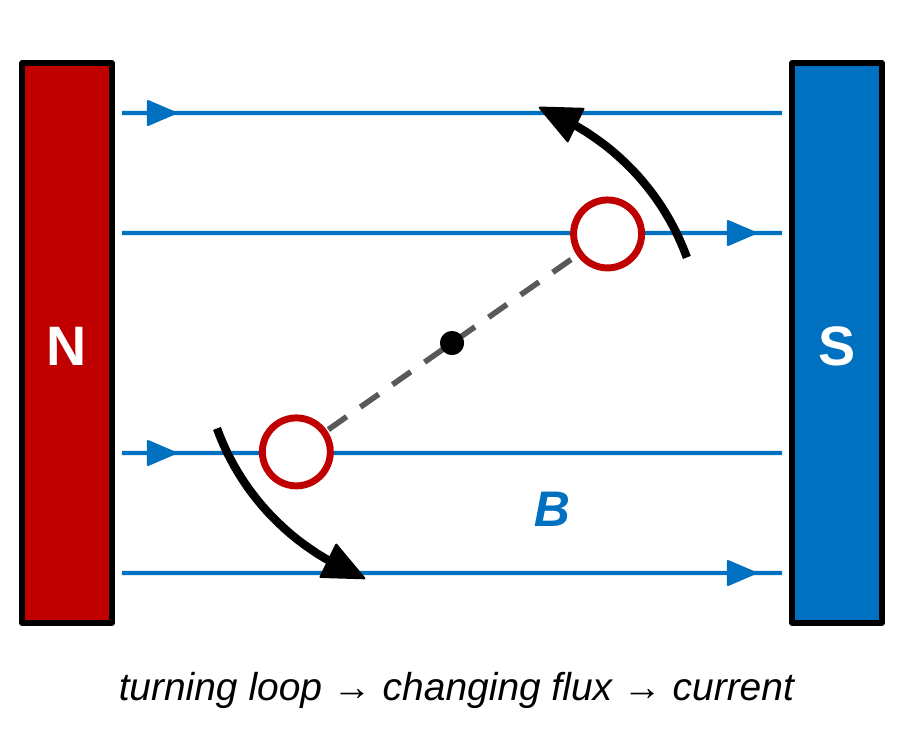
A generator is a motor run backward. Instead of feeding current in, you turn the coil with a crank, a turbine, or a wind blade. As the coil turns in the magnetic field, the number of field lines passing through it keeps changing: lots of flux when the coil faces the poles, zero flux when it is edge-on. That changing flux induces a voltage and a current, exactly as Faraday’s law predicts. The faster the coil spins, the faster the flux changes and the more voltage it makes.
Alternating Current
- Current reverses every half turn
- This is alternating current (AC)
- US outlets: 60 cycles per second
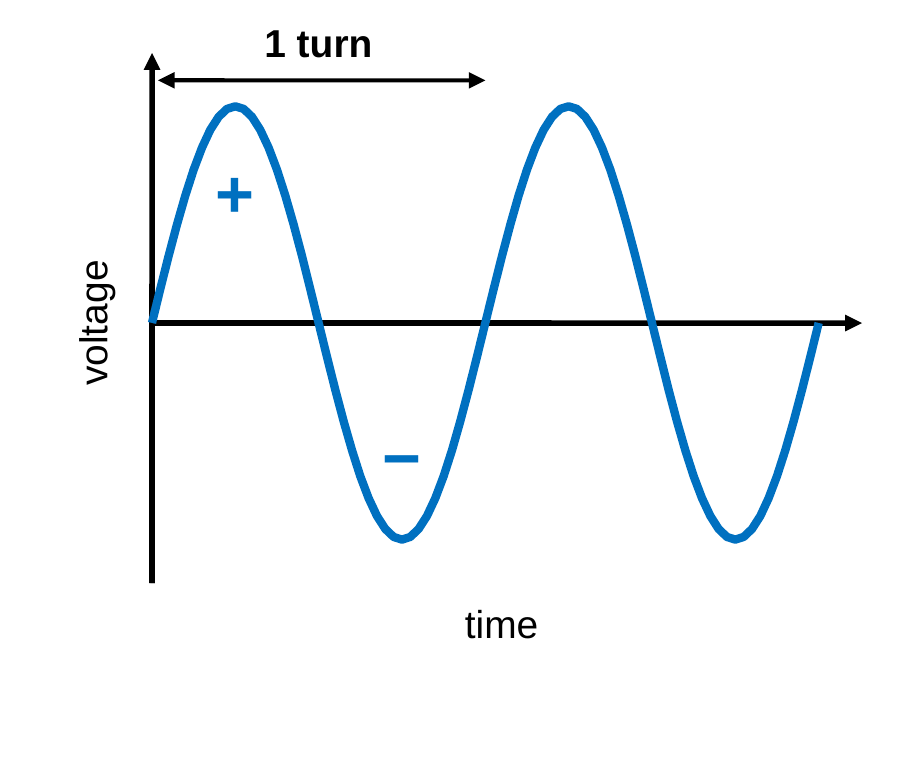
As a generator’s coil turns, each side moves up through the field and then down through it, so the induced current flows one way for half a turn and the opposite way for the next half. The voltage rises and falls smoothly, making a wave. Current that keeps reversing like this is called alternating current, or AC. Power plants in the United States make AC that completes 60 cycles every second (60 Hz). A battery, by contrast, makes direct current (DC), which flows only one way.
Same Parts, Opposite Jobs
- Motor: electrical energy → motion (magnetic force on a current)
- Generator: motion → electrical energy (electromagnetic induction)
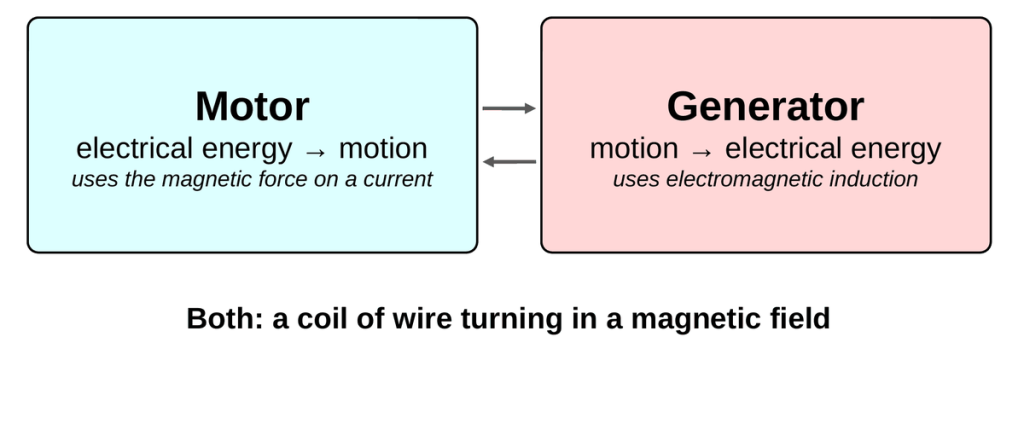
A motor and a generator are built from the same parts: a coil of wire that can turn inside a magnetic field. The difference is which way the energy flows. A motor takes in electrical energy and puts out motion, using the magnetic force on a current. A generator takes in motion and puts out electrical energy, using electromagnetic induction. In fact, many electric and hybrid cars use their motors as generators when braking, turning the car’s kinetic energy back into electrical energy to recharge the battery.
Transformers
Vs / Vp = Ns / Np
- Vp and Vs = voltages across the primary (input) and secondary (output) coils, in volts (V)
- Np and Ns = number of turns on the primary and secondary coils
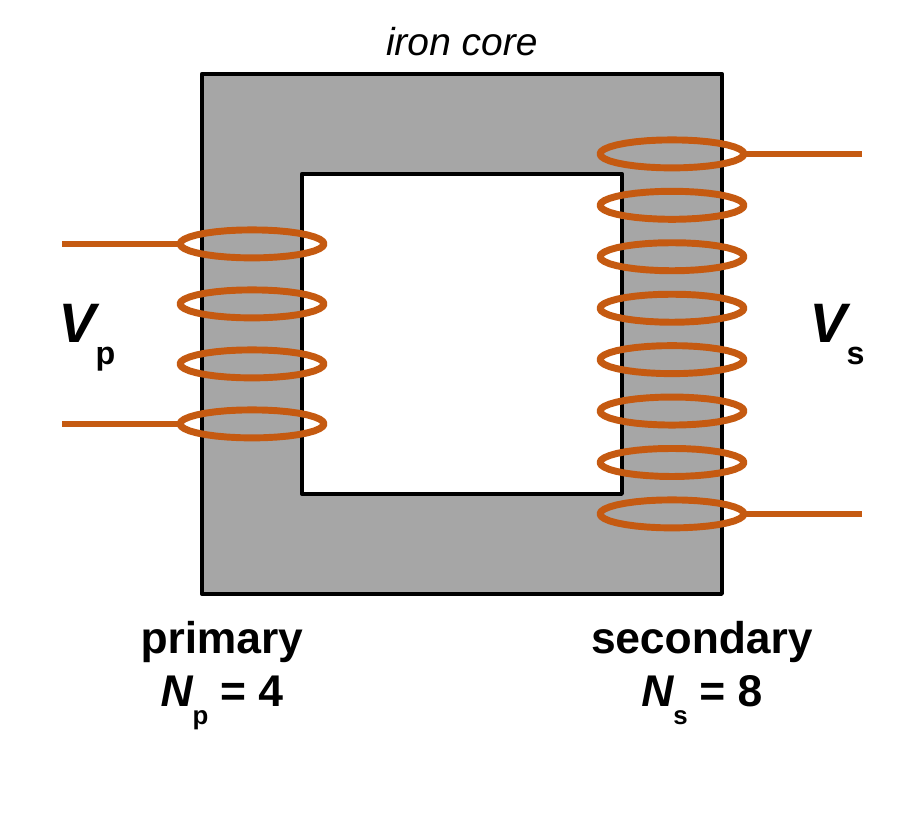
A transformer is two coils wrapped on the same iron core. Alternating current in the primary coil makes a changing magnetic field, and the iron carries that changing field through the secondary coil, where it induces a voltage. The voltage ratio equals the turns ratio. If the secondary has more turns, the voltage goes up (a step-up transformer). If it has fewer turns, the voltage goes down (a step-down transformer). Transformers only work with AC, because a steady DC current makes a field that doesn’t change, and no change means no induction.
From Power Plant to Home
- A turbine spins a generator
- Step up: high voltage, low current
- Step down: safe voltage at home
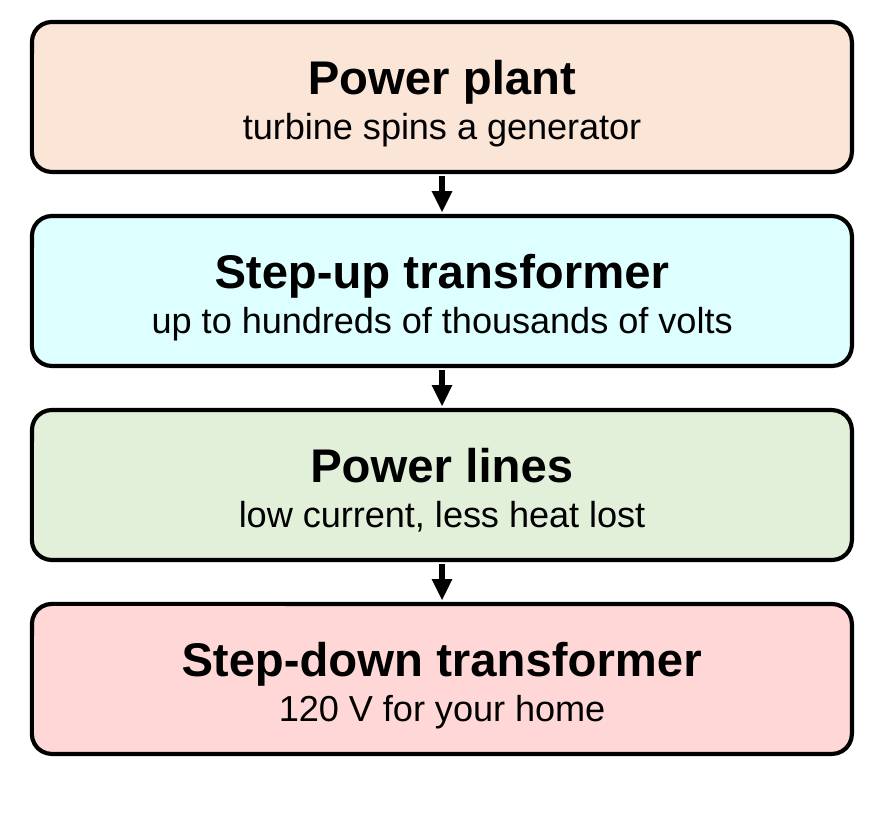
In most power plants, steam, falling water, or wind spins a turbine, which turns a generator. Next, a step-up transformer raises the voltage to hundreds of thousands of volts. Since power is P = IV, raising the voltage lets the same power travel with much less current, and less current means much less energy wasted as heat in the long power lines. Near your neighborhood, step-down transformers lower the voltage to a safe 120 V for your outlets.
Worked Examples
Try each problem on your own first, then check your work against the solution.
Example 1: Which Way Does It Turn?
A motor loop is shown end-on between N and S poles. The left wire carries current into the page and the right wire carries current out of the page. Find the force on each side. Which way does the loop turn?
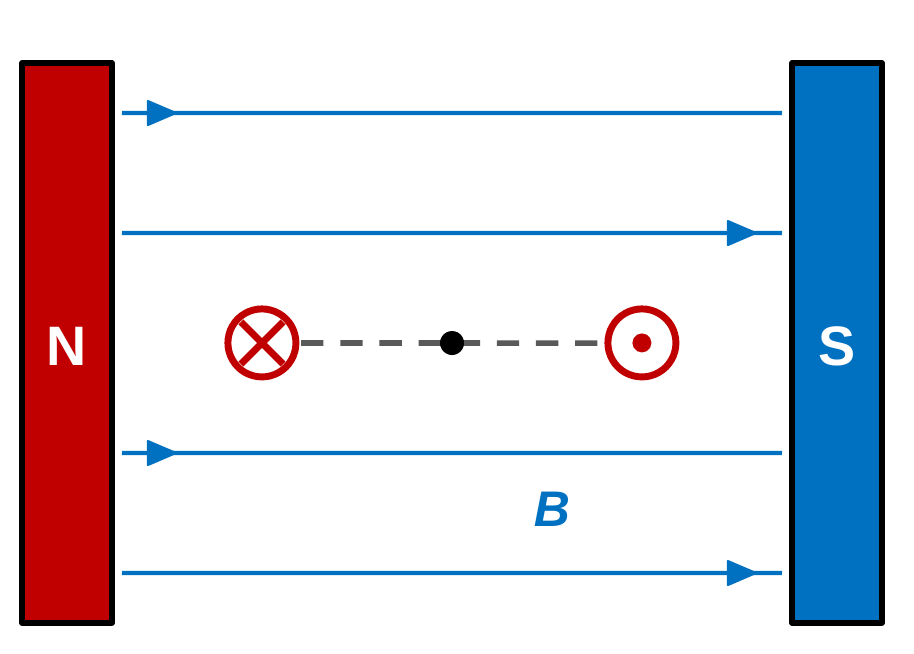
- Field: The field points from N to S, to the right.
- Left side: Current into the page. Right-hand rule: fingers right (B), thumb into the page (I), palm faces down. The force is down.
- Right side: Current out of the page. Fingers right, thumb out of the page, palm faces up. The force is up.
- Answer: Left side pushed down, right side pushed up, so the loop turns counterclockwise.
Compare this with the Electric Motors slide: reversing the current reversed the direction the motor spins. That’s how a cordless drill switches between forward and reverse.
Example 2: Step-Down Transformer
A phone charger’s transformer has 600 turns on its primary coil, which plugs into a 120 V outlet. Its secondary coil has 30 turns. What is the output voltage?
- Knowns: Np = 600, Vp = 120 V, Ns = 30
- Equation: Vs/Vp = Ns/Np, so Vs = Vp × Ns/Np
- Substitute: Vs = (120 V)(30/600) = (120 V)(0.050)
- Answer: Vs = 6.0 V
The secondary has 1/20 as many turns, so the voltage drops to 1/20 of 120 V. That’s a step-down transformer.
Example 3: Step-Up Transformer
A power plant’s generator produces 12,000 V. A step-up transformer with 200 turns on its primary must raise this to 240,000 V. How many turns does the secondary need?
- Knowns: Vp = 12,000 V, Np = 200, Vs = 240,000 V
- Equation: Vs/Vp = Ns/Np, so Ns = Np × Vs/Vp
- Substitute: Ns = (200)(240,000 V / 12,000 V) = (200)(20)
- Answer: Ns = 4,000 turns
Example 4: Why High Voltage?
A power plant sends 6.0 × 10⁵ W down a power line. Find the current in the line if the power is sent at 12,000 V, and again if it is sent at 240,000 V.
- Knowns: P = 6.0 × 10⁵ W, V = 12,000 V or 240,000 V
- Equation: P = IV, so I = P/V
- At 12,000 V: I = (6.0 × 10⁵ W)/(12,000 V) = 50. A
- At 240,000 V: I = (6.0 × 10⁵ W)/(240,000 V) = 2.5 A
Stepping the voltage up 20 times cuts the current to 1/20. Because the heat wasted in the wires grows with the current, sending power at high voltage saves a huge amount of energy.
Big Ideas
- Motor: electrical energy → motion (magnetic force)
- Generator: motion → electrical energy (induction)
- Generators make AC; transformers change its voltage
- Vs/Vp = Ns/Np; high voltage means less loss
Back to the essential question: a motor turns electricity into motion because a magnetic field pushes on the current in a coil and makes it spin. A generator does the opposite: spinning a coil in a magnetic field changes the flux through it and induces a current. They use the same parts with the energy flowing in opposite directions, and transformers adjust the voltage so power plants can send that electricity to your home. This wraps up our electromagnetism unit.

