
The video lesson for this topic is coming soon.
Essential Question
How can electricity make a magnet?
Magnets are not the only things that make magnetic fields. By the end of this lesson, you should be able to find the direction of the magnetic field around a wire or a coil with the right-hand grip rule and explain how to make an electromagnet stronger.
Oersted’s Discovery
- Current in a wire turns a compass
- Moving charges make magnetic fields
- No current, no field
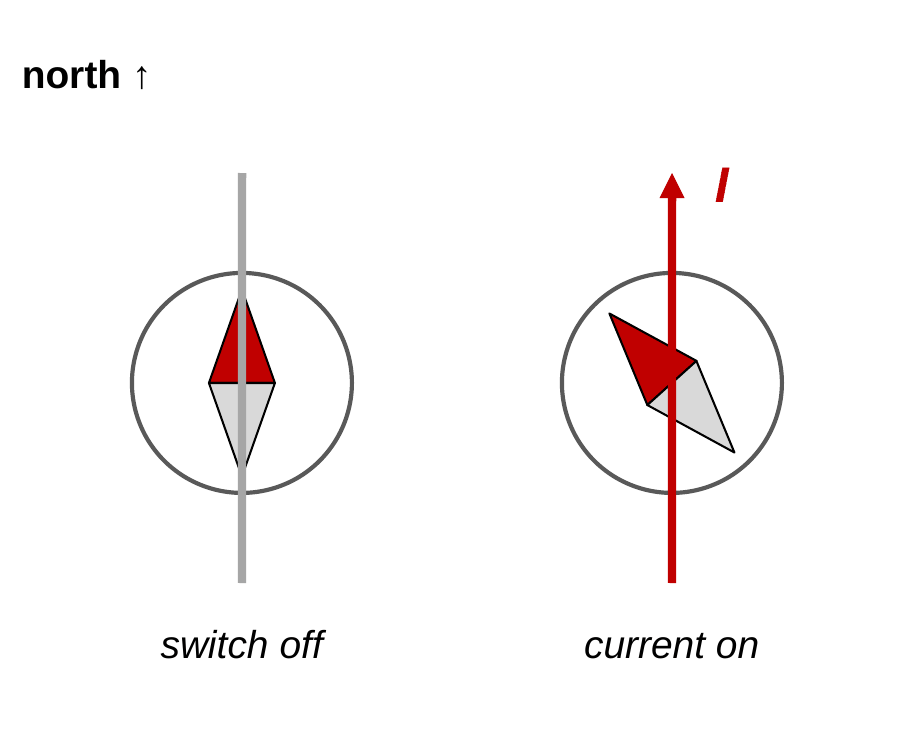
In 1820, Hans Christian Oersted noticed that a compass needle swung when he turned on the current in a nearby wire. When he switched the current off, the needle swung back to point north. This showed that an electric current makes a magnetic field. In fact, any moving charge makes a magnetic field. Charges sitting still do not.
Field Around a Wire
- Field lines are circles around the wire
- Closer to the wire: stronger
- More current: stronger
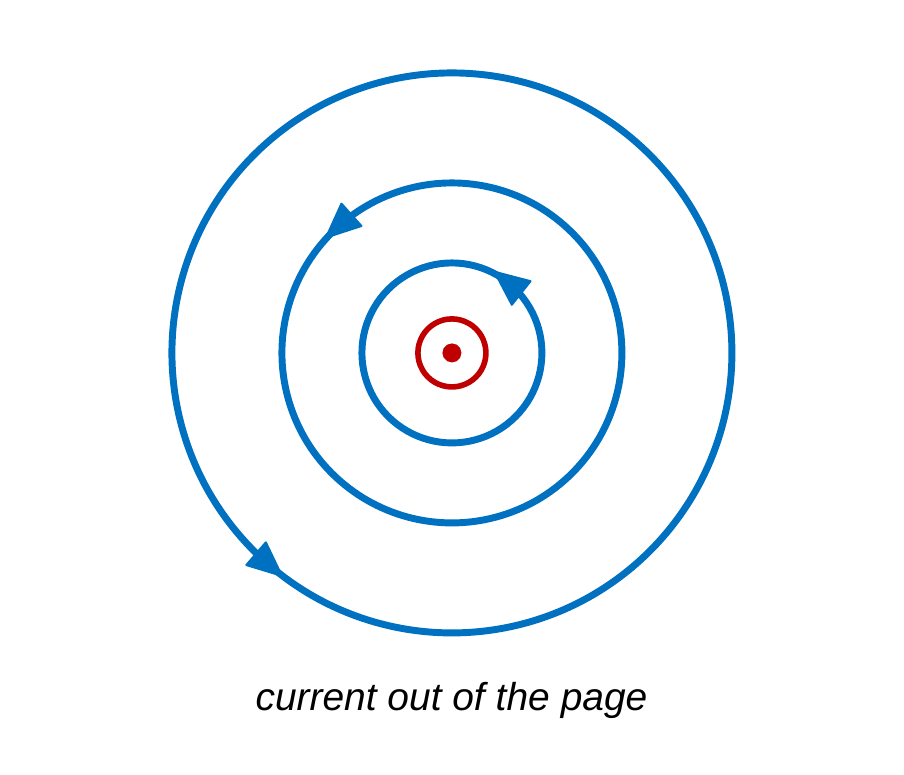
The magnetic field around a long straight wire forms circles centered on the wire. Here the wire points straight out of the page, so we see it end-on, and the current comes toward you. The field is strongest close to the wire and gets weaker farther away, which is why the circles spread apart. More current makes a stronger field.
Dots and Crosses
- Dot: out of the page, toward you
- Cross: into the page, away from you
- Used for both current and field
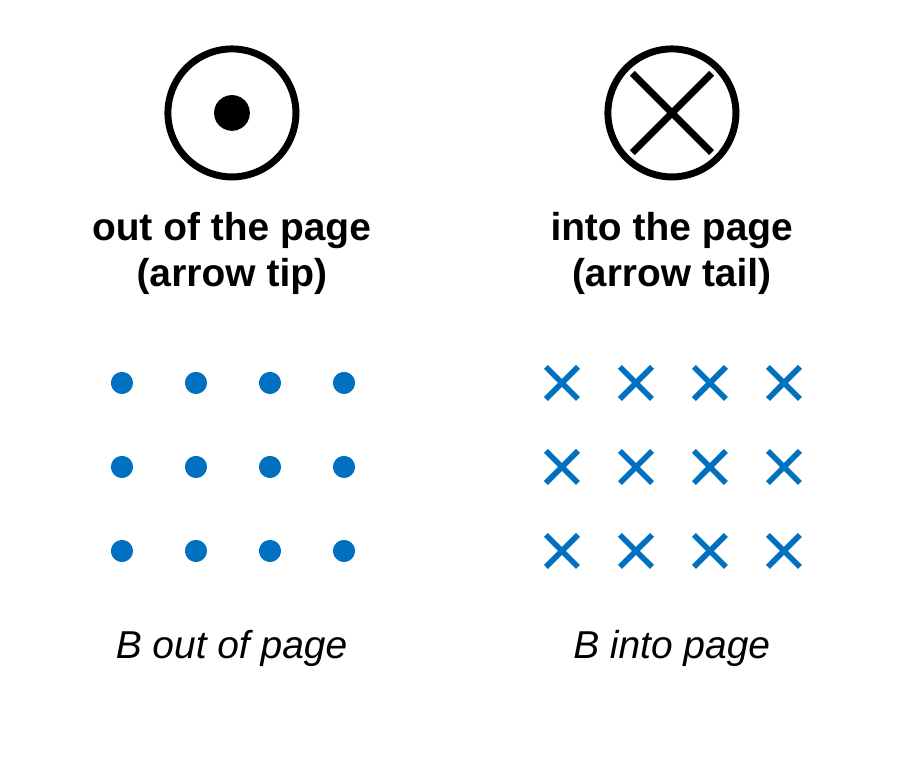
Magnetic fields and currents often point straight into or out of the page, which is hard to draw. Physicists use a simple code. A dot means out of the page, toward you, like the tip of an arrow flying at you. A cross (×) means into the page, away from you, like the feathers on the tail of an arrow flying away. A grid of dots shows a magnetic field coming out of the page. A grid of crosses shows a field going into the page.
Right-Hand Grip Rule
- Thumb points along current I
- Fingers curl the way B circles
- I = conventional current (+ flow)
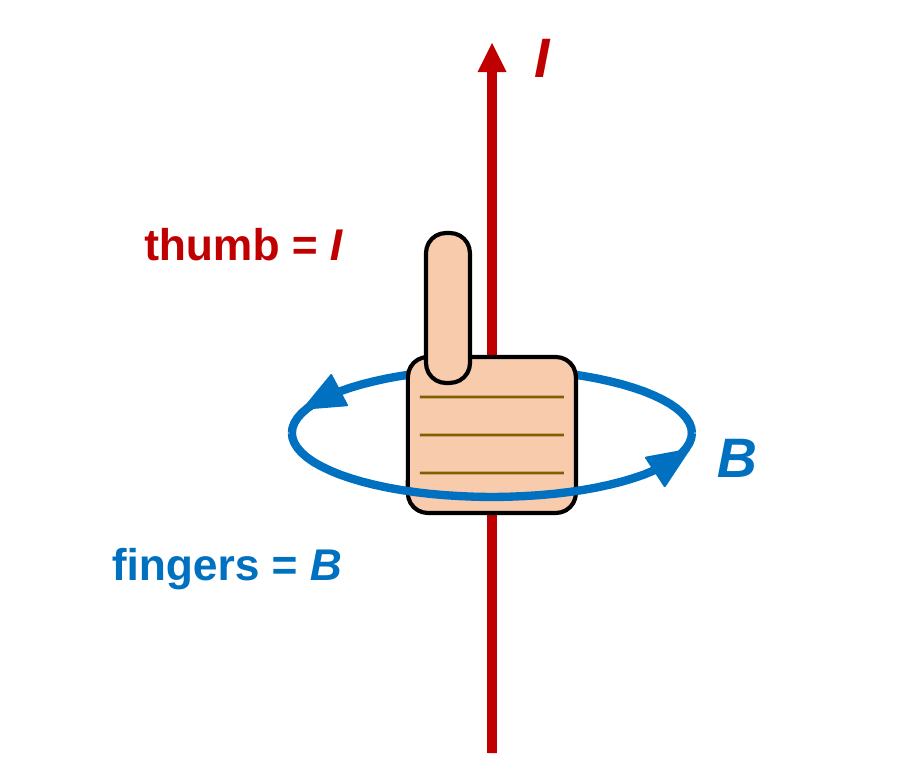
To find which way the field circles, use the right-hand grip rule. Grab the wire with your right hand so your thumb points in the direction of the current. Your fingers curl around the wire in the direction of the magnetic field. In this unit, current always means conventional current: the direction positive charges would move, from the + side of a battery to the − side. (Electrons actually move the opposite way, but every right-hand rule here uses conventional current.)
Wire in the Page
- Field pokes through the page
- Current up: × on the right
- Current up: • on the left
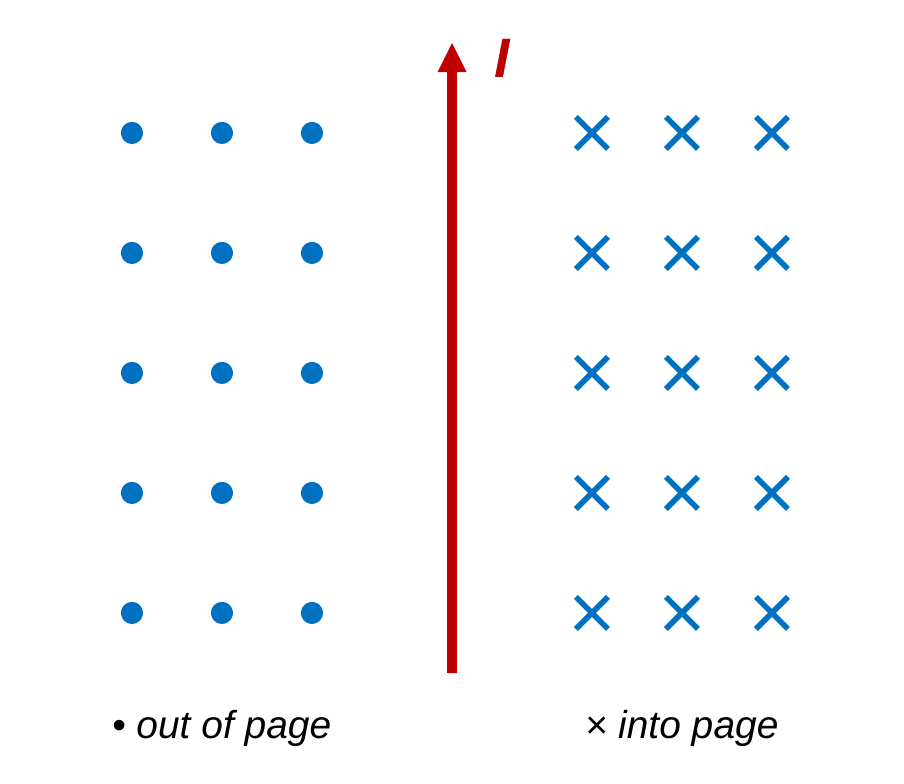
When a wire lies flat in the page, its circular field passes through the page: it comes up out of the page on one side of the wire and goes back down into the page on the other side. For a current pointing up the page, the right-hand grip rule shows the field points into the page (×) on the right of the wire and out of the page (•) on the left.
Field of a Coil
- Coil: many loops of wire
- Inside, the loops’ fields add up
- A coil acts like a bar magnet
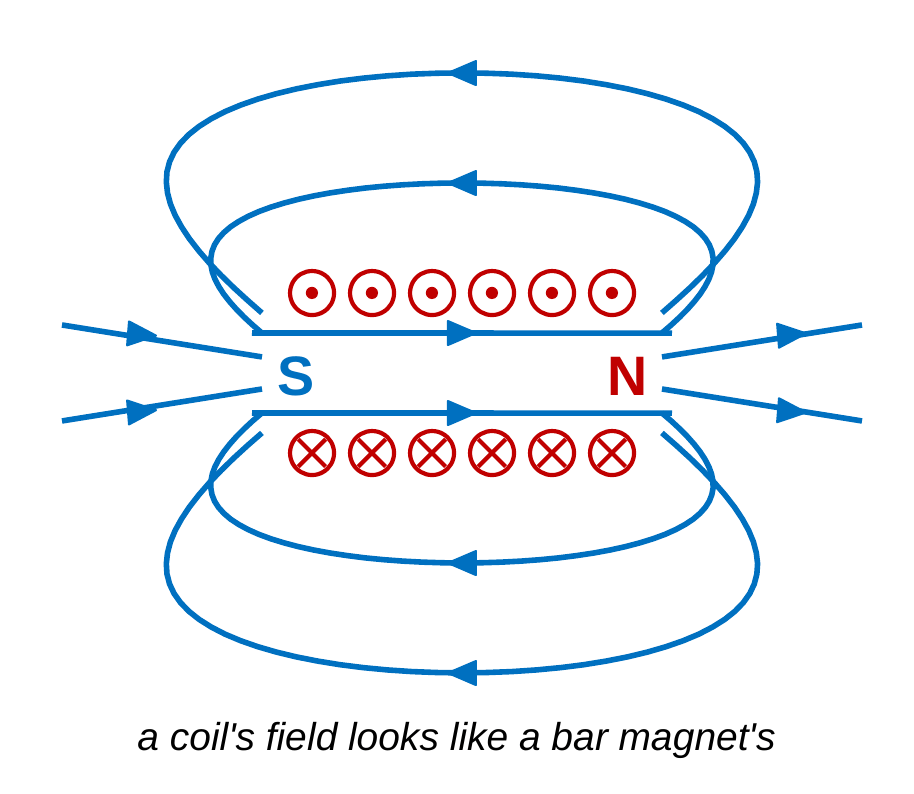
Wind a wire into a coil (also called a solenoid) and the fields from all the loops add together inside it. This picture slices the coil in half: the top wires carry current out of the page (dots) and the bottom wires carry current into the page (crosses). Inside the coil, the field is strong and points straight along the coil. Outside, the field lines loop around from one end to the other, exactly like a bar magnet. The end where the field lines come out is the N pole. To find it, curl the fingers of your right hand the way the current goes around the loops, and your thumb points to the N end.
Electromagnets
- Coil wrapped around an iron core
- Current on: magnet. Current off: not
- Used in cranes, speakers, and doorbells
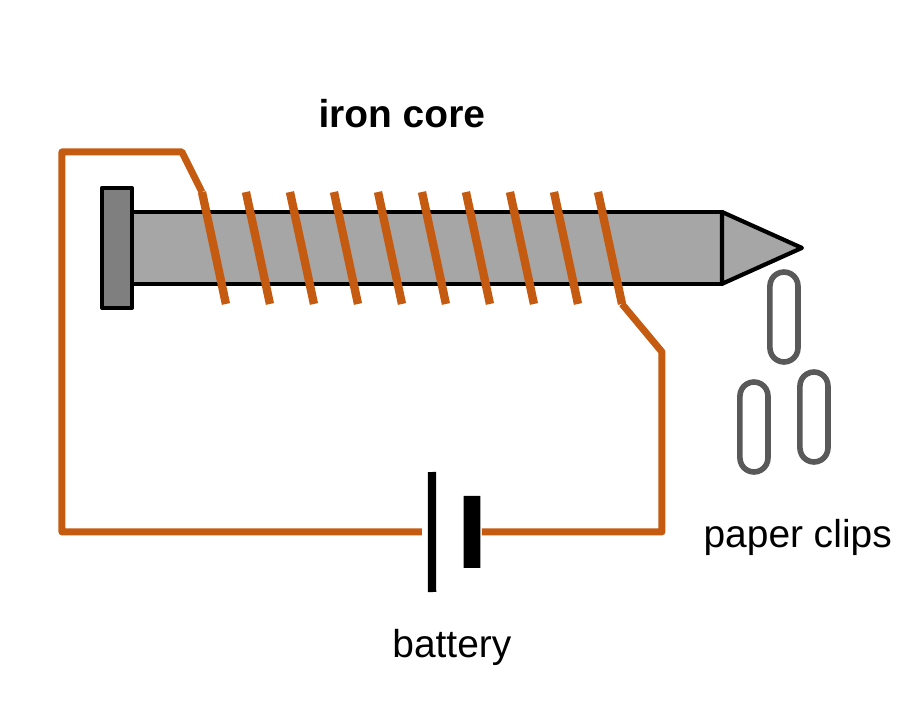
An electromagnet is a coil of wire wrapped around an iron core, like a nail. When current flows, the coil makes a magnetic field, and the iron’s domains line up with it, making the field much stronger. When the current stops, the field disappears. Because you can switch it on and off, electromagnets are used in scrapyard cranes, speakers, doorbells, MRI machines, and electric motors.
Making It Stronger
B ∝ N × I
- B = strength of the magnetic field
- N = number of turns (loops) in the coil
- I = current, in amperes (A)
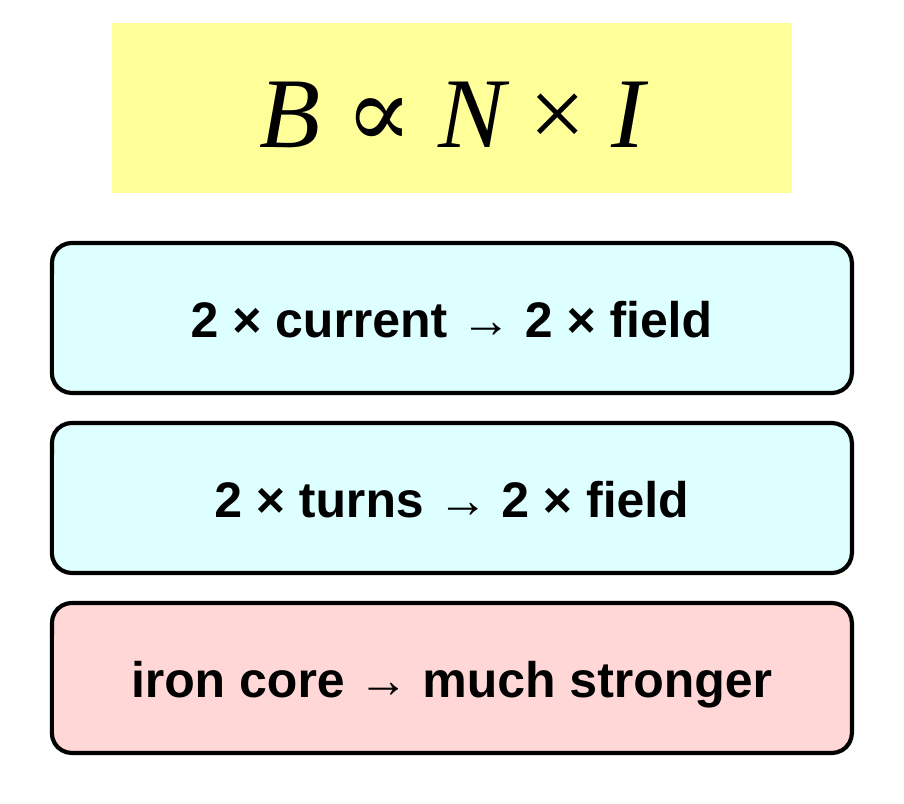
For a coil of a given length, the field is proportional to the number of turns times the current. Double the current and the field doubles. Double the turns and the field doubles. Do both and the field is four times as strong. Adding an iron core multiplies the field many times over, because the iron’s domains line up and add their own fields.
Worked Examples
Try each problem on your own first, then check your work against the solution.
Example 1: Field Next to a Wire
A long straight wire carries current toward the bottom of the page. Does the magnetic field at point P, to the left of the wire, point into or out of the page?
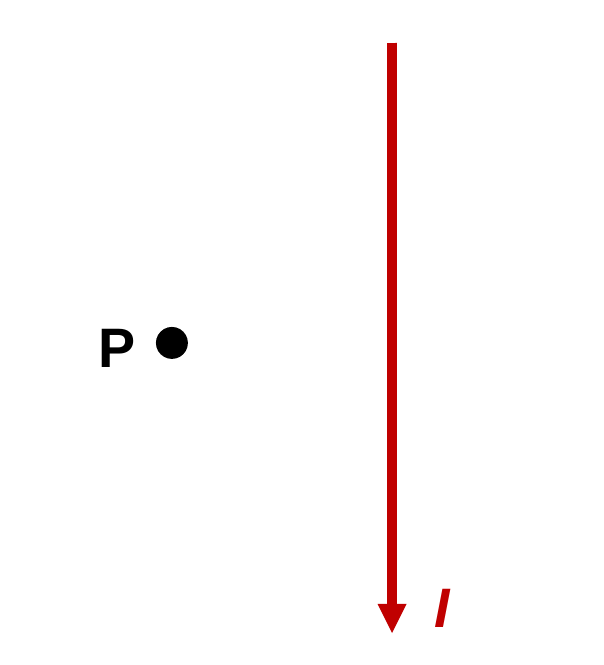
- Rule: Right-hand grip rule: thumb along the current, fingers curl in the direction of the field.
- Thumb: Point your right thumb down the page, along I.
- Fingers: Your fingers come out of the page on the right, wrap over the wire, and go down into the page on the left.
- Answer: The field at P points into the page (×).
Example 2: Current Out of the Page
A wire carries current straight out of the page. Which way does the magnetic field point at point P, directly above the wire?
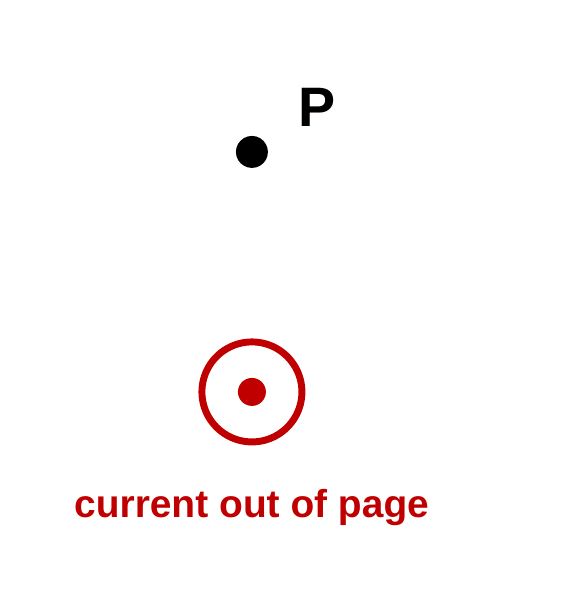
- Thumb: Point your right thumb out of the page, toward you, along the current.
- Fingers: Your fingers curl counterclockwise around the wire.
- At P: P is at the top of a counterclockwise circle. Going counterclockwise, the top of the circle moves to the left.
- Answer: The field at P points to the left.
Example 3: Which End Is North?
This cut-away coil has crosses (current into the page) on the top row and dots (current out of the page) on the bottom row. Which end of the coil is its N pole?
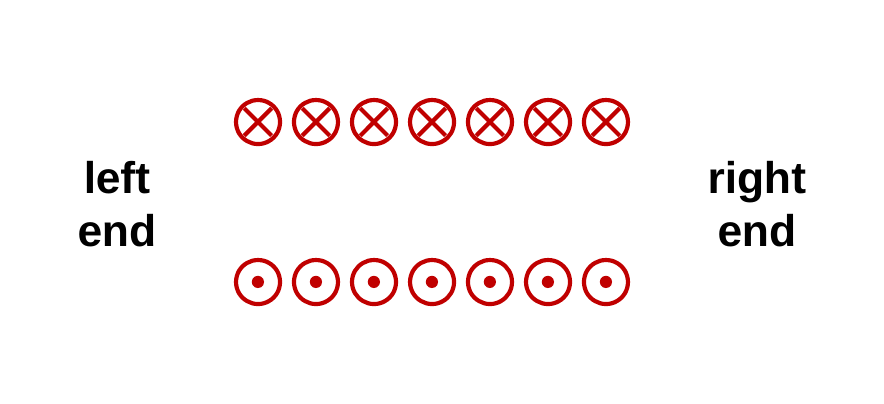
- Top wire: Current into the page: point your right thumb into the page. Your fingers curl clockwise, so just below the top wire (inside the coil) the field points left.
- Bottom wire: Current out of the page: point your thumb toward you. Your fingers curl counterclockwise, so just above the bottom wire (inside the coil) the field also points left.
- Field inside: Both rows agree: the field inside the coil points to the left.
- Answer: Field lines come out of the left end, so the left end is the N pole.
Example 4: Stronger Electromagnet
An electromagnet has 100 turns of wire carrying 2.0 A. You rewind it with 300 turns and raise the current to 4.0 A. How many times stronger is its magnetic field?
- Knowns: Before: N = 100, I = 2.0 A. After: N = 300, I = 4.0 A.
- Relationship: B ∝ N × I, so compare N × I before and after.
- Before: 100 × 2.0 = 200
- After: 300 × 4.0 = 1,200
- Answer: 1,200 ÷ 200 = 6.0 times stronger
Another way to see it: tripling the turns triples the field, and doubling the current doubles it again, so 3 × 2 = 6.
Big Ideas
- Moving charges (currents) make magnetic fields
- Grip rule: thumb = I, fingers curl = B
- • out of page, × into page
- Coil = electromagnet: B ∝ N × I, iron core helps
Back to the essential question: electricity makes a magnet because any moving charge, including an electric current, creates a magnetic field. The field circles a straight wire, and a coil of wire acts like a bar magnet, which gets stronger with more current, more turns, and an iron core. Next up, we’ll flip the idea around and see how a magnetic field pushes on moving charges.

