
The video lesson for this topic is coming soon.
Essential Question
How does a magnetic field push on a moving charge?
A magnetic field can push on an electric charge, but only if the charge is moving, and the push comes from the side. By the end of this lesson, you should be able to find the direction of the magnetic force with a right-hand rule and calculate its size for a moving charge and for a current-carrying wire.
Force on a Moving Charge
- A field pushes on moving charges
- The force is sideways
- F is ⟂ to both v and B
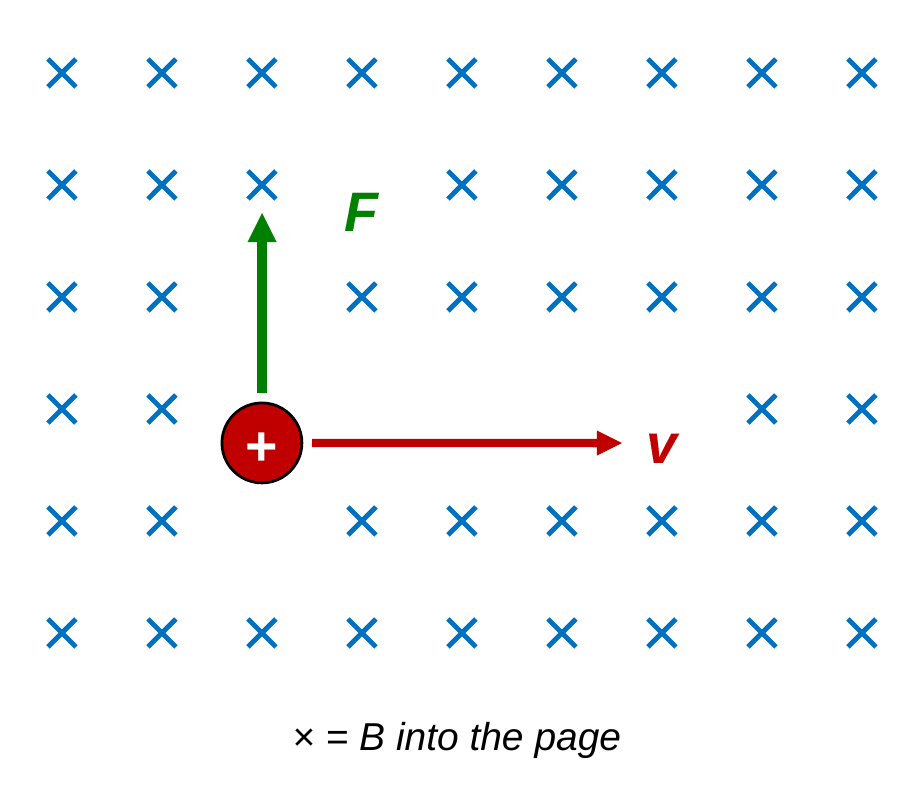
When a charged particle moves through a magnetic field, the field pushes on it. The strange part is the direction: the magnetic force is always perpendicular (⟂) to both the particle’s velocity v and the field B. Here the field points into the page and a positive charge moves to the right, so the force on it points up the page, at a right angle to its motion.
Right-Hand Rule for Force
- Fingers point along B
- Thumb points along v (or I)
- Palm pushes: direction of F
- Works for + charges
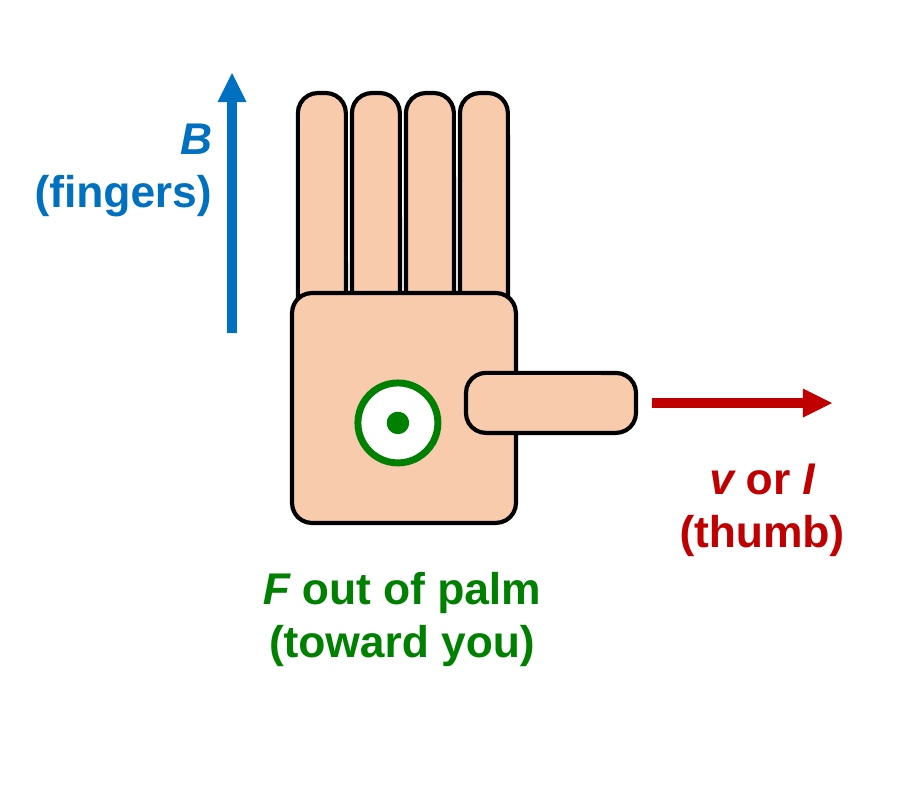
To find the direction of the magnetic force on a positive charge, hold your right hand flat. Point your fingers in the direction of the field B and your thumb in the direction the charge moves, v. Your palm faces the direction of the force F, as if you were pushing with it. For a current-carrying wire, point your thumb along the conventional current I. In the picture, the fingers point up the page and the thumb points right, so the palm faces you: the force comes out of the page.
Negative Charges
- Use the same right-hand rule
- Then flip the force
- Electron: force is opposite
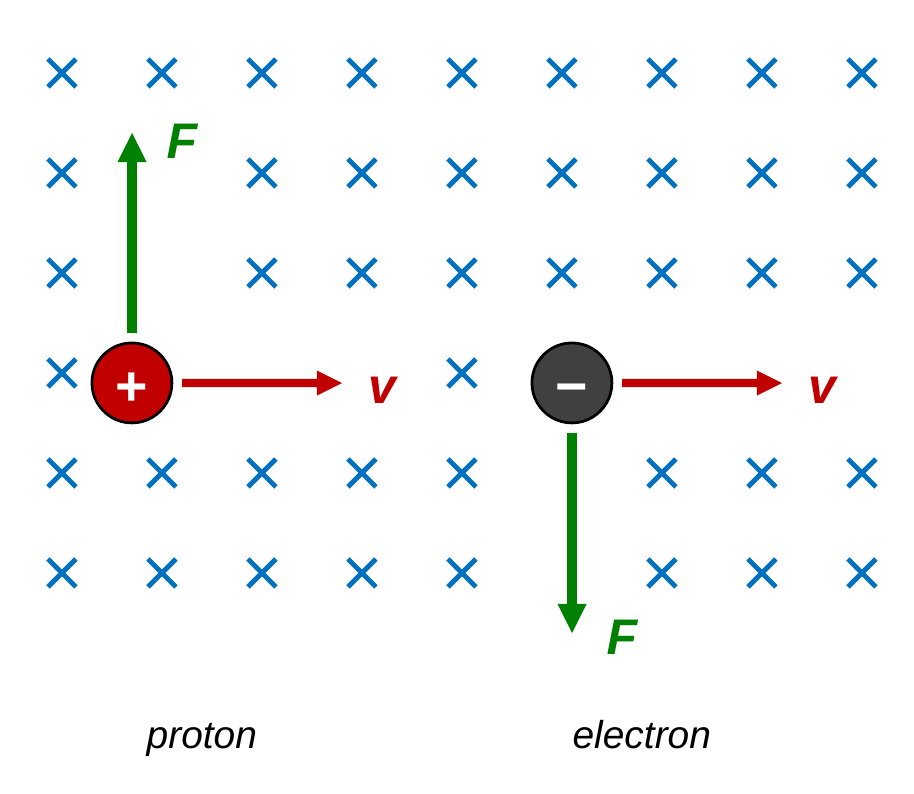
The right-hand rule gives the force on a positive charge. A negative charge, like an electron, feels a force in exactly the opposite direction. So for an electron, use the right-hand rule as usual, then reverse the answer. Here both particles move to the right through the same field: the proton is pushed up and the electron is pushed down.
When Is There No Force?
- Charge at rest: no force
- Moving along B: no force
- Moving across B: biggest force
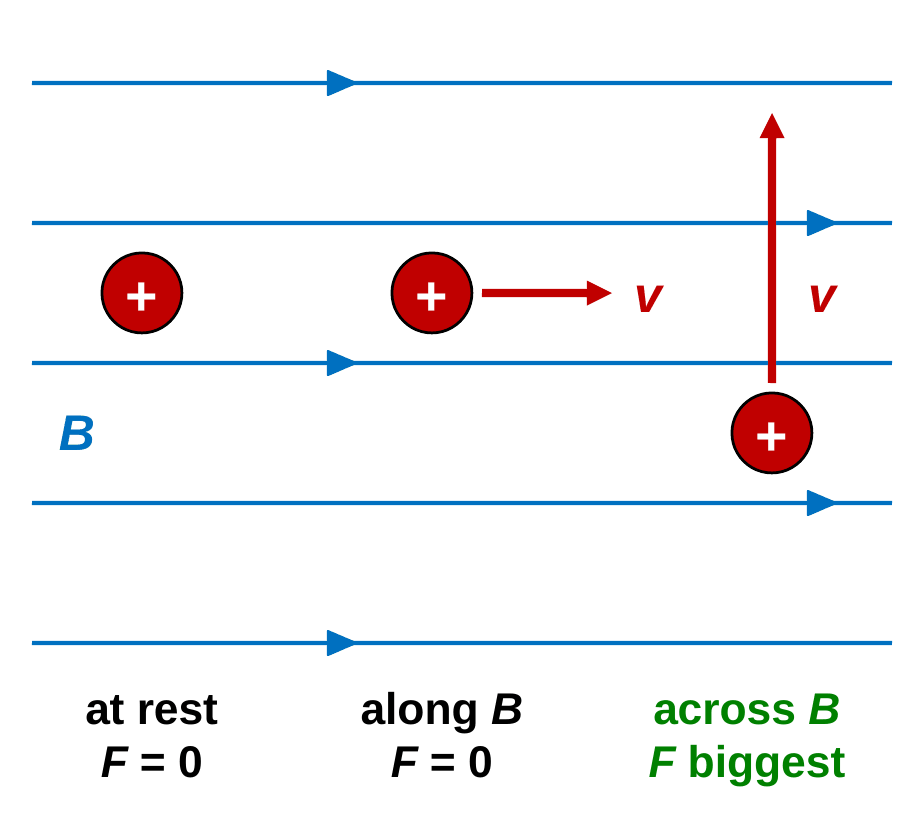
A magnetic field only pushes on a charge that is moving, and only on the part of the motion that cuts across the field. A charge at rest feels no magnetic force. A charge moving straight along the field lines (parallel or antiparallel to B) also feels no force. The force is biggest when the charge moves at a right angle to the field.
The Magnetic Force Equation
F = qvB sin θ
- F = magnetic force, in newtons (N)
- q = charge, in coulombs (C)
- v = speed, in meters per second (m/s)
- B = magnetic field, in teslas (T)
- θ = the angle between v and B
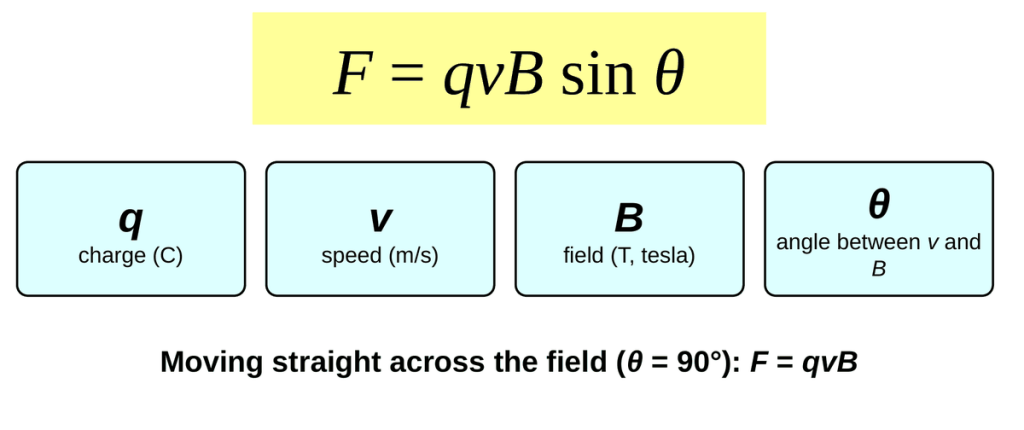
When the charge moves straight across the field (θ = 90°), sin 90° = 1 and the equation becomes F = qvB, the biggest force possible. When it moves along the field (θ = 0°), sin 0° = 0 and the force is zero. This equation gives only the size of the force. Use the right-hand rule for its direction.
Force on a Wire
F = ILB
- I = current, in amperes (A)
- L = length of wire in the field, in meters (m)
- B = magnetic field, in teslas (T)
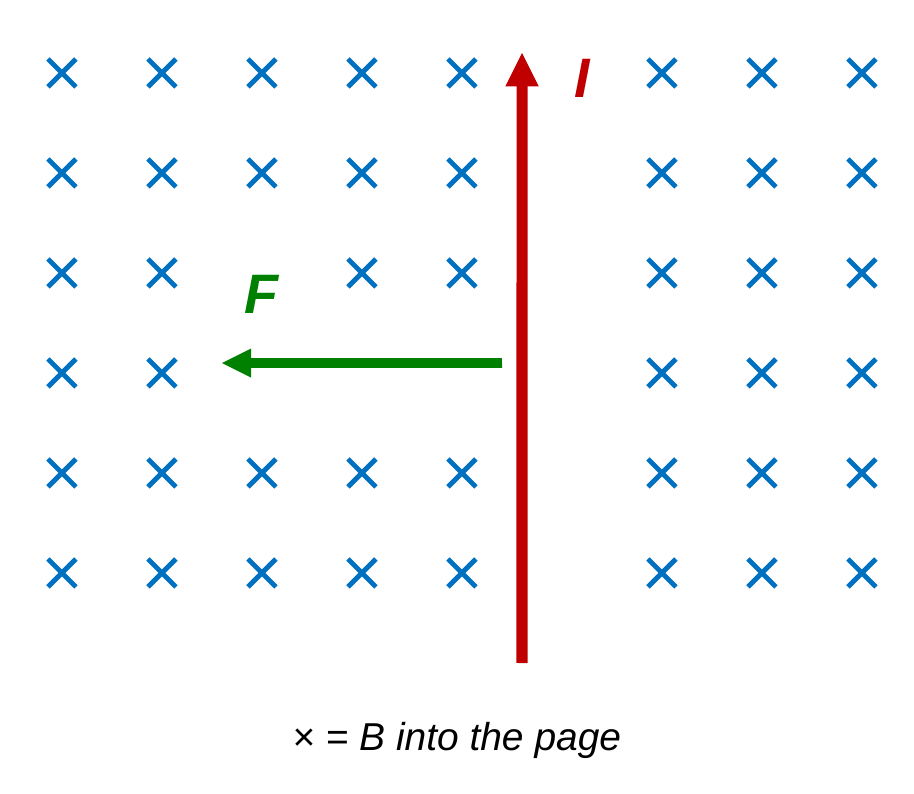
A current is just a stream of moving charges, so a current-carrying wire in a magnetic field feels a force too. When the wire is perpendicular to the field, the force is F = ILB. Find the direction with the same right-hand rule, with your thumb along the conventional current. Here the field points into the page and the current points up, so the force pushes the wire to the left. This force is what makes electric motors spin.
Steers, Doesn’t Speed Up
- Force always ⟂ to the motion
- Changes direction, not speed
- No work done: path bends into a circle
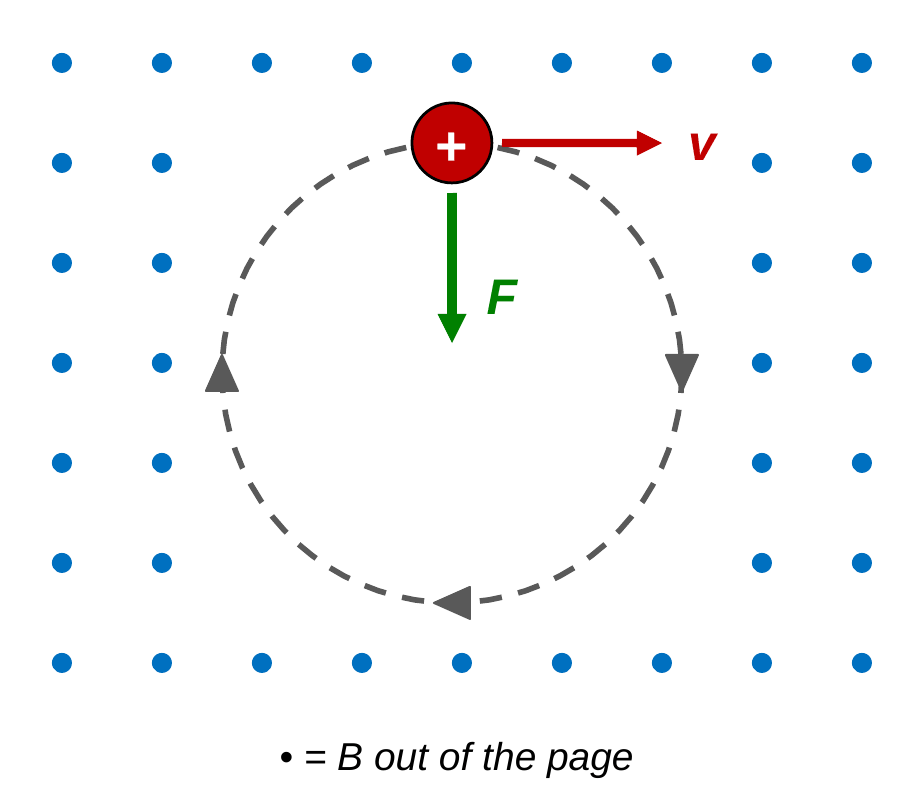
The magnetic force is always perpendicular to the velocity, so it never pushes a charge forward or backward. That means it does no work on the charge, and the charge’s speed and kinetic energy never change. All the force can do is change the direction of motion. A charge moving straight across a uniform field keeps getting steered sideways, so it travels in a circle, with the magnetic force acting as the centripetal force. Here the field points out of the page and a positive charge circles clockwise.
Worked Examples
Try each problem on your own first, then check your work against the solution.
Example 1: Force on a Proton
A proton (q = 1.60 × 10⁻¹⁹ C) moves to the right at 2.0 × 10⁶ m/s through a 0.50 T magnetic field that points into the page. Find the magnitude and direction of the magnetic force on it.
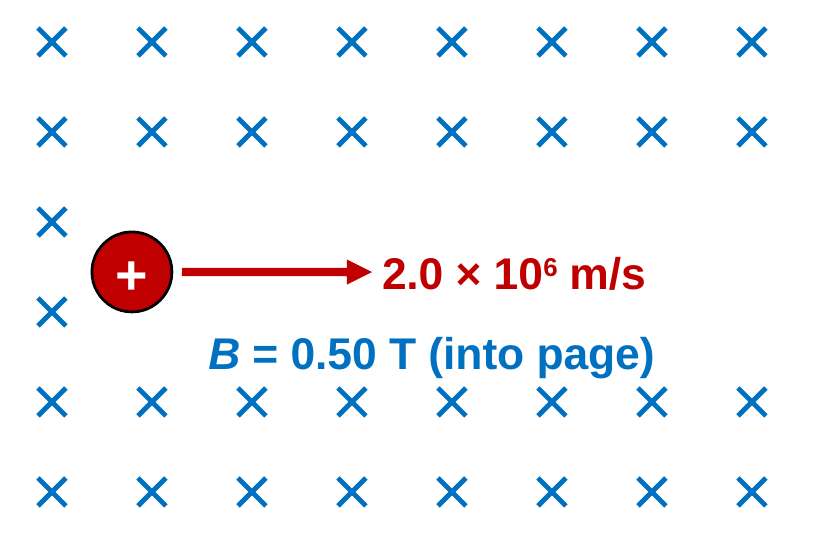
- Knowns: q = 1.60 × 10⁻¹⁹ C, v = 2.0 × 10⁶ m/s, B = 0.50 T, θ = 90°
- Equation: F = qvB sin θ, and sin 90° = 1, so F = qvB
- Substitute: F = (1.60 × 10⁻¹⁹ C)(2.0 × 10⁶ m/s)(0.50 T)
- Magnitude: F = 1.6 × 10⁻¹³ N
- Direction: Right-hand rule: fingers into the page (B), thumb to the right (v), palm faces up. A proton is positive, so no flip.
- Answer: F = 1.6 × 10⁻¹³ N, toward the top of the page
Example 2: Force on an Electron
An electron (q = −1.60 × 10⁻¹⁹ C) moves toward the top of the page at 3.0 × 10⁶ m/s through a 0.20 T field that points out of the page. Find the magnitude and direction of the magnetic force on it.
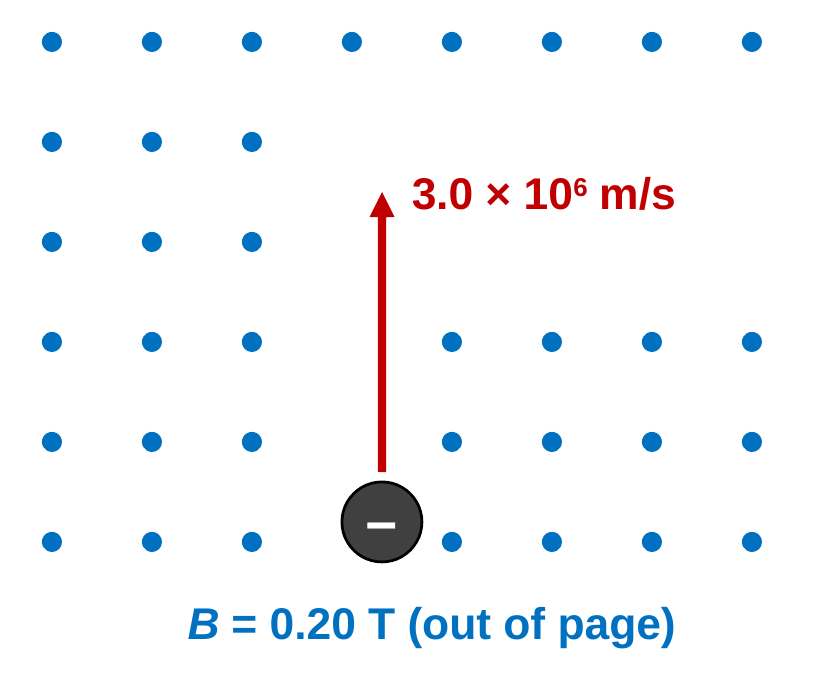
- Knowns: |q| = 1.60 × 10⁻¹⁹ C, v = 3.0 × 10⁶ m/s, B = 0.20 T, θ = 90°
- Equation: F = |q|vB (use the size of the charge for the magnitude)
- Substitute: F = (1.60 × 10⁻¹⁹ C)(3.0 × 10⁶ m/s)(0.20 T) = 9.6 × 10⁻¹⁴ N
- Direction for a + charge: Fingers out of the page (B), thumb up the page (v): palm faces right.
- Flip for the electron: The electron is negative, so the force is opposite: to the left.
- Answer: F = 9.6 × 10⁻¹⁴ N, to the left
Example 3: Charge at an Angle
A proton (q = 1.60 × 10⁻¹⁹ C) moves at 5.0 × 10⁵ m/s through a 0.40 T field. Its velocity makes a 30.0° angle with the field. What is the magnitude of the magnetic force on it?
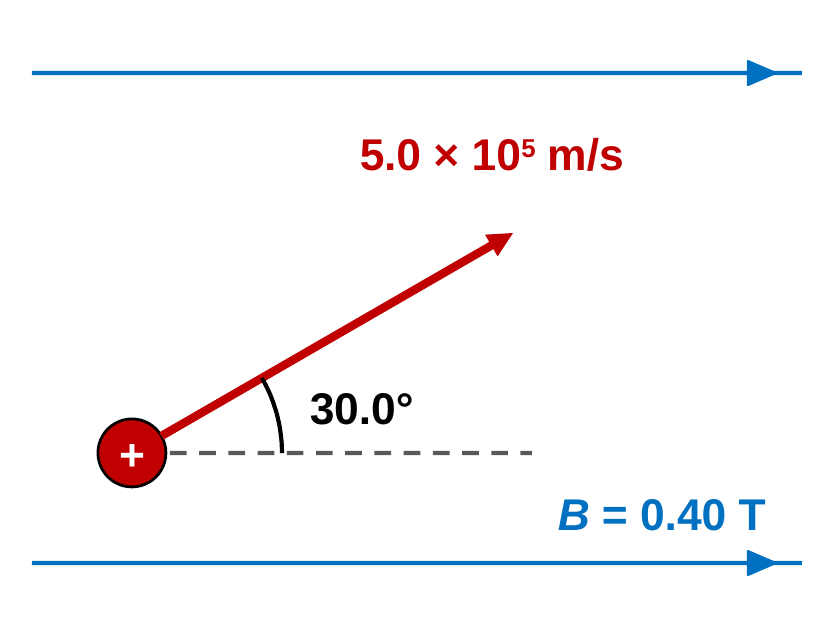
- Knowns: q = 1.60 × 10⁻¹⁹ C, v = 5.0 × 10⁵ m/s, B = 0.40 T, θ = 30.0°
- Equation: F = qvB sin θ
- Substitute: F = (1.60 × 10⁻¹⁹ C)(5.0 × 10⁵ m/s)(0.40 T)(sin 30.0°), and sin 30.0° = 0.500
- Answer: F = 1.6 × 10⁻¹⁴ N
Moving at 30.0° to the field cuts the force in half compared to moving straight across it, because only part of the motion cuts across the field lines.
Example 4: Force on a Wire
A 0.50 m section of wire carries 4.0 A to the right through a 0.30 T field that points out of the page. Find the magnitude and direction of the force on the wire.
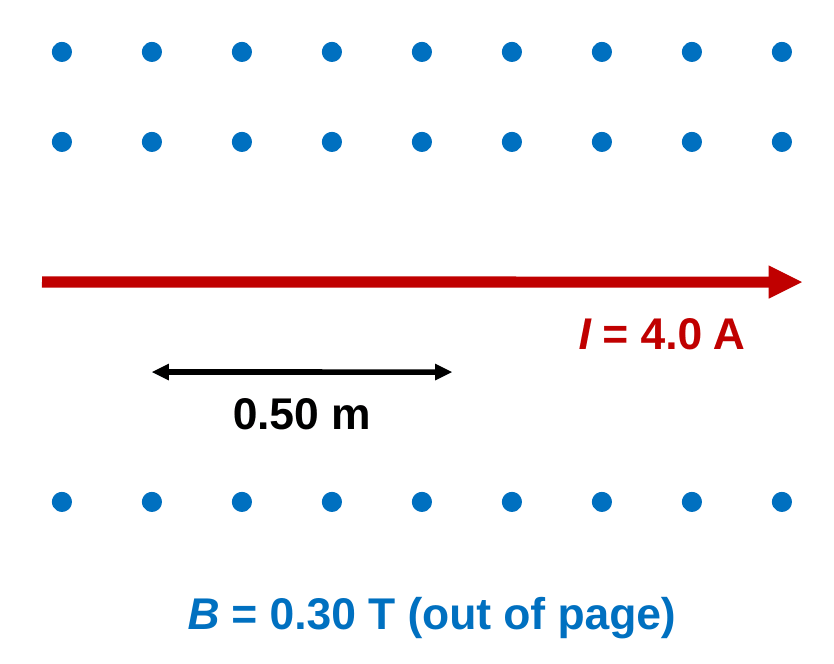
- Knowns: L = 0.50 m, I = 4.0 A, B = 0.30 T, wire ⟂ field
- Equation: F = ILB
- Substitute: F = (4.0 A)(0.50 m)(0.30 T) = 0.60 N
- Direction: Right-hand rule: fingers out of the page (B), thumb to the right (I). The palm faces down the page.
- Answer: F = 0.60 N, toward the bottom of the page
Big Ideas
- Moving charges in a field feel a sideways force
- Right hand: fingers B, thumb v or I, palm F
- Flip it for negative charges
- F = qvB sin θ, F = ILB; no force at rest or along B
Back to the essential question: a magnetic field pushes on a moving charge with a force that is perpendicular to both the charge’s velocity and the field, found with the right-hand rule and calculated with F = qvB sin θ. A charge at rest or moving along the field feels no force, and because the force is always sideways, it changes the charge’s direction but not its speed. Next up, we’ll see how a changing magnetic field can create a current, which is called electromagnetic induction.

