
The video lesson for this topic is coming soon.
Essential Question
Which is stronger: gravity or the electric force?
Gravity holds planets in orbit, and electric forces hold atoms together. By the end of this lesson, you should be able to compare the two forces, explain which is stronger, and explain why gravity rules at the scale of planets and stars while electric forces rule at the scale of everyday life.
Same Shape
- Both are inverse square
- Both act at a distance
- Mass ↔ charge, G ↔ k
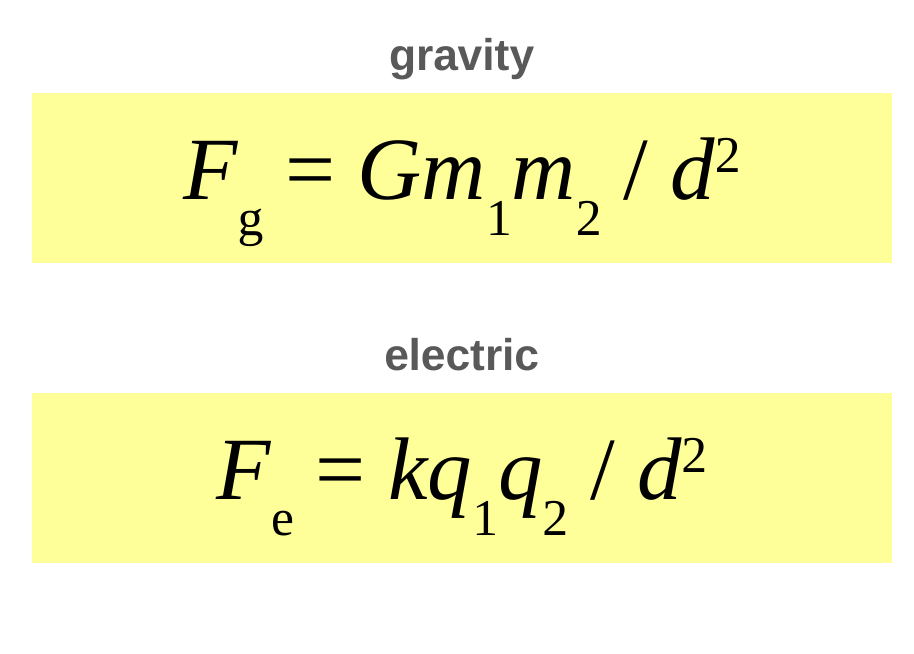
Newton’s law of gravitation and Coulomb’s law have exactly the same form. In both, the force depends on the product of two quantities (masses or charges) divided by the distance squared, so both are inverse square laws. Both forces also act at a distance: the objects don’t need to touch, because each one creates a field that reaches across space.
Attract vs. Repel
- Gravity only attracts
- Electric forces attract or repel
- No such thing as negative mass
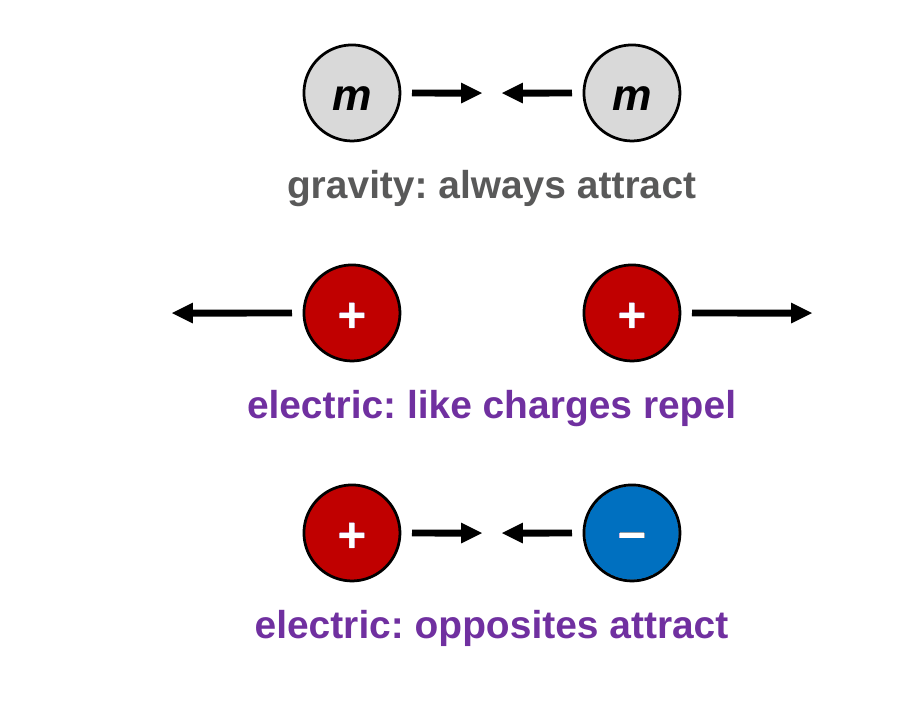
Here is the biggest difference between the two forces. Charge comes in two types, positive and negative, so electric forces can attract or repel. Mass only comes in one type. There is no negative mass, so gravity can only pull. It never pushes.
Electric Forces Are Stronger
- A charged comb lifts paper
- Tiny charge beats all of Earth
- Electric force is far stronger
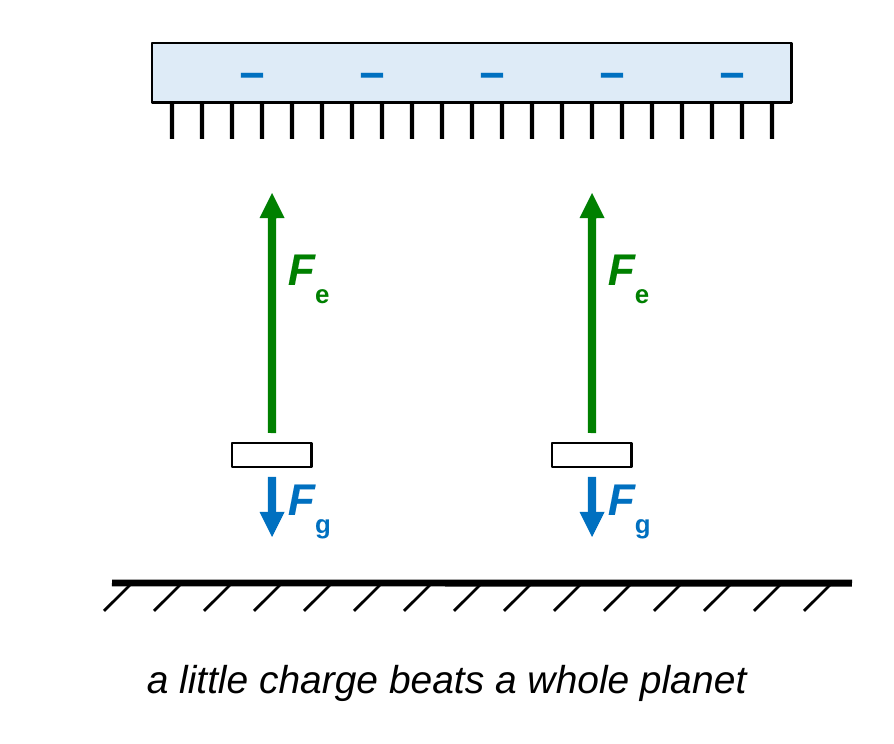
Run a plastic comb through your hair and hold it over tiny bits of paper. The paper jumps up to the comb. The entire Earth, with a mass of about 6 × 1024 kg, is pulling the paper down, but a few billionths of a coulomb of charge on the comb pulls it up harder. That shows how much stronger the electric force is than gravity.
Why Gravity Rules Space
- Matter is mostly neutral
- + and − cancel out
- Mass always adds up
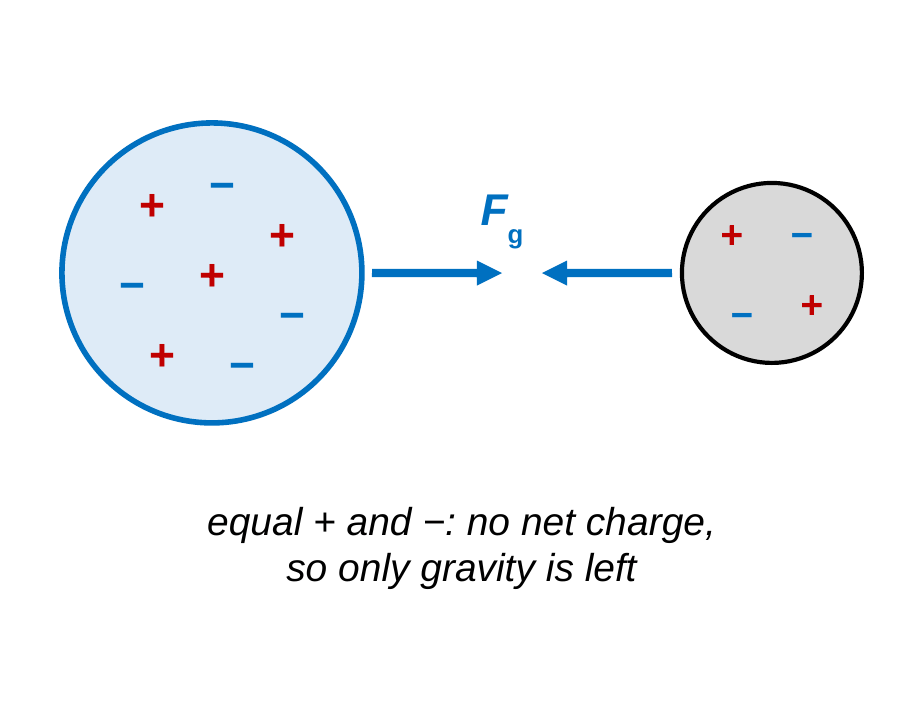
If the electric force is so much stronger, why does gravity control the motion of planets, moons, and stars? Because big objects are almost perfectly neutral. They have nearly equal amounts of positive and negative charge, so their electric pushes and pulls cancel out. Mass never cancels, because it only comes in one type. Add up the mass of a whole planet and the gravity is enormous, while the net electric force is essentially zero.
Contact Forces Are Electric
- Normal force, friction, tension
- All are electric forces
- Electrons push on electrons
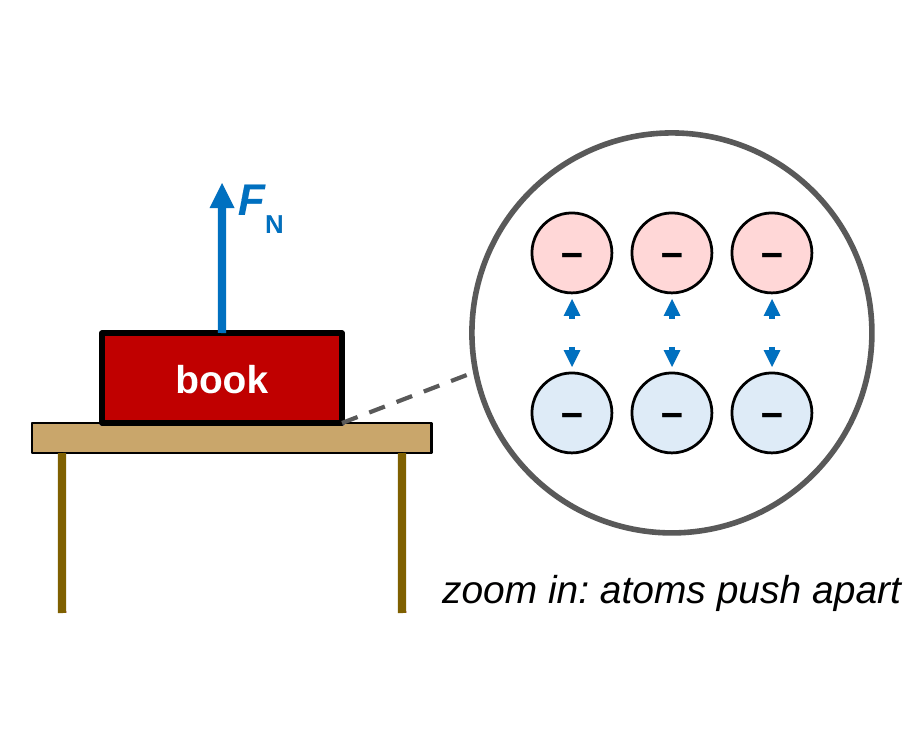
Every contact force you have studied, including the normal force, friction, and tension, is really the electric force at work. When a book rests on a table, the electrons on the outside of the book’s atoms are pushed away by the electrons on the outside of the table’s atoms. That repulsion is the normal force. Friction and tension come from electric forces between atoms too. Gravity pulls you down, but almost every other push or pull you feel is electric.
Side by Side
Gravity and the electric force at a glance:
- Acts on: gravity acts on mass; the electric force acts on charge
- Direction: gravity only attracts; the electric force attracts or repels
- Strength: gravity is very weak; the electric force is very strong
- Rules at: gravity rules planets and stars; the electric force rules atoms and everyday life
- Both: inverse square laws that act at a distance
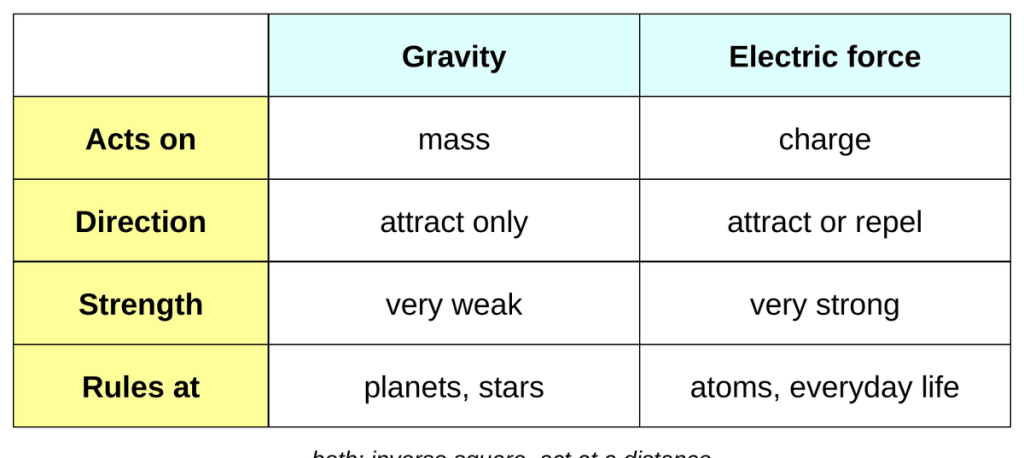
Each force wins in a different place. Electric forces are vastly stronger, but they cancel out in large, neutral objects. Gravity is weak, but it only adds up, so it takes over when enormous masses are involved.
Worked Examples
Try each problem on your own first, then check your work against the solution.
Example 1: Electric Force in Hydrogen
In a hydrogen atom, the electron is 5.3 × 10⁻¹¹ m from the proton. Each has a charge of size 1.6 × 10⁻¹⁹ C. What is the electric force between them?
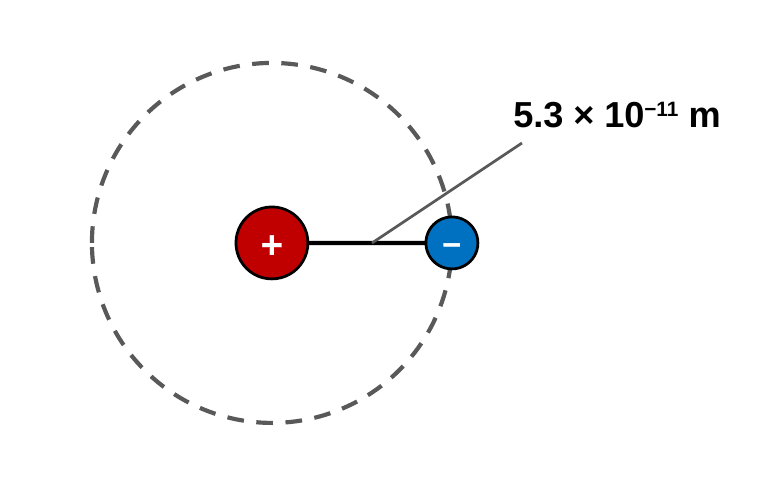
- Knowns: q1 = q2 = 1.6 × 10⁻¹⁹ C, d = 5.3 × 10⁻¹¹ m, k = 9.0 × 10⁹ N·m2/C2
- Equation: Fe = kq1q2/d2
- Top: (9.0 × 10⁹)(1.6 × 10⁻¹⁹)(1.6 × 10⁻¹⁹) = 2.30 × 10⁻²⁸
- Bottom: (5.3 × 10⁻¹¹ m)2 = 2.81 × 10⁻²¹ m2
- Answer: Fe = 2.30 × 10⁻²⁸ ÷ 2.81 × 10−21 = 8.2 × 10⁻⁸ N, attractive
Example 2: Gravity in Hydrogen
The proton has a mass of 1.67 × 10⁻²⁷ kg and the electron 9.11 × 10⁻³¹ kg. They are 5.3 × 10⁻¹¹ m apart. What is the gravitational force between them?
- Knowns: m1 = 1.67 × 10⁻²⁷ kg, m2 = 9.11 × 10⁻³¹ kg, d = 5.3 × 10⁻¹¹ m, G = 6.67 × 10⁻¹¹ N·m2/kg2
- Equation: Fg = Gm1m2/d2
- Top: (6.67 × 10⁻¹¹)(1.67 × 10⁻²⁷)(9.11 × 10⁻³¹) = 1.01 × 10−67
- Bottom: (5.3 × 10⁻¹¹ m)2 = 2.81 × 10⁻²¹ m2
- Answer: Fg = 1.01 × 10−67 ÷ 2.81 × 10−21 = 3.6 × 10−47 N, attractive
Example 3: Comparing the Forces
In a hydrogen atom, the electric force is 8.2 × 10⁻⁸ N and the gravitational force is 3.6 × 10−47 N. How many times stronger is the electric force?
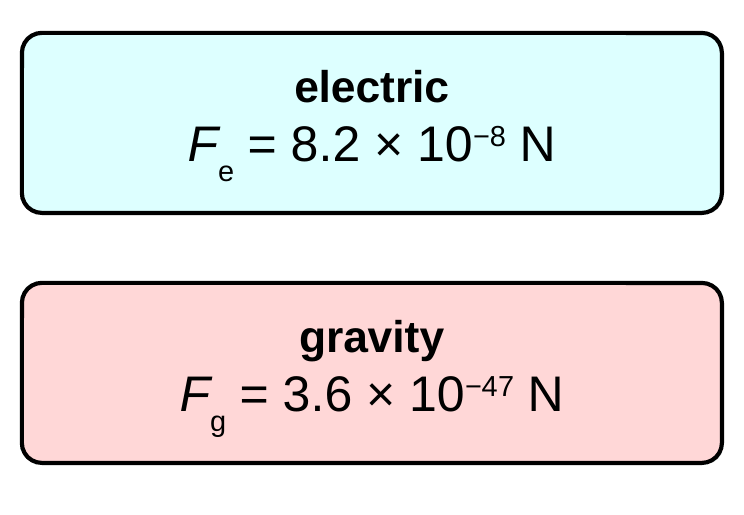
- Set up: ratio = Fe ÷ Fg = 8.2 × 10⁻⁸ N ÷ 3.6 × 10−47 N. The newtons cancel.
- Front numbers: 8.2 ÷ 3.6 = 2.3
- Exponents: 10−8 ÷ 10−47 = 10−8 − (−47) = 1039
- Answer: the electric force is 2.3 × 1039 times stronger than gravity
That’s 23 followed by 38 zeros. Gravity between a proton and an electron is so weak that it plays no role at all inside an atom.
Big Ideas
- Both: inverse square, act at a distance
- Gravity attracts; electric attracts or repels
- Electric force is ~1039 times stronger
- Neutral matter: gravity rules space
Back to the essential question: the electric force is far stronger than gravity, about 1039 times stronger between a proton and an electron. Both are inverse square forces that act at a distance, but gravity only attracts, while electric forces attract or repel. Because matter is mostly neutral, electric forces cancel out over large distances, so gravity rules planets and stars. Up close, electric forces rule, and they are behind every push and pull you feel, including normal force, friction, and tension. That wraps up our unit on fields. Next, we’ll put moving charges to work in electric circuits.

