
The video lesson for this topic is coming soon.
Essential Question
Why doesn’t the Moon fall down to Earth?
Earth and the Moon pull on each other with an enormous force, so why doesn’t the Moon crash into Earth? By the end of this lesson, you should be able to describe a gravitational field, calculate field strength with g = F/m, and explain how gravity keeps satellites and moons in orbit.
Gravitational Field
- Mass creates a field around it
- Field lines point toward the mass
- Closer lines = stronger field
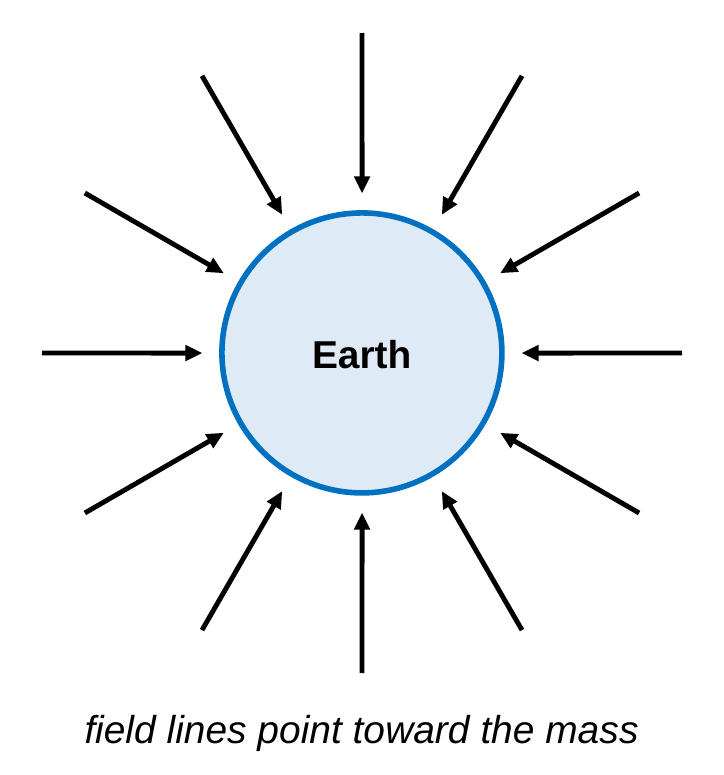
Just as a charge creates an electric field, a mass creates a gravitational field in the space around it. Any other mass placed in that field feels a pull. Gravitational field lines always point toward the mass, because gravity only attracts. The lines are crowded near the planet, where the field is strong, and spread out farther away, where it is weaker.
Field Strength
g = F / m
- g = gravitational field strength, in newtons per kilogram (N/kg)
- F = gravitational force on the object, in newtons (N)
- m = mass of the object, in kilograms (kg)
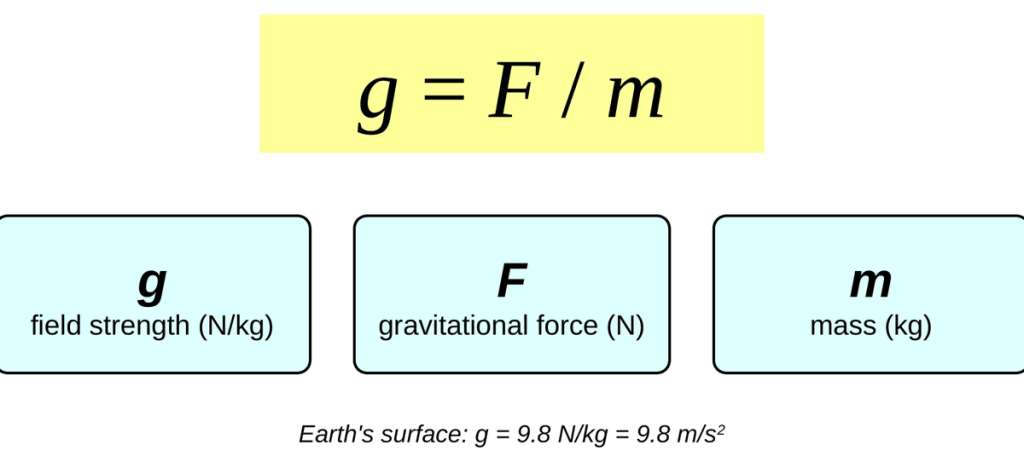
Gravitational field strength is the force of gravity on each kilogram of mass. At Earth’s surface, every kilogram is pulled with 9.8 N, so g = 9.8 N/kg. A newton per kilogram is the same unit as a meter per second squared, which is why the field strength is also the acceleration of a falling object. This is the same idea as E = F/q, with mass in place of charge.
Weaker with Distance
- g = GM/d2
- M: mass of the planet
- Double d: ¼ the field
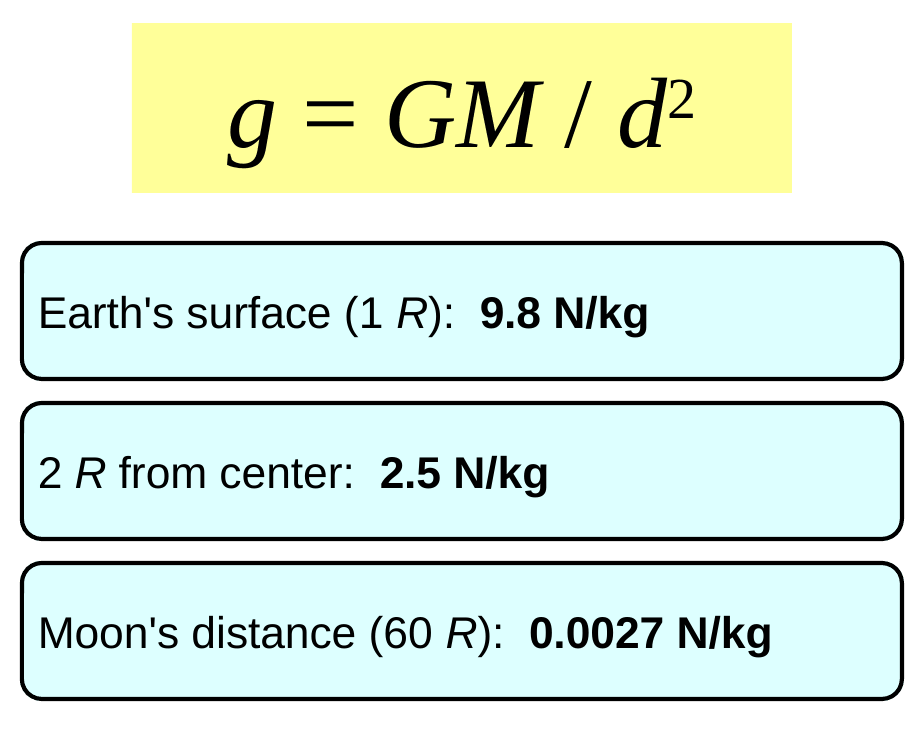
Combining g = F/m with Newton’s law of gravitation gives g = GM/d2, where M is the mass of the planet and d is the distance from its center. The field follows an inverse square law. At twice Earth’s radius from the center, the field is one fourth of 9.8 N/kg, about 2.5 N/kg. At the Moon’s distance, about 60 Earth radii away, it is only 0.0027 N/kg, but that small pull is still enough to hold the Moon in orbit.
Gravity Bends the Path
- Gravity pulls toward the center
- Velocity points sideways
- Gravity is the centripetal force
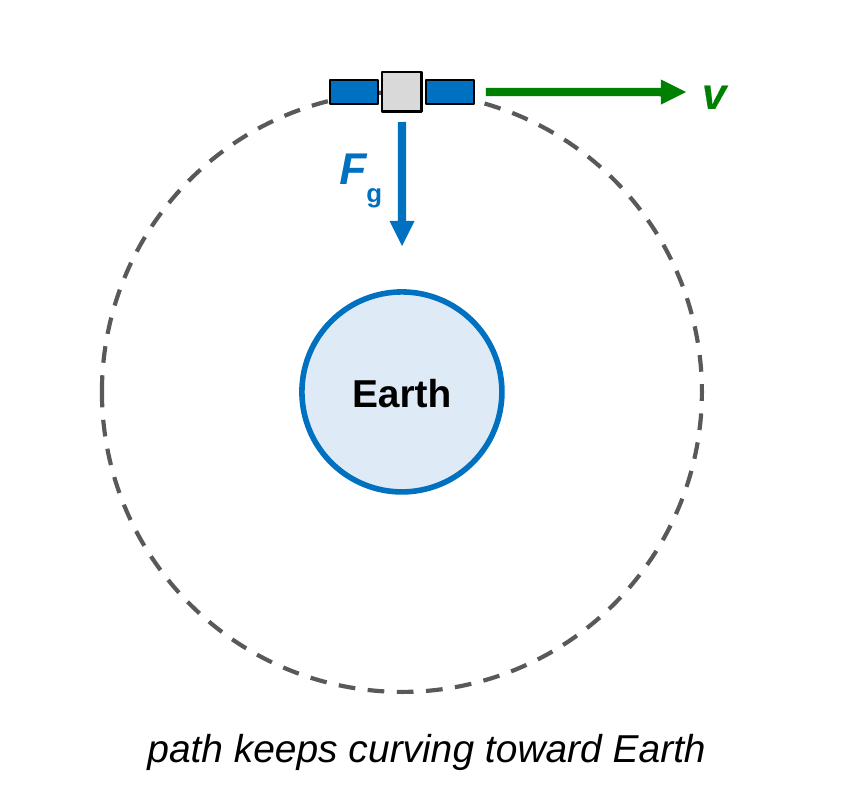
A satellite moves sideways while gravity pulls it toward Earth’s center. The pull is always at a right angle to the motion, so it doesn’t speed the satellite up or slow it down. It only turns its direction, bending the path into a circle. In other words, gravity provides the centripetal force for every orbit, the same way the tension in a string keeps a ball moving in a circle.
Always Falling
- Orbiting objects are always falling
- They move sideways fast enough
- Earth curves away below them
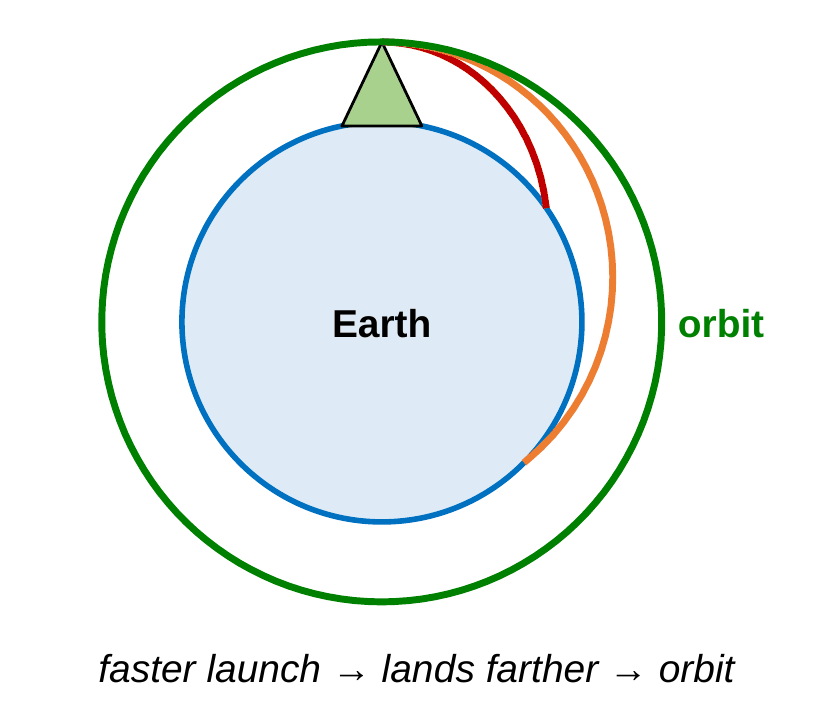
Imagine launching a ball sideways from a very tall mountain. A slow launch curves down and lands nearby. A faster launch travels farther before it lands. Because Earth is round, its surface curves away under the ball. If the launch is fast enough, about 7.9 km/s near Earth’s surface, the ball falls toward Earth just as fast as the ground curves away, so it never lands. That’s an orbit. Satellites and the Moon are always falling, but they keep missing. Astronauts float because they are falling right along with their spacecraft, not because there is no gravity.
Orbital Speed
- Set Fg equal to Fc
- Satellite’s mass cancels out
- Closer orbit: faster speed
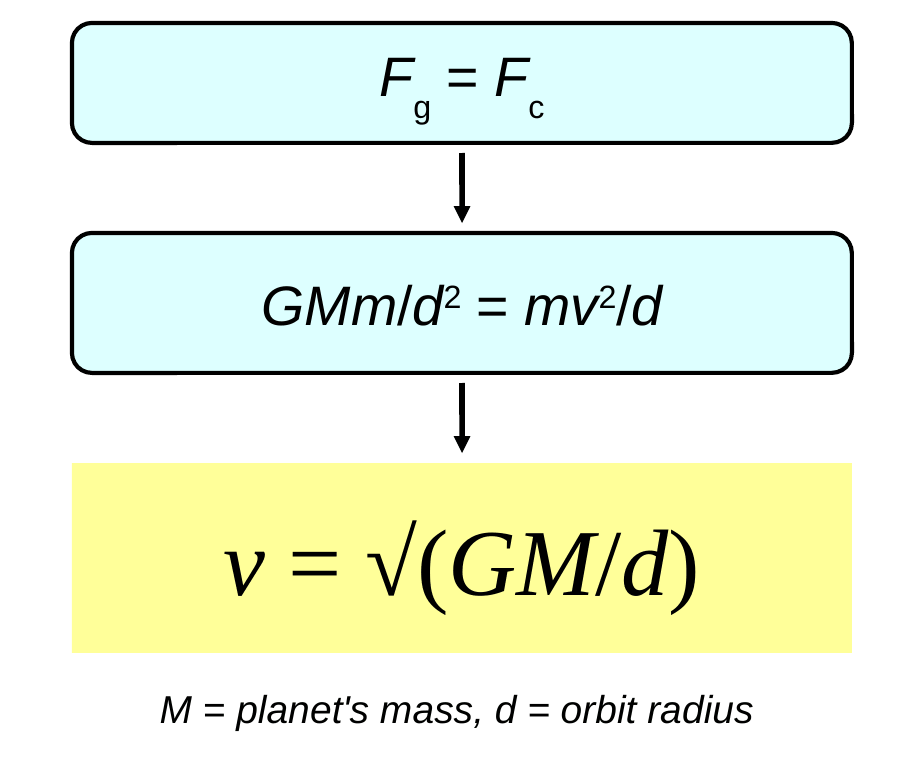
Setting the gravitational force equal to the centripetal force, GMm/d2 = mv2/d, and solving for v gives the speed needed for a circular orbit: v = √(GM/d). The satellite’s own mass m cancels, so a tiny satellite and a huge space station at the same height move at the same speed. A smaller orbit radius means a faster speed.
Worked Examples
Try each problem on your own first, then check your work against the solution.
Example 1: Field Strength on Mars
A rover on Mars picks up a 2.5 kg rock. Mars pulls on the rock with a force of 9.3 N. What is the gravitational field strength on Mars?
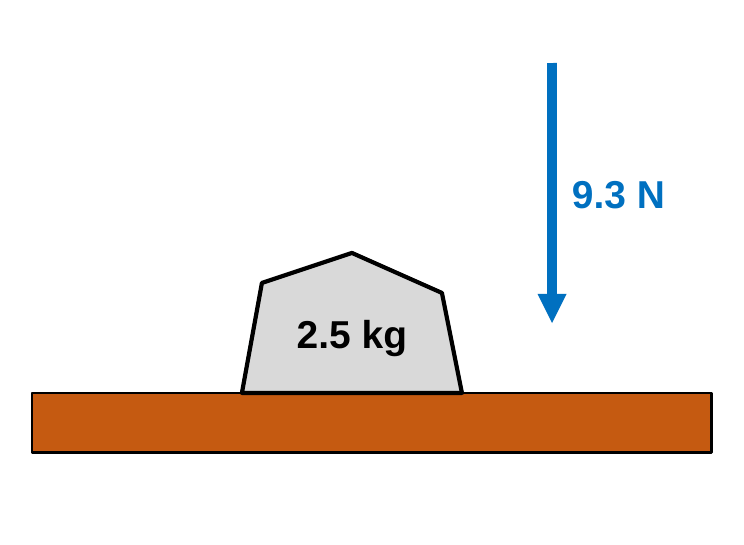
- Knowns: m = 2.5 kg, F = 9.3 N
- Equation: g = F/m
- Substitute: g = 9.3 N / 2.5 kg
- Answer: g = 3.7 N/kg, toward the center of Mars
That’s about 38% of Earth’s 9.8 N/kg, so you would weigh a little more than a third of your Earth weight on Mars.
Example 2: Gravity at the Space Station
The space station orbits 4.2 × 10⁵ m above Earth’s surface. Earth’s mass is 5.97 × 1024 kg and its radius is 6.37 × 10⁶ m. What is g at the station?
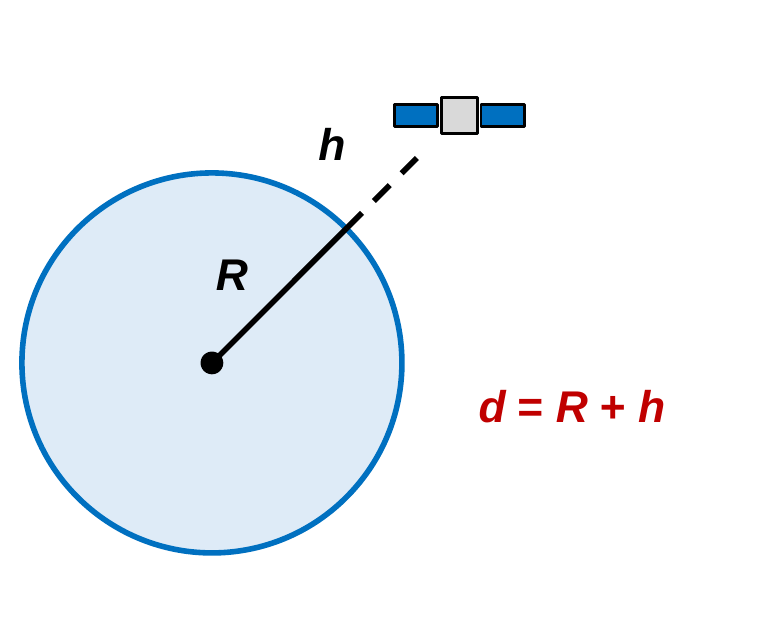
- Knowns: h = 4.2 × 10⁵ m, M = 5.97 × 1024 kg, R = 6.37 × 10⁶ m
- Distance: d = R + h = 6.37 × 10⁶ m + 0.42 × 10⁶ m = 6.79 × 10⁶ m
- Equation: g = GM/d2
- Top: GM = (6.67 × 10⁻¹¹)(5.97 × 1024) = 3.98 × 10¹⁴
- Bottom: d2 = (6.79 × 10⁶ m)2 = 4.61 × 10¹³ m2
- Answer: g = 3.98 × 10¹⁴ ÷ 4.61 × 1013 = 8.64 N/kg
That’s about 88% of the field at Earth’s surface. Astronauts on the station feel weightless because they are in free fall, not because gravity is missing.
Example 3: Orbital Speed
The space station orbits 6.79 × 10⁶ m from Earth’s center. Earth’s mass is 5.97 × 1024 kg. How fast must the station move to stay in orbit?
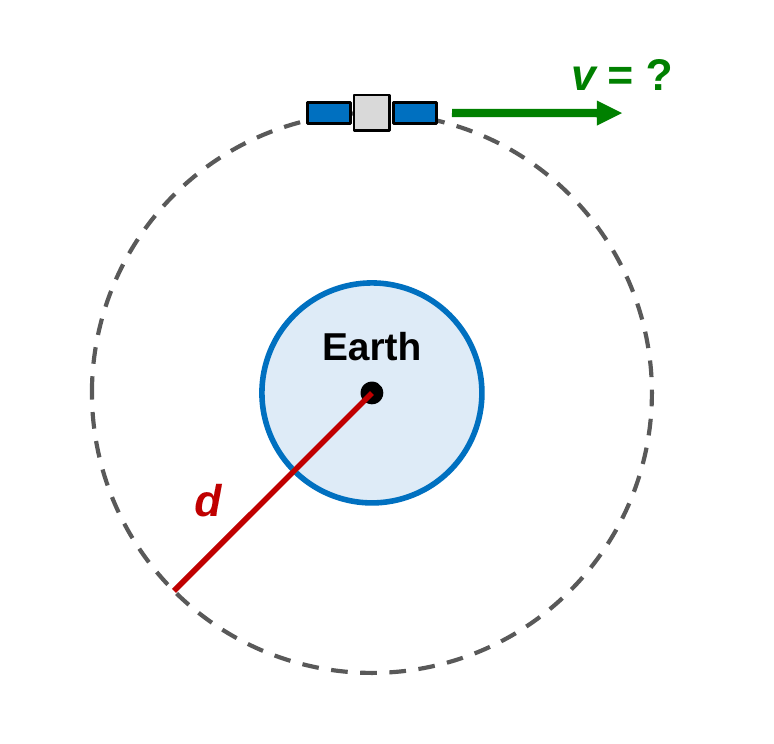
- Knowns: d = 6.79 × 10⁶ m, M = 5.97 × 1024 kg, G = 6.67 × 10⁻¹¹ N·m2/kg2
- Equation: GMm/d2 = mv2/d, so v = √(GM/d)
- Substitute: v = √(3.98 × 10¹⁴ ÷ 6.79 × 10⁶)
- Divide: 3.98 × 10¹⁴ ÷ 6.79 × 106 = 5.86 × 10⁷ m2/s2
- Answer: v = √(5.86 × 10⁷ m2/s2) = 7.66 × 10³ m/s
That’s about 7.7 km every second, fast enough to circle Earth in about an hour and a half.
Big Ideas
- Mass makes a field; lines point toward it
- g = F/m (N/kg), weaker with distance
- Gravity is the centripetal force for orbits
- Orbiting objects are always falling
Back to the essential question: the Moon is falling toward Earth all the time, but it also moves sideways so fast that it keeps missing. Earth’s gravitational field, which points toward Earth and weakens with distance, supplies the centripetal force that bends the Moon’s path into an orbit. Next up, Comparing Gravity and Electric Forces puts gravity side by side with the electric force to see how they are alike and how they differ.

