
The video lesson for this topic is coming soon.
Essential Question
How strongly do two masses pull on each other?
Earth pulls on you, but you also pull on Earth, and on every other object around you. By the end of this lesson, you should be able to use Newton’s law of universal gravitation, Fg = Gm1m2/d2, to solve for force, mass, or distance.
Gravity Is Universal
- Any two masses attract
- Each pulls on the other equally
- More mass, more force
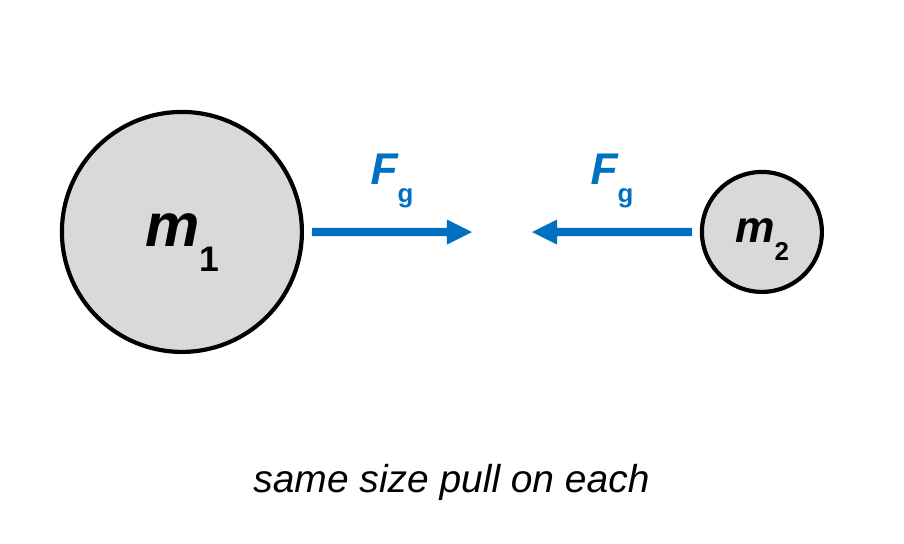
Isaac Newton realized that the force pulling an apple to the ground is the same force that keeps the Moon circling Earth. In fact, every mass in the universe attracts every other mass. The pull is the same size on both objects, even when one is much bigger, because the forces are a Newton’s third law pair. More mass on either object means a bigger pull.
Newton’s Law of Gravitation
Fg = Gm1m2 / d2
- Fg = gravitational force, in newtons (N)
- G = universal gravitational constant, 6.67 × 10⁻¹¹ N·m2/kg2
- m1, m2 = the two masses, in kilograms (kg)
- d = distance between the centers of the masses, in meters (m)
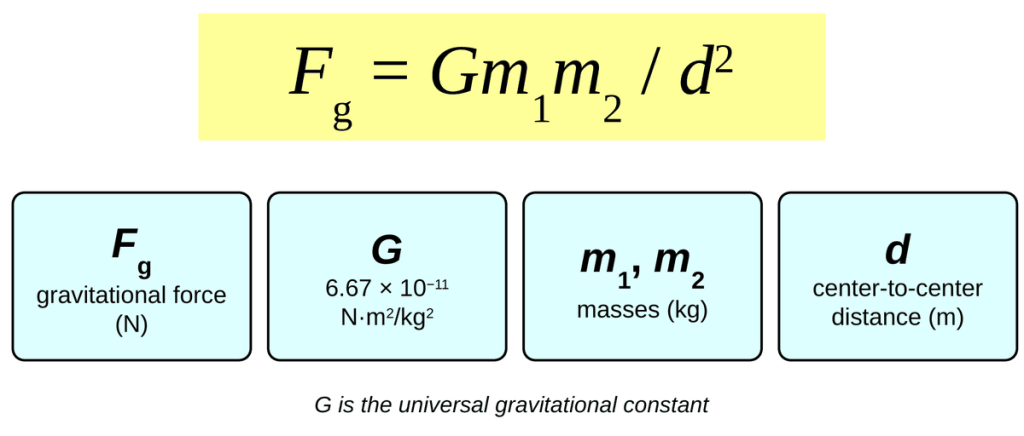
This equation has the same shape as Coulomb’s law, with masses in place of charges and G in place of k. The constant G is incredibly small, which is why the gravitational pull between everyday objects is far too weak to notice.
Center to Center
- Measure d center to center
- Above a planet: d = R + h
- Not surface to surface
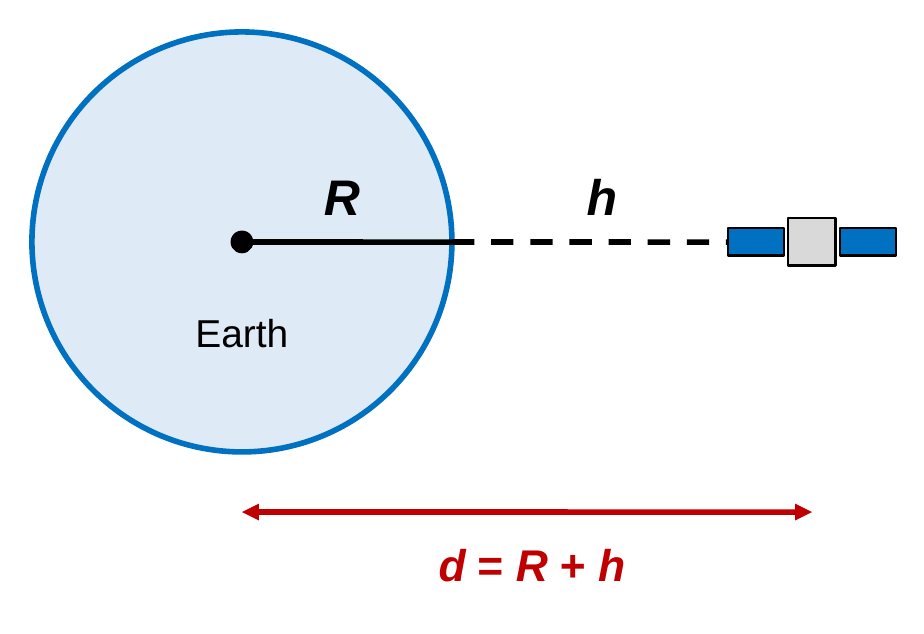
In the gravitation equation, d is always the distance between the centers of the two objects. For something on or above a planet, that means the planet’s radius R plus the height h above the surface. A common mistake is to use only the height above the ground, which leaves out thousands of kilometers.
Inverse Square Law
- Double d: ¼ the force
- Triple d: 1/9 the force
- Weaker, but never zero
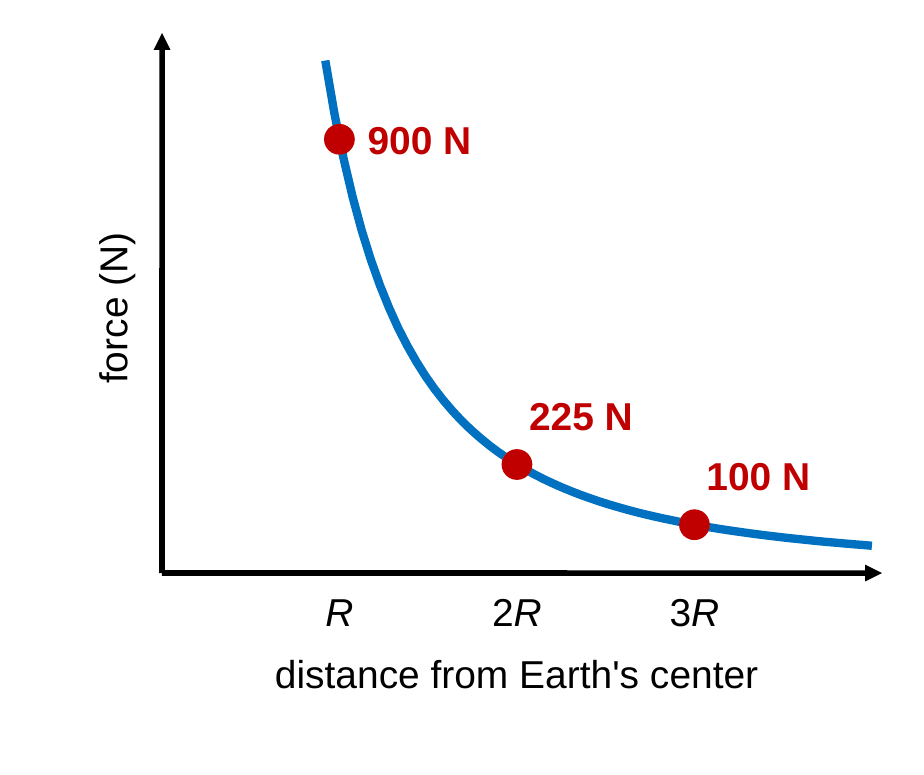
Gravity follows the same inverse square law as the electric force. An astronaut who weighs 900 N on Earth’s surface, one Earth radius from the center, would feel only 225 N at twice that distance and 100 N at three times that distance. The pull keeps shrinking as you move away, but it never reaches exactly zero.
Why Is Gravity So Weak?
- G is tiny
- Everyday objects: tiny pull
- Only huge masses pull hard
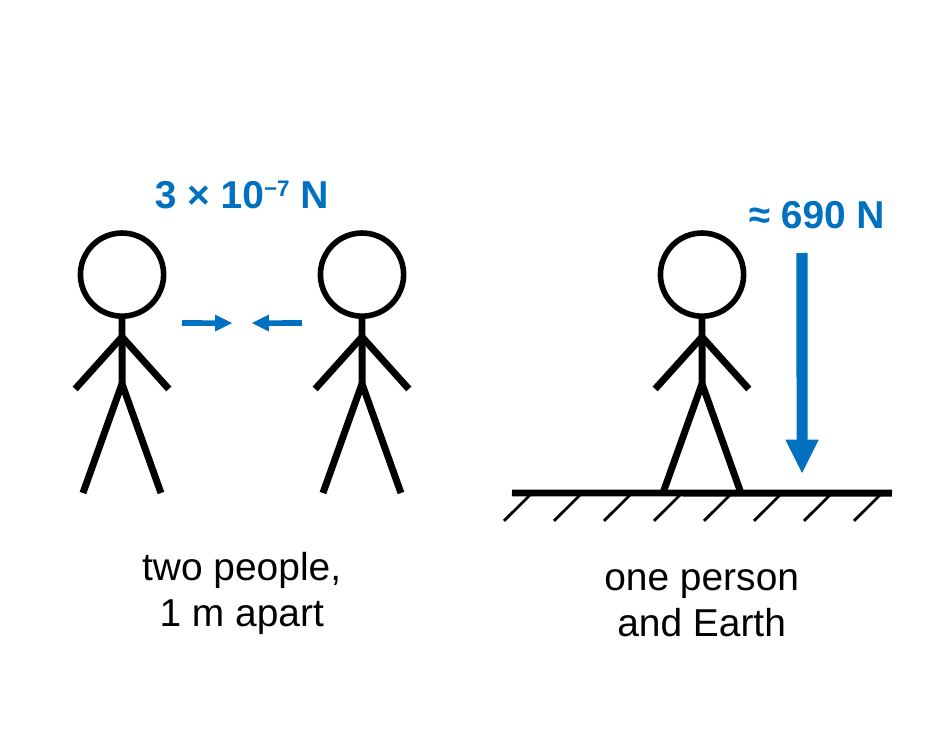
Two 70 kg people standing 1 m apart pull on each other with about 3 × 10⁻⁷ N, far too small to feel. The same person standing on Earth feels about 690 N, which is their weight. The difference is mass: Earth has about 6 × 1024 kg. Because G is so small, gravity only becomes a noticeable force when at least one of the objects is enormous.
Worked Examples
Try each problem on your own first, then check your work against the solution.
Example 1: Two Cargo Ships
Two cargo ships, each with a mass of 5.0 × 10⁷ kg, are 2.0 × 10² m apart (center to center). What is the gravitational force between them?
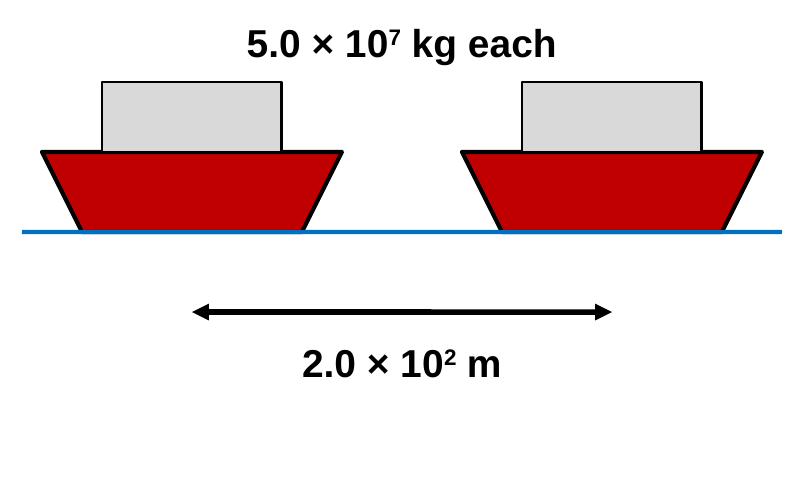
- Knowns: m1 = m2 = 5.0 × 10⁷ kg, d = 2.0 × 10² m, G = 6.67 × 10⁻¹¹ N·m2/kg2
- Equation: Fg = Gm1m2/d2
- Substitute: Fg = (6.67 × 10⁻¹¹)(5.0 × 10⁷ kg)(5.0 × 10⁷ kg) / (2.0 × 10² m)2
- Top: 6.67 × 5.0 × 5.0 = 166.75 and 10−11 × 107 × 107 = 103, so the top is 1.6675 × 10⁵
- Bottom: (2.0 × 10² m)2 = 4.0 × 10⁴ m2
- Answer: Fg = 1.6675 × 10⁵ ÷ 4.0 × 104 = 4.2 N
Two enormous ships pull on each other with only about 4 N, roughly the weight of a can of soup.
Example 2: Earth and the Moon
Earth has a mass of 5.97 × 1024 kg and the Moon has a mass of 7.35 × 10²² kg. Their centers are 3.84 × 10⁸ m apart. What is the gravitational force between them?
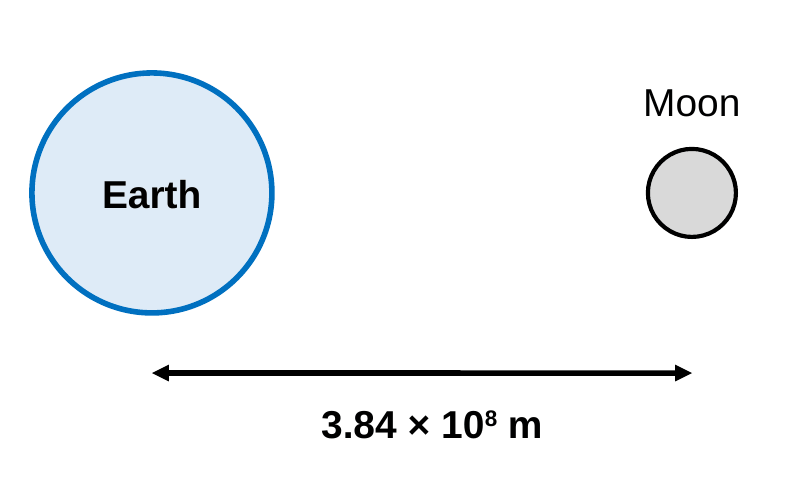
- Knowns: m1 = 5.97 × 1024 kg, m2 = 7.35 × 10²² kg, d = 3.84 × 10⁸ m
- Equation: Fg = Gm1m2/d2
- Top: (6.67 × 10⁻¹¹)(5.97 × 1024)(7.35 × 10²²) = 2.927 × 1037
- Bottom: (3.84 × 10⁸ m)2 = 1.475 × 10¹⁷ m2
- Answer: Fg = 2.927 × 1037 ÷ 1.475 × 1017 = 1.98 × 10²⁰ N
Keep the unrounded calculator values until the last step. Rounding the top and bottom too early can change the last digit.
Example 3: Two Bowling Balls
Two identical bowling balls are 0.50 m apart, center to center. They attract each other with a force of 1.5 × 10⁻⁸ N. What is the mass of each ball?
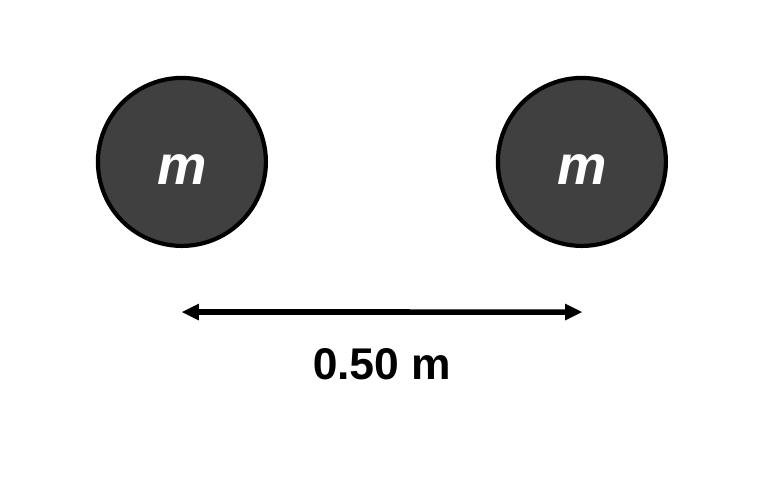
- Knowns: m1 = m2 = m, d = 0.50 m, Fg = 1.5 × 10⁻⁸ N, G = 6.67 × 10⁻¹¹ N·m2/kg2
- Rearrange: Fg = Gm2/d2, so m2 = Fgd2/G
- Substitute: m2 = (1.5 × 10⁻⁸ N)(0.50 m)2 / 6.67 × 10−11 = 3.75 × 10⁻⁹ / 6.67 × 10⁻¹¹
- Simplify: m2 = 56.2 kg2
- Answer: m = √(56.2 kg2) = 7.5 kg each
Example 4: Finding the Distance
Earth (5.97 × 1024 kg) pulls on a 1.00 × 10³ kg satellite with a force of 2,450 N. How far is the satellite from Earth’s center?
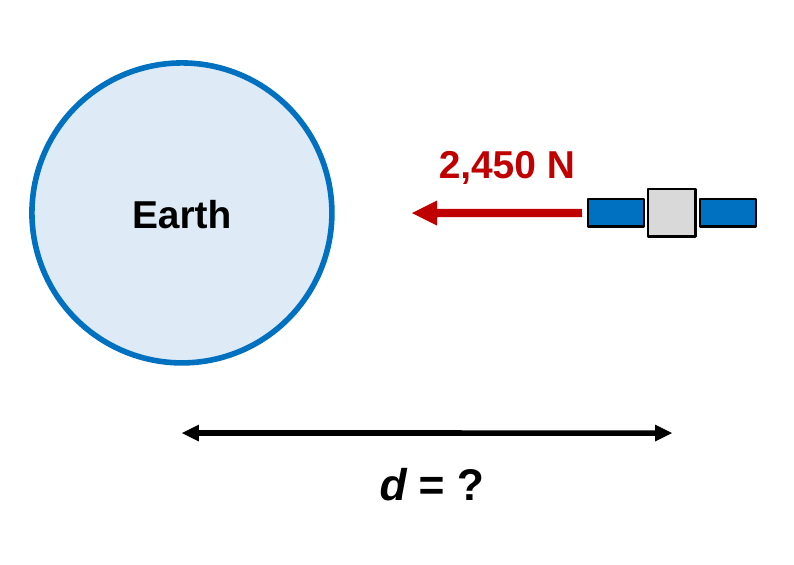
- Knowns: m1 = 5.97 × 1024 kg, m2 = 1.00 × 10³ kg, Fg = 2,450 N
- Rearrange: d2 = Gm1m2/Fg
- Top: (6.67 × 10⁻¹¹)(5.97 × 1024)(1.00 × 10³) = 3.98 × 10¹⁷
- Divide: d2 = 3.98 × 10¹⁷ ÷ 2,450 = 1.63 × 10¹⁴ m2
- Answer: d = √(1.63 × 10¹⁴ m2) = 1.27 × 10⁷ m from Earth’s center
That is about twice Earth’s radius (6.37 × 10⁶ m), so the satellite is roughly one Earth radius above the surface.
Big Ideas
- Every two masses attract
- Fg = Gm1m2/d2, G = 6.67 × 10⁻¹¹ N·m2/kg2
- d is measured center to center
- Inverse square: 2× distance, ¼ force
Back to the essential question: every two masses pull on each other with a force given by Fg = Gm1m2/d2, where d is measured center to center. The force grows with each mass and follows an inverse square law with distance. Because G is so small, the pull is only noticeable when at least one mass is enormous, like a planet. Next up, Gravitational Fields and Orbits uses this idea to explain why the Moon and satellites stay in orbit.

