
The video lesson for this topic is coming soon.
Essential Question
What makes one machine more powerful than another?
Light bulbs, hair dryers, and car engines all have power ratings. In this lesson, you’ll find out that power is not about how much energy is transferred, but how fast. By the end, you should be able to calculate power with P = W/t and work with watts.
What Is Power?
- How fast work is done
- How fast energy is transferred
- Same work, faster: more power
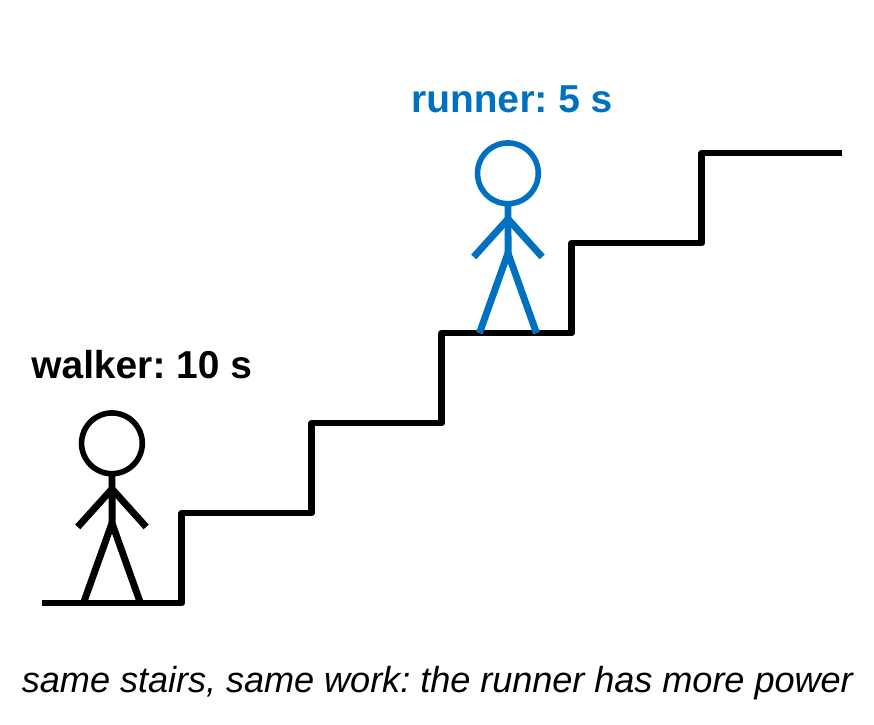
Power is how fast work is done, or how fast energy is transferred. Two students with the same mass climbing the same stairs do the same amount of work against gravity. But the one who runs up in 5 s does it twice as fast as the one who walks up in 10 s, so the runner has twice the power.
The Power Equation
P = W / t = ΔE / t
- P = power, in watts (symbol W)
- W = work, or ΔE = energy transferred, in joules (J)
- t = time, in seconds (s)
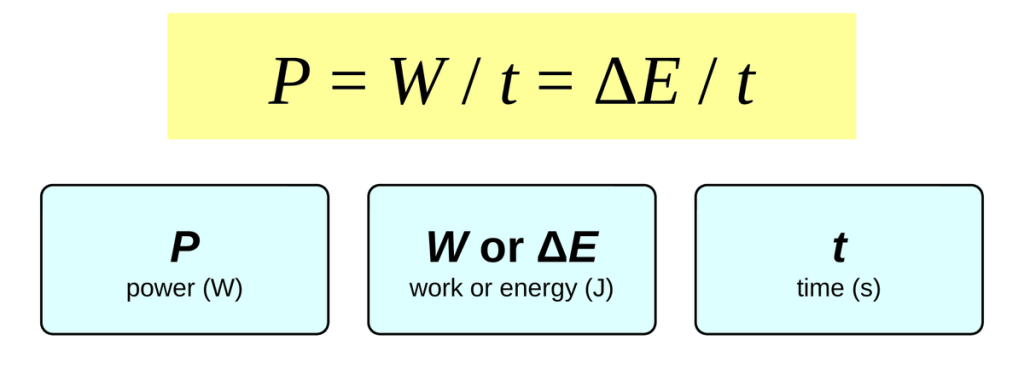
Power is work divided by time. Since work is a transfer of energy, power is also the energy transferred divided by the time it takes. Be careful: the letter W is used for both work (in italics, W) and the unit watt (symbol W). Context tells you which one is meant.
The Watt
- 1 W = 1 J/s
- 1 kilowatt (kW) = 1,000 W
- 1 horsepower ≈ 746 W
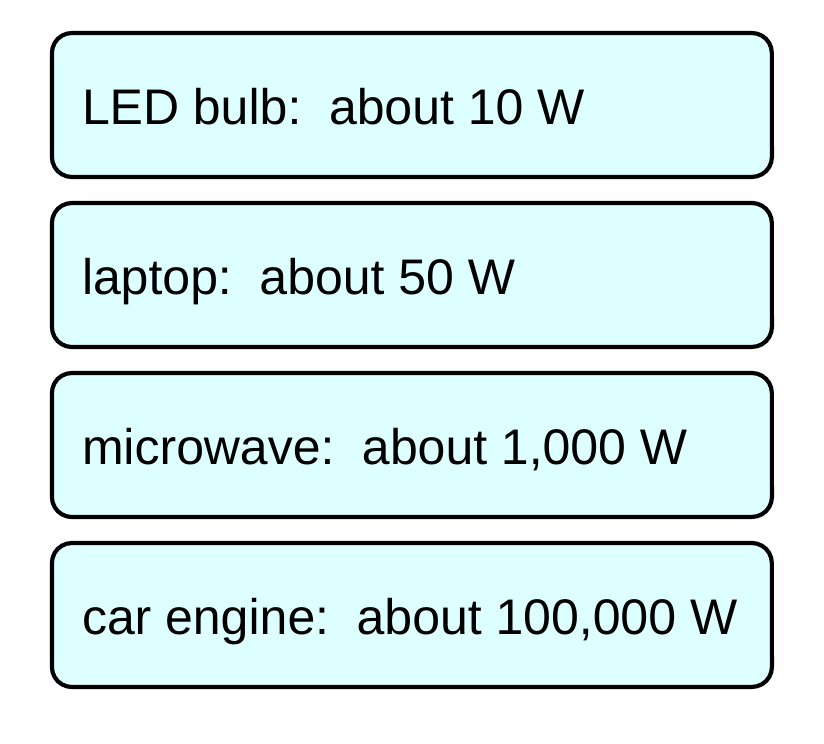
One watt (symbol W) is one joule of energy transferred every second. A 10 W LED bulb transfers 10 J of energy every second. Bigger powers use kilowatts (1 kW = 1,000 W), and car engines are often rated in horsepower, where 1 hp is about 746 W. A typical LED bulb uses about 10 W, a laptop about 50 W, a microwave about 1,000 W, and a car engine around 100,000 W.
Same Work, Different Power
- Same work: 1,500 J
- Half the time
- Twice the power
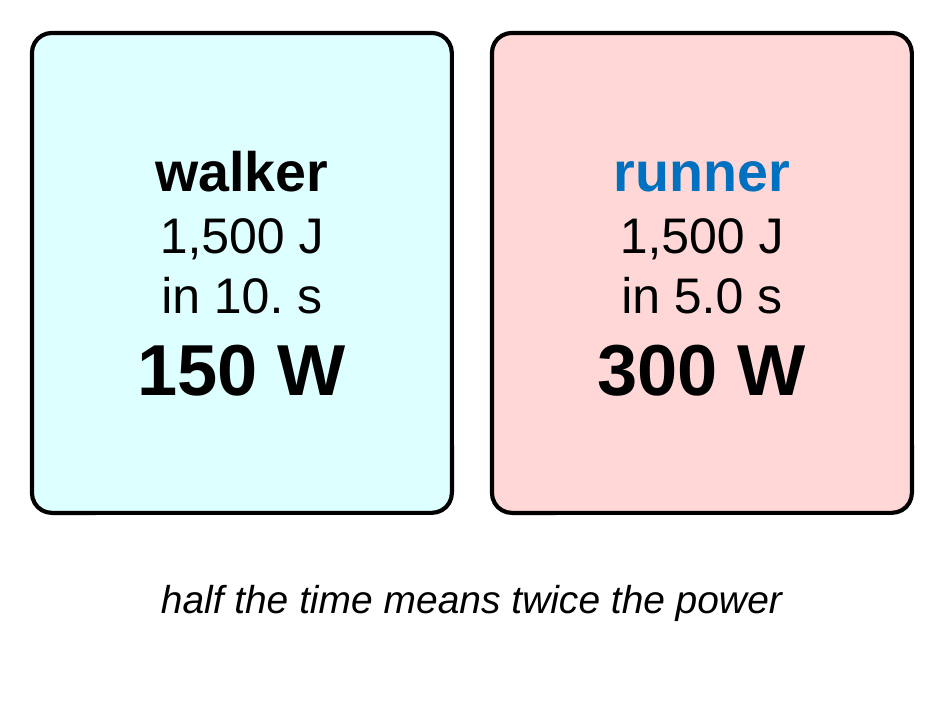
Suppose both students do 1,500 J of work climbing the stairs. The walker takes 10. s, so her power is 1,500 J ÷ 10. s = 150 W. The runner takes 5.0 s, so his power is 1,500 J ÷ 5.0 s = 300 W. Same work, half the time, twice the power. Power and time are inversely related when the work stays the same.
Solving for Any Variable
- Find power: P = W / t
- Find work: W = Pt
- Find time: t = W / P
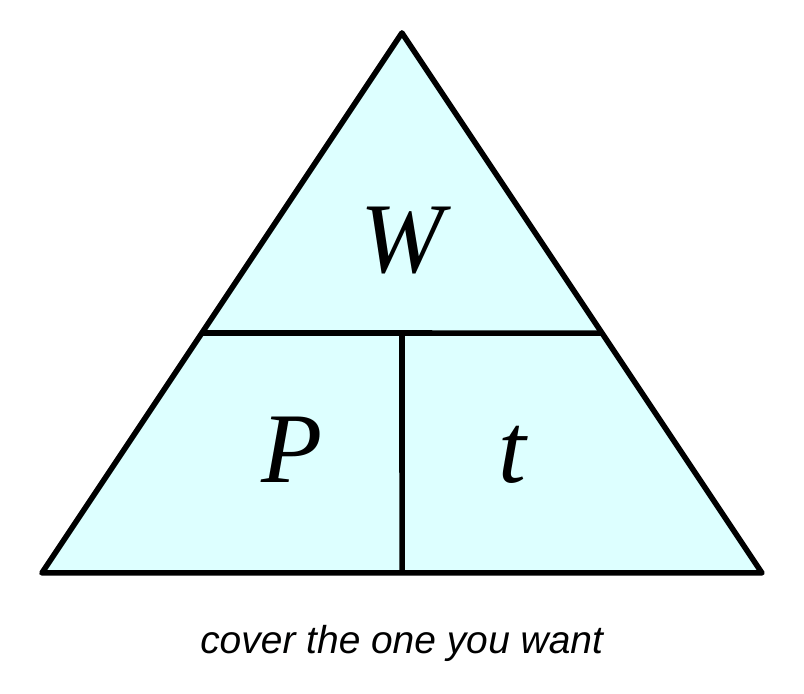
Rearrange P = W/t to find whatever the problem asks for. To find work or energy, multiply power by time: W = Pt. To find time, divide work by power: t = W/P. Always convert times to seconds first, since a watt is a joule per second.
Worked Examples
Try each problem on your own first, then check your work against the solution.
Example 1: Climbing Stairs
A student does 1,800 J of work climbing a flight of stairs in 4.0 s. What is her power?
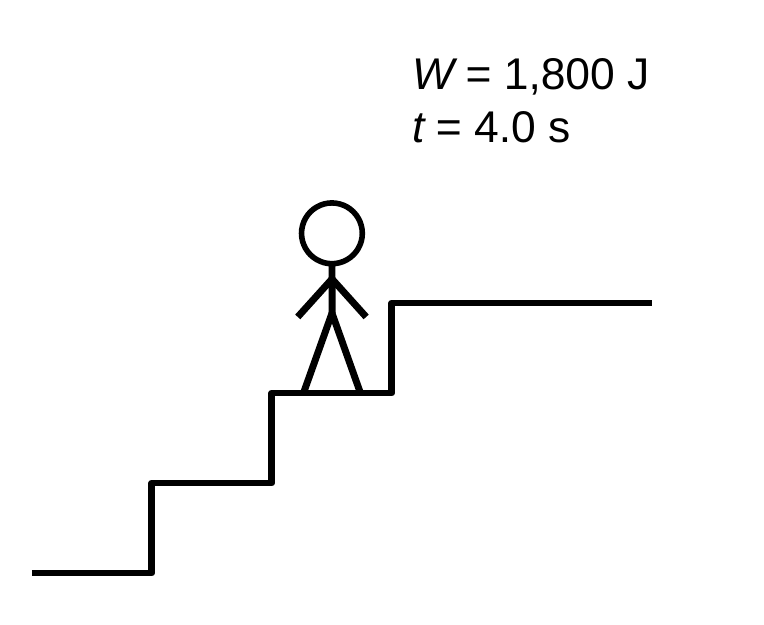
- Knowns: W = 1,800 J, t = 4.0 s, P = ?
- Equation: P = W/t
- Substitute: P = 1,800 J / 4.0 s
- Answer: P = 450 W
Example 2: Motor Lifting a Crate
A motor lifts a 25 kg crate straight up 8.0 m at a constant speed in 14 s. What is the motor’s power?
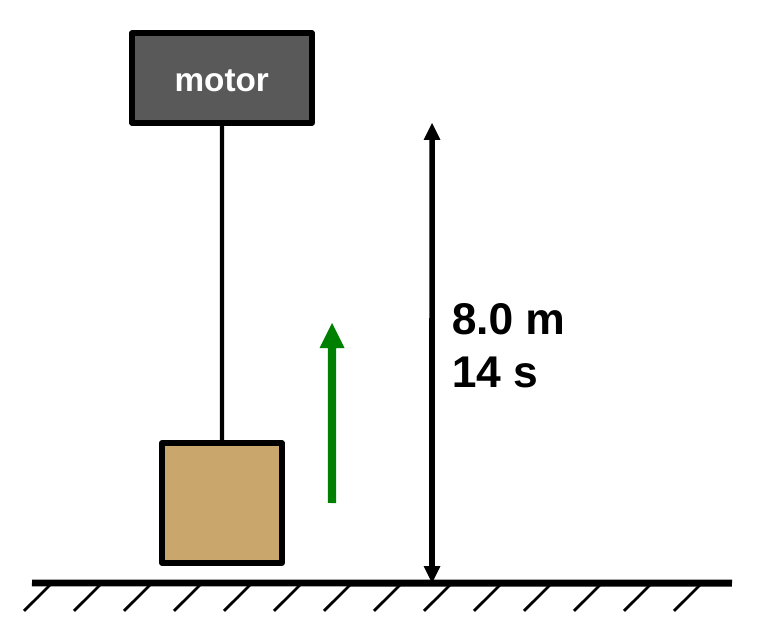
- Knowns: m = 25 kg, h = 8.0 m, t = 14 s, g = 9.8 m/s2
- Work: constant speed, so W = mgh = (25 kg)(9.8 m/s2)(8.0 m) = 1,960 J
- Power: P = W/t = 1,960 J / 14 s
- Answer: P = 140 W
Example 3: Light Bulb
A 60.0 W light bulb transfers 4,500 J of energy. How long is it on?
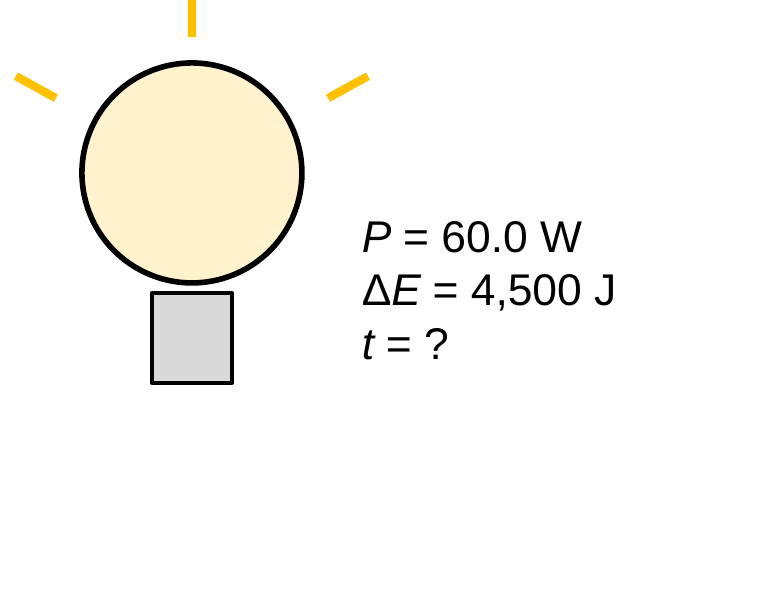
- Knowns: P = 60.0 W, ΔE = 4,500 J, t = ?
- Rearrange: P = ΔE/t, so t = ΔE/P
- Substitute: t = 4,500 J / 60.0 J/s
- Answer: t = 75 s
Example 4: Hair Dryer
A 1,500 W hair dryer runs for 2.0 minutes. How much energy does it transfer?
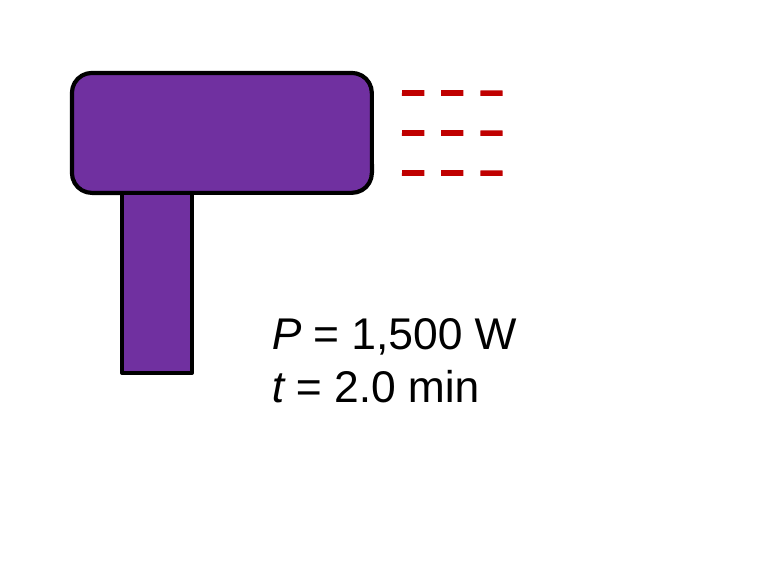
- Convert time: t = 2.0 min × 60 s/min = 120 s
- Rearrange: P = ΔE/t, so ΔE = Pt
- Substitute: ΔE = (1,500 J/s)(120 s) = 180,000 J
- Answer: ΔE = 1.8 × 10⁵ J
Big Ideas
- Power: how fast energy is transferred
- P = W/t = ΔE/t
- Watt: 1 W = 1 J/s
- Same work, less time: more power
Back to the essential question: a more powerful machine transfers energy faster. Power is the rate of doing work, P = W/t = ΔE/t, measured in watts, where 1 W = 1 J/s. Doing the same work in less time takes more power. This wraps up our unit on energy.

