
The video lesson for this topic is coming soon.
Essential Question
How are current, voltage, and resistance connected?
Voltage pushes, resistance resists, and current flows. One equation ties all three together. By the end of this lesson, you should be able to use V = IR to solve for any of the three quantities and find resistance from a graph.
Ohm’s Law
V = IR
- V = voltage across the resistor, in volts (V)
- I = current through the resistor, in amperes (A)
- R = resistance, in ohms (Ω)
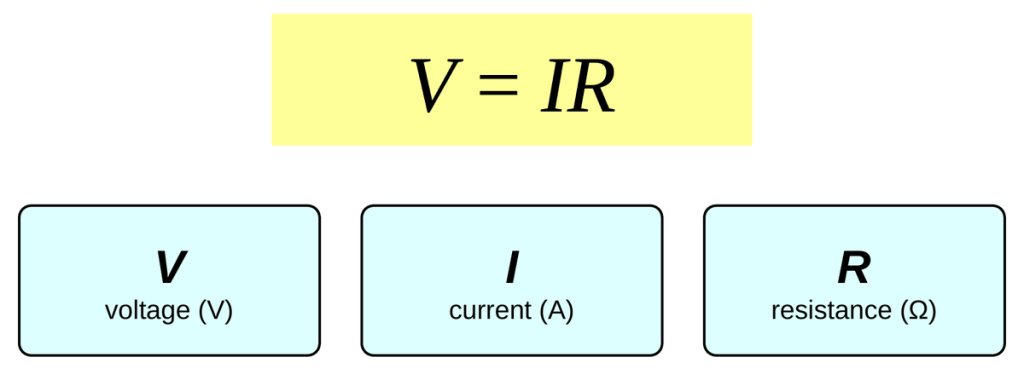
Ohm’s law says the voltage across a resistor equals the current through it times its resistance. Here V is short for ΔV, the voltage from the last lesson. Rearranged, Ohm’s law also defines the ohm: 1 Ω = 1 V/A.
More Voltage, More Current
- Same resistor, more voltage
- Double V, double I
- Current is proportional to voltage
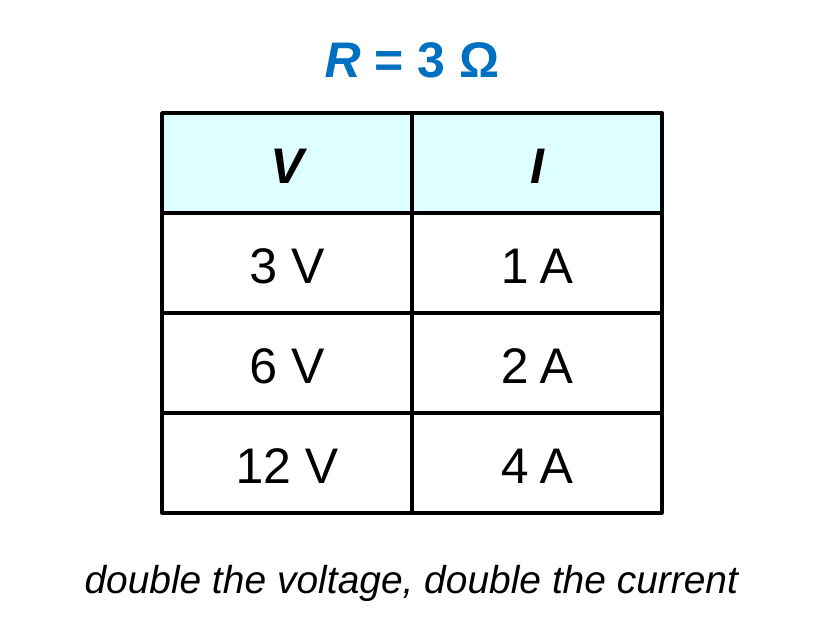
For a 3 Ω resistor, 3 V pushes 1 A through it, 6 V pushes 2 A, and 12 V pushes 4 A. Doubling the voltage doubles the current. When one quantity changes by the same factor as another, we say they are directly proportional. In the water picture, a stronger pump moves more water.
More Resistance, Less Current
- Same voltage, more resistance
- Double R, half the I
- I = V/R
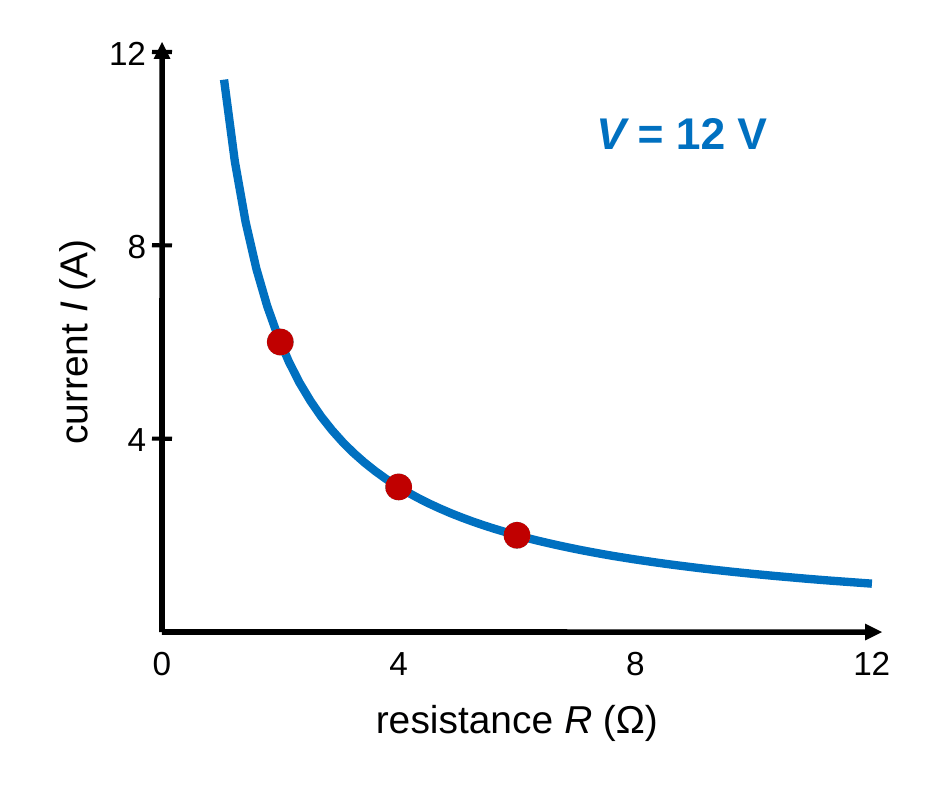
With the voltage held at 12 V, a 2 Ω resistor carries 6 A, a 4 Ω resistor carries 3 A, and a 6 Ω resistor carries 2 A. Doubling the resistance cuts the current in half. Current and resistance are inversely proportional, so the graph is a curve that drops quickly and then levels off.
Graph of V vs. I
- Straight line through the origin
- Slope = R
- Steeper line: bigger R
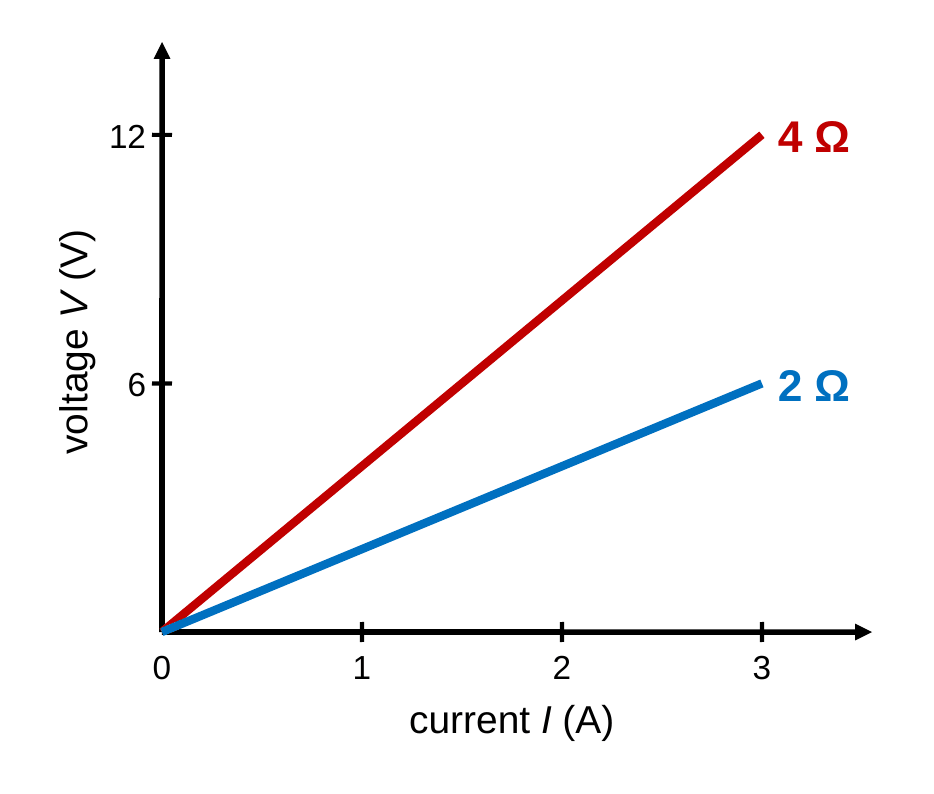
If you measure the voltage across a resistor and the current through it several times and graph V against I, you get a straight line through the origin. The slope is rise over run, V/I, which is exactly the resistance. A steeper line means a bigger resistance: the 4 Ω line rises 12 V over 3 A, while the 2 Ω line rises only 6 V over the same 3 A.
Solving for Any Variable
- Find voltage: V = IR
- Find current: I = V/R
- Find resistance: R = V/I
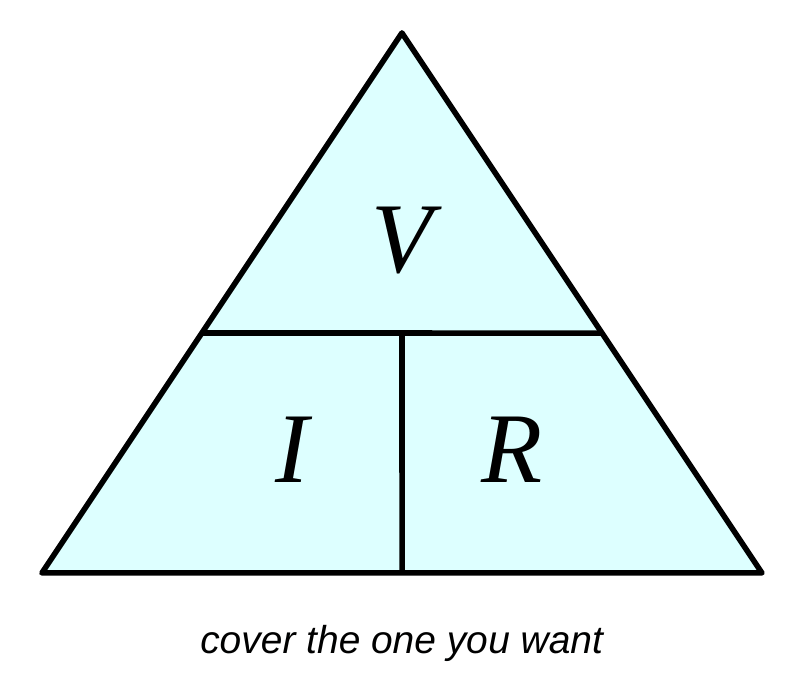
Rearrange Ohm’s law to solve for whatever the problem asks for. With the triangle, cover the quantity you want and read what’s left: covering V leaves I next to R, so multiply. Covering I leaves V over R, so divide. Covering R leaves V over I.
Measuring Resistance
- Ammeter reads current I
- Voltmeter reads voltage V
- Then R = V/I
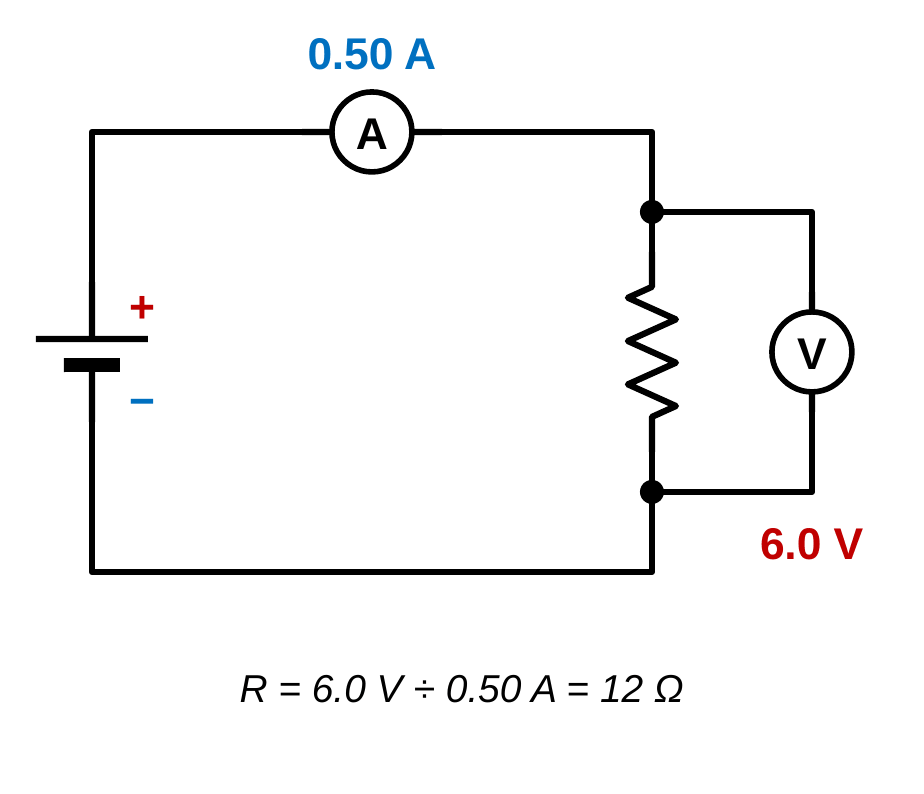
To find the resistance of a part in the lab, measure the current through it with an ammeter (in the loop) and the voltage across it with a voltmeter (across the part). Then divide. Here the ammeter reads 0.50 A and the voltmeter reads 6.0 V, so R = 6.0 V ÷ 0.50 A = 12 Ω.
Worked Examples
Try each problem on your own first, then check your work against the solution.
Example 1: Finding Voltage
A 15 Ω resistor has a current of 0.80 A through it. What is the voltage across the resistor?
- Knowns: R = 15 Ω, I = 0.80 A
- Equation: V = IR
- Substitute: V = (0.80 A)(15 Ω)
- Answer: V = 12 V
Example 2: Finding Current
A 9.0 V battery is connected to a 36 Ω resistor. What is the current in the circuit?
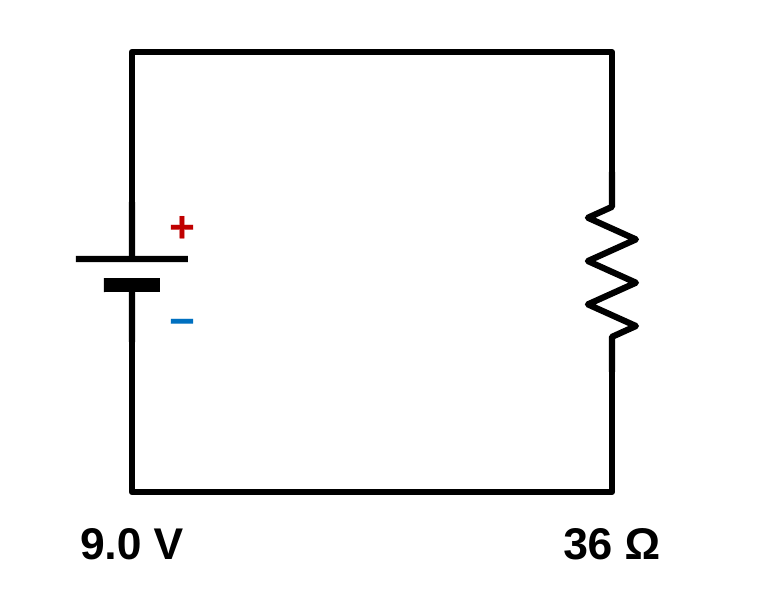
- Knowns: V = 9.0 V, R = 36 Ω
- Equation: V = IR, so I = V/R
- Substitute: I = 9.0 V / 36 Ω
- Answer: I = 0.25 A
Example 3: Finding Resistance
A flashlight bulb draws 0.30 A from a 4.5 V battery pack. What is the resistance of the bulb?
- Knowns: I = 0.30 A, V = 4.5 V
- Equation: V = IR, so R = V/I
- Substitute: R = 4.5 V / 0.30 A
- Answer: R = 15 Ω
Example 4: Reading a Graph
A graph of voltage (vertical axis) vs. current (horizontal axis) for a resistor is a straight line through the origin that passes through the point (2.0 A, 8.0 V). What is its resistance?
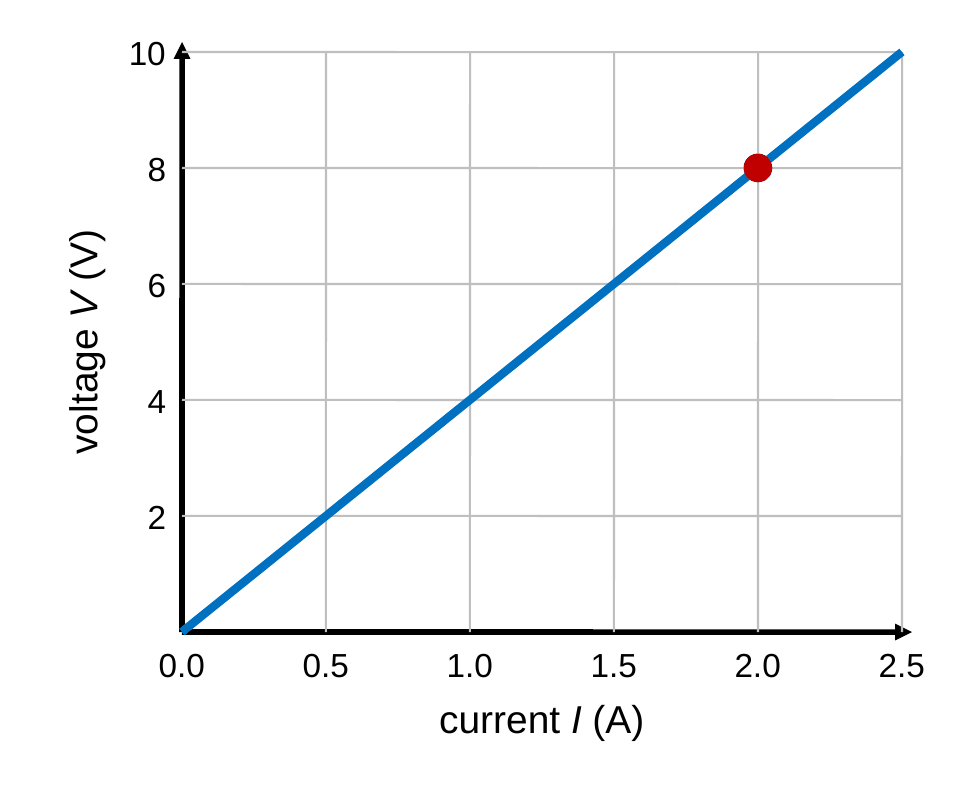
- Pick a point: choose a point right on the line where it crosses grid lines: (2.0 A, 8.0 V)
- Slope = R: on a V vs. I graph, slope = rise ÷ run = V/I = R
- Substitute: R = (8.0 V − 0 V) / (2.0 A − 0 A) = 8.0 V / 2.0 A
- Answer: R = 4.0 Ω
Big Ideas
- Ohm’s law: V = IR
- More voltage, more current
- More resistance, less current
- V vs. I graph: slope = R
Back to the essential question: they are connected by Ohm’s law, V = IR. For a resistor, more voltage means more current, and more resistance means less current. On a graph of voltage versus current, the slope is the resistance. Next up, we’ll see how fast circuits use energy with electric power.

